Act I
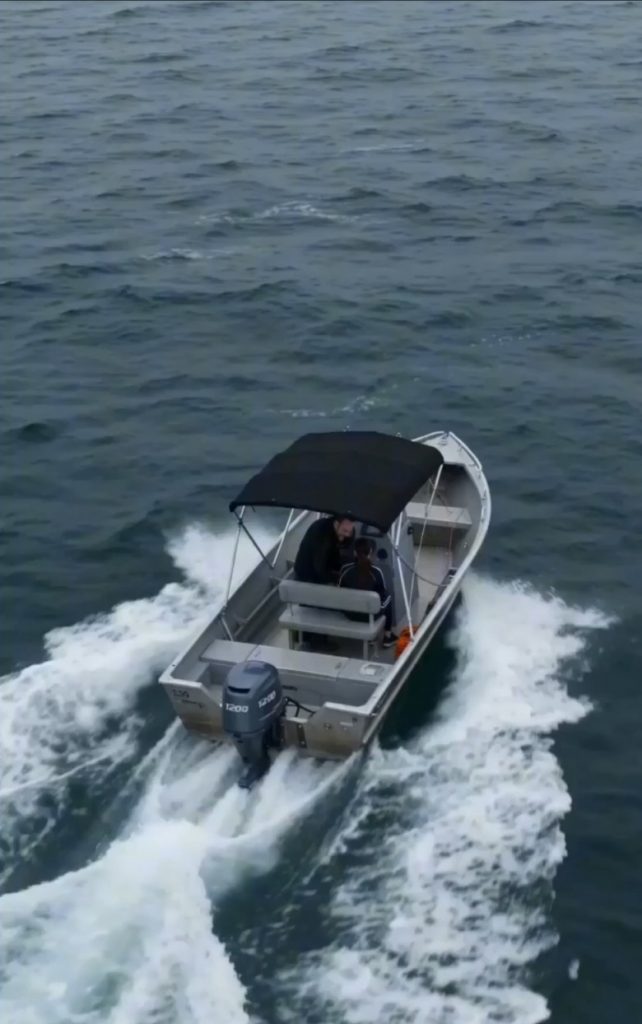
The boat cut through the gray water like it was running from something.
Behind it, a white wake stretched across the choppy surface, wide and foaming, the only bright thing under a sky that looked pressed flat by winter. The outboard motor hummed hard at the stern, its black casing stamped with the number 1200, vibrating beneath the hand of the man standing over it.
Ava sat on the middle bench with her knees drawn close.
Her dark ponytail whipped against her cheek. Both hands were clasped tightly between her bent knees, fingers locked together so hard her knuckles had gone pale. She kept her eyes on the man at the back of the boat, trying to read the face she once believed she knew.
Grant Vale did not look worried.
That frightened her more than the water.
He stood tall in his black outdoor jacket, the gold zipper catching the dull light whenever the boat shifted. His messy dark hair moved in the wind, but his expression stayed fixed. Cold. Amused. Almost disappointed that she had not understood sooner.
“What did you think why I brought you here?” he asked.
Ava stared at him.
The open water rolled endlessly around them. No shoreline close enough to matter. No other boat near enough to wave down. Just the gray horizon, the engine, and the man who had promised he only wanted to talk.
“You said you had something to talk about,” she said.
Her voice was soft, but it did not break.
For a moment, Grant only looked at her.
Then he laughed.
It burst out of him sharp and ugly, too loud for the empty water, his mouth wide, his teeth bright in the dead light. He leaned forward slightly as if the joke were too delicious to keep inside.
“You actually believed that?” he said. “Ha!”
Ava’s breath caught.
Her eyes widened before she could stop them. The warning signs she had ignored all week came rushing back in one cold wave: the locked office, the missing files, the sudden invitation, the way he had insisted she leave her phone in the truck because “out here, signal is useless anyway.”
Grant stepped forward.
It happened so fast that her body understood before her mind did.
His hands seized her shoulders. The boat rocked. Ava gasped once, a short sound swallowed by the wind.
Then the gray sky flipped.
The water rose to meet her.
She hit with a massive splash, cold closing over her face, her jacket dragging heavy as the boat surged ahead without slowing. For one terrifying second, there was only foam and engine noise and the white churn of the wake.
Then she broke the surface.
Ava gasped, hair plastered to her face, one hand clawing at the rolling water as the boat pulled farther away. Grant stood at the stern, shrinking into the distance, watching her like she was already gone.
“Swim!” he shouted.
The word traveled back over the wake.
Not help.
Not sorry.
Swim.
Ava stared after him, chest burning, the cold trying to steal every thought from her head.
But Grant had made one mistake.
He thought he had brought her out here to disappear.
He did not know she had brought him out here to confess.
Act II
Ava Marlow had spent most of her life being told the water was in her blood.
Her father used to say it every time she got scared.
When storms shook the windows of their old house near the marina, he would sit beside her bed and tell her that fear was not a weakness. It was a signal. A warning light. Something to respect, not something to worship.
“Listen to fear,” he would say. “Then decide what kind of person you want to be after it speaks.”
Thomas Marlow owned a small boat repair yard on the northern edge of Greyhaven, a town built around fog, diesel, and families who measured time by tide charts. He was not rich, but he was trusted. Fishermen came to him before sunrise. Tour captains called him in the middle of dinner. Strangers broke down near the inlet and left with stories about the mechanic who refused to overcharge them.
Grant Vale had been Thomas’s business partner.
At least, that was what everyone called him.
He handled contracts, investors, insurance, and all the paper things Thomas hated. He wore clean jackets in rooms full of men with grease under their nails. He smiled at Ava when she was a teenager and brought her hot chocolate from the café when she studied in the office after school.
After Thomas died, Grant cried at the funeral.
Ava remembered that most clearly.
Not because it moved her.
Because now she wondered how he had done it so well.
Her father’s death had been called an accident. A late repair run. A sudden mechanical failure. A boat found drifting near the outer channel before dawn. There had been no dramatic mystery, no scandal big enough for the papers, only a grieving family and a marina that somehow passed, within months, into Grant’s control.
Ava was twenty-two then.
Old enough to sign papers.
Too broken to read them.
Grant told her he was protecting the business. He told her the debts were worse than her father had admitted. He told her that if she fought the transfer, the marina would collapse and her mother would lose the house.
So Ava signed.
She went quiet for three years.
She finished her degree in maritime logistics. She took a job two towns away. She returned to Greyhaven only on holidays, standing at the edge of the marina like a visitor to a life that should have been hers.
Then her mother found the first envelope.
It was tucked behind the false back of Thomas’s old tool cabinet. Inside were photocopied contracts, handwritten notes, and a key to a storage unit Ava had never known existed.
The unit held the rest.
Maintenance records. Insurance documents. Fuel receipts. Copies of emails printed and marked in her father’s hand. The deeper Ava looked, the colder she became.
Her father had known.
Before he died, Thomas had discovered money moving through shell accounts connected to Grant. He had found altered maintenance logs. He had written one sentence across the top of a yellow legal pad.
If anything happens to me, look at the transfer.
Ava did not run to the police immediately.
That was what Grant expected people like her to do when they found pain: panic, accuse, and hand him enough time to bury the rest.
Instead, she studied.
She copied everything. She met quietly with an attorney. She contacted an investigator her father had once helped. She let Grant think she was still grieving, still unsure, still the girl who had signed away her birthright with shaking hands.
Then she called him.
“I found some of Dad’s old records,” she said.
Grant went silent for half a second.
Half a second was enough.
The next day, he asked to meet.
Not at the office.
Not at the house.
On the water.
“I owe you the truth,” he said.
Ava almost laughed when he said it. Not because it was funny, but because it was exactly the kind of sentence a liar used when he had run out of safe lies.
Still, she went.
She wore a black athletic jacket and tied her hair back. She left her phone where he asked, inside the truck. She let him believe he had stripped her of proof.
But before she stepped onto the boat, she had already sent the documents.
And under the zipper of her jacket, sealed against her chest, was the one thing Grant did not know she had taken from her father’s storage unit.
A tiny recorder.
Old, scratched, and still working.
Thomas Marlow had once used it to dictate repair notes when his hands were too dirty to write.
Now his daughter carried it into open water.
And when Grant asked what she thought he had brought her there for, it was already listening.
Act III
The cold was worse than Ava expected.
It did not feel like water at first. It felt like impact. Like the entire sea had turned into a wall and closed around her. Her breath came out broken, and for a few seconds all she could do was fight to keep her face above the chop.
The boat was getting smaller.
Grant stood at the stern, one hand on the rail, watching.
Ava could barely hear him now over the engine and the water, but she saw the shape of him clearly enough. No panic. No hesitation. No turning back.
He had planned this.
That realization should have destroyed her.
Instead, it steadied one thought inside her mind.
Survive long enough.
Not forever.
Not the whole sea.
Just long enough.
Her father’s voice returned with cruel tenderness.
Do not argue with the water. Respect it. Breathe. Choose.
Ava forced herself to stop wasting strength on panic. The waves lifted and dropped her. The boat’s wake pushed past in white folds. Her shoes felt heavy, her jacket heavier, but she kept her face up and her eyes moving.
There.
Far behind the boat’s path, barely visible through the gray, a low shape moved across the horizon.
Another vessel.
Small. Slow. Real.
Ava raised one arm, then the other, but the distance mocked her. The water swallowed every sound she made. Grant’s boat kept racing away, leaving a bright V-shaped scar behind it.
She thought of her mother.
Not as she had been at the funeral, hollow-eyed and silent, but as she had looked two nights ago when Ava spread the documents across the kitchen table. Her mother had touched Thomas’s handwriting with one trembling finger.
“Are you sure?” she had asked.
“No,” Ava had said. “But I’m sure enough to stop being afraid of him.”
Now fear tried to climb back into her throat.
She pushed it down.
The recorder beneath her jacket pressed cold against her chest. She did not know if it had survived the fall. She did not know if the sound would be clear enough. She did not know if anyone would reach her before the gray water took the last of her strength.
But she knew Grant’s voice was on it.
The question.
The laugh.
The shout.
Swim.
For the first time since she hit the water, Ava felt anger cut through the cold.
Grant had taken her father’s business, her family’s peace, her mother’s sleep, and years of her own life. Now he had thrown her into open water because he believed the world would accept whatever story he told when he returned alone.
An accident.
A misunderstanding.
A tragic fall.
He would lower his voice. He would look shaken. He would tell the authorities he tried to save her. He would stand beside her mother wearing grief like another expensive jacket.
No.
Ava lifted her arm again.
This time, the vessel in the distance changed course.
She was not sure at first. The horizon moved strangely through wet hair and gray light. But then the shape angled toward her, slow but deliberate, cutting across the water instead of away from it.
Ava laughed once.
It came out almost like a sob.
She kept moving.
Kept breathing.
Kept her eyes on the approaching boat.
By the time strong hands reached down toward her, her body was shaking so hard she could not speak. Someone wrapped her in a thermal blanket. Someone else shouted instructions to the helm. A woman with a weathered face leaned close and told Ava she was safe.
Ava gripped the front of the woman’s coat.
“Greyhaven Marina,” she managed.
The woman frowned.
“What?”
Ava swallowed, every word scraping out of her.
“Take me back before he finishes lying.”
Act IV
Grant arrived at Greyhaven Marina twenty-seven minutes before Ava did.
He slowed the boat as he entered the harbor, careful now, controlled now, already building the face he would wear for the next few hours. Concern, but not too much. Shock, but not guilt. A man caught in tragedy, not a man running from it.
By the time he stepped onto the dock, he was breathing hard on purpose.
A dockhand named Leo saw him first.
“Where’s Ava?”
Grant bent over, hands on his knees, as if grief had made him weak.
“She fell,” he said. “She just—she lost her balance. I tried to circle back, but the water was rough. I couldn’t see her.”
Leo stared at him.
Something in the dockhand’s face did not cooperate. He did not rush to comfort Grant. He did not say it was not his fault. He looked past him toward the empty boat.
“Did you call harbor patrol?”
Grant’s jaw tightened.
“I was coming in to do that.”
Leo’s expression changed.
Only slightly.
But Grant saw it.
Within minutes, the marina began to fill with voices. Someone called emergency services. Someone ran to the office. Someone else reached Ava’s mother, who arrived still wearing her house slippers, face drained of all color.
Grant met her halfway up the dock.
“Eleanor,” he said, opening his arms.
She did not step into them.
“Where is my daughter?”
Grant lowered his head.
“I did everything I could.”
It was almost perfect.
Almost.
Then a horn sounded from beyond the breakwater.
Everyone turned.
A small rescue vessel entered the harbor, pushing slowly through the gray chop. At the rail stood a woman wrapped in a blanket, dark hair wet against her face, one hand gripping the metal as if she had returned from another world.
Ava.
Grant did not move.
His face emptied.
Eleanor made a sound that broke every heart on the dock and ran toward the vessel before it had fully tied off. Ava stepped down with help, unsteady but upright, and her mother caught her like she was afraid the world might try to take her twice.
Grant backed up half a step.
Leo saw.
So did the harbor officer arriving from the parking lot.
Ava lifted her head from her mother’s shoulder and looked straight at Grant.
For a moment, nobody spoke.
The marina had known Grant for years. They had seen him sign checks, shake hands, give speeches at charity events, stand under black umbrellas at funerals. They had heard him call Thomas Marlow his best friend.
Now they watched him stare at Thomas’s daughter like a man seeing a ghost.
“You said I fell,” Ava said.
Grant’s mouth opened.
“Ava, you’re in shock.”
“No,” she said. “I was in shock when you laughed.”
The harbor officer stepped closer.
“Miss Marlow, we need to get you checked by medical personnel.”
“In a minute,” Ava said.
Her voice was thin, but it carried.
She reached beneath the blanket and pulled out the small recorder from inside her jacket. Water ran from its casing. The officer frowned, but Ava pressed the button with shaking fingers.
For half a second, there was only crackle.
Then Grant’s voice came through.
“What did you think why I brought you here?”
The dock went silent.
Ava’s voice followed, softer.
“You said you had something to talk about.”
Then the laugh.
“You actually believed that? Ha!”
Eleanor stared at Grant.
The recording continued.
A rush of movement. A sharp cry. Wind. Engine noise.
Then Grant’s voice again, distant but unmistakable.
“Swim!”
No one touched him.
No one needed to.
The space around him emptied as if every person on the dock had taken one silent step away.
Grant shook his head.
“That is not what it sounds like.”
Ava almost smiled, though there was no warmth in it.
“It never is with you.”
The officer took the recorder carefully. Another officer arrived. Then another. Grant began speaking quickly, too quickly, claiming stress, confusion, misunderstanding, anything that might build a bridge back to the man people used to believe he was.
But Ava had not returned with only his voice.
She had returned with the files already delivered.
Within hours, the attorney produced Thomas Marlow’s storage documents. The financial records. The altered transfer agreement. The insurance discrepancies. The old notes in Thomas’s handwriting.
Grant had not just tried to silence Ava.
He had been protecting a decade of theft.
And perhaps worse.
By sunset, as the gray sky darkened over the marina, Grant Vale was escorted past the repair yard he had stolen and into the back of a patrol vehicle.
He did not look at Eleanor.
He did not look at Ava.
But when the car door closed, every mechanic on the dock heard the sound.
It was not justice yet.
But it was the first honest ending Grant had ever been forced to face.
Act V
Ava did not become fearless after that day.
That was the part people never understood.
They wanted the story to be cleaner. They wanted to say she went into the water one person and came out another, stronger and sharper and permanently unbreakable. They wanted survival to turn pain into something shiny.
But real survival was messier.
For weeks, Ava woke before dawn hearing the engine. She avoided the far end of the marina where the wind hit hardest. Some mornings, she sat in her father’s old office with the door closed, one hand on the desk, reminding herself she was on land.
Her mother stayed close without asking too many questions.
The town stayed closer than either of them expected.
Leo repaired the office lock. The café owner brought soup. The old fishermen who had once trusted Thomas began arriving with stories, receipts, memories, and little scraps of truth they had been too intimidated to share while Grant controlled the marina.
It turned out silence had not meant ignorance.
It had meant fear.
Once Grant was gone, people began speaking.
The legal process moved slowly, as it always does when money has spent years learning where to hide. But the evidence held. The recording held. The documents held. Grant’s polished version of himself cracked under testimony, then collapsed under records he had believed were buried.
The marina returned to the Marlow family before the year ended.
Not as a gift.
As a correction.
On the first morning Ava unlocked the office as its rightful owner, she stood in the doorway for a long time. Dust floated in the early light. Her father’s tools still hung along the back wall, each one outlined by years of use. His old mug sat on a shelf, chipped at the rim, too ugly for anyone else to want and too precious for her to throw away.
Eleanor came in behind her.
Neither of them spoke at first.
Then her mother placed Thomas’s recorder on the desk.
It had been dried, cleaned, and returned after the investigation. Scratched worse now, slightly warped, but still intact.
Ava touched it with two fingers.
“He knew,” she said.
Eleanor nodded.
“He knew something. But he didn’t know you’d be the one brave enough to finish it.”
Ava looked out the window toward the docks.
The water beyond the marina was calm that morning, silver beneath a pale sky. Boats rocked gently in their slips. The world looked almost innocent.
Almost.
Months later, the town gathered for the reopening of Marlow Marine.
No speeches had been planned, but people expected one anyway. They stood on the dock with paper cups of coffee and wind-reddened faces, waiting while Ava stepped in front of the old blue office door.
She wore a black jacket zipped to the collar.
Her hair was tied back.
For a second, she looked toward the open water, and everyone there knew what she was remembering.
Then she turned back to them.
“My father built this place on trust,” she said. “Someone used that trust to take it from him. From us. From all of you.”
The crowd stayed silent.
Ava’s voice steadied.
“I used to think the worst thing someone could do was betray you. I was wrong. The worst thing is convincing you that your truth will never matter.”
She glanced at her mother.
“But truth does matter. Even when it is hidden in a tool cabinet. Even when it sits in a storage unit for years. Even when it has to cross cold water to get home.”
No one clapped right away.
The words needed room to settle.
Then Leo started.
One pair of hands became ten, then twenty, then the whole dock was applauding beneath the gray morning sky. Eleanor cried openly. Ava did not. She only breathed in, slow and deep, and let the sound reach the places fear had left behind.
That afternoon, after everyone had gone, Ava walked alone to the edge of the pier.
The water moved below her, dark and restless.
For a long moment, she hated it.
Then she remembered her father’s voice again.
Fear is a signal. Not a sentence.
Ava crouched and touched the surface with her fingertips.
Cold.
Real.
Still there.
So was she.
Grant had believed the open water would erase her. He had believed noise could cover the truth, distance could protect him, and fear could finish what his lies had started.
He was wrong.
The sea had carried his voice back.
And Ava had carried herself.