Act I
The little girl came through the glass doors like she had run from the end of the world.
She was barefoot.
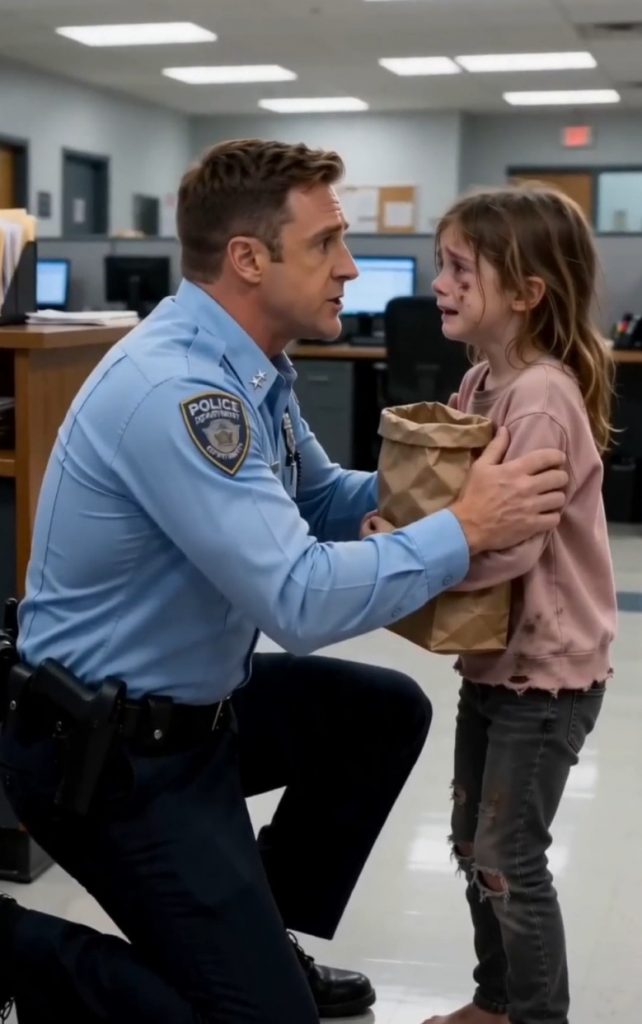
Her dusty pink sweatshirt hung loose on her small frame, and her torn gray jeans were wet at the cuffs. Dirt smudged her cheeks. Tear tracks cut clean lines through the grime. Both arms were wrapped around a large brown paper grocery bag pressed tightly against her chest.
The front desk officer spun around at the sound of the door slamming open.
“Please,” the girl sobbed. “My baby brother won’t wake up.”
Officer Daniel Hayes was out of his chair before the sentence was finished.
The precinct reception area was bright with fluorescent lights, too harsh for a child who looked as if she had crawled out of darkness. Stacks of manila folders sat across the wooden counter. Phones rang in the office behind him. A printer hummed somewhere near the partitioned desks.
But all of that vanished when Daniel saw the bag.
He moved around the counter and dropped to one knee in front of her.
“Hey, sweetheart,” he said, keeping his voice low. “You’re safe now. Let me see him.”
The girl shook so badly the bag trembled in her arms.
Daniel placed one hand beneath it and carefully pulled back the folded paper rim. Inside, tucked into a soft white cloth, was a newborn baby.
Tiny.
Still.
His eyes were closed, his skin pale under the station lights. For one terrible second, Daniel’s own breath stopped.
Then the baby’s lips moved.
A faint twitch.
A breath.
Daniel grabbed the radio clipped to his shoulder.
“Dispatch, ambulance now!” he shouted. “We got a newborn. He’s still breathing!”
The whole precinct changed at once.
Chairs scraped. A backup officer rushed from the office area. Someone yelled for blankets. Someone else called for a medical kit. Daniel lowered the bag carefully onto his lap and supported the baby through the cloth, trying to keep his hands steady.
The little girl stared at him, her chest heaving.
“I tried to keep him warm,” she whispered. “I tried.”
Daniel looked up at her.
There were children who cried because they were scared.
Then there were children who cried because they had already been asked to be stronger than any child should ever be.
“You did the right thing,” he said.
Her face crumpled.
“I didn’t know where else to go.”
Daniel was about to ask her name when she opened one small fist.
Inside her palm was a plastic hospital bracelet.
The name printed on it made Daniel go cold.
Baby Boy Mercer.
And beneath it was the name of a woman the department had been searching for all night.
Act II
Her name was Hannah Mercer.
Twenty-nine years old. Eight months pregnant. Missing since the previous afternoon.
Daniel had seen her picture on the bulletin board before his shift began. Brown hair. Tired eyes. A thin smile that looked like it had been forced for the camera. Her seven-year-old daughter, Sophie, was listed beside her as possibly endangered.
The first report had come from a neighbor.
Screaming through the wall. A crash. Then silence.
By the time officers arrived at the small rental house on Cedar Lane, the place was empty. No Hannah. No Sophie. No hospital bag. No car in the driveway.
Only signs of a hurried departure and a kitchen drawer pulled open so violently it had scattered utensils across the floor.
Hannah’s boyfriend, Evan Pike, told officers she had left willingly.
“She does this,” he said. “Gets emotional. Takes the kid. Runs to make me look bad.”
He was calm when he said it.
Too calm, Daniel thought.
But calm men could waste hours if people wanted to believe them.
Now Sophie Mercer stood inside the precinct, barefoot and shaking, holding the newborn brother nobody knew had already been born.
Daniel’s voice softened.
“Sophie?”
The girl flinched.
“How do you know my name?”
“We were looking for you,” he said. “For you and your mom.”
At the word mom, Sophie’s eyes filled again.
“She told me to run.”
Daniel felt the room narrow.
“Where is she?”
Sophie looked toward the glass door as if the darkness outside might have followed her in.
“I don’t know. She fell down after the baby came. She told me to take him and go to the place with the flag.”
Officer Marcus Bell, the backup officer, crouched beside them with a thermal blanket.
“The precinct,” he murmured.
Daniel nodded once, but his attention stayed on Sophie.
“You came all the way here by yourself?”
Sophie nodded.
“With him?”
She hugged her arms around herself.
“I put him in the grocery bag because I couldn’t carry him right. I wrapped him in Mom’s shirt first, but it got wet. I didn’t mean to hurt him.”
“No,” Daniel said quickly. “You helped him. You protected him.”
The ambulance sirens sounded in the distance.
Sophie’s lower lip trembled.
“Is he going to die?”
Daniel did not lie.
He had learned early that children could feel a lie even when they did not understand the words.
“The paramedics are coming fast,” he said. “He’s breathing. That matters. We’re going to help him.”
Sophie stared at the baby.
“Mom said his name is Noah.”
Daniel looked at the tiny face beneath the white cloth.
Noah Mercer.
Born in fear. Carried through cold streets in a grocery bag by a sister who should have been asleep under cartoon bedsheets.
The paramedics burst through the door moments later.
They moved quickly but gently, taking Noah from the bag, checking his breathing, wrapping him in warmth. Sophie screamed when they lifted him away.
“No! Don’t take him!”
Daniel caught her before she could chase the stretcher.
“They’re helping him,” he said. “Sophie, look at me. They’re helping Noah breathe better. You got him here. Now let them do their part.”
She clung to his uniform shirt.
“I promised Mom.”
“What did you promise?”
“That I wouldn’t let him go.”
Daniel’s throat tightened.
He looked at Marcus.
“Get Child Services on standby, but nobody removes her from this building without my say-so. And call Detective Ramirez. Tell her Sophie Mercer is here, Noah is alive, and Hannah may still be at the delivery location.”
Marcus nodded and ran.
Daniel looked back at Sophie.
“Sweetheart, I need you to be brave one more time.”
She shook her head hard.
“I can’t.”
“You already were,” he said. “Now I just need you to tell me where you came from.”
Sophie closed her eyes.
And whispered the one place no one had searched.
“The old laundromat.”
Act III
The laundromat on Briar Street had been closed for six years.
Daniel knew it.
Everyone in the district knew it.
Its windows were painted over from the inside, its sign half-broken, its parking lot cracked with weeds. Teenagers dared each other to sneak in sometimes. People without shelter used the back rooms during winter. Patrol officers checked it when complaints came in, but otherwise it sat there like a dead tooth in the neighborhood.
Evan Pike had worked there once.
That detail had been buried in an old employment record.
Daniel stood so quickly Sophie grabbed his sleeve.
“Don’t leave,” she pleaded.
He stopped.
The urgency in his body fought the fear in her eyes.
“I’m not leaving you alone,” he said. “Officer Bell is going to stay with you. Detective Ramirez is going to talk to you. And I’m going to help find your mom.”
Sophie pulled something from the pocket of her torn jeans.
A key.
It was tied to a purple hair elastic.
“Mom said the back door sticks,” she whispered. “You have to push hard.”
Daniel took it carefully.
“Did anyone else see you leave?”
Sophie’s eyes went wide.
“He was outside.”
“Evan?”
She nodded.
“He said Mom was making everything hard. He said babies cost too much.”
Daniel’s jaw tightened, but his voice stayed calm.
“Did he follow you?”
“I hid under a truck. Then I ran when the light changed.”
Daniel looked through the glass entrance.
The street outside was turning blue with dusk. Cars passed. Pedestrians moved along the sidewalk. Nothing looked unusual, which was exactly how danger often worked. It wore ordinary clothes until it was close enough.
Detective Elena Ramirez arrived within minutes, coat still wet from the mist outside. She was sharp-eyed, careful, and one of the few detectives Daniel trusted to hear a child without turning the child into an interrogation.
She knelt in front of Sophie.
“Hi, Sophie. I’m Elena.”
Sophie looked at Daniel.
He nodded.
“She’s safe.”
Ramirez did not reach for the girl. She did not crowd her. She only opened her notebook and said, “Your brother is very lucky you’re his sister.”
Sophie blinked.
That, somehow, made her cry harder.
While Ramirez stayed with Sophie, Daniel and two patrol units left for Briar Street.
The old laundromat appeared through the windshield like a memory nobody wanted. Its windows were dark. Its faded sign swung slightly in the wind. A single light glowed somewhere deep inside the building.
Daniel got out with his hand near his radio.
The back door was chained, but the chain was loose. The lock looked newer than the building. He took Sophie’s key, slid it in, and turned.
It worked.
The door stuck.
Daniel pushed hard.
Inside, the air smelled of dust, mildew, and old detergent. Broken washing machines lined the walls like metal tombs. Flashlights swept across peeling paint, overturned chairs, and a stack of blankets near the office door.
Then they heard her.
A weak voice from the back room.
“Please.”
Daniel moved fast.
Hannah Mercer lay on a mattress behind the office, wrapped in a coat, her face pale with exhaustion. Her brown hair clung to her cheeks. One hand was pressed to her stomach. The other reached toward the sound of their footsteps as if she had been reaching for hours.
“Where’s my baby?” she whispered.
Daniel dropped beside her.
“He’s alive. Sophie got him to the precinct.”
Hannah closed her eyes.
The relief that passed over her face was so raw Daniel had to look away for half a second.
“My girl,” she breathed. “My brave girl.”
Paramedics were called in immediately.
As they worked, Daniel noticed something on the floor beside the mattress.
A manila folder.
Inside were photographs, bank receipts, and a handwritten statement. Hannah had been collecting evidence. Not just against Evan for what he had done inside their home, but against a wider scheme involving forged rental applications, stolen benefits, and women being coerced into signing over checks to men who called themselves protectors.
Evan had not only wanted control.
He had wanted silence.
And Hannah had been planning to speak.
That was why she ran.
That was why he chased her.
That was why Sophie had walked into a police station carrying her baby brother in a paper bag.
Daniel stood, folder in hand.
A patrol officer appeared at the doorway.
“Hayes,” he said. “We found Evan Pike two blocks over. He was watching the precinct entrance from a parked car.”
Daniel looked down at Hannah.
Her eyes opened.
For the first time, fear did not own her face.
“Did he see Sophie?” she asked.
Daniel’s voice was steady.
“He won’t get near her.”
Act IV
Evan Pike was brought into the precinct less than twenty minutes after Hannah was taken to the hospital.
He came in angry.
Not panicked. Not ashamed.
Angry.
His eyes swept the reception area, searching for Sophie, then for the bag, then for any sign that the story could still be bent into something useful.
Daniel stood near the front desk.
Evan smiled when he saw him.
“You people have no idea what’s going on,” he said. “Hannah’s unstable. The kid exaggerates. I was trying to find them.”
Daniel said nothing.
That was the thing men like Evan hated most.
Silence gave their lies no place to land.
Detective Ramirez stepped into view with the manila folder in her hand.
“We found Hannah,” she said.
Evan’s smile faltered.
“She okay?”
The question came too late to sound human.
“She’s receiving medical care,” Ramirez replied. “No thanks to you.”
His face hardened.
“I want a lawyer.”
“You’ll get one.”
Daniel watched him.
All the shouting, all the control, all the threats Sophie had run from, and here he was beneath fluorescent lights, reduced to a man in cuffs trying to look misunderstood.
Then Sophie appeared at the hallway entrance.
She had a blanket around her shoulders and a stuffed bear someone from dispatch had found in a donation box. Marcus Bell stood beside her, one hand lowered protectively near her shoulder but not touching.
Evan saw her.
His expression changed instantly.
Soft voice. Tilted head. Fake concern.
“Sophie,” he said. “Come here. You scared everybody.”
The little girl froze.
Daniel took one step in front of her.
Evan laughed under his breath.
“Seriously? You’re letting a kid run this now?”
Sophie’s fingers tightened around the bear.
Daniel expected her to hide.
Instead, she stepped around him just enough to be seen.
“You said no one would believe me,” she said.
The room went still.
Evan’s face emptied.
Sophie’s voice shook, but she kept going.
“You said Mom would get in trouble if I told. You said Noah would be gone. You lied.”
Ramirez looked at Daniel.
Daniel nodded almost imperceptibly.
The statement was heard. Witnessed. Protected.
Evan lunged forward half a step before an officer stopped him.
“You little—”
“Enough,” Daniel snapped.
The word cracked across the reception area.
For the first time since he entered, Evan looked afraid.
Not of Daniel’s badge.
Of losing the story.
Sophie began to cry again, but she did not run. Marcus guided her back toward the hallway, where a child advocate waited with warm socks and juice.
Daniel watched her go.
Then he turned to Evan.
“Your mistake,” Daniel said quietly, “was thinking she was too small to save anyone.”
Evan looked away.
By midnight, charges were moving. By morning, the folder Hannah had hidden in the laundromat had opened two more investigations. Names connected to Evan’s accounts appeared in other reports, other complaints, other women who had been dismissed as unreliable until paperwork finally began speaking the same language as fear.
Noah was transferred to the neonatal unit, fragile but stable.
Hannah survived.
Sophie refused to sleep until someone promised she could see both of them.
Daniel was off duty by then, but he stayed.
He sat outside the hospital room in a plastic chair, still in uniform, holding a paper cup of terrible coffee. Through the glass, he watched Sophie climb carefully onto the bed beside her mother.
Hannah wrapped one arm around her daughter.
A nurse placed Noah in a warmed blanket nearby, close enough for Sophie to see him.
The little girl reached out one finger.
Noah’s tiny hand moved.
It curled around her fingertip.
Sophie’s face changed completely.
For the first time since she had crashed through the precinct doors, she looked like a child.
Not a witness.
Not a protector.
Just a little girl seeing that her promise had held.
Act V
The brown paper grocery bag became evidence.
Daniel hated that.
It sat in a clear plastic sleeve in a property room, labeled, photographed, and logged. To the system, it was an item tied to a case. To Daniel, it was a cradle made out of fear, hope, and a child’s impossible courage.
Weeks passed before Sophie returned to the precinct.
This time, she wore shoes.
Purple sneakers with silver stars on the sides. Her hair was brushed. Her pink sweatshirt had been replaced with a yellow sweater too bright for the building’s fluorescent lights. She held Hannah’s hand with one hand and carried a small drawing with the other.
Noah was still in the hospital, but growing stronger.
Hannah looked tired, but alive in the deeper sense of the word. Not merely breathing. Present. Standing upright. Looking people in the eye again.
Daniel came around the counter when he saw them.
Sophie hid behind her mother at first.
Then she peeked out.
“Hi,” she said.
“Hi, Sophie.”
She stepped forward and handed him the drawing.
It showed the police station as a big square building with blue windows. A tiny girl stood at the door holding a brown bag. A tall officer knelt in front of her. Above them, in careful uneven letters, she had written:
I found help.
Daniel looked down at it for a long moment.
His throat tightened.
“You sure did,” he said.
Hannah wiped her eyes.
“She wanted you to have it.”
Daniel crouched, just as he had that first night.
“I’m going to put this near my desk.”
Sophie looked worried.
“Not in the evidence room?”
Daniel almost smiled.
“No. This one stays with me.”
Hannah thanked him then.
Not in the quick way people thank police officers because they do not know what else to say. She thanked him with the full weight of a mother who understood exactly how close the world had come to taking everything.
Daniel shook his head.
“She got him here,” he said. “Sophie did that.”
Hannah looked down at her daughter.
“I know.”
Sophie leaned into her mother’s side, embarrassed by the attention.
The case went on for months.
Evan’s lies shrank under records, witnesses, security footage, and Hannah’s hidden folder. Other women came forward. Some quietly. Some shaking. Some angry enough to make the walls of the courthouse feel too small.
Hannah testified.
So did Sophie, but only in the protected way children should be allowed to speak, with care around her and no one treating her pain like a performance.
Daniel was there the day Evan accepted that the story was no longer his to control.
He watched Hannah leave the courthouse holding Sophie’s hand.
Noah was at home by then, round-cheeked and loud, wrapped in a blue blanket knitted by one of the dispatchers who pretended she did not knit for “every baby who survives my shift,” even though everyone knew she did.
A year later, the precinct changed its lobby.
Not much.
Police stations do not transform easily. The lights were still too bright. The desk was still covered in folders. The security door still groaned when it opened.
But beside the reception counter, near the bench where people waited with bad news in their hands, Daniel helped install a small shelf stocked with blankets, socks, bottled water, granola bars, diapers, and stuffed animals.
Above it was a sign.
For anyone who had to run.
No one put Sophie’s name on it.
Daniel did not need to.
He thought of her every time a frightened person entered the precinct and looked around as if unsure whether help was really allowed to belong to them.
One cold afternoon, Hannah came by with both children.
Sophie was taller. Her hair was cut neatly at her shoulders. Noah toddled beside her with both hands in the air for balance, laughing every time he nearly fell.
Daniel came out from behind the desk.
Noah stared at his badge, fascinated.
Sophie looked at the shelf.
“You made a running-away place,” she said.
Daniel nodded.
“A running-to place.”
She considered that.
Then she smiled.
That smile stayed with him longer than any commendation ever would.
Before they left, Sophie reached into her backpack and pulled out a folded brown paper bag.
Daniel recognized it immediately, even though it was new, clean, and covered in drawings of stars.
“I made this for Noah’s memory box,” she said. “Mom said the real one had to stay with the case.”
She handed it to him.
On the front, she had drawn a baby wrapped in white cloth, a police badge, and a girl with messy hair standing very tall.
Underneath, she had written:
I kept him warm.
Daniel looked at the words.
Then at the girl who had once arrived barefoot beneath fluorescent lights, carrying a newborn through fear because her mother trusted her and because love had made her brave beyond reason.
“You did,” he said softly.
Sophie nodded.
This time, she believed it.
When the glass doors opened and the little family stepped back into the afternoon, Daniel stood in the lobby and watched them go.
Hannah held Noah on one hip.
Sophie walked beside her, wearing purple sneakers with silver stars.
No one looking from the sidewalk would know what they had survived. No one would see the laundromat, the cold, the bag, the newborn’s faint breath beneath the white cloth. No one would hear a little girl whispering, I tried.
But Daniel would.
For the rest of his life, he would remember the night a child ran into his precinct with the smallest life in the world held against her chest.
He would remember how terror looked when it refused to give up.
And he would remember that sometimes heroism does not arrive in armor.
Sometimes it arrives barefoot, crying, and carrying a paper bag through the dark.