Act I
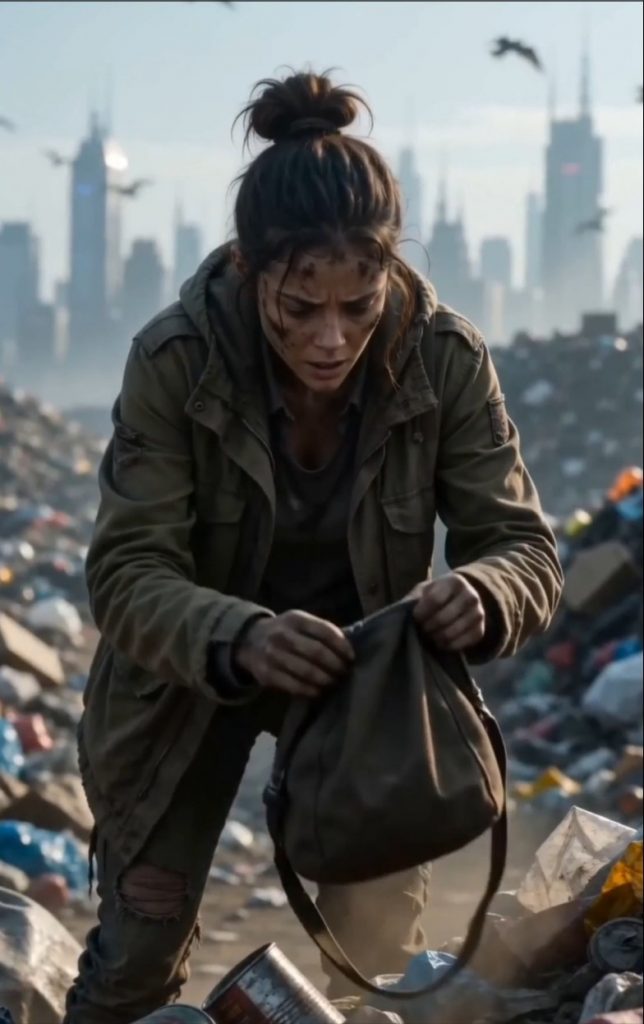
Mara Finch knew the landfill had its own language.
Metal clinked differently when it was worth something. Plastic sighed when it shifted under the sun. Glass gave a warning before it cut. Even the birds circling above seemed to know which trucks carried food, which carried factory waste, and which carried things people were desperate to forget.
That morning, the city glittered in the distance like it belonged to another planet.
Glass towers rose beyond the haze, bright and clean against the pale blue sky. From where Mara stood, ankle-deep in a slope of torn bags and crushed bottles, the skyline looked close enough to touch.
It was not.
The landfill stretched between her and that city like a punishment.
Mara shifted the huge canvas sack over her shoulder, teeth clenched as cans and bottles clattered inside it. The sack was nearly as big as she was, mud-caked and swollen from hours of work.
Her hands were raw. Her back burned. Dust stuck to the sweat on her face.
Still, she kept moving.
Stopping meant earning less.
Earning less meant no dinner.
A garbage truck rolled past on the dirt road, its wheels kicking up a gray cloud that swallowed the morning. Mara turned away, coughing into her sleeve. When the dust thinned, she saw the truck’s rear gate lift.
Another load spilled down the mound.
Plastic. Cardboard. spoiled food. broken furniture. factory scraps.
Then something landed on top of it all without breaking.
A dark-brown canvas bag.
Clean.
Too clean.
Mara froze.
In a place where everything arrived stained, crushed, torn, or crawling with flies, the bag looked impossible. It lay half-open on a slope of refuse, its brass zipper catching the light.
Mara’s first thought was that someone else would see it.
Her second was that clean things were rarely safe.
She dropped her heavy sack. It hit the dirt with a wet thud and the sharp crunch of cans collapsing under its weight.
Then she climbed.
Her boots slipped twice. A piece of plastic snapped under her hand. Dust rose around her in thin, bitter clouds.
When she reached the bag, she crouched and looked around.
No one nearby had noticed.
The other scavengers were scattered across the landfill, bent over their own piles, too tired to care about anything that was not directly in front of them.
Mara pulled the bag close.
It smelled faintly of leather and rain.
Her pulse quickened.
She opened the side compartment first. Her dirty fingers trembled around the silver zipper, dragging it slowly along the teeth.
Zzzip.
Inside was something black.
Smooth.
Polished.
Not a wallet. Not a phone. Not anything she had ever seen thrown away.
Mara reached in and pulled out a small black case, hard as stone, with a silver crest pressed into the lid. Beneath it was a sealed envelope, a flash drive, a stack of legal papers, and a photograph wrapped in plastic.
She opened the photograph.
A woman in a white coat stood in front of the city skyline, holding a baby wrapped in a pale yellow blanket. The woman was smiling, but her eyes looked afraid.
Around the baby’s neck was a tiny silver locket.
Mara’s hand went cold.
Slowly, she reached beneath her own tattered parka and pulled out the locket she had worn every day since she could remember.
The same locket.
The same shape.
The same broken clasp.
Her breath caught.
On the back of the photograph, written in faded ink, were six words.
My daughter did not die here.
Mara stared at the sentence until the landfill blurred around her.
Then the black case in her lap blinked once with a tiny blue light.
And a woman’s voice whispered from inside it.
“If you found this, then they failed to bury you.”
Act II
Mara had been raised on the edge of other people’s waste.
Not in a home, exactly.
A shelter made of scrap metal and blue tarp. A cot built from old shipping pallets. A cracked basin for washing when the rain barrels were full.
Her guardian, Rafi, used to call it a kingdom.
“That pile there is the west wall,” he would say, pointing with a rusted spoon. “The road is our river. The birds are our soldiers.”
Mara was six the first time she understood he was trying to make poverty sound magical.
By then, she already knew better.
She knew the landfill had rules. Never dig under fresh chemical waste. Never fight over copper unless you were ready to lose teeth. Never trust men from the city when they came wearing clean boots and carrying clipboards.
Most importantly, never ask too much about where you came from.
Rafi had found her when she was a child.
That was all he would say.
“Found me where?” Mara asked once.
“In the world,” he answered.
“What kind of answer is that?”
“The only one that kept you alive.”
Rafi had been old even then, with a bent back and a cough that shook his whole body. He taught her which metals paid best, which buyers cheated, and how to read discarded newspapers so she could understand the city that refused to look at her.
That was how Mara learned about Helena Voss.
The name was everywhere.
Voss Industries. Voss Foundation. Voss Renewal Towers. Voss Clean Future Initiative.
Helena Voss had been a scientist, an inventor, and the richest woman in the city before Mara was born. She built the waste-conversion technology that turned the modern skyline into a symbol of progress.
Then she died in an accident.
That was the official story.
A laboratory fire. A grieving city. A husband already dead. A baby daughter presumed lost with her.
After Helena’s death, her younger brother, Victor Voss, inherited the company and became the face of the city’s “green transformation.” His portrait hung on billboards above highways.
A cleaner tomorrow begins with us.
Mara saw that slogan every week from the landfill.
It made the scavengers laugh.
There was nothing clean about tomorrow when you woke up breathing smoke from burning plastic.
Victor Voss visited the landfill once a year with cameras. He wore a white helmet, shook hands with managers, and promised reforms. He never walked far enough to smell the worst sections.
Mara had seen him from a distance only once.
She remembered his smile.
It looked expensive.
Now, crouched in the trash with the black case glowing in her hands, she heard a dead woman’s voice say her life had been stolen.
The recording crackled.
“My name is Helena Voss,” the woman said. “If this archive has opened, it means the paired locket is nearby. It means my daughter is alive.”
Mara could not move.
The voice continued, weak but steady.
“Victor has forged the transfer papers. He has altered the waste reports. He has sold the city a miracle while hiding poison under its poorest districts. I tried to expose him. I underestimated what he would do to keep control.”
Mara’s fingers tightened around the locket.
Inside the case, a small screen flickered on.
A file opened.
Birth certificate.
Elara Mae Voss.
Born twenty-two years ago.
Mother: Helena Voss.
The screen shifted to an infant photograph.
Same dark hair.
Same left cheek dimple.
Same crescent-shaped birthmark just below the collarbone.
Mara’s hand flew to her chest.
She had spent her whole life thinking the birthmark was the only thing that belonged to her.
Now it was evidence.
A gust of wind moved over the landfill, stirring plastic bags like ghosts.
Mara turned the photograph over again.
My daughter did not die here.
Here.
Not in the fire.
Here.
The landfill.
A sound rose behind her.
An engine.
Not one of the old garbage trucks.
This one was smoother. Lower. Closer.
Mara shoved the photograph and case back into the canvas bag and looked down the dirt road.
Two black SUVs were coming through the dust.
They were headed straight for the mound where she stood.
And for the first time in her life, Mara understood why Rafi had told her never to ask where she came from.
Someone had been waiting for her to ask.
Act III
Mara ran.
She did not run toward the open road. That was for people who trusted straight paths. She cut left instead, down the side of the trash mound, sliding on cardboard and wet plastic, one hand gripping the canvas bag against her chest.
Behind her, car doors slammed.
A man shouted.
“Stop her!”
Mara knew every ditch, every broken fence, every half-buried pipe in that landfill. The men chasing her did not. Their shoes sank. Their coats caught on scrap wire. One slipped hard and cursed loud enough for half the mound to hear.
Mara kept moving.
She ducked under the rusted frame of a burned-out bus and crawled through the gap where Rafi had once hidden stolen bread from a gang of older boys. On the other side, she found the narrow path between two walls of compacted trash and followed it until she reached the shack.
Rafi was sitting outside, repairing the handle of a broken shovel.
He looked up once and saw her face.
Then he saw the bag.
The shovel slipped from his hand.
“No,” he whispered.
Mara stopped in front of him, breathing hard.
His expression told her everything.
“You knew.”
Rafi closed his eyes.
The betrayal hurt before the explanation came.
“You knew who I was.”
“I knew who they said you were,” he said.
“Don’t do that.”
His old face folded with grief.
“Mara—”
“My name isn’t Mara, is it?”
Rafi looked toward the landfill road, where the SUVs had stopped. Men were spreading out through the mounds.
He pulled her inside the shack and closed the sheet-metal door.
The room was dark, hot, and cramped. Mara stood in the center, clutching the bag, while the only father she had ever known sat on the edge of the cot and looked twenty years older than he had that morning.
“I found you after the fire,” he said. “Not in it. Here.”
Mara’s throat tightened.
“Where?”
“Sector Nine. Night shift. A private truck came in after midnight. No markings. No driver log. I thought it was medical waste because they paid the gate guard cash and told everyone to stay clear.”
His voice shook.
“When they dumped the load, I heard crying.”
Mara stopped breathing.
Rafi looked at her, eyes wet.
“You were inside a laundry crate wrapped in a yellow blanket. There was smoke in your hair. A locket around your neck. And a note.”
He reached beneath the cot and pulled out a small tin box.
Mara had seen it before. He never let her touch it.
Now he opened it.
Inside was the other half of her life.
A baby hospital bracelet. A burned corner of a letter. A tiny silver key. And a note written in a hand she now recognized from the photograph.
If you find her, do not take her to police. Victor owns them. Hide her. Her name is Elara.
Mara sat down because her legs had stopped trusting her.
“You renamed me.”
“I saved you.”
“You lied to me.”
“I saved you first,” Rafi said, voice breaking. “Then I lied. And I have paid for both every day.”
Outside, a distant shout moved closer.
Mara opened the canvas bag again and pulled out the legal papers.
There were trust documents. Medical reports. Waste disposal maps. A list of payments to city officials. Photographs of barrels buried beneath the landfill’s oldest sections.
The final page was a corporate succession order.
If Helena Voss and her child were declared dead, all voting shares transferred to Victor.
If the child was alive, control remained with Elara Mae Voss upon adulthood.
Mara laughed once, but it sounded nothing like humor.
“That’s why they threw me away.”
Rafi shook his head.
“That’s why they tried.”
A knock hit the metal door.
Not loud.
Certain.
Rafi stood.
Mara grabbed his arm.
He pressed the tiny silver key into her palm.
“Listen to me. That black case was made by your mother. It needs the locket and this key to unlock the full archive. Once it opens, it sends everything to every news office Helena trusted.”
“How do you know that?”
“Because the woman who gave me the note came back before she died. She said Helena planned for the truth to survive even if she didn’t.”
The knock came again.
Harder.
A man outside called, “Mr. Rafi. We know she’s with you.”
Rafi looked at Mara.
For once, he did not call her his little queen of the landfill.
He called her by the name that had been hidden beneath the trash, beneath the dust, beneath twenty-two years of fear.
“Elara,” he said, “run toward the city.”
Act IV
The city had never looked real to Mara until she entered it covered in landfill dust.
People stared.
Of course they did.
She walked through the financial district with torn trousers, a tattered parka, and a dark canvas bag clutched against her chest like a stolen child. Her hair had come loose from its bun. Grime streaked her face. Her boots left pale prints on polished stone.
No one stopped her at first.
People like Mara were not invisible because they were unseen.
They were invisible because looking at them required guilt.
The Voss Tower rose at the center of the city, all glass and silver, reflecting a sky cleaner than the one above the landfill. Banners hung outside the entrance.
VOSS CLEAN FUTURE GALA
Tonight, Victor Voss would announce the final phase of the landfill renewal project. Mara had read about it in a discarded newspaper. The city planned to seal the old landfill, build luxury housing near the skyline, and call it environmental justice.
But the documents in her bag told another story.
They were not sealing waste.
They were burying evidence.
Security stopped her at the revolving doors.
“You can’t be here,” one guard said.
Mara looked past him into the lobby, where guests in black suits and glittering dresses moved beneath a chandelier shaped like falling rain.
“I need to see Victor Voss.”
The guard almost smiled.
“You and everyone else.”
Mara pulled out the locket.
His expression did not change.
Then she pulled out the black case.
That changed something.
The guard’s eyes flicked to a camera above the door. He spoke into his sleeve. Within seconds, two more guards appeared.
Then a woman in a cream suit approached.
She looked Mara up and down with practiced disgust.
“Where did you get that?”
Mara held the bag tighter.
“From where your people left it.”
The woman’s polite mask slipped.
“Come with me.”
“No.”
A hand closed around Mara’s arm.
She twisted away.
The bag fell open. Papers spilled across the marble floor. A photograph slid out and came to rest beneath the chandelier light.
Helena Voss holding a baby.
A few guests turned.
Then more.
Whispers began.
From the staircase above, a man’s voice cut through the lobby.
“What is happening here?”
Victor Voss descended slowly.
He was older than the billboards, but only slightly. Silver hair. Perfect suit. Calm eyes. He looked at the papers on the floor, then at the black case, then at Mara’s face.
For one second, he stopped breathing.
She saw it.
So did the woman in the cream suit.
Then Victor smiled.
“My God,” he said warmly, loud enough for the guests to hear. “This poor girl must be confused.”
Mara’s stomach turned.
He walked toward her with his hands open.
“Someone call medical assistance.”
“I’m not confused.”
Victor lowered his voice.
“You have no idea what you’re holding.”
“My mother did.”
The lobby went quiet.
Victor’s eyes sharpened.
“Your mother?”
Mara lifted the locket.
His smile disappeared.
For the first time, the city’s most admired man looked directly at the girl from the landfill and saw not dirt, not poverty, not a problem to remove.
He saw the child who should have died.
Mara took the tiny silver key from her pocket.
The black case clicked open.
The chandelier lights flickered as the case connected to every screen in the lobby.
Victor moved fast.
“Stop her.”
Too late.
Helena Voss appeared above them, her face projected across the giant gala display.
Her voice filled the tower.
“If you are seeing this, then Victor failed.”
Gasps rose from the crowd.
Mara stood beneath her mother’s image, shaking, filthy, and no longer invisible.
Helena’s recording continued.
“My brother forged company documents, concealed illegal dumping, and ordered my daughter’s death to take control of Voss Industries. I leave this archive to Elara Mae Voss, my child and sole heir. Believe the evidence, not the man who smiles beside my grave.”
Victor lunged for the case.
Mara stepped back.
A dozen phones were already recording.
On every screen, the files began to upload.
Waste maps.
Payment ledgers.
Police transfers.
Medical reports from landfill workers poisoned by buried industrial chemicals.
Then came the final image.
A photograph of baby Elara wearing the locket.
Beside it, a live scan from the black case confirmed the match.
Elara Mae Voss: verified.
The lobby erupted.
Victor looked around, searching for someone still willing to obey him.
But power is a costume.
And once everyone sees the stain beneath it, even loyal men hesitate.
Police arrived ten minutes later.
This time, they did not come for Mara.
They came for him.
Act V
The city spent weeks pretending to be shocked.
Mara did not.
Shock was a luxury for people who had not been breathing the truth for years.
The landfill workers had always known something was wrong. Children grew up coughing. Old men lost strength too early. Water collected in rainbow puddles after rain. Trucks came at night and left before dawn.
But knowing is not the same as being believed.
Helena’s archive changed that.
It did not ask politely. It named officials. It named companies. It showed dates, signatures, payments, and burial sites. It showed how Victor Voss built a clean city by pushing its poison onto the people least able to fight back.
The arrests began at the top and moved downward.
Victor’s executives resigned before they were charged. City inspectors suddenly remembered missing forms. Lawyers issued statements full of sorrow and no responsibility.
Mara ignored most of it.
She stayed at Rafi’s hospital bed.
He had been injured while helping her escape the landfill, not badly enough to die, though he complained dramatically enough that nurses threatened to sedate him with paperwork.
“You’re rich now,” he told Mara one afternoon. “You should bring me better soup.”
“I’m not rich.”
“You own half the skyline.”
“I own a headache.”
He smiled, then grew quiet.
“You hate me?”
Mara looked at him for a long time.
She had asked herself that question every night since the truth came out.
He had lied.
He had also carried her out of the trash.
He had hidden her from men who would have finished what they started.
He had taught her how to survive with nothing.
“No,” she said finally. “But I’m still angry.”
“That’s fair.”
“I needed the truth.”
“I know.”
“You should have trusted me with it.”
His eyes filled.
“I was afraid if you knew, you’d run toward them before you were strong enough.”
Mara reached for his hand.
“I ran anyway.”
Rafi laughed softly.
“Yes. Like your mother, then.”
The official recognition came later.
Elara Mae Voss was declared alive by the court.
Mara Finch did not disappear. She refused to let one name erase the other. Mara was the girl who survived the landfill. Elara was the child someone tried to bury. Both belonged to her.
The first thing she did with her inheritance was not buy a house.
She bought water rights.
Then medical treatment for every landfill worker who had been exposed. Then lawyers for families who had lost people to sickness no one had investigated. Then land for a recycling cooperative owned by the scavengers themselves.
Reporters kept asking how it felt to go from trash picker to heir.
Mara hated that question.
“I didn’t change,” she told one of them. “You just found out I was always a person.”
The clip went viral.
The city loved her then, in the shallow way cities love redemption stories that let them clap instead of apologize.
Mara did not need their love.
She needed contracts signed, clinics built, names restored, and the landfill closed properly, not buried under luxury apartments.
Months after the gala, she returned to the mound where she had found the bag.
The air was clearer now. Work crews had begun marking the contaminated zones. The scavengers no longer bent silently over dangerous piles for pennies. Many had jobs sorting materials in the new cooperative, with gloves, masks, wages, and names printed on badges.
Rafi walked beside her with a cane, pretending he did not need it.
“You sure you want to be here?” he asked.
Mara looked toward the skyline.
For most of her life, it had seemed like a wall of glass built to keep her out.
Now it looked different.
Not kinder.
Just less untouchable.
She reached into her coat pocket and pulled out the old silver locket. The broken clasp had been repaired, but she had kept the scratches.
Inside, she had placed two tiny photographs.
Helena Voss on one side.
Rafi on the other.
Blood and survival.
Truth and shelter.
Her mother had left her an empire, but Rafi had kept her alive long enough to inherit it.
Mara knelt where the brown canvas bag had landed. The exact spot was impossible to know now, but she remembered the shape of the mound, the angle of the sun, the strange clean line of the bag against all that ruin.
“Why would they throw this away?” she had whispered then.
Now she knew.
They had thrown it away because they believed everything buried among the poor stayed buried.
Evidence.
Poison.
Children.
Names.
But the landfill had its own language.
It had been speaking for years.
Mara had simply been the first person the city could no longer ignore.
As the sun dipped behind the towers, birds circled high above the clearing. The air smelled of dust, metal, and something almost like rain.
Rafi touched her shoulder.
“Ready, Mara?”
She stood.
“Elara,” she said softly, testing the name without surrendering the old one.
Then she smiled.
“Mara too.”
Together, they walked back down the dirt road, away from the mound and toward the city that had mistaken her for disposable.
Behind her, the landfill no longer looked endless.
And ahead, for the first time, the skyline looked reachable.