Act I
The German Shepherd had no reason to be in the middle of that street.
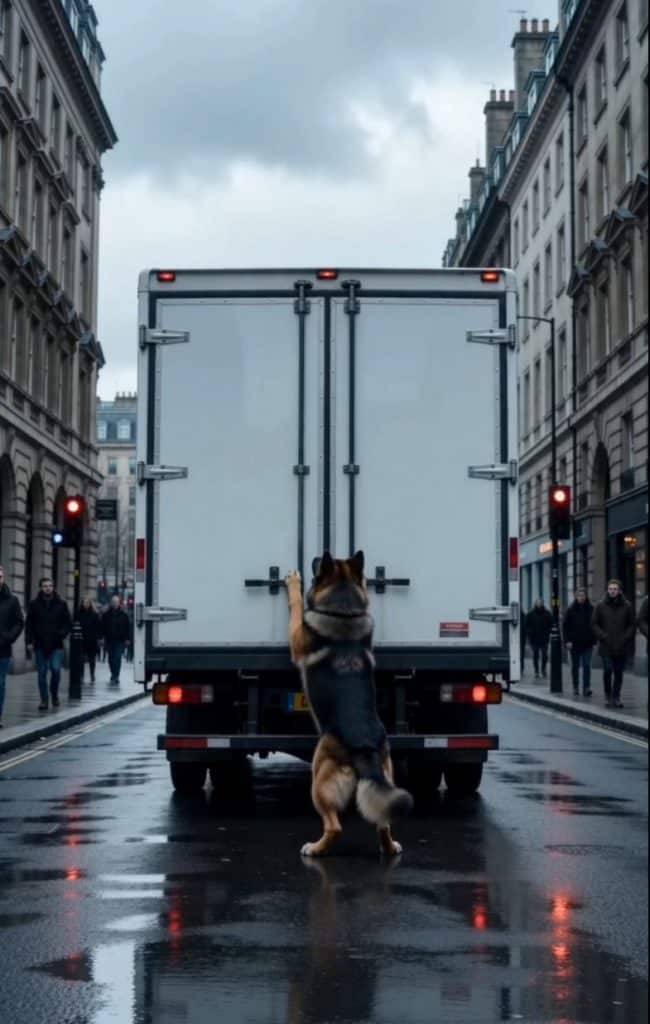
Traffic had stopped behind the white delivery truck. Rainwater shone on the asphalt, reflecting the gray sky and the narrow stone buildings that leaned over the road like silent witnesses. Pedestrians slowed under umbrellas, annoyed at first, then uneasy.
Because the dog was not lost.
He was working.
He stood on his hind legs at the rear of the truck, powerful front paws hooked around the black metal handle. His claws scraped against the painted door. His teeth closed around the lever, and he pulled until the whole truck rocked on its tires.
A few people laughed nervously.
Then the dog barked.
The sound cut through the cold morning air with such urgency that the laughter died at once.
On the sidewalk, Adrian Weiss stopped walking.
He was thirty-two, clean-shaven, wrapped in a black wool overcoat, late for a client meeting he had already decided did not matter. His hand stayed in his pocket around his phone as he watched the Shepherd jerk the handle again.
“What does it want to do?” he muttered.
Three men behind him slowed, drawn by the same strange force.
The dog dropped to all fours, circled once, then rose again and slammed both paws against the handle. Metal clanked. The truck doors shuddered.
A woman across the street said, “Where is the driver?”
No one answered.
The truck had no company logo. No delivery markings. Just a plain white body, clean enough to look deliberate. The engine was off. The cab was empty.
The dog barked again, then bit down on the handle and pulled with a deep, furious growl.
Adrian felt something tighten in his chest.
It was not fear yet.
It was recognition.
Not of the dog.
Of the feeling.
The terrible sense that everyone was standing inches from something they did not understand, and that the only creature telling the truth could not speak.
The handle finally moved.
A sharp click snapped through the street.
The vertical locking bar slipped free.
The Shepherd jumped back just as the rear doors began to swing open.
Slowly.
Heavily.
The hinges groaned like something waking up.
People stepped closer.
The inside of the truck was black.
Not dim.
Black.
The cloudy daylight reached only a few feet inside before dying against the darkness. At first, it looked empty. A hollow metal box. Nothing stacked, nothing loaded, nothing worth a dog tearing at a door for.
One of the men behind Adrian exhaled.
“Maybe it smelled food.”
The Shepherd did not move.
He stood at the opening, ears forward, body rigid, staring into the darkness.
Then he whined.
A low, broken sound.
Adrian stepped off the curb.
“Careful,” someone warned.
He ignored them.
The Shepherd looked back at him once, not pleading exactly, but demanding. Then the dog lowered his head and barked at the floor of the truck.
Adrian climbed one step onto the metal bumper.
The smell hit him first.
Cold air. Damp fabric. Fear.
Then came the sound.
Tap.
Tap.
Tap.
So faint he almost thought he imagined it.
The dog barked louder.
Adrian leaned into the cargo space, eyes adjusting. The truck was not empty. Not really.
Near the far wall, barely visible in the dark, was a small red mitten lying beside a metal seam in the floor.
Then the seam moved.
Adrian’s blood went cold.
The floor had a hidden panel.
And beneath it, something was tapping back.
“Oh my God,” he whispered.
The dog had not opened a delivery truck.
He had opened a tomb that was not supposed to be found.
Act II
Six months earlier, Adrian would have walked away.
That was the part of himself he hated most.
He had built a life out of not getting involved. Not because he was cruel. Because involvement had once hollowed out his family so completely that silence began to feel like survival.
His father, Inspector Tomas Weiss, had spent the last years of his career chasing a rumor no one wanted to believe.
White trucks.
False delivery papers.
Missing children from train stations, shelters, temporary housing blocks, and border clinics. Children who had no powerful parents demanding answers. Children whose names were easy for officials to misspell and easier to forget.
Tomas believed the trucks moved through respectable streets in daylight because nobody feared what looked ordinary.
Nobody searched what looked clean.
Nobody questioned paperwork stamped by the right office.
Then Tomas died of a sudden stroke at his desk, surrounded by case notes no one wanted to inherit.
At the funeral, senior officers praised his dedication.
Privately, they called him obsessed.
Adrian called him foolish, because anger was easier than grief.
He packed the case boxes into storage, took a legal job reviewing contracts, bought better coats, attended better dinners, and trained himself not to look too closely at things that made his stomach twist.
Until one morning, in a wet European street, a German Shepherd forced open a white truck.
Now Adrian stood on the bumper with his hand pressed to the cold wall, listening.
Tap.
Tap.
Tap.
Behind him, people began murmuring.
“Call the police.”
“Is someone in there?”
“Maybe it’s a prank.”
The Shepherd snarled at that last word.
Adrian crouched and brushed his fingers along the metal seam. There was no handle. No obvious latch. Whoever designed the compartment had expected inspections, but not a dog with enough will to tear a door open.
The red mitten trembled.
No, not the mitten.
The air beneath it.
Adrian turned to the crowd.
“Get a crowbar. Tire iron. Anything.”
The men who had been watching him stared for half a second, stunned out of their hesitation. Then one ran toward a parked taxi. Another searched the truck cab. A third called emergency services and began shouting the location into his phone.
The Shepherd climbed into the truck beside Adrian.
Up close, Adrian saw the collar.
Black leather. Worn. Official-looking once, but stripped of any visible badge. A small metal tag swung beneath the dog’s throat, scratched almost unreadable.
Adrian caught only two letters.
M. R.
The dog put one paw on the hidden panel and barked again.
“I know,” Adrian said, though he had no idea why he was speaking to him. “I know.”
A taxi driver arrived with a tire iron.
Adrian wedged it into the seam and pushed.
Nothing.
He pushed harder.
The panel groaned.
From beneath it came a sound that made every person in the street fall silent.
A child crying.
Not loudly.
Not dramatically.
Just one thin, exhausted sob from under the floor.
The Shepherd began clawing at the panel.
Adrian’s hands slipped on the metal. Another man jumped into the truck to help. Then another. Together they forced the iron deeper, bent the seam upward, and pulled until the hidden latch snapped.
The panel lifted.
Cold stale air rushed out.
For one terrible second, Adrian could not make himself look.
Then he did.
Beneath the floor was a narrow compartment lined with gray insulation. Too low to stand in. Too dark for anyone inside to know whether it was day or night.
Three children huddled together under a torn blanket.
They were alive.
Terrified.
Silent now, blinking up at the sudden light.
The smallest girl still held the red mitten in one hand.
The German Shepherd stepped forward and lowered his head.
The girl reached toward him before she reached toward any adult.
“Bruno,” she whispered.
The dog pressed his nose to her fingers and let out a sound so soft it broke something in Adrian’s chest.
He knew then that this was not a random animal.
This dog had been looking for them.
And someone had tried very hard to make sure he never did.
Act III
The police arrived within minutes.
Too many of them.
That was Adrian’s first warning.
Three patrol cars blocked both ends of the street. Officers moved quickly, efficiently, and with expressions so controlled they looked rehearsed. An ambulance followed, then another. People were pushed back onto the sidewalks.
The children were lifted out gently.
The smallest girl clung to Bruno’s collar until a paramedic promised the dog could stay beside her. Even then, she watched every uniform with eyes too old for her face.
Adrian stood near the truck, hands cold, coat damp, heart still hammering.
An officer approached him.
“You opened the vehicle?”
“The dog opened it,” Adrian said.
The officer did not smile.
“I need your phone.”
Adrian looked at him.
“Why?”
“For evidence.”
“I haven’t recorded anything.”
“Then you won’t mind handing it over.”
That was the second warning.
The third came when a senior police official arrived in a dark sedan instead of a patrol car.
Commander Viktor Hale.
Adrian knew his face from old news articles. Hale had spoken at his father’s funeral. He had called Tomas Weiss a man of “unusual passion,” which Adrian now understood had been an insult wrapped in ceremony.
Hale looked at the truck, the children, then the dog.
His expression barely changed.
“Secure the animal,” he ordered.
Bruno growled.
Adrian stepped closer to him.
One of the paramedics, a young woman with rain on her hair, looked sharply at Hale.
“He found them.”
“And now he may contaminate the scene,” Hale said.
The smallest girl began to panic.
“No,” she cried. “No, don’t take him. The lady said Bruno would find us.”
Adrian turned to her.
“What lady?”
The girl looked around at the officers and shut her mouth.
Hale noticed.
So did Adrian.
He knelt slowly, keeping his voice gentle.
“It’s okay. What lady?”
The girl’s eyes filled with tears.
“The police lady,” she whispered. “The one with Bruno.”
Adrian’s mind moved through the letters on the collar tag.
M. R.
Then memory struck.
Mira Roth.
The missing detective.
His father had written her name in the margins of the old case notes. Young. Brilliant. K-9 unit. Reported missing after refusing to close a transport investigation that senior officers called “administratively resolved.”
Adrian looked at Bruno.
“You were hers,” he said.
The dog’s ears twitched at the name he did not say.
Hale stepped forward.
“That’s enough.”
But the smallest girl was crying harder now, words spilling out.
“She gave me the mitten. She said if the truck stopped, push it through the floor crack. She said Bruno would smell it. She said he always finds what they hide.”
Hale’s face changed for less than a second.
Not much.
Enough.
Adrian pulled out his phone and started recording.
The officer beside him reached for it.
Bruno moved first.
He did not attack.
He simply placed himself between Adrian and the officer, teeth bared, powerful body still as a barricade.
People on the sidewalk raised their phones too.
One recording became ten.
Ten became thirty.
The street, which had been silent with fear, began to wake up.
“Why are you taking his phone?” someone shouted.
“Why did you want the dog removed?”
“Who owns the truck?”
Hale’s jaw tightened.
The truck cab radio suddenly crackled.
A voice came through, low and urgent.
“Unit Twelve, confirm delivery delay. Commander wants the cargo moved before inspection.”
Everyone heard it.
Even the officers froze.
Hale turned toward the cab as if he could kill the sound by looking at it.
Adrian walked to the open driver’s door.
Inside, clipped above the visor, was a delivery manifest with a charity logo printed at the top.
Saint Orlan Relief Foundation.
Beneath it were three signatures authorizing private transport through the city.
One belonged to Commander Hale.
The second belonged to a judge.
The third was a name Adrian had not seen since he packed his father’s files away.
Arthur Bell.
The man who signed Tomas Weiss’s investigation closed.
His father had not been obsessed.
His father had been right.
And the proof had been driving through the city in a white truck.
Act IV
By noon, the story was everywhere.
Not because the police released it.
Because ordinary people refused to let it disappear.
Videos from the street spread faster than officials could contain them. The dog pulling the handle. The hidden panel. The children being lifted into the light. Commander Hale trying to seize a witness’s phone while the truck radio betrayed him in front of half the block.
News crews arrived before the street was cleared.
Hale was suddenly unavailable for comment.
Adrian went home only long enough to drag his father’s case boxes from storage.
Dust covered the cardboard lids. His father’s handwriting ran across the sides in black marker.
Transport irregularities.
Missing minors.
Unauthorized charity routes.
White trucks.
For years, Adrian had avoided those boxes because opening them felt like admitting his father had died still pleading with a world that refused to listen.
Now he opened them all.
Inside were maps, photographs, copied manifests, witness statements, and notes written in the hurried script of a man racing time.
One photograph stopped Adrian cold.
A younger Mira Roth stood beside Bruno in a police training yard, one hand resting on the dog’s back. She was smiling, but her eyes looked serious.
On the back, Tomas had written:
Roth believes the trucks have false floors. Her dog alerted twice. Hale dismissed it.
Adrian sat on the floor until the room darkened.
Then his phone rang.
Unknown number.
He answered.
A woman’s voice whispered, “Your father trusted me.”
Adrian stood.
“Who is this?”
“Mira Roth.”
The room seemed to vanish around him.
“You’re alive.”
“Barely. Listen carefully. They’ll move the others tonight.”
“What others?”
A pause.
Then the sound of pain in her breathing, controlled but present.
“The foundation has a warehouse under the old customs depot. Bruno knows the route. Don’t go to Hale. Don’t go to city police. Contact federal investigators. And Adrian?”
He gripped the phone.
“Yes?”
“Your father didn’t die of a stroke.”
The line went dead.
For a moment, Adrian could not move.
Then Bruno barked from the hallway.
The dog had been brought to him by the paramedic after the children refused to be separated from him and state authorities began taking over the case. He now stood by the apartment door, body tense, eyes fixed on the stairwell.
Someone was outside.
Adrian stepped quietly to the peephole.
Two men stood in the hall.
Not police.
Not neighbors.
One held a folded paper. The other looked straight at the door as if he knew Adrian was watching.
Bruno growled low.
Adrian backed away and called the only number his father had circled twice in the old file.
Federal Inspector Lena March.
She answered on the second ring.
“I was hoping you’d find the boxes,” she said.
That night, the old customs depot filled with headlights.
No sirens.
No warning.
Federal agents moved through the warehouse doors while rain hammered the roof above them. Adrian stayed behind the line where he was told to stay, one hand on Bruno’s collar. The dog trembled with the need to run forward.
Then, from inside the warehouse, a whistle sounded.
Not loud.
But Bruno heard it.
His body went still.
A second whistle followed.
Two short notes and one long.
The dog tore free.
“Bruno!” Adrian shouted.
But the Shepherd was already inside.
Agents followed him down a corridor between stacked crates and abandoned shipping pallets. Adrian broke through the line despite someone yelling his name.
Bruno stopped at a locked storage room.
He barked once.
A battering ram hit the door.
Inside, under a single hanging light, sat Mira Roth.
Thin. Exhausted. Alive.
Bruno reached her first.
The detective dropped to her knees and wrapped both arms around his neck.
For a moment, no one spoke.
Even the agents lowered their weapons.
Mira pressed her face into the dog’s fur and whispered, “I knew you’d find them.”
Then she looked past Bruno and saw Adrian.
Her eyes filled with recognition.
“You’re Tomas’s boy.”
Adrian nodded, unable to speak.
Mira reached into her jacket and pulled out a sealed evidence pouch.
“Your father gave me this before he died. I kept it hidden because I needed the final link.”
“What link?”
She looked toward the crates behind her.
“The judges. The police. The charity board. All of them.”
Federal agents opened the crates.
Not children this time.
Records.
Hard drives.
Passports.
Payment ledgers.
Everything the powerful had moved through the city under the cover of compassion.
Everything they thought would stay locked in the dark.
Act V
Commander Hale was arrested before sunrise.
Judge Bell followed an hour later.
By afternoon, Saint Orlan Relief Foundation no longer had smiling donation posters in train stations. Its offices were sealed. Its board members stopped answering calls. Men and women who had built reputations on charity suddenly needed lawyers to explain why their signatures appeared on transport orders no honest person would have approved.
The rescued children were taken into protective care.
Their names were restored.
Their families were contacted where possible.
No official statement could make that part simple, because no crime like that ends neatly when the doors open. Fear lingers. Paperwork follows. Nightmares return. But the children were alive, and this time, they were seen.
Bruno stayed with Mira Roth.
No one argued.
After a week in the hospital, she gave her statement from a recovery bed with the German Shepherd lying beside her. She described the trucks. The false floors. The officers paid to look away. The night she was taken after Bruno alerted at a checkpoint.
“They made one mistake,” she told investigators.
“What was that?”
Mira looked down at the dog.
“They left him alive.”
Adrian watched the interview through a glass window and thought of his father.
For years, he had believed Tomas Weiss wasted his life chasing shadows. Now those shadows had names, accounts, offices, and handcuffs waiting for them.
The apology came later.
A formal one.
Too polished. Too late.
The city commissioner stood before cameras and admitted that Inspector Tomas Weiss had been “unfairly dismissed in his concerns.” Adrian hated that sentence. It sounded like someone apologizing to furniture after burning down a house.
So when it was his turn to speak, he did not use their language.
“My father was not difficult,” Adrian said. “He was inconvenient. There’s a difference.”
The room went quiet.
He continued.
“People ignored him because the truth pointed at men with titles. They ignored Detective Roth because her evidence came with a dog instead of a signature. They ignored families because grief without power is easy to file away. That ends here.”
Mira watched from the side of the room, one hand resting on Bruno’s head.
The dog looked bored by justice, as dogs often do after doing the hardest part themselves.
Months later, the street where the truck had stopped looked ordinary again.
Rain washed the asphalt clean. Pedestrians hurried past shop windows. Delivery vans came and went under stricter inspections. The red traffic light still glowed at the corner, and the stone buildings still leaned over the road as if guarding old secrets.
Adrian returned there with Bruno and Mira on the first clear morning of spring.
The city had placed a small plaque near the curb.
It did not mention the powerful men arrested.
It did not mention the scandal.
It simply read:
Here, lives hidden in darkness were brought into light.
Bruno sniffed the plaque, unimpressed.
Mira smiled faintly.
“He hates ceremonies.”
“So did my father,” Adrian said.
She looked at him.
“He never stopped believing someone would listen.”
Adrian swallowed.
“I wish I had listened sooner.”
Mira’s face softened, but she did not offer easy comfort.
“Then listen now.”
Across the street, a little girl in a red coat walked with her foster mother. She saw Bruno and stopped. For a second, fear crossed her face.
Then recognition.
She lifted one hand.
Bruno’s ears perked.
The girl smiled.
Not fully.
Not the way children smile before the world teaches them caution.
But enough.
The Shepherd wagged his tail once, solemn as a soldier accepting a medal he did not need.
Adrian watched the girl disappear into the crowd.
For the first time in years, he understood why his father kept chasing what others called impossible. Not because he thought he could save everyone. No one could.
But because hidden things stay hidden only when decent people decide the darkness is someone else’s problem.
That morning, a dog had not made that decision.
He had stood in the rain, placed his teeth around a cold metal handle, and pulled until the door opened.
And once it did, the whole city had to look inside.