Act I
The insult landed louder than any dropped diamond could have.
“Yes,” Vanessa said, laughing sharply enough for half the boutique to hear. “She is my old friend…”
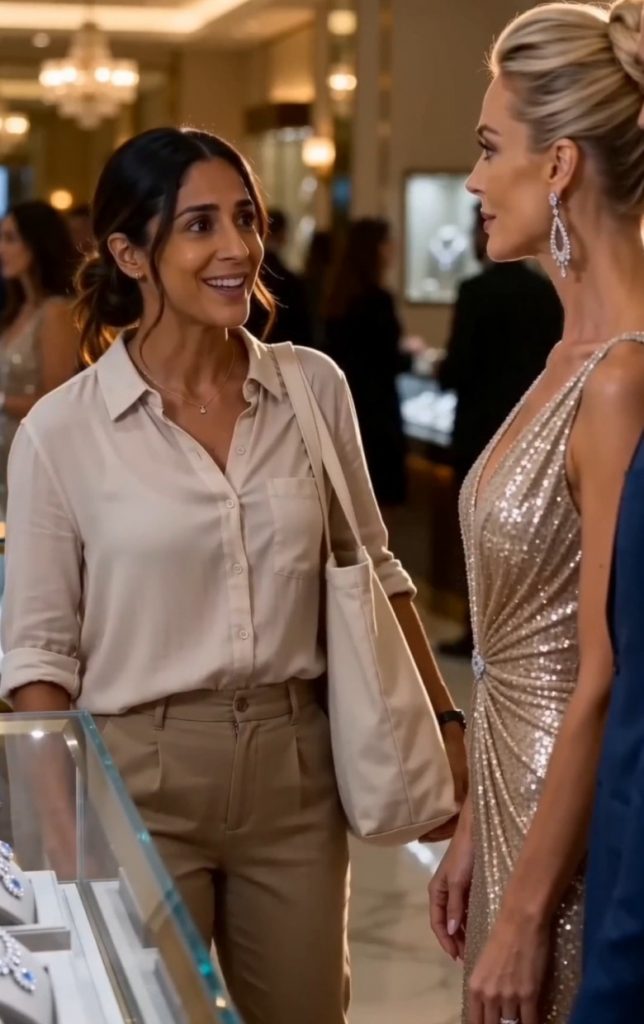
She paused, letting her eyes travel from the plain beige shirt to the khaki trousers, then to the off-white canvas tote hanging from the woman’s shoulder.
“But poor.”
The word glittered under the golden lights.
Around them, the luxury jewelry boutique seemed to hold its breath. Glass cases lined the polished marble floor, each one glowing with diamond necklaces, bracelets, and rings displayed like captured stars. Staff members in black suits pretended not to listen. Wealthy customers pretended even harder.
The woman with the canvas tote stood very still.
Her name was Amelia Hart.
A moment earlier, she had approached Vanessa with a warm smile, genuinely pleased to see someone from a life she had not thought about in years.
“How are you?” Amelia had asked softly. “It’s been a long time since we last met.”
For one second, she had been twenty again.
Back in a cramped college dorm with two girls eating instant noodles at midnight, sharing thrift-store dresses before interviews, promising each other they would never become the kind of women who measured human worth by price tags.
Then Vanessa looked at her like she was something that had been tracked in from the street.
Now Amelia stood in the middle of the boutique, feeling every eye she had not earned and every judgment she had not asked for.
Vanessa’s partner, Adrian, glanced between them. He was handsome in a navy suit, the kind of man who listened carefully for signals about who mattered. His expression shifted when Vanessa laughed, as if her cruelty had given him permission to be amused.
“Poor?” he repeated under his breath.
Vanessa smiled wider.
“Oh, don’t look so shocked. Amelia and I go way back.” She flicked her gaze toward the tote again. “She was always very… simple.”
A few feet away, a sales associate lowered her eyes.
Amelia’s hand tightened around the strap of her bag.
It was not the word poor that hurt most.
She had been poor.
Poverty had been her winter coat with a broken zipper. It had been counting coins for bus fare. It had been skipping meals and calling it focus. It had been sewing the same black skirt three times because she could not afford another one before her first internship.
No, what hurt was the satisfaction in Vanessa’s voice.
The pleasure of saying it now, under chandeliers, while diamonds watched from behind glass.
Amelia inhaled once.
Slowly.
She could have corrected her. She could have destroyed her in one sentence. She could have said the truth, sharp and clean, and watched Vanessa’s face collapse in front of everyone.
But Amelia had learned long ago that power did not need to rush.
Then footsteps approached from behind the main display wall.
The boutique manager crossed the marble floor with purpose. He wore a black tuxedo, a white shirt, and a bow tie, his expression formal and composed. He did not stop for Vanessa. He did not greet Adrian. He walked straight to Amelia.
Then he bowed.
“Madam Director,” he said clearly, his voice carrying through the room, “a pleasure to see you today. Please, this way to your office.”
Vanessa’s smile died.
Adrian turned sharply toward Amelia.
The sales associates froze.
Amelia looked up at the manager, then back at the woman who had just called her poor.
And for the first time that afternoon, Vanessa looked like she understood she had insulted the wrong person.
Act II
Vanessa Crane had not always been cruel in public.
In college, she had been charming in the way beautiful people learn to be when they discover doors open before they knock. She wore borrowed perfume, cried dramatically over failed exams, and talked about becoming “someone unforgettable.”
Amelia had believed in her.
That was the tragedy of it.
They met during their first year at the city design institute, two scholarship girls assigned to the same dorm because neither could afford the newer housing across campus. Amelia came from a town with one grocery store and one dying factory. Vanessa came from a family that had once been wealthy enough to resent losing it.
They bonded over hunger at first.
Not poetic hunger. Real hunger.
The kind that made them split one sandwich and pretend they were not still starving. The kind that made them study in department store dressing rooms during winter because the heating worked better there than in their dorm.
Amelia had talent.
Vanessa had instinct.
Together, they made things out of nothing. Amelia sketched jewelry designs on the backs of old lecture notes. Vanessa modeled them in student exhibitions, turning cheap brass, thrifted chains, and glass beads into something people stopped to admire.
The first piece Amelia ever sold was a silver pendant shaped like a small broken wing.
Vanessa wore it to a campus fundraiser and told everyone she had “discovered” Amelia.
Amelia had laughed then.
She thought Vanessa was joking.
By senior year, the jokes had sharpened.
Vanessa began introducing Amelia as “my little genius friend” in front of professors and “my charity case” in front of rich students. She borrowed Amelia’s designs without asking. She flirted with donors. She learned which people were useful and which were scenery.
Still, Amelia stayed loyal.
When Vanessa’s landlord threatened eviction, Amelia gave her rent money. When Vanessa needed a portfolio, Amelia stayed up three nights photographing her work. When Vanessa cried over a man who humiliated her at a gallery party, Amelia walked her home barefoot because Vanessa’s heels had cut her ankles.
Then came the competition.
The Laurent Prize.
A national jewelry design award that came with money, press coverage, and an apprenticeship in Paris. Amelia submitted a collection called “Hidden Light,” inspired by her mother, who had cleaned office buildings at night and left before sunrise.
Vanessa submitted a collection too.
Two days before judging, Amelia’s portfolio disappeared from the studio.
She found the sketches later in Vanessa’s drawer.
Not all of them.
Just enough.
Vanessa cried when confronted. She said she panicked. She said Amelia would win anyway. She said one mistake should not destroy a friendship built on years of survival.
Amelia withdrew quietly.
Vanessa won.
After graduation, Vanessa climbed fast. She married briefly, divorced profitably, learned the language of private events and donor circles, and dressed herself in gold until no one remembered she had once counted bus coins.
Amelia vanished from that world.
At least, that was what Vanessa believed.
In truth, Amelia did something far more dangerous than vanish.
She worked.
She apprenticed under a retired jeweler who taught her how to set stones by hand and judge a diamond without letting its shine bully her. She repaired antique pieces in a back room no client ever saw. She learned contracts, supply chains, ethical sourcing, metalwork, valuation, and the quiet brutality of luxury retail.
Then, five years ago, she bought a failing boutique with borrowed money and a promise to herself.
No customer would be ignored because they dressed simply.
No staff member would be trained to flatter cruelty.
No piece would enter her cases if she could not trace its origin.
She renamed the store Liora House.
Under her direction, it became one of the most respected private jewelry houses in the country.
The same boutique where Vanessa now stood in a gold gown, realizing the woman she had mocked owned the room beneath her feet.
The manager, Mr. Laurent, remained respectfully beside Amelia.
“Your office is prepared,” he said.
Amelia nodded.
“Thank you, Daniel.”
Vanessa’s mouth opened slightly.
“Your office?” she whispered.
Amelia turned toward her with a calmness that made Vanessa’s diamonds look loud.
“Yes,” she said. “Mine.”
Act III
Adrian recovered first.
Men like him usually did.
He stepped forward with a polished smile, the kind used in boardrooms and charity dinners when embarrassment needed to be converted into opportunity.
“Madam Director,” he said smoothly. “I had no idea we were speaking with the owner.”
Amelia looked at him.
“You weren’t.”
The sentence was gentle.
It still cut.
Adrian’s smile tightened.
Vanessa laughed once, too high and too thin.
“This is unbelievable,” she said. “Amelia, why didn’t you say something?”
Amelia tilted her head.
“When?”
The question hung in the air.
When Vanessa looked her up and down?
When she laughed at her bag?
When she called her poor in front of strangers?
Vanessa’s cheeks warmed beneath her makeup.
“I was teasing,” she said. “You know me.”
“I did,” Amelia replied.
That hurt more than anger would have.
Mr. Laurent shifted slightly, his expression controlled but disapproving.
“Madam Director,” he said, “the Vale collection is ready for your final approval. Also, the foundation pieces arrived this morning.”
Vanessa blinked.
“Foundation?”
Amelia glanced at her.
“Liora House funds apprenticeships for young designers from low-income backgrounds. Today’s auction supports the next group.”
One of the sales associates looked up with quiet pride.
Vanessa’s partner frowned, suddenly calculating.
“Liora House,” Adrian repeated. “You’re the Amelia Hart?”
For the first time, there was fear beneath his curiosity.
Amelia did not answer.
She did not need to.
Adrian had read about her. Anyone in luxury investment had. Amelia Hart was private, rarely photographed, known for refusing celebrity partnerships if the contracts felt exploitative. Her designs sold quietly to collectors who preferred discretion over display. Her foundation had embarrassed several larger houses by exposing labor abuses in their supply chains.
Vanessa had mocked a woman whose name opened far more doors than hers ever could.
But that was not the full humiliation.
The full humiliation was that Vanessa should have known.
She had known Amelia before the articles, before the awards, before the carefully written profiles calling her “the conscience of modern jewelry.” She had known her when all Amelia owned fit into two suitcases and a locked sketchbook.
Vanessa’s eyes moved to the display case beside them.
A necklace lay there under warm light: delicate white diamonds arranged like drops of rain along a barely visible platinum chain. Elegant, restrained, unforgettable.
Her expression shifted.
“I saw this piece in Milan,” she said slowly.
Amelia’s face did not change.
“Yes.”
Vanessa stared harder.
“It was called Hidden Light.”
The name entered the room like an old ghost.
Amelia said nothing.
Vanessa’s lips parted.
“You used that title?”
“It was mine.”
Adrian looked between them.
Vanessa laughed again, but now there was panic in it.
“Oh, come on. We were girls. We shared everything back then.”
“No,” Amelia said. “I shared. You took.”
The boutique fell silent enough to hear the faint hum of the lights.
Vanessa’s eyes flashed.
“You’re really going to do this here?”
Amelia looked around at the marble floor, the glass cases, the staff, the customers pretending not to watch.
“No,” she said. “You did this here.”
For the first time all afternoon, Vanessa had no immediate answer.
Then Mr. Laurent leaned slightly toward Amelia.
“Madam Director, shall I have Mrs. Crane’s appointment moved to a private salon?”
Amelia looked at the diamond bracelet resting on the velvet pad in front of Vanessa.
“No. She came for the Aurélie bracelet, didn’t she?”
Vanessa stiffened.
Adrian’s gaze sharpened.
“Yes,” he said carefully. “We were considering it.”
Amelia nodded.
“That piece is not available to her.”
Vanessa’s face hardened.
“Excuse me?”
Amelia’s voice stayed soft.
“Liora House reserves the right to refuse private sale when a client violates our conduct policy toward staff, guests, or patrons.”
Vanessa’s eyes widened.
“You can’t be serious.”
“I am.”
“It’s a bracelet.”
“It is also my store.”
The words settled over them with finality.
Then Amelia added the part Vanessa never expected.
“And it was designed by a scholarship apprentice from the foundation you just mocked.”
Act IV
Vanessa looked as though someone had slapped her without moving a hand.
Around her, the boutique had stopped pretending. A woman near the emerald display lowered her champagne glass. A sales associate behind the counter straightened his shoulders. Even Adrian seemed to step half an inch away from her, as if arrogance had become contagious.
Vanessa noticed.
That made it worse.
“You’re enjoying this,” she said to Amelia.
Amelia’s expression softened, but not with pity.
With memory.
“No,” she said. “I’m remembering how many times you enjoyed it first.”
Vanessa’s face twisted.
“I had to survive too.”
“I know.”
“You think I had it easy because I learned how to look rich?”
“No.”
“Then don’t stand there acting holy.”
Amelia’s eyes darkened.
“I’m not holy, Vanessa. I’m tired.”
That quiet sentence reached places shouting could not.
For a second, something human flickered behind Vanessa’s polished face. Something like shame. Or grief. Or the memory of a girl eating instant noodles in a cold dorm room, swearing she would never become the people who laughed at her shoes.
But pride moved faster.
“You don’t know what it took for me to get here,” Vanessa said.
Amelia took one slow step closer.
“I know exactly what it took. I paid part of the cost.”
Vanessa looked away first.
Adrian finally spoke.
“Vanessa,” he said, his voice low, “is there something I should know?”
There it was.
The social collapse.
Not moral regret. Not genuine sorrow. The immediate terror of being seen differently by a man whose opinion mattered to her because he represented rooms she still wanted to enter.
Vanessa turned to him.
“This is ancient history.”
Amelia said nothing.
Mr. Laurent, however, held out a slim folder.
“Madam Director,” he said, “the archive copy you requested.”
Amelia had not requested it for Vanessa.
She had requested it for the foundation exhibition opening that evening.
Inside the folder was a photograph from the design institute’s archives: two young women sitting on a dorm room floor surrounded by sketches, wire, and beads. Amelia, shy and serious, held up a necklace frame. Vanessa leaned into the camera, smiling like she owned the future.
Behind the photograph was a scanned copy of the original Hidden Light sketches.
Amelia’s name appeared in the corner.
Vanessa saw it.
So did Adrian.
The color drained from her face.
“I didn’t know you kept those,” she whispered.
“I kept everything I almost let you convince me didn’t matter.”
Vanessa’s mouth trembled. For a moment, it seemed she might apologize.
Not perform one.
Not soften one into excuses.
Actually apologize.
But the weight of witnesses was too much. Her pride, built over years like armor, could not bend without cracking.
So she lifted her chin.
“You still walked in here looking like that,” she said, though the words had lost their power. “What did you expect?”
Amelia looked down at her simple shirt, her practical trousers, her canvas tote.
Then she smiled faintly.
“I expected to approve the collection, meet with my foundation director, and maybe greet an old friend.”
Vanessa flinched.
That was the blow.
Not poor.
Not thief.
Not liar.
Old friend.
The thing she had been before envy, before hunger, before status became a religion she practiced by sacrificing anyone who reminded her of where she came from.
Amelia turned to Mr. Laurent.
“Please escort Mrs. Crane and her guest to the exit.”
Adrian’s eyes widened.
“Her guest?”
Amelia met his gaze.
“Yes. You may decide later whether you prefer to be more than that.”
The sales associates looked down quickly, hiding their reactions.
Vanessa drew herself up, but humiliation had already entered her posture. Her gold sequined gown, dazzling minutes earlier, now looked heavy, almost desperate, as if she had dressed for a throne and found herself outside the palace gates.
As Mr. Laurent guided them toward the door, Vanessa stopped.
She turned back.
“Amelia.”
The boutique waited.
Amelia looked at her.
Vanessa swallowed.
“I was hungry too.”
Amelia’s face softened with sadness.
“I know,” she said. “But you ate people.”
Vanessa’s eyes filled, but no tears fell.
Then she walked out beneath the golden lights, leaving behind the bracelet she could not buy and the past she could no longer rewrite.
Act V
The door closed quietly behind Vanessa Crane.
No dramatic slam. No final shout.
Just the soft click of glass and metal returning the boutique to its carefully curated calm.
But nothing felt the same.
A junior sales associate named Nina stood near the front case with red eyes. She was nineteen, new to the city, and the designer of the Aurélie bracelet Vanessa had wanted. Amelia noticed her clutching a polishing cloth in both hands as if it were a lifeline.
“You heard?” Amelia asked gently.
Nina nodded.
“I’m sorry, Madam Director. I wasn’t trying to listen.”
“It was hard not to.”
Nina looked toward the door.
“She called you poor.”
Amelia smiled a little.
“She was not the first.”
“How do you stand it?”
The question was honest. Young. Painfully familiar.
Amelia looked at the diamonds in the case, then at the reflection of her own plain clothes in the glass.
“I stopped treating other people’s blindness as evidence against me.”
Nina absorbed that slowly.
Behind them, staff began moving again. Customers resumed conversations in softer tones. The boutique breathed itself back into motion, but something warmer had entered the room. Not comfort exactly. Recognition.
Mr. Laurent approached with care.
“The foundation guests are arriving in fifteen minutes.”
Amelia nodded.
“I’ll be ready.”
“Would you like a moment in your office?”
She looked once more toward the door Vanessa had exited.
Then she shook her head.
“No. Keep the front open.”
That evening, Liora House filled with people who did not all look like they belonged in luxury spaces.
That was the point.
There were donors in tailored suits, yes, and collectors with quiet fortunes. But there were also students with nervous hands, mothers in work uniforms, apprentices wearing borrowed jackets, and former scholarship recipients who had built careers from the first tools the foundation gave them.
The Hidden Light collection sat at the center of the boutique.
Under soft golden lights, the pieces looked like rain becoming stars.
Amelia stood before them and spoke without notes.
“When I designed the first version of this collection,” she said, “I believed light was something you had to chase. Something far away. Something other people owned.”
The room was still.
“I was wrong. Light is often hidden inside people who have been told they are nothing. People who have been overlooked, mocked, priced out, or spoken down to in rooms designed to make them feel small.”
Nina stood near the back, crying quietly.
Amelia continued.
“This house exists because I was once helped by people who saw my work before anyone saw my worth. And because I was once hurt by people who mistook poverty for weakness.”
She paused.
“But poverty is not weakness. Cruelty is.”
No one clapped right away.
They needed a moment.
Then the applause rose.
Not polished. Not polite.
Real.
Later, after the speeches, after the donors, after Nina’s bracelet sold to a museum curator who asked to meet the designer personally, Amelia finally went upstairs to her office.
It was not large.
That surprised people.
They expected a throne room, perhaps, or a wall of awards. Instead, her office held a workbench, old tools, framed sketches, a kettle, a cracked ceramic mug, and a canvas board covered in photographs of apprentices from every year of the foundation.
On the bottom corner of the board was the old dorm photograph.
Amelia and Vanessa on the floor.
Young. Hungry. Still possible.
Amelia touched the edge of it.
She did not hate Vanessa as much as people might have expected.
Hate required a kind of closeness Vanessa no longer deserved. What Amelia felt was sadder and cleaner. Grief for the girl Vanessa had buried under gold. Grief for the friendship that had once been real before envy entered the room and sat between them.
Her phone buzzed.
An unknown number.
For a moment, Amelia considered ignoring it.
Then she opened the message.
I’m sorry.
Two words.
No excuses.
No explanation.
Not enough to fix anything.
But enough to be the first honest thing Vanessa had given her in years.
Amelia stared at the screen for a long time.
Then she set the phone down without replying.
Forgiveness, she had learned, was not a performance either.
It did not have to arrive on command just because someone finally discovered regret.
Downstairs, laughter rose from the boutique. Nina’s voice, bright and disbelieving, floated up through the old brass vent as she described her bracelet to a group of students.
Amelia smiled.
That was the sound that mattered.
Not Vanessa’s apology.
Not Adrian’s sudden respect.
Not the shock on faces when a manager bowed and called her Madam Director.
The real victory was not that Vanessa had been humiliated.
It was that every young person in that room had seen the truth with their own eyes.
A canvas tote did not make a woman small.
A plain shirt did not erase power.
A person’s worth was not waiting inside a glass case with a price tag beneath it.
The next morning, a photograph from the event appeared in several fashion columns.
In it, Amelia stood beside Nina and three other apprentices, all of them laughing near the Hidden Light display. She wore the same beige shirt and khaki trousers. Her canvas tote was slung over one shoulder.
The caption called her understated.
Amelia laughed when she read it.
Understated was what people called power when it did not beg to be recognized.
A week later, the Aurélie bracelet was moved to a special case at the front of the boutique. Not because it was the most expensive piece in the store, though by then its value had risen. But because Amelia wanted every customer to see the small plaque beside it.
Designed by Nina Bell, Liora Foundation Apprentice.
Inspired by the belief that dignity should never depend on who can afford to enter the room.
People stopped to read it.
Some smiled.
Some looked uncomfortable.
Amelia considered both reactions useful.
As for Vanessa, she did not return.
Not for months.
But one rainy afternoon, a package arrived at Liora House. Inside was the silver broken-wing pendant Amelia had sold in college, the first piece she ever made that someone wanted enough to buy. Vanessa had kept it all those years.
There was no note.
Amelia held it in her palm, feeling the uneven edges, the imperfect clasp, the hopeful little shape of it.
Then she placed it in the foundation archive.
Not as a tribute to Vanessa.
As a reminder.
Some people will call you poor because they cannot recognize anything they cannot price.
Let them.
The room does not become yours when they approve of you.
It becomes yours when you no longer need them to.