Act I
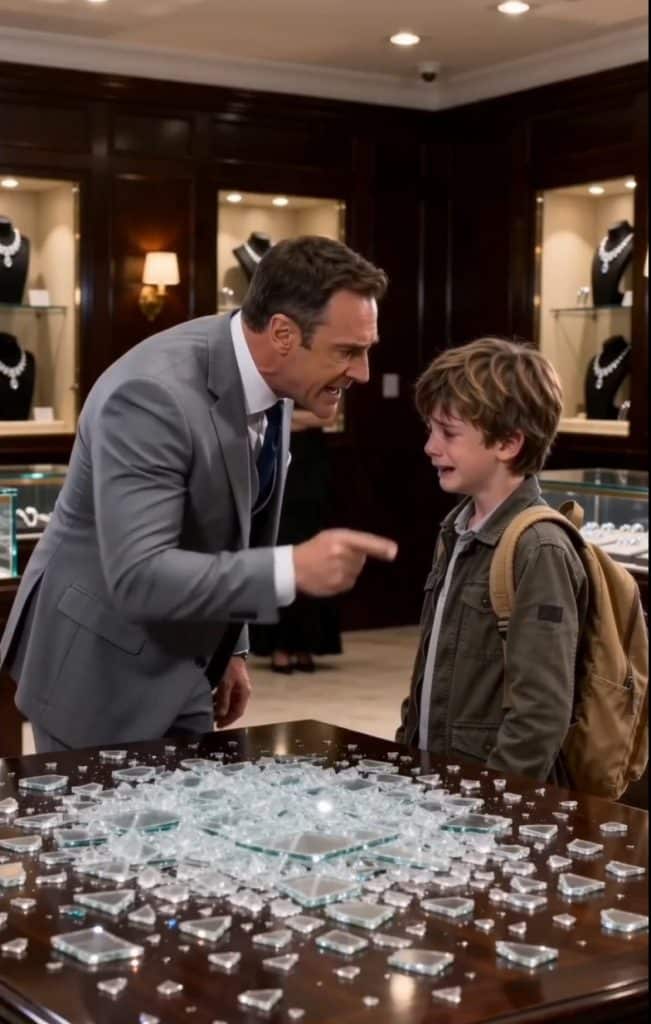
The sound of breaking glass silenced everyone in the store.
It did not crack softly. It exploded across the dark wood table in a glittering spill, hundreds of sharp fragments scattering beneath the warm track lights like fallen ice.
For one stunned second, nobody moved.
Then the manager stepped forward.
Caleb Whitmore was not a man who raised his voice often. He did not need to. His tailored gray suit, polished shoes, and cold blue stare usually did the work before his mouth opened.
But now he leaned over the shattered display case with fury tightening every line of his face.
“Do you have any idea what you have just destroyed?”
The boy in front of him could not answer.
He looked no older than nine. Messy brown hair fell across his forehead. His olive jacket was too thin for the cold outside, and the tan canvas backpack hanging from one shoulder looked almost as worn out as he did.
Tears ran down his face unchecked.
Behind him, two women in black evening gowns stood near the diamond necklace display, arms crossed, watching him with the chilly interest of people who believed poverty was a kind of bad manners.
“I didn’t mean to,” the boy choked out.
Caleb pointed to the ruined table.
“That case held a hand-set antique diamond collar worth more than most people’s cars.”
The boy flinched.
One of the women whispered, “Children like that shouldn’t even be allowed inside.”
The boy heard it.
His shoulders curled inward.
Caleb heard it too, but he was still looking at the glass, the broken lock, the velvet tray overturned beneath the wreckage. His father’s voice lived somewhere in his head, sharp and merciless.
Control the room. Protect the merchandise. Never let desperation touch luxury.
The boy suddenly dropped to his knees.
“Please,” he sobbed, clawing at the zipper of his backpack. “Please don’t call the police. I wasn’t stealing. I promise. I just needed someone to listen.”
Caleb’s jaw tightened.
Security had already stepped toward the front door.
The boy yanked out a crumpled white paper and held it up with both hands, as if it were the only shield he had left.
“My mother is very sick,” he cried. “She needs her medicine.”
The store went still again, but differently this time.
Caleb stared at the note.
He almost refused to take it.
He had heard every story before. Sick mothers. Lost wallets. Dead batteries. Emergency bus fare. People came to expensive places believing guilt could be converted into cash.
But something about the boy’s hands stopped him.
They were shaking too hard for performance.
Caleb took the paper.
The handwriting was uneven, half childlike, half rushed panic.
Please, my mom needs this prescription today. Her name is Sarah Bennett. Tell Mr. Whitmore she never stole anything. Tell him she still has the blue box.
Caleb read the name once.
Then again.
The blood drained from his face.
The glass, the women, the guards, the store itself seemed to move very far away.
He lifted his eyes to the boy.
“What did you say your mother’s name was?”
The boy sniffed, terrified.
“Sarah.”
Caleb’s voice dropped into a stunned whisper.
“Sarah Bennett?”
The boy nodded.
Caleb stared at him as if the past had just walked barefoot through the front door.
“Is your mother Sarah?” he breathed. “Sarah’s son?”
The boy did not understand why the man had gone pale.
But Caleb did.
Because ten years earlier, Sarah Bennett had disappeared from his life carrying a secret his family had paid dearly to bury.
And now her child was standing in his store, surrounded by broken glass.
Act II
Before Caleb Whitmore became the coldest manager on Fifth Avenue, he had been a young man stupid enough to believe love could survive money.
Sarah Bennett had worked in the restoration room behind the showroom.
She was not rich. She was not polished. She did not know the old families who came in pretending not to look at price tags.
But she had hands that could repair almost anything.
Loose clasps. cracked settings. antique lockets with missing hinges. She could take a ruined piece of jewelry and find the original promise inside it.
Caleb had loved watching her work.
He loved the way she hummed under her breath when concentrating. The way she tucked pencils behind her ear and forgot they were there. The way she never looked impressed by wealth unless it had a story attached.
“You sell memories,” she once told him, holding up an old wedding band she had restored for a widow. “Not diamonds.”
His father, Arthur Whitmore, hated her for that sentence.
Arthur believed jewelry was status, not sentiment. He had built Whitmore & Gray into a shrine for people who wanted to be admired. He liked clients who arrived in black cars and spoke in low voices. He liked women who wore diamonds like armor.
Sarah, with her thrift-store coats and stubborn honesty, offended him simply by existing.
“She is temporary,” Arthur told Caleb one evening after closing. “Do not confuse kindness with suitability.”
Caleb had been twenty-nine and arrogant enough to think defiance was the same as courage.
He asked Sarah to marry him anyway.
For three months, they were happy in the secret, fragile way people are happy when they know the world is gathering arguments against them.
Then the blue box vanished.
It held the Whitmore Star, a rare sapphire brooch once worn by Caleb’s grandmother. Arthur claimed it disappeared from the private vault the same night Sarah closed the restoration room.
Police were called.
Sarah’s locker was searched.
A pawn ticket appeared in her coat pocket.
Caleb remembered that moment more clearly than he remembered the months after it.
Sarah standing beneath the harsh office light, face white with disbelief.
Arthur holding the ticket like a verdict.
Caleb saying nothing.
That was the sin that haunted him.
Not that he accused her.
That he hesitated.
Sarah looked at him once, waiting for him to defend her, waiting for the man who said he loved her to know her better than a piece of paper.
He did not speak fast enough.
By morning, she was gone.
The charges were quietly dropped when the brooch was “recovered” through private channels. Arthur said the scandal would be bad for business. Sarah never came back to collect her final paycheck.
Caleb wrote letters.
They returned unopened.
He went to her old apartment.
Empty.
He searched for months, then years, but always through the clean, useless methods of a man who had never learned how desperate people disappear when they no longer trust anyone with power.
Eventually, he accepted the story his father preferred.
Sarah had taken money and left.
Sarah had lied.
Sarah had used him.
But acceptance was not the same as peace.
Caleb became colder. Better at business. Better at standing behind glass counters and smiling at people he did not respect. When Arthur died, Caleb inherited the store, the debts, the reputation, and a private office full of locked drawers.
He never found the Whitmore Star.
He never found Sarah.
Until a crying boy walked in with her name written on a note.
The boy’s name was Oliver.
He told the story in broken pieces while sitting in Caleb’s office, wrapped in the wool coat Caleb had taken from his own shoulders.
His mother had been sick for weeks. Some days she could barely stand. They had gone to a free clinic. The prescription was too expensive. Sarah had written the note because she was too weak to come herself.
“She said to ask for Mr. Whitmore,” Oliver whispered. “She said he might hate her, but he would remember the blue box.”
Caleb’s fingers tightened around the paper.
“Where is she now?”
Oliver looked down.
“In our room.”
“What room?”
The boy hesitated.
Caleb softened his voice.
“Oliver, I need to know.”
The child swallowed.
“The motel by the bus station. Room twelve.”
Caleb closed his eyes.
Sarah Bennett, who once restored diamonds under museum lights, was sick in a motel room while her son begged strangers for medicine.
And he had been standing in a luxury showroom, yelling about glass.
Then Oliver reached into his backpack again.
“I was supposed to give you this too.”
He pulled out a small velvet pouch.
Caleb knew it before he opened it.
His hands shook as he loosened the string.
Inside was the Whitmore Star.
The sapphire brooch glowed deep blue against the worn fabric, untouched by time, impossible and damning.
Wrapped around it was a note in Sarah’s handwriting.
Your father hid this in my bag, then came to me later and told me to leave or he would make sure you went to prison for helping me. I kept it because it was the only proof I had. I tried to tell you. He made sure I never reached you.
Caleb read the words until they blurred.
His father had not protected the family.
He had destroyed one.
And somewhere in the city, Sarah was still paying for it.
Act III
Caleb left the shattered case uncovered.
For the first time in his life, he did not care what the clients saw.
One of the women in black stepped toward his office door as he came out with Oliver.
“Mr. Whitmore,” she said sharply, “surely you’re not letting that child leave after what he did.”
Caleb looked at her.
The woman stopped speaking.
There was something in his face now that did not belong in a boutique jewelry store. It was not politeness. It was not service. It was a man realizing that the room he had spent years controlling had been built on someone else’s suffering.
“The store is closed,” he said.
“But our appointment—”
“Closed.”
His staff stared at him.
Security opened the front door.
The women left in offended silence, their heels clicking across the marble floor like tiny gavels.
Caleb knelt in front of Oliver.
“I’m going to take you to your mother.”
The boy clutched his backpack.
“Are you mad at her?”
The question struck harder than any accusation.
“No,” Caleb said. “I’m mad at myself.”
They reached the motel twenty minutes later.
Room twelve faced the parking lot, its curtains drawn against the afternoon. The place smelled of damp carpet, cigarette smoke, and old rain.
Oliver ran ahead and knocked three times.
“Mom? It’s me.”
For a moment, nothing happened.
Then a weak voice answered, “Ollie?”
The door opened.
Sarah Bennett stood there with one hand braced against the frame.
Caleb forgot how to move.
Ten years had changed her, but not erased her. Her face was thinner. Her hair was shorter, tied back carelessly. Exhaustion had settled under her eyes. Still, the sight of her hit him with the force of a life he could have had if he had been braver when it mattered.
Sarah saw him and went still.
Not shocked.
Wounded.
As if some part of her had always expected this day and feared it anyway.
Oliver rushed to her.
“I got him,” he said. “I’m sorry about the glass. I didn’t mean to break it. A lady grabbed my bag and I pulled back and the case—”
Sarah closed her eyes.
“Oh, Ollie.”
Caleb stepped forward.
“Sarah.”
She opened her eyes again.
There was no softness in them.
“You shouldn’t have come.”
“You sent him to me.”
“I sent him to the store. I thought maybe someone there would buy the brooch. I didn’t think you would be kind.”
The words deserved to hurt.
They did.
Caleb looked past her into the motel room. A small suitcase lay open on a chair. Medicine papers were scattered on the table. Two paper cups sat beside a half-empty bottle of water.
No flowers.
No comfort.
No one caring for the woman his silence had exiled.
“I have the prescription,” he said. “I’ll get it filled.”
Sarah shook her head.
“I’m not asking you to save me.”
“I know.”
“Then why are you here?”
Caleb looked at Oliver.
The boy stood close to his mother, one hand gripping her sweater. Same brown hair. Same stubborn chin.
Then he saw it.
The small birthmark near Oliver’s left ear.
Caleb’s own mother had once teased him about the exact same mark.
His chest tightened.
Sarah followed his gaze and stepped slightly in front of Oliver.
Too late.
Caleb whispered, “How old is he?”
Sarah’s face changed.
Oliver looked between them.
“Nine,” she said.
The hallway seemed to tilt.
Nine.
The timing was not uncertain. Not vague. Not something grief could misread.
Caleb had spent ten years believing Sarah had abandoned him.
Sarah had spent ten years raising his son alone.
He looked at her, barely breathing.
“Why didn’t you tell me?”
Her laugh was quiet and bitter.
“I tried.”
Caleb said nothing.
Sarah’s voice trembled, but she did not look away.
“I wrote to you from three cities. I called the store. I came once when Oliver was six months old and stood across the street for an hour. Your father’s driver found me before I reached the door. He told me you were married. He told me you knew about the baby and wanted nothing to do with either of us.”
Caleb’s face went pale.
“I was never married.”
“I know that now.”
Silence opened between them like a grave.
Oliver’s small voice broke it.
“Is he my dad?”
Sarah closed her eyes.
Caleb looked at the boy, at the tears still drying on his cheeks, at the child who had walked into a store full of diamonds asking only for medicine.
He did not deserve another lie.
“Yes,” Caleb said, his voice breaking. “I think I am.”
Oliver stared at him.
No joy came first.
Only confusion.
Then fear.
“Are you going to be mad I broke the glass?”
Caleb dropped to one knee in the motel hallway.
For the second time that day, shame nearly brought him to the floor.
“No,” he said. “I’m going to fix what I should have fixed a long time ago.”
But Sarah’s knees suddenly buckled.
Caleb caught her before she hit the ground.
And as Oliver screamed for his mother, Caleb realized the truth had not come too late for his pride.
It might have come too late for her life.
Act IV
The hospital lights were cruelly white.
Caleb sat in a chair outside Sarah’s room with Oliver asleep against his side, the boy’s head heavy on his arm. A paper pharmacy bag rested on the floor near his shoes. The prescription had been filled. The doctor had explained the infection, the exhaustion, the malnutrition, and the danger of waiting even one more day.
“She needs rest,” the doctor said. “And stability.”
Caleb almost laughed.
Stability.
The one thing his family had stolen from her.
At dawn, while Sarah slept, Caleb returned to the store.
The broken glass was still on the table. His assistant manager had covered it with black cloth. The damaged necklace had been moved to the safe. Staff whispered when he entered.
Caleb walked straight to his father’s old office.
For years, he had avoided the bottom drawer of Arthur Whitmore’s desk. It was locked, and after Arthur died, Caleb convinced himself anything inside would be business records or old grudges.
Now he broke it open.
Inside were letters.
Dozens.
All addressed to him.
All from Sarah.
Some unopened. Some opened and refolded. One had a photograph tucked inside.
Sarah holding a newborn Oliver.
On the back, she had written:
His name is Oliver. I don’t want money. I want him to know the truth someday.
Caleb sat behind his father’s desk and covered his face with both hands.
The great Arthur Whitmore had not merely separated two people.
He had stolen a child’s father.
But there was more.
At the bottom of the drawer was a file labeled BENNETT SETTLEMENT.
Caleb opened it.
Inside were forged statements, private investigator reports, and a signed agreement Sarah had never signed. It claimed she accepted money in exchange for silence after stealing from the store.
Arthur had used the fake document to protect the company from scandal.
To the outside world, Sarah was not a victim.
She was a thief who had been generously spared.
Caleb took the file, the letters, the brooch, and the security footage from the day Oliver entered the store.
Then he called the company attorney.
By noon, Whitmore & Gray released a public statement.
It did not hide behind vague language. It did not blame clerical errors or family misunderstandings. Caleb wrote it himself.
Sarah Bennett was falsely accused. Evidence was fabricated by former ownership. The company withdraws every allegation ever made against her and will cooperate fully in correcting the record.
By evening, the story spread.
A boy breaking a jewelry case would have been gossip.
A luxury family business admitting it ruined an innocent woman became news.
The two women in black who had watched Oliver cry were suddenly silent online after witnesses described how they had treated him.
Former employees came forward.
One remembered Arthur ordering Sarah’s locker searched before the police arrived. Another remembered seeing Arthur’s driver remove files from the restoration room. A retired accountant admitted money had been moved to bury “a delicate family matter.”
Caleb did not sleep.
He paid for Sarah’s care. He arranged a private room. He hired a patient advocate. He placed Oliver in the safest hotel suite he could find and still slept in a chair by the boy’s door because Oliver asked, quietly, if he was going to disappear too.
“No,” Caleb said.
“People say that,” Oliver whispered.
“I know.”
“Then how do I know?”
Caleb sat on the edge of the bed.
“Because tomorrow morning, when you wake up, I’ll still be here.”
Oliver studied him with Sarah’s eyes.
“Promise?”
Caleb swallowed.
“Promise.”
The next morning, Oliver woke to find Caleb asleep in the chair, still wearing yesterday’s suit.
For the first time since entering the jewelry store, the boy smiled.
But Sarah did not smile when Caleb told her what he had found.
She lay against the hospital pillows, pale but awake, listening as he placed copies of the letters beside her.
“You kept them,” she said.
“My father kept them from me.”
Sarah looked toward the window.
“I used to imagine this moment,” she admitted. “I thought I would yell. I thought I would make you feel everything I felt.”
“You should.”
She turned back to him.
“But now I’m just tired.”
Those words hurt most.
Not anger.
Not accusation.
Exhaustion.
Caleb reached into his jacket and removed the blue velvet pouch.
“I brought this back.”
Sarah stared at the Whitmore Star.
“It was never mine.”
“No,” Caleb said. “But it proved you were telling the truth.”
He placed it on the bedside table.
Then he removed something else.
A small silver charm shaped like a key.
Sarah recognized it immediately.
She had made it in the restoration room from scrap silver during their last winter together. She had given it to Caleb as a joke.
For the man who owns too many locked doors.
Caleb’s voice shook.
“I kept this.”
Sarah looked at the charm for a long time.
Then at him.
The past did not heal in that moment.
But for the first time, it stopped bleeding.
Act V
Oliver returned to the store two weeks later.
This time, he entered through the front door with Caleb on one side and Sarah on the other.
The shattered table had been repaired, but Caleb had ordered one piece of broken glass preserved beneath a small brass plaque in the restoration room.
Not in the showroom.
Not for customers.
For himself.
A reminder that sometimes destruction is the only sound truth can make when nobody will listen.
The staff lined up quietly as Sarah walked in.
Some had never met her. Some had heard the old rumors. One elderly jeweler named Mrs. Vale began crying the moment Sarah crossed the threshold.
“I should have said something,” she whispered.
Sarah took her hand.
“Yes,” she said softly. “You should have.”
It was not cruel.
It was true.
Caleb watched as those words landed. He had learned, finally, that forgiveness given too quickly can become another way of protecting the guilty.
Sarah did not owe anyone ease.
The public apology came later that afternoon.
Caleb stood before reporters in the showroom, not behind a counter, not elevated, not guarded by polished language.
“My father built this company,” he said. “But he also used it to harm an innocent woman. I continued that harm by believing silence was the same as moving on. Sarah Bennett did not steal from Whitmore & Gray. She was framed. She was threatened. She was erased. Today, that ends.”
Sarah stood beside Oliver near the back.
She did not want to speak.
Oliver held her hand, looking small beneath the diamond lights, but not as frightened as before.
When a reporter asked whether Sarah planned to sue, Caleb answered before anyone else could turn her pain into entertainment.
“That is her choice,” he said. “And this company will not fight her.”
Sarah looked at him then.
Not warmly.
But with something like recognition.
The legal settlement came quietly. Caleb insisted it include more than money. Sarah’s name was cleared in all company records. A formal notice was sent to every former client and employee who had heard the lie. The forged documents were turned over to prosecutors. Arthur Whitmore’s portrait was removed from the private office.
In its place, Caleb hung nothing.
Some walls deserved to stay bare for a while.
Sarah recovered slowly.
She and Oliver moved into a small apartment Caleb arranged near the hospital, though Sarah made him put the lease in her name and refused anything that felt like a cage built from guilt.
Caleb accepted every boundary.
He showed up anyway.
School forms. Doctor visits. Groceries left at the door when Sarah was too tired to talk. Dinners where Oliver asked questions Caleb had no right to rush.
Did you know I existed?
No.
Would you have wanted me?
Yes. More than I can explain.
Why didn’t you find us?
Because I believed the wrong person.
That answer always made Oliver quiet.
But he kept asking.
And Caleb kept answering.
Months passed.
Spring softened the city. Sarah’s strength returned in small, ordinary victories: walking three blocks without resting, laughing at something Oliver said, wearing earrings she had repaired herself.
One evening, Caleb found her in the restoration room after closing.
She was seated beneath the lamp, examining a broken antique locket a client had abandoned years ago. Oliver sat nearby doing homework, kicking his feet beneath the table.
For a moment, Caleb stood in the doorway unnoticed.
The room looked exactly as it had ten years earlier.
Except now the truth was awake inside it.
Sarah looked up.
“You’re staring.”
“I know.”
“That used to annoy me.”
“Does it still?”
She considered this.
“A little.”
Caleb smiled faintly.
Oliver glanced between them.
“Are you two being weird again?”
Sarah laughed.
Caleb did too.
The sound surprised him.
Not because it was happy, exactly, but because it was possible.
Later, Sarah handed Caleb the restored locket.
Inside, she had placed the small silver key charm he had kept all those years.
“I’m not giving this back,” she said.
Caleb looked at it.
“What are you doing?”
“Putting it somewhere safer than your pocket.”
He understood what she meant.
Not forgiveness.
Not yet.
Maybe not ever in the simple way people like to imagine.
But a door had opened.
Not wide.
Enough.
At the front of the store, Oliver stood by the repaired display case. He looked at the diamonds with curious eyes, no longer like a child waiting to be thrown out of a world that was not meant for him.
Caleb joined him.
“That case used to scare me,” Oliver said.
“Me too,” Caleb admitted.
Oliver looked up. “You weren’t scared of a case.”
“No,” Caleb said. “I was scared of what it showed me.”
The boy thought about that.
Then he slipped his hand into Caleb’s.
It was small, unexpected, and more generous than Caleb deserved.
Across the room, Sarah watched them beneath the warm lights.
The store was quiet now.
No shouting. No breaking glass. No women whispering judgment from behind diamonds.
Just a boy, his mother, and a man who had finally learned that the most valuable thing in the building had never been locked behind glass.
It had walked in crying, holding a crumpled note, asking only to be believed.