Act I
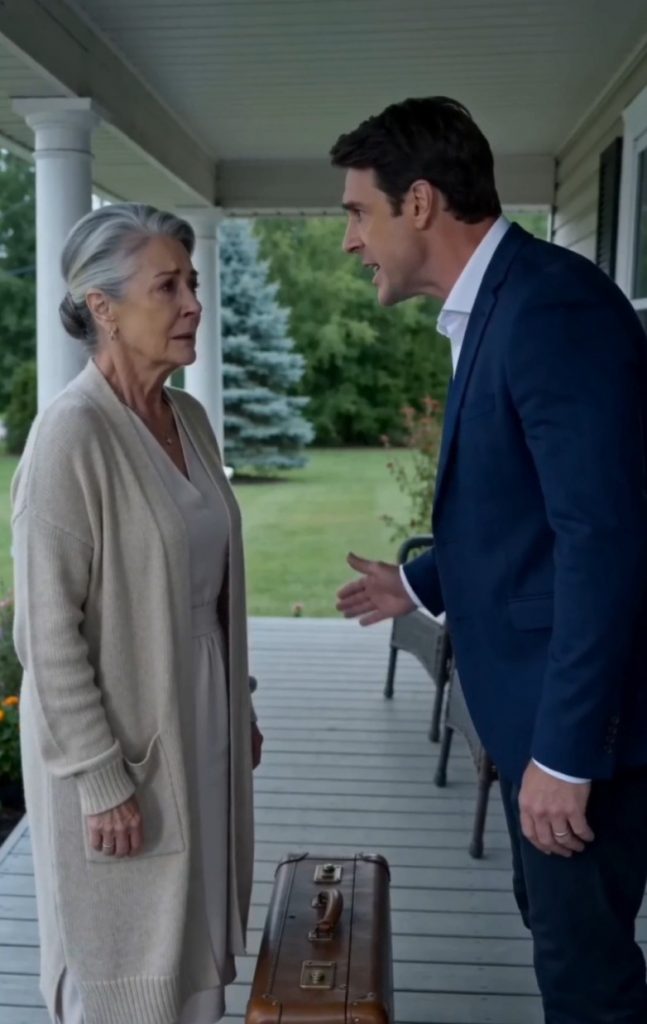
The suitcase sat between them like a verdict.
It was old brown leather, the corners worn soft from a life that had once included train stations, summer visits, and family vacations that Mrs. Henderson could still remember by the smell of sunscreen and peanut butter sandwiches. Now it rested on the wooden porch floor of her own home, packed badly by hands that had no patience for memories.
Her son stood beside it, one hand stretched toward her.
“Mom, we need these keys right now,” Julian said. “It is time for you to go.”
Mrs. Henderson looked at him for a long moment.
The porch light had not come on yet, but the sky was already gray with evening. The gravel driveway curved down toward the street, bordered by a thin green lawn she had watered through twenty-seven summers. Wind moved through the maple tree her husband planted when Julian was five.
That tree had grown tall.
Julian had grown cold.
He was dressed too sharply for a son sending his mother away. Navy blazer, white open-collar shirt, dark slacks, polished shoes that had never knelt in garden dirt or tracked mud through the kitchen. His face had the tight, impatient look of a man who had already decided kindness was a waste of time.
“Please,” Mrs. Henderson said quietly. “Just one more night.”
Julian’s jaw hardened.
“We talked about this.”
No, she thought. He had talked. She had listened.
He said the house was too much for her. He said the stairs were unsafe, though she only used the downstairs bedroom now. He said the taxes were crushing him, though she had paid them herself for years. He said the assisted living facility was “nice,” though he had never shown her the room.
Then, that morning, she saw the real estate folder on the kitchen counter.
Cash offer.
Fast closing.
No contingencies.
Her son wanted her gone by sunset.
Mrs. Henderson looked past him into the house. Her house. The narrow hallway with Julian’s height marks still penciled near the pantry. The little brass hook where her late husband used to hang his work cap. The dining room where she had fed children, neighbors, strangers, anyone who appeared at her door hungry enough to be honest.
“I raised you here,” she whispered.
Julian looked away.
“That doesn’t change anything.”
A sound rose from the road.
Not one engine.
Several.
Mrs. Henderson turned her head toward the driveway.
Three black vehicles appeared at the entrance: a Mercedes-Maybach first, then a Cadillac Escalade, then a long stretch limousine moving slowly over the gravel as if arriving at a mansion instead of a modest suburban home with peeling porch rails and a stubborn old maple tree.
Julian froze.
The cars stopped in a neat line.
A man stepped out of the limousine carrying white lilies.
And before Mrs. Henderson understood why her heart had started pounding, he looked up at the porch and said the sentence that pulled twenty-five years out of the past.
“Do you remember the three boys you fed during the storm?”
Act II
Mrs. Henderson did not answer right away.
The man at the bottom of the porch steps was in his early thirties, dressed in a charcoal suit with a white shirt open at the throat. His hair was cropped short. His posture was straight, respectful, almost formal. But his eyes were not the eyes of a stranger.
They held a memory.
A memory she had buried under bills, grief, medicine bottles, and the quiet humiliation of needing help from a son who treated help like a debt.
Julian stepped forward.
“Who are you?”
The man did not look at him.
His gaze stayed on Mrs. Henderson.
“My name is Gabriel Reed,” he said softly. “I was twelve when you found us behind your garage.”
The porch blurred.
Rain. Thunder. A different evening. A sky split open by lightning.
Mrs. Henderson’s hand rose to her throat.
Twenty-five years ago, the storm had come without warning. It flooded the underpass, knocked out power for six blocks, and turned the roads into rivers of dirty water. Her husband, Thomas, had been away working a double shift at the mill. Julian had been upstairs with a fever.
She had gone outside to secure the trash bins when she heard coughing near the garage.
Three boys were huddled beside the wall, soaked through, shivering so hard their teeth clicked.
The oldest tried to stand when she saw him. He was thin, proud, and terrified. He said they were fine. He said they were just waiting for the rain to stop. He said it with the kind of lie children use when the truth has already failed them.
Mrs. Henderson took one look at their blue lips and brought them inside.
She gave them towels. Soup. Bread. Dry socks from Thomas’s drawer. She sat them at her kitchen table while rain battered the windows and Julian slept under a damp washcloth upstairs.
The youngest boy had cried into his bowl.
The middle one asked if he could take his soup slowly because he wanted it to last.
The oldest, Gabriel, kept saying thank you until Mrs. Henderson finally placed a hand over his and said, “Eat first. Gratitude can wait.”
They stayed two nights.
Not because she planned it. Because the storm washed out the shelter where they had been headed, and no one came looking for them.
On the second morning, Thomas found out what she had done and quietly drove to the store before sunrise. He came back with blankets, canned food, and three cheap backpacks.
“Children don’t leave this house empty-handed,” he had said.
Mrs. Henderson remembered Gabriel standing on the porch with those backpacks at his feet, trying not to cry.
“You don’t owe me anything,” she had told him.
He had looked at her with rain still hanging from the ends of his hair.
“Yes, ma’am,” he said. “We do.”
Then life swallowed the memory.
Thomas got sick. The mill closed. Julian went to college. The mortgage became a mountain. The boys became a story she told once in a while when she still believed kindness traveled farther than people did.
Now one of those boys stood in her driveway beside a limousine.
And her son was holding out his hand for her keys.
Gabriel climbed the porch steps slowly, as if approaching something sacred.
“I looked for you for years,” he said. “But we only knew your first name then. And the street. We didn’t know how to find the woman who saved us.”
Mrs. Henderson’s lower lip trembled.
“I didn’t save you.”
Gabriel’s expression broke.
“You did.”
The other car doors opened.
Two more men stepped out.
One tall and broad-shouldered in a dark overcoat. One lean, wearing glasses, with a medical bag in his hand as if he had come straight from a hospital. They stood behind Gabriel, older now, successful now, but when Mrs. Henderson looked at them, she could still see three wet boys cupping soup bowls at her kitchen table.
Gabriel lifted the bouquet of white lilies with both hands.
“We finally came back,” he said, “to settle the debt.”
Julian laughed once, sharp and uncomfortable.
“This is touching, but it’s not a good time.”
Gabriel finally looked at him.
His face did not harden.
That made it worse.
“I think,” he said, “we arrived exactly on time.”
Act III
Julian straightened, suddenly aware of his blazer, his driveway, the expensive cars, and the fact that the scene was no longer under his control.
“This is a family matter,” he said.
Mrs. Henderson flinched at the word family.
Gabriel noticed.
So did the two men behind him.
The tall one stepped forward first.
“I’m Isaiah Brooks,” he said to Mrs. Henderson. “You gave me your husband’s socks. They had little green stripes.”
Mrs. Henderson let out a tiny breath that was almost a laugh, almost a sob.
“You hated them.”
“I wore them for six months.”
The man with the glasses smiled through wet eyes.
“And I’m Noah Patel. You put extra honey in my tea because I kept coughing.”
“Oh,” Mrs. Henderson whispered. “Oh my Lord.”
Noah looked toward the suitcase.
His smile faded.
“Are you leaving, Mrs. Henderson?”
Julian cut in quickly.
“She’s moving somewhere more appropriate. She can’t manage this property anymore.”
Mrs. Henderson lowered her eyes.
Gabriel’s gaze moved from the suitcase to the keys in Julian’s hand, then to the real estate sign lying face-down near the porch railing, still wrapped in plastic.
“Did she choose that?” Gabriel asked.
Julian’s face tightened.
“She’s my mother.”
“That wasn’t the question.”
The air changed.
Mrs. Henderson felt it the way one feels pressure before a storm breaks. For months, Julian’s voice had been the loudest thing in every room. He arrived with documents, deadlines, brochures, and sighs. He spoke to her as if her age had erased her right to decide.
But Gabriel’s quietness made Julian look smaller.
“She needs care,” Julian said.
Mrs. Henderson whispered, “I need my home.”
Julian turned toward her.
“Mom, don’t start.”
The words landed in front of the strangers.
For the first time, shame crossed his face.
Gabriel’s hand closed gently around the lilies.
“Mrs. Henderson,” he said, “may I ask you something?”
She nodded.
“Did you sign papers giving him authority to sell this house?”
Julian stepped forward.
“That is none of your business.”
Gabriel did not blink.
“I own Reed Development Group. Isaiah is my chief financial officer. Noah is chief of surgery at Westbridge Children’s Hospital. Between us, we employ lawyers who spend entire careers making sure predatory contracts don’t survive daylight.”
Julian went pale.
“Predatory?” he repeated.
Isaiah looked at him now.
“The cash offer on this house came through a shell buyer tied to your consulting firm.”
Julian’s mouth opened.
Mrs. Henderson turned slowly toward her son.
“What?”
Gabriel’s voice stayed calm.
“We were searching for Mrs. Henderson last month when one of our property analysts flagged this address. The buyer was trying to acquire it below market value. Very fast. Too fast.”
Julian backed toward the door.
“You had no right to dig into my business.”
“You tried to sell the house of the woman who kept us alive,” Isaiah said. “We got curious.”
Noah stepped closer to Mrs. Henderson.
“Did he tell you the facility he chose is owned by the same investment group?”
Mrs. Henderson’s face drained of color.
Julian looked trapped now, but not sorry.
“That place is fine,” he snapped. “And I have bills. You think maintaining this house is free? You think I have time to play nurse every week?”
Every week.
He had not visited weekly in years.
Mrs. Henderson stared at him.
“I never asked you to be my nurse.”
“No, you just made me feel guilty my whole life,” Julian said, the resentment finally spilling out. “Dad loved this house more than anything. You love this house. Everyone loves this house. And what did I get? Expectations. Memories. A mother who still thinks kindness pays the bills.”
Silence fell over the porch.
The words were ugly because they were honest.
Mrs. Henderson swayed slightly.
Gabriel moved as if to catch her, but she steadied herself on the railing.
“When you were little,” she said softly, “I used to cut my own medication in half so you could have lunch money.”
Julian looked away.
She nodded once, as if the last thread had finally snapped.
“I see,” she whispered.
Then Gabriel reached into his jacket and removed a thick envelope.
“There is something else you need to see.”
Act IV
Gabriel handed the envelope to Mrs. Henderson with both hands.
Her fingers shook as she opened it.
Inside was a photograph, old and creased.
Three boys sat at her kitchen table, wrapped in blankets, each holding a bowl of soup. She remembered taking it with a disposable camera because Thomas said one day those boys would want proof that not every door stayed closed.
Behind the photograph was a letter.
Not from Gabriel.
From Thomas.
Mrs. Henderson stopped breathing.
She knew his handwriting before she read a single word.
Gabriel spoke gently.
“Your husband wrote to us after we left. He found the shelter director and sent care packages for a year. He included notes. We kept them.”
Mrs. Henderson touched the page as if it were skin.
“Thomas?”
Gabriel nodded.
“The last letter said if we ever had the means, we should not pay him back. We should pass it forward. But he added one line for you.”
Mrs. Henderson unfolded the letter.
The porch, the cars, Julian, the suitcase—all of it faded.
She read Thomas’s words through tears.
If the boys ever come back grown, tell Ruth I was right. The food she gives away is the only money we ever spent that made us richer.
Mrs. Henderson pressed the letter to her chest.
For years after Thomas died, she had wondered if she had been foolish. Too generous. Too soft. Too willing to open the door when there was barely enough for the people already inside.
Julian had made her feel that way.
Bills made her feel that way.
Loneliness made her feel that way.
But here was proof in her dead husband’s handwriting.
Kindness had not vanished.
It had been growing somewhere she could not see.
Gabriel turned toward Julian.
“We didn’t come here to embarrass you.”
Julian laughed bitterly.
“Could’ve fooled me.”
“We came to honor her,” Noah said.
Isaiah opened a leather folder.
“And to protect her.”
Julian’s eyes dropped to the papers.
Gabriel took a slow breath.
“Mrs. Henderson, your mortgage was purchased this morning by a trust controlled by our foundation. It has been paid in full.”
She stared at him.
“No.”
“Yes,” Isaiah said, his voice thick. “Property taxes too. For the next ten years.”
Mrs. Henderson shook her head.
“I can’t accept that.”
Gabriel smiled sadly.
“You already taught us how.”
She began to cry then, silently at first. Not the helpless crying of defeat, but the overwhelmed kind, the kind that comes when the weight you have carried for too long is suddenly lifted and your body does not know what to do without it.
Julian looked from one man to the other.
“You can’t just interfere with my mother’s estate.”
Gabriel’s expression sharpened.
“Her estate?”
Julian realized the mistake too late.
Mrs. Henderson turned to him.
“My estate?”
He said nothing.
Noah’s voice was quiet but firm.
“We also arranged for independent counsel to review any documents she may have been pressured to sign.”
Julian’s face went hard.
“You people show up with cars and flowers and think you’re heroes?”
“No,” Isaiah said. “We showed up because twenty-five years ago, she saw three hungry boys and did not ask what helping them would cost.”
Gabriel looked at the suitcase.
“Today, we saw a woman being pushed out of her own home and decided not to walk past.”
Julian’s anger had nowhere clean to go. So he aimed it at his mother.
“You’re really going to let strangers turn you against your own son?”
Mrs. Henderson stood very still.
For a moment, Gabriel thought she might soften. A lifetime of motherhood does not shut off because a child becomes cruel. Love can survive disappointment, but survival is not surrender.
She looked at Julian with tears on her cheeks.
“You are my son,” she said. “That is why I begged you to sit with me. To talk to me. To remember who we were before money entered this porch.”
Julian swallowed.
“But you did not come as my son today,” she continued. “You came as a man asking for keys.”
The gravel driveway was silent.
Mrs. Henderson reached into the pocket of her cardigan and removed the house keys.
Julian’s eyes flickered with hope.
Then she placed them in her own palm and closed her fingers around them.
“These are mine.”
Act V
Julian left before sunset.
Not with triumph. Not with keys. Not with the quiet satisfaction of having cleared the porch and delivered his mother to a place where she would not inconvenience his plans.
He left with his blazer wrinkled, his face pale, and the real estate sign still lying unopened near the railing.
No one stopped him.
Mrs. Henderson watched his car pull down the gravel driveway and turn onto the road. Her expression did not change until the sound of the engine faded.
Then her shoulders folded inward.
Gabriel set the lilies down and stepped toward her.
“I’m sorry,” he said.
She shook her head, but tears fell faster.
“I keep seeing him at five years old,” she whispered. “He had muddy knees and a gap in his teeth. He used to bring me dandelions and call them gold flowers.”
Noah lowered his eyes.
Isaiah looked away toward the lawn.
There was nothing to say to that. No amount of justice makes it painless to see what someone you love has become.
Gabriel offered his arm.
“May we carry your suitcase back inside?”
Mrs. Henderson looked at the old brown leather case.
For the first time all day, it did not look like exile.
It looked like something that had been interrupted.
“Yes,” she said. “Please.”
Isaiah picked it up gently, as though it were fragile. Noah gathered the spilled papers Julian had left on the porch. Gabriel carried the lilies.
Together, they entered the house.
The inside smelled faintly of lemon polish, old books, and the soup Mrs. Henderson had started that morning before Julian arrived with his demands. The dining room still had the same wooden table from the photograph. Scratches marked one corner where Julian had once done homework with too much pressure on his pencil.
Gabriel stopped when he saw it.
“That’s the table,” he said.
Mrs. Henderson nodded.
“You boys ate like wolves.”
Isaiah laughed softly.
“We were wolves.”
Noah touched the back of one chair.
“I remember thinking this was the warmest room in the world.”
Mrs. Henderson stood in the doorway, holding Thomas’s letter against her chest.
For years, the house had grown quieter around her. Each room had become a museum of someone gone. Thomas’s chair. Julian’s old baseball glove. The guest room no one used. The kitchen where she still cooked too much out of habit.
But now three men stood in it, carrying the past back in with them.
Not as ghosts.
As proof.
Gabriel opened the folder again.
“There’s more,” he said. “Only if you want to hear it.”
She nodded.
He explained the foundation they had built together. It funded emergency housing, school meal programs, and transitional support for teenagers who aged out of foster care. Its first grant had been named after her, though they had only known her then as Ruth from Maple Lane.
Mrs. Henderson covered her mouth.
“You named it after me?”
“We named the kitchen after you,” Noah said. “At the youth center downtown.”
Isaiah smiled.
“The Henderson Room. Every child who eats there sees that name.”
Mrs. Henderson sat down slowly.
Her hand trembled over the photograph.
All those years, she had believed the storm had ended when the boys walked away with backpacks.
But the storm had kept moving.
So had the shelter.
So had the soup.
So had the socks with little green stripes.
Gabriel knelt beside her chair, still tall even on one knee.
“We are not here to buy your gratitude,” he said. “We are here because we have carried yours all our lives.”
She reached for his hand.
“You owe me nothing.”
His eyes filled.
“Then let us love you without owing.”
That broke her.
Mrs. Henderson leaned forward and cried into her hands while the three men surrounded her with the careful helplessness of people who wanted to fix what could only be held.
Later, Gabriel called an attorney. Noah called a home care coordinator who worked with dignity instead of control. Isaiah called someone about repairing the porch railing, the roof flashing, and the crack in the front steps Mrs. Henderson had been hiding with a flowerpot.
By morning, there were fresh groceries in the kitchen.
By the end of the week, a lawyer had revoked the documents Julian had pressured her to sign.
By the end of the month, Mrs. Henderson’s house had a new ramp, stronger locks, a repaired heater, and laughter in the dining room every Thursday night when Gabriel, Isaiah, Noah, and their families came for supper.
Julian called twice.
The first time, he shouted.
The second time, he cried.
Mrs. Henderson answered both calls. She did not hand him her house. She did not pretend nothing had happened. But she told him, with a grief only mothers understand, that the door to repentance was not the same as the door to control.
He could visit when he was ready to come as a son.
Not as an owner.
Winter came early that year.
One evening, Mrs. Henderson stood on the porch in her beige cardigan, watching snow gather along the driveway. The old brown suitcase was no longer by the door. It had been placed in the attic, empty.
Inside the house, children were laughing around the dining table.
Gabriel’s daughter was helping Noah’s son draw stars on paper napkins. Isaiah was arguing with someone in the kitchen about whether too much garlic was possible. The smell of soup drifted through the hallway.
Gabriel stepped onto the porch beside her.
“You’ll catch cold,” he said.
She smiled.
“I’ve survived worse than cold.”
He looked out at the driveway, where the limousine had once stopped like something from another world.
“I used to dream about finding this house again,” he said. “For years, I thought maybe I made it better in my memory than it really was.”
“And?”
He turned to her.
“It’s smaller than I remembered.”
Mrs. Henderson laughed.
Gabriel smiled.
“But warmer.”
She looked at the maple tree Thomas had planted, its bare branches holding snow like white blossoms.
For a long time, she said nothing.
Then she whispered, “I thought I was being thrown away.”
Gabriel’s voice softened.
“No, Mrs. Henderson. You were being returned.”
She looked at him, confused.
“To who?”
He glanced through the window at the crowded dining room, at the people brought together by one forgotten storm and one woman who opened her door.
“To everyone you saved.”
Mrs. Henderson’s eyes filled again, but this time she did not feel broken by the tears.
She felt watered.
Like some part of her that had gone dry was beginning to live again.
Twenty-five years ago, three hungry boys knocked on no door at all. They had only hidden near a garage and hoped the rain would pass.
But Ruth Henderson had heard them.
She had fed them.
She had sent them into the world believing kindness could be real.
And on the day her own son tried to put her out of her home, that kindness came back up the gravel driveway in three black cars, carrying lilies, lawyers, and a debt that had never really been debt at all.
It was love.
Delayed, maybe.
But not lost.