Act I
The apartment was too quiet when Jonah Mercer opened the door.
No television humming in the living room. No kettle boiling in the kitchen. No soft music from the old radio his mother used to keep near the window because she said silence made a home feel abandoned.
Just warm, dim light.
Long shadows.
And the sound of someone eating very slowly.
Jonah stepped inside with his tan leather suitcase in one hand, still wearing the olive bomber jacket he had thrown on at the airport. He had been traveling for fourteen hours, running on bad coffee and the kind of fear that keeps a man awake even when his body is begging to collapse.
“Mom?” he called.
No answer.
Then he saw her.
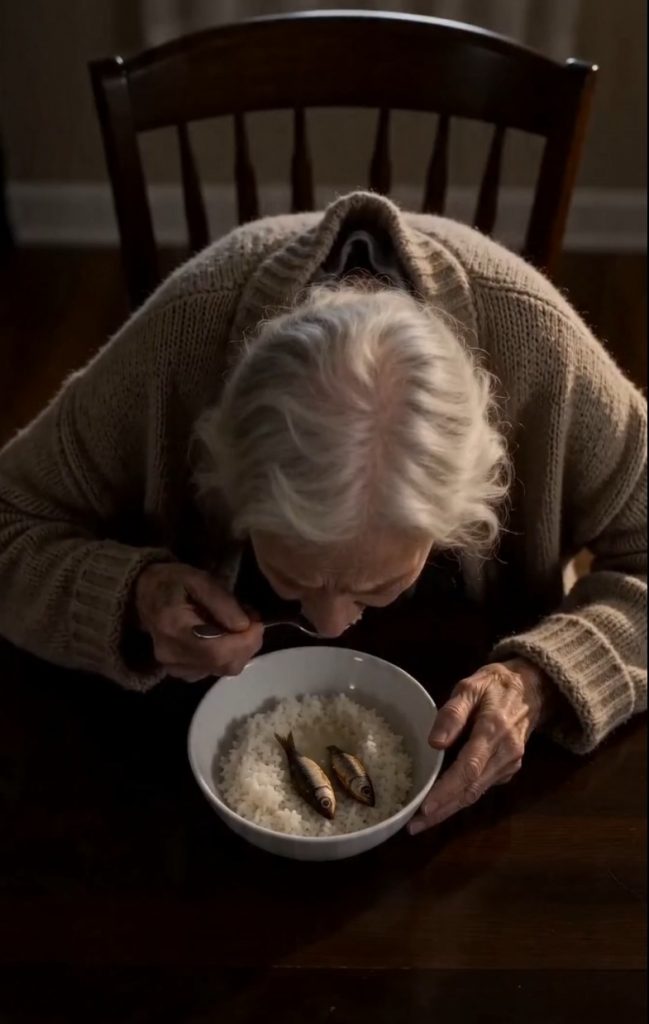
Ruth Mercer sat hunched at the dining table, her thin shoulders swallowed by an oversized tan cardigan. Her silver hair had been tied back carelessly, wisps falling around her pale face. Both hands trembled as she held a fork over a white ceramic bowl.
Plain rice.
Two tiny dried fish.
Nothing else.
Jonah stopped breathing.
This was the same woman who used to pack three lunches for him because she was afraid he might get hungry at school. The same woman who worked double shifts at a laundromat after his father died. The same woman who would go without dinner and lie, smiling, that she had already eaten.
Now she sat in her own home, bent over a bowl like a servant stealing scraps.
At the kitchen counter, Claire stood perfectly still.
His wife looked flawless.
Cream silk blouse. Charcoal pencil skirt. Dark hair cut in a sleek bob sharp enough to seem deliberate. She did not look surprised to see him.
She looked annoyed.
Jonah’s eyes moved from his mother’s bowl to Claire’s face.
“What is this?” he asked.
Ruth lifted her head slowly.
Her eyes widened when she saw him.
“Jonah,” she whispered, and the sound of his name in her mouth nearly broke him.
He took one step toward her.
Claire’s voice stopped him.
“She should be grateful I even fed her.”
The words landed in the room with a coldness that made the walls seem to pull back.
Jonah turned.
For a second, he did not look like a tired son coming home.
He looked like every year of sacrifice his mother had ever made had risen inside him at once.
The suitcase fell from his hand and hit the floor with a heavy thud.
Claire’s chin lifted.
“Don’t start,” she said.
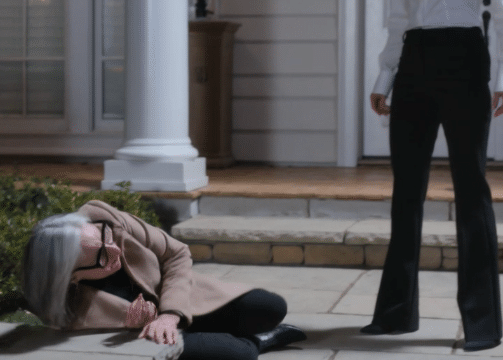
Jonah moved so fast the chair beside him scraped backward across the floor. Claire stepped away, startled for the first time, her heel catching against the edge of the rug. She stumbled, grabbed at the counter, and dropped hard to the floor.
But Jonah did not touch her.
He stood over her with his fist clenched at his side, shaking with the effort it took not to become the kind of man rage wanted him to be.
Then he turned away from Claire and knelt beside his mother.
Ruth’s bowl sat between them.
Two dried fish.
A few grains of rice stuck to the porcelain.
Jonah’s voice came out low.
“Mom,” he said, “how long?”
Ruth looked at Claire on the floor.
Fear crossed her face before grief did.
That was when Jonah understood.
This was not one bad night.
This was a system.
And his mother had been surviving it in silence.
Then Ruth lifted one trembling hand and pointed—not at Claire, not at the bowl, but at the white light switch beside the front door.
“There,” she whispered.
Jonah followed her gaze.
The switchplate sat slightly crooked against the wall.
Behind it, something pale was tucked into the gap.
Jonah stood, crossed the room, and pulled the plate loose.
A folded note fell into his hand.
The handwriting was weak.
But he knew every curve of it.
Claire is taking my money. She tells people I am confused. Jonah, if you come home, do not believe her.
Jonah looked back at his wife.
Claire had gone completely still.
And for the first time since he stepped into the apartment, she looked afraid.
Because the starving old woman at the table had left proof.
Act II
Jonah had not been home in eleven months.
That was the excuse Claire used later.
He was away too long. He did not understand how difficult Ruth had become. He had no idea what it meant to care for an elderly parent. He arrived in the middle of one bad moment and judged an entire marriage from a bowl of rice.
But the truth was uglier than distance.
Jonah had left because Claire convinced him leaving was the responsible thing to do.
A consulting contract in Seattle. Six figures. Housing covered. A chance to pay off medical debt, renovate the apartment, and hire Ruth a proper daytime caregiver.
“You’re doing this for her,” Claire had told him, resting her hand on his chest the night before his flight. “For us.”
Jonah believed her.
He wanted to.
His mother had recently fallen in the bathroom and fractured her hip. She recovered, but not fully. Her steps grew slower. Her back curved more sharply. Some days she forgot where she put things. Some days she asked the same question twice.
Claire began using the word decline.
Always gently at first.
“She’s declining, Jonah.”
“She had a confused spell today.”
“She accused me of moving her medicine, but I think she just forgot.”
Every call became another small warning. Ruth was tired. Ruth did not want video calls. Ruth had eaten already. Ruth was sleeping. Ruth was embarrassed by how she looked.
Jonah sent money.
More every month.
For groceries. For medication. For a caregiver named Maribel whom he had never spoken to directly because Claire said Maribel did not like being bothered while working.
He bought a better mattress for Ruth.
Claire said it arrived.
He paid for physical therapy.
Claire said Ruth refused to go.
He ordered meal deliveries.
Claire said Ruth complained they were too rich and wanted simple food.
For months, Jonah carried guilt like a stone in his chest. Every time his mother sounded faint on the phone, he blamed himself. Every time Claire sighed and said, “I’m trying my best,” he apologized.
Then a neighbor called him.
Mrs. Alvarez lived across the hall and had known Ruth for twenty years. She did not waste words.
“Your mother knocked on my door last night,” she said. “She asked if I had bread.”
Jonah sat down on the edge of his hotel bed.
“What?”
“She was shaking. She said Claire had locked the pantry because Ruth was ‘wasting food.’”
Jonah felt the world narrow.
“Why didn’t Mom tell me?”
Mrs. Alvarez was quiet for a moment.
“Because she is afraid you will think she is losing her mind.”
That night, Jonah booked the first flight home.
He did not tell Claire.
At the airport, he received a text from his wife.
Your mother had another episode. She’s becoming impossible.
Jonah stared at the message until the screen went dark.
Then he opened his suitcase.
Inside were clothes, old family papers he had collected during the trip, and a sealed envelope from a bank investigator who had called him two days earlier asking whether Ruth Mercer had truly authorized a transfer of seventy-eight thousand dollars.
The transfer had gone to a private account.
Claire’s private account.
Jonah had not wanted to believe it.
A man can suspect many things before he accepts that the person sleeping beside him has been harming the woman who raised him.
So he came home needing answers.
Instead, he found his mother eating rice and dried fish under the cold gaze of his wife.
And now he had a note hidden behind a light switch.
The note was only the beginning.
Act III
Claire stood slowly, smoothing her skirt as if dignity could still be arranged by hand.
“That note means nothing,” she said. “Your mother writes strange things all the time.”
Ruth flinched.
Jonah saw it.
That tiny movement said more than any confession could.
“Don’t talk about her like she isn’t here,” he said.
Claire let out a sharp laugh.
“She barely is here. Do you know what I’ve dealt with while you were away? The accusations? The wandering? The paranoia?”
Jonah looked at Ruth.
“Mom.”
Ruth’s eyes filled with tears.
“I don’t wander,” she said softly. “She took my key.”
Claire’s face hardened.
“For her safety.”
“She locked the fridge,” Ruth said.
“For her diet.”
“She told the pharmacist I was forgetting my pills.”
“You were.”
Ruth’s hands shook in her lap.
“She signed my name.”
The room changed.
Jonah turned back to Claire.
His voice dropped.
“What did you sign?”
Claire’s mouth opened, but no answer came.
Jonah walked to the suitcase on the floor and unbuckled it. The leather creaked as he lifted the lid. From inside, he removed the bank envelope, then a yellow folder, then a copy of his mother’s medical evaluation.
He placed each one on the dining table beside the bowl of rice.
The table suddenly looked like a courtroom.
“I spoke with Dr. Patel,” Jonah said. “Mom’s memory test from last month was normal for her age. No dementia diagnosis. No incompetency finding.”
Claire’s eyes flicked toward the door.
Jonah noticed.
“So why did you file for financial guardianship?”
Ruth gasped.
Claire’s face lost color.
“You had no right opening my mail.”
“It came to my office because you used my company address as a backup contact and forgot I still had access.”
Claire swallowed.
Jonah took another paper from the folder.
“You also forged my signature on the caregiver contract.”
Claire recovered enough to sneer.
“Oh, please. I managed the household while you played hero across the country.”
“There was no caregiver.”
The silence after that was terrible.
Ruth looked down.
Jonah saw shame cross his mother’s face, and it nearly undid him.
“She told me Maribel came every day,” he said.
Ruth shook her head.
“No one came.”
Jonah closed his eyes for one second.
He saw every invoice. Every payment. Every message from Claire saying the caregiver was expensive but worth it.
Then he opened his eyes again.
“Where did the money go?”
Claire said nothing.
Ruth reached into the pocket of her cardigan with slow, trembling fingers. She pulled out a small key tied to a faded blue ribbon.
“I kept this,” she said.
Claire’s expression shifted from fear to panic.
Jonah took the key.
“What is it?”
Ruth nodded toward the kitchen.
“The bottom drawer. Under the towels.”
Claire moved first.
Jonah stepped between her and the drawer.
“Sit down,” he said.
There was something in his voice that made her obey.
He opened the drawer, lifted the folded dish towels, and found a small metal cash box. The key fit.
Inside were receipts, pharmacy slips, photocopied checks, and three photographs.
The first showed the refrigerator padlocked with a bicycle chain.
The second showed Ruth’s medication bottles emptied into the trash.
The third showed Claire at an expensive restaurant downtown, smiling over champagne, wearing the pearl earrings Jonah had bought for his mother years ago.
On the back of the last photo, Ruth had written one sentence.
She said no one would believe me.
Jonah stared at the words.
Then he looked at Claire.
The elegant woman in the silk blouse was gone.
What remained was someone cornered by the truth she had mistaken for weakness.
“Why?” Jonah asked.
Claire’s lips trembled, not from guilt, but anger.
“Because I was tired of living like a nurse in a museum,” she snapped. “Because everything was about Ruth. Ruth’s medicine. Ruth’s comfort. Ruth’s memories. Ruth’s precious apartment.”
Jonah went still.
Claire realized too late what she had said.
Ruth’s apartment.
Not theirs.
Ruth had owned the apartment outright since Jonah was a teenager. His father had left it to her, along with a small life insurance policy she never spent because she said a home should always be kept safe for family.
Jonah looked down at the guardianship papers.
Then the missing money.
Then the forged signatures.
“You weren’t trying to care for her,” he said.
Claire did not answer.
“You were trying to take the apartment.”
And Ruth, who had been silent for most of her suffering, finally whispered the truth.
“She said once the papers were approved, she would send me somewhere you’d never visit.”
Act IV
Jonah called the police from the kitchen table.
Claire tried to laugh when he dialed.
Then she tried to cry.
Then she tried to take his phone.
Milo, the neighbor’s old terrier, began barking across the hall when voices rose, and within minutes Mrs. Alvarez was at the open doorway in her robe, holding her own phone like a weapon.
“I recorded what I heard,” she said.
Claire stared at her.
“You nosy old woman.”
Mrs. Alvarez did not blink.
“I was nosy enough to feed Ruth when you would not.”
Ruth began to cry then, quietly, with one hand over her mouth. Not loud enough to demand attention. Just enough to reveal how long she had been holding herself together.
Jonah knelt beside her.
“I’m sorry,” he said.
Ruth shook her head.
“No, baby.”
“I should have come sooner.”
“You came now.”
That was when Claire made her last mistake.
She stood from the chair and pointed at Ruth.
“She planned this. She hates me. She’s been trying to turn you against me for years.”
Jonah rose slowly.
“My mother asked a neighbor for bread.”
“She was being dramatic.”
“You locked up food.”
“She overate.”
“She weighs ninety-six pounds.”
Claire’s mouth closed.
The number landed hard.
Because Jonah had read it in Dr. Patel’s report.
Because the truth was no longer emotional.
It was documented.
When the officers arrived, Claire became calm in the way people become calm when they think charm is still a currency. She said there had been a misunderstanding. She said Ruth was confused. She said Jonah was exhausted from travel and overreacting.
Then Ruth spoke.
Not loudly.
Not perfectly.
But clearly.
“She told me I was lucky,” Ruth said, looking at the officers. “She said old women disappear into homes every day, and sons get busy.”
One officer’s expression changed.
Claire saw it and snapped, “She’s lying.”
Mrs. Alvarez lifted her phone.
“I have videos of Ruth knocking on my door for food. Three times. I also have the messages Claire sent me telling me not to answer.”
Jonah turned.
“You never told me.”
Mrs. Alvarez’s eyes softened.
“I tried. Claire blocked my number on your mother’s phone. I didn’t have yours until Ruth remembered where you kept an old business card.”
The apartment seemed to tilt under the weight of every small cruelty.
The locked fridge.
The hidden phone.
The forged papers.
The meals reduced to scraps while Claire bought silk blouses and restaurant dinners with stolen money.
One officer asked Claire to step into the hallway.
She refused.
Then he asked again, differently.
This time, she went.
But before she crossed the threshold, she turned to Jonah.
“You’re throwing away your marriage over a senile old woman?”
Jonah looked at his mother.
Ruth sat at the table with her hands folded, small and frail and more dignified than anyone in the room.
“No,” he said. “I’m ending it because I finally came home.”
Claire had no answer for that.
The officers escorted her out.
Not dramatically.
Not with the grand collapse she deserved.
Just down the hallway, past Mrs. Alvarez, past the neighbors peering through cracked doors, past the life she had built out of lies and locked cabinets.
When the door closed behind her, the apartment felt different.
Still dim.
Still bruised by what had happened inside it.
But the fear had gone out of the air.
Jonah walked to the kitchen, opened every cabinet, and began taking food down from the shelves.
Soup.
Tea.
Crackers.
A jar of peaches Ruth loved.
Then he found a locked plastic bin in the pantry.
Inside were groceries he had paid for.
Protein shakes. Vitamins. Soft bread. Good coffee. Imported biscuits Ruth used to hide from him as a joke when he was a boy.
Jonah stood there holding the bin, unable to speak.
Ruth looked at it and gave him a tired, embarrassed smile.
“I thought about breaking it,” she said. “But I couldn’t find the hammer.”
Jonah laughed once.
It came out broken.
Then he cried.
Act V
The case did not end that night.
Cruelty inside a home rarely fits neatly into one report.
There were bank records to subpoena, forged documents to examine, doctors to interview, and signatures to compare. There were explanations from Claire’s attorney and statements from neighbors who admitted they had heard things but never wanted to interfere.
Claire pleaded innocence until the bank footage surfaced.
Then the notary confessed.
Then investigators found the private storage unit Claire had rented under her maiden name, filled with Ruth’s jewelry, old photographs, family silver, and boxes of documents she had removed from the apartment.
Among them was Jonah’s father’s watch.
Ruth had thought she lost it.
Claire had planned to sell it.
That was the thing Jonah could never forgive.
Not because of the money.
Because Ruth had searched for that watch for weeks, apologizing to a dead husband every night for misplacing the last thing he wore before the hospital took him.
Claire had watched her suffer and said nothing.
The divorce was quiet.
Jonah did not want spectacle. He wanted distance. He wanted his mother safe. He wanted every stolen dollar accounted for and every forged document burned out of their lives with legal fire.
Claire lost the apartment claim before it ever reached a courtroom.
The guardianship petition was dismissed.
The money was partially recovered.
The rest became a debt attached to Claire’s name like a shadow.
Ruth did not celebrate.
She spent the first weeks after Claire’s arrest sleeping in short stretches, waking whenever a cabinet closed too loudly. She hid bread in napkins. She asked Jonah twice before taking anything from the fridge.
Each time, Jonah answered the same way.
“Mom, this is your home.”
Little by little, the apartment changed.
The silk curtains Claire had chosen came down. Ruth picked yellow ones instead, soft cotton that let morning light spill into the kitchen. The dining table was moved closer to the window. The padlock was thrown away.
Jonah replaced the crooked light switch but kept the note.
He framed it, not to preserve the pain, but to honor the courage it took to write it.
Some truths do not arrive with shouting.
Some are folded small and hidden behind a wall, waiting for someone to come home and care enough to look.
One month later, Jonah cooked dinner.
Badly.
He burned the chicken, oversalted the potatoes, and forgot the rolls in the oven until smoke curled under the cabinet. Ruth sat at the table laughing so hard she had to wipe her eyes.
“You were better at cereal,” she said.
“I was eight.”
“And yet somehow more qualified.”
Jonah smiled.
It hurt less than it used to.
Mrs. Alvarez came over with soup, pretending she had made too much. The three of them ate together at the dark wood table that no longer looked like a place of punishment.
Halfway through the meal, Ruth reached for Jonah’s hand.
“I don’t want you to remember me like that,” she said.
He knew what she meant.
The bowl.
The dried fish.
The hunched shoulders.
The note hidden behind the switch.
Jonah squeezed her hand gently.
“I remember everything,” he said. “But that’s not all I remember.”
Her eyes softened.
He looked around the apartment.
“I remember you carrying me up three flights of stairs when I had a fever. I remember you working nights and still making pancakes in the morning. I remember you teaching me that anger is easy, but protecting someone is harder.”
Ruth’s lip trembled.
“I was scared,” she whispered.
“I know.”
“I thought you wouldn’t believe me.”
Jonah lowered his head.
“That’s the part I’ll spend the rest of my life making right.”
Outside, evening settled over the city. Warm light filled the apartment, touching the table, the chairs, the open pantry, the suitcase now resting by the wall.
Jonah had not unpacked it fully.
Part of him had arrived that day ready to leave again if the truth became too complicated.
Now he knew better.
The suitcase would go into the closet.
The door would stay open.
And Ruth Mercer would never again have to be grateful for scraps in a home that belonged to her.
Later, when Jonah washed the dishes, Ruth stood beside him drying them with careful hands. She was still frail. Still bent by age and pain. But she was no longer shrinking.
The apartment was quiet again.
This time, the silence was gentle.
Not the silence of fear.
The silence of a home finally safe enough to rest.