Act I
The wineglass hit the ground before anyone understood what was happening.
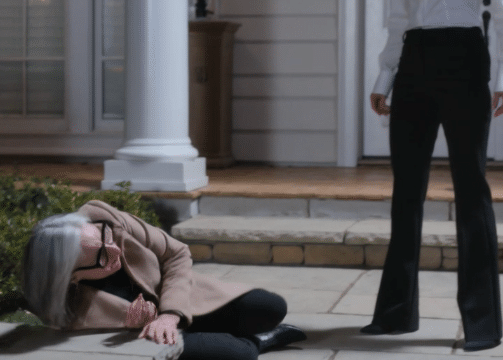
It shattered beneath the string lights, red wine splashing across the grass like a stain no one would ever fully remove. Conversation died at once. Forks paused above white linen tables. A violinist near the edge of the trees lowered her bow without realizing it.
Vivian Ashford stood in the center of her own gala, trembling with rage in a silver gown that caught every warm bulb overhead.
“How dare you show your face here!” she shouted.
Then she slapped the young soldier across the face.
The sound cracked through the wooded estate like a snapped branch.
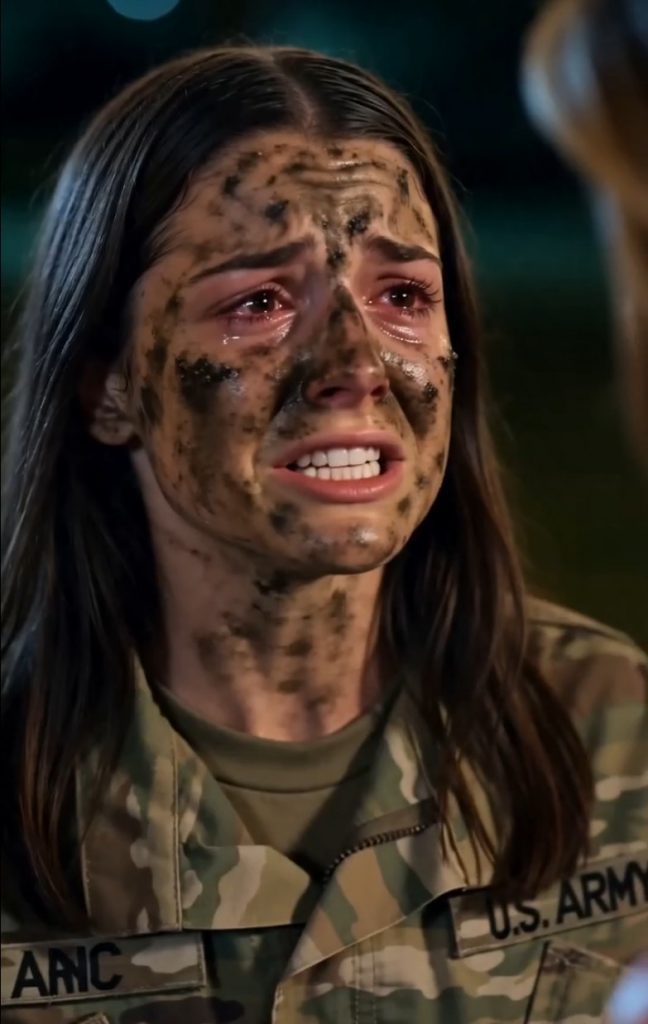
The soldier’s head turned with the impact. She did not lift a hand to defend herself. She simply stood there in her mud-streaked Army uniform, boots sunk slightly into the damp grass, long dark hair clinging to her face.
Her eyes were red and swollen.
Not from the slap.
From something older than the slap. Something that had followed her home.
Around them, the Ashford Courage Gala froze in place. Guests in tuxedos and evening gowns stared beneath the hanging Edison bulbs, suddenly unsure whether to look away or lean closer.
Vivian Ashford did not lower her hand.
To her, the girl in the dirty camouflage uniform was not a soldier. She was an embarrassment. A stain on a perfect evening. A reminder of a story Vivian had spent months polishing until it sparkled.
The soldier swallowed hard.
“I…” Her voice broke. “I just got back from deployment.”
Vivian stepped closer, her diamond earrings flashing as her face twisted.
“You should have learned some dignity.”
She grabbed the front of the soldier’s uniform with both hands and yanked her forward.
Several guests gasped.
Still, no one moved.
Vivian’s estate was the kind of place where people waited to see what power wanted before deciding what was right. She was a donor, a board member, a widow of old money, and the mother of Captain Julian Ashford, the man the night was supposedly honoring.
His portrait stood beneath the trees near the auction table.
Smiling. Clean. Heroic.
A bronze plaque beneath it read: For courage, sacrifice, and honor.
The soldier looked at the portrait once.
Fresh tears cut pale lines through the mud on her cheeks.
Vivian saw the glance and tightened her grip.
“You don’t get to look at him,” she hissed. “Not after what you did.”
That was when a man in a dark blue Army dress uniform stepped out from the crowd.
His medals caught the light before his face did.
The guests parted instinctively.
Brigadier General Nathan Cole walked toward the two women with a calm so heavy it felt like a command. His jaw was set, his eyes fixed on Vivian’s hands gripping the soldier’s collar.
“Let her go,” he said.
Vivian released the soldier as if burned.
The General stopped between them.
He looked at Vivian Ashford for one long second, then asked in a voice that seemed to drop the temperature of the entire gala.
“Do you have any idea who this soldier is?”
Vivian tried to recover her dignity.
“She is the reason my son’s name was dragged through military gossip,” she snapped. “She is the reason people whispered.”
The General’s expression did not change.
“This soldier saved twelve of my men,” he said, “the night your son ran away.”
The words landed harder than the slap.
Vivian recoiled.
Her mouth opened, but no sound came out at first.
Then she whispered, terrified and confused, “Who is she?”
The soldier lowered her eyes.
And the General gave the answer that turned the gala into a courtroom.
Act II
Her name was Sergeant Elena Reyes.
Most people called her Lena.
Three months earlier, Vivian Ashford had known that name only as a problem to be managed.
It appeared in emails from military contacts. It appeared in a redacted report she was not supposed to see. It appeared once in a handwritten note from her son, mailed from overseas and never mentioned again.
Mom,
If anything happens, don’t blame Reyes.
Vivian had hated the name from the moment she read it.
Julian Ashford was not supposed to need defending from a girl like Elena Reyes.
Julian had been raised beneath chandeliers and oak portraits. He had attended private schools with Latin mottos, worn tailored uniforms, and grown up hearing that Ashford men did not bend. When he enlisted, Vivian turned it into a family legend.
Her son, the patriot.
Her son, the officer.
Her son, the proof that privilege could still produce courage.
She hosted fundraisers, posed beside flags, donated to veterans’ clinics, and spoke beautifully about sacrifice. She learned just enough military language to sound sincere in front of cameras.
But Julian had not been built from speeches.
He had been softer than Vivian allowed him to be. He hated shouting. He hated the family legacy that treated fear like a moral failure. As a boy, he used to hide in the greenhouse when his mother’s dinner parties became too loud.
Lena Reyes had learned fear differently.
She was the daughter of a mechanic from San Antonio and a nurse who worked nights. She joined the Army because college was expensive, because her younger brothers needed space to grow, and because she believed service could turn a hard life into something useful.
She met Julian during training.
At first, she thought he was arrogant.
He thought she was impossible.
She corrected him in front of others. He quoted rules when common sense would do. She moved fast. He overthought. She hated how polished he sounded. He hated how easily she saw through him.
Then, somewhere between field exercises and bad coffee, they became friends.
Then more than friends.
Julian never told Vivian.
Not because he was ashamed of Lena.
Because he was afraid of what his mother would do with someone who could not be controlled.
During deployment, Lena saw the truth behind Julian’s perfect posture. He tried. He really did. But fear followed him everywhere, and the harder he pretended it did not exist, the more it owned him.
Lena did not mock him for it.
She covered for him when she could. She pushed him when she had to. She told him courage was not the absence of fear, no matter what his mother put in speeches.
Courage was doing the next right thing while fear was still in the room.
Julian wanted to believe her.
But wanting is not the same as becoming.
The night everything changed, their unit was stationed near a remote supply route when communications failed during a sudden coordinated attack. The situation became chaotic within minutes. Men were separated. Vehicles were disabled. Orders came in broken fragments.
Julian was supposed to hold a position long enough for the others to regroup.
Instead, he ran.
Not far.
Not forever.
But far enough.
Far enough that twelve soldiers were left exposed.
Far enough that Lena Reyes had to make a choice no one her age should have had to make.
She took command of the moment because no one else could. She moved men into cover. She carried the radio through the confusion. She guided the wounded toward extraction. She kept calling names until voices answered back.
By dawn, twelve men were alive who should not have been.
Julian Ashford was found hours later, shaking, ashamed, and unable to explain himself.
The official report did not call him a monster.
War had already done enough damage without turning fear into theater.
But it did tell the truth.
And truth, in Vivian Ashford’s world, was dangerous when it touched the family name.
So Vivian did what she had always done.
She tried to buy silence.
And when silence failed, she built a gala bright enough to blind everyone.
But Lena had not come to ruin the Ashford name.
She had come because Julian had sent for her.
And no one at the gala knew he was still alive.
Act III
The first guest to speak was a senator’s wife.
“That can’t be right,” she whispered, though no one had asked her.
Vivian heard it and seized the moment.
“No,” she said, straightening her shoulders. “It isn’t right. My son is not here to defend himself. And this girl appears filthy, hysterical, and late to an event honoring him.”
Lena flinched at the word honoring.
The General noticed.
So did several soldiers standing near the back of the crowd, men Vivian had invited because uniforms looked good beside donation tables. They had been quiet until now, but their faces had hardened.
General Cole turned toward the portrait of Julian.
“Mrs. Ashford,” he said, “this event is not honoring your son’s service. It is hiding his confession.”
A murmur moved through the trees.
Vivian’s face changed.
Only for a second.
But it was enough.
The General reached into the inner pocket of his dress jacket and removed a folded envelope. It was worn at the edges, as if it had traveled farther than paper should.
“Julian asked me to deliver this if you attempted to blame Sergeant Reyes again.”
Vivian stared at the envelope.
“That is private.”
“No,” the General said. “What you did to her was public.”
Lena looked up then, her muddy face lit by the warm string lights. She seemed younger than she had a moment before. Not weak. Just exhausted from carrying too much without permission to set it down.
The General unfolded the letter.
He did not read all of it.
Only the part that mattered.
My mother will try to protect me by destroying whoever tells the truth. She will call it loyalty. It is not. I left my post. Reyes stayed. Men lived because she stayed. If my name is ever used to take honor from her, then my name deserves to fall.
Vivian shook her head slowly.
“No. He would never write that.”
“He did,” Lena whispered.
Vivian turned on her.
“You don’t speak for my son.”
Lena’s voice trembled, but she did not look away.
“I was with him when he wrote it.”
The gala went silent again, but this time the silence belonged to Lena.
Vivian’s hands curled at her sides.
“You were with him where?”
Lena looked toward the portrait.
“At the hospital.”
Several people gasped.
Vivian’s face drained of color.
The official public story had been simple. Julian Ashford had come home quietly for medical recovery after classified injuries, then entered private care. Vivian told donors he was too fragile for public appearances. She implied sacrifice without explaining anything.
That implication had raised millions.
But Julian was not hidden because of wounds people could photograph.
He was hidden because he had told the truth.
He had refused to let his mother turn him into a symbol.
So Vivian had taken his phone, controlled his visitors, and told the world he needed silence.
Only one person had been allowed to see him before Vivian closed the doors completely.
Lena.
Because Julian had begged for her.
Lena reached into the pocket of her uniform and pulled out a small object wrapped in cloth.
Not a medal.
Not a weapon.
A silver tie clip shaped like an oak leaf.
Vivian recognized it instantly.
Julian had worn it at his college graduation. His father had worn it before him. It was an Ashford family piece, passed down like proof of belonging.
“He gave this to me,” Lena said. “He told me to bring it tonight.”
Vivian stared at the tie clip as if it were impossible.
Lena unfolded the cloth.
Inside was also a plain gold ring.
The guests leaned closer.
Vivian took one step back.
Lena’s voice broke.
“He asked me to tell you he was sorry he couldn’t become the son you kept announcing to rooms like this.”
Vivian’s lips parted.
Then Lena said the words Vivian had feared without knowing it.
“And he asked me to stop you from selling his shame as courage.”
Act IV
Grant Ashford had been dead for six years, but his portrait still hung in the estate’s west hall.
Vivian had spent those six years turning grief into architecture. Every party, every gala, every foundation dinner was another wall around the truth that her family was not noble because it was rich.
It was only rich.
And wealth, without mercy, could make even cowardice look like marble.
General Cole signaled to one of his aides near the projection screen. The aide hesitated, then connected a tablet to the outdoor display prepared for Vivian’s charity presentation.
The screen lit up.
At first, everyone expected battlefield footage.
Instead, a video appeared of Julian Ashford sitting in a plain hospital room, thinner than the portrait behind him, his hair cut short, his eyes clear but tired.
Vivian covered her mouth.
“Turn it off,” she said.
The General did not move.
On the screen, Julian looked directly into the camera.
“My name is Captain Julian Ashford. I am recording this voluntarily.”
His voice shook, but he kept going.
“I failed my unit. I have given my full statement to command. I accept the consequences of that failure. But I will not allow my mother or anyone connected to my family to blame Sergeant Elena Reyes.”
Lena lowered her head.
The soldiers near the back stood straighter.
Julian continued.
“She saved lives after I abandoned my responsibility. She found me afterward. She did not expose me when she could have. She told me that the truth would hurt less than living inside a lie.”
Vivian began crying, but it was not yet remorse. It was panic. It was the sound of control leaving her body.
On the screen, Julian swallowed hard.
“Mom, if you are watching this, it means you didn’t listen. Please stop. Don’t make my worst moment into someone else’s punishment.”
The video ended.
No one clapped.
No one spoke.
The entire gala had become something far heavier than entertainment. The guests were no longer witnesses to a scandal. They were participants in a lie they had funded with checks and applause.
Vivian turned slowly toward Lena.
“You knew,” she whispered. “You knew he was going to do this to me.”
Lena looked stunned.
“To you?”
The words seemed to pull something from her that the slap had not.
“I flew home in the same uniform I wore when we landed because he called me from the hospital and said you were announcing the foundation grant tonight. He said you were naming it after the night he ran.”
Her voice cracked, but she did not stop.
“I came because he was afraid. Not for himself. For every soldier who would have to stand under that banner and pretend.”
Vivian’s expression hardened one last time.
“My son was sick. He didn’t know what he was saying.”
General Cole stepped closer.
“Your son knew exactly what he was saying. And he signed authorization for the investigative findings to be released to the foundation board if you continued.”
A board member near the front lowered his champagne glass.
“Released to us?”
The General turned.
“Yes. Along with financial records showing that donations earmarked for veteran recovery programs were redirected into image consulting, private security, and reputation management tied to the Ashford family.”
The senator’s wife stepped back as if the grass had opened beneath her.
A man from the foundation board whispered, “Vivian.”
But Vivian was no longer looking at him.
She was staring at Lena.
The girl she had slapped.
The girl she had called a disgrace.
The girl wearing mud like proof that she had come straight from service, not from a salon, not from a hotel suite, not from a life where pain waited politely until after dinner.
Lena held out the oak-leaf tie clip.
“He wanted you to have this back when you were ready to love him without needing him to be perfect.”
Vivian looked at the tie clip.
For the first time all evening, she did not reach for what belonged to her.
Because maybe, somewhere beneath the diamonds and the silver gown and the years of performance, she understood that it did not belong to her anymore.
Then a quiet voice came from the edge of the crowd.
“Lena?”
Everyone turned.
A young man stood beneath the trees, leaning slightly on a cane, pale but upright.
Julian Ashford had come home.
And this time, his mother could not write the story for him.
Act V
Vivian made a sound that was almost his name.
Julian stood at the edge of the lights in a dark suit that hung loosely from his shoulders. He looked nothing like the portrait behind him. No polished smile. No heroic pose. No carefully edited version of a son built for public admiration.
He looked real.
That was what broke her.
“Julian,” she whispered.
She started toward him, but he raised one hand.
Not cruelly.
Enough to stop her.
The entire gala watched a mother realize that access to her child was no longer something money could guarantee.
Julian’s eyes moved past her first.
To Lena.
She stood frozen in the grass, still muddy, still shaking, still holding the ring and tie clip like pieces of a life no one had allowed to exist in public.
Julian crossed the distance slowly.
When he reached her, he did not embrace her for the crowd. He did not turn the moment into a performance. He simply touched her hand, as if making sure she was truly there.
“I told you not to come alone,” he said softly.
A broken laugh escaped her.
“You also told me your mother might behave like a decent person.”
Julian looked toward Vivian.
“So did I.”
Vivian’s face crumpled.
“I was protecting you.”
Julian shook his head.
“No. You were protecting the version of me you could survive loving.”
The words seemed to age her.
He turned to the guests then, and the old Ashford instinct flickered for a moment in his posture. But this time, he did not stand like a man trained to impress them.
He stood like a man finished begging for permission to be human.
“My mother’s foundation will no longer carry my name,” he said. “Not until every dollar is audited and redirected to the recovery programs it promised to support.”
A foundation board member nodded quickly.
Julian continued, “And Sergeant Reyes will receive a formal public apology tonight. From my family. From this board. From anyone who repeated a lie because the truth was inconvenient.”
Vivian stared at the grass.
All her life, she had known how to speak in rooms full of powerful people. She knew how to charm donors, wound rivals, and turn grief into currency.
But apology required a language she had never practiced.
She looked at Lena.
The young soldier’s cheek was still marked from the slap.
Vivian saw it now.
Not as a challenge.
As evidence.
“I was wrong,” Vivian said.
Her voice was thin.
The crowd waited.
Vivian forced herself to continue.
“I humiliated you because I was afraid of what you represented. You told the truth about my son when I wanted a statue. You brought him back to me as he was, and I punished you for not bringing me the myth.”
Lena’s eyes filled again.
Vivian swallowed.
“I am sorry, Sergeant Reyes.”
It did not fix everything.
No one pretended it did.
An apology cannot unstrike a face. It cannot erase months of lies, or years of raising a child to believe fear was shameful. It cannot make stolen donations clean.
But it can be the first honest thing in a room built on falsehood.
General Cole stepped forward.
“Sergeant Reyes,” he said, his voice formal now, “on behalf of the men you brought home, and on behalf of those who failed to speak soon enough, thank you.”
One by one, the soldiers at the back of the gala stood at attention.
Not for Vivian.
Not for Julian.
For Lena.
She tried to hold herself together, but her shoulders shook.
Julian held her hand tighter.
A photographer lifted a camera, then slowly lowered it. Some moments did not belong to society pages.
By morning, the Ashford Courage Gala was no longer a celebration. It was an investigation. The foundation board suspended Vivian’s authority. Donors demanded records. The portrait of Julian was removed from the lawn before sunrise.
But something else happened too.
The twelve soldiers Lena had saved sent statements.
Not polished ones.
Not dramatic ones.
Simple words. Human words.
She came back for us.
She kept calling.
She did not leave.
Those statements spread farther than Vivian’s gala ever could.
Weeks later, at a smaller ceremony inside a military hall with no chandeliers and no champagne towers, Lena Reyes received the recognition her actions had earned. She stood in a clean uniform this time, her hair pulled back, her face bare of mud but not of memory.
Julian sat in the front row.
Vivian sat two seats away from him, not beside him. Not yet.
When Lena’s name was called, the room rose.
She did not look like a symbol.
She looked like a young woman who had seen too much and still chosen to carry others through it.
After the ceremony, Vivian approached her in the hallway.
No diamonds. No silver gown. No audience worth impressing.
Only a mother who had mistaken pride for love and a soldier who had paid for that mistake.
Vivian held out the oak-leaf tie clip.
“Julian said you should keep it,” she said.
Lena looked at it for a long moment.
Then she shook her head.
“No,” she said quietly. “Give it to him when you’re ready to know him.”
Vivian closed her fingers around it.
Lena turned to leave, but Vivian spoke again.
“Sergeant Reyes.”
Lena paused.
Vivian’s voice broke.
“Thank you for bringing my son home.”
Lena looked back.
This time, there was no anger in her face.
Only exhaustion. And something close to mercy.
“He brought himself home,” she said. “He just finally stopped running.”
Outside, the evening air was cool and clear.
There were no string lights. No marble tables. No wealthy guests waiting to decide whose pain mattered.
Just a quiet sidewalk, a line of trees, and a soldier walking forward with steady steps.
The world had first seen her that night covered in mud, slapped beneath golden lights, and called a disgrace by a woman who thought dignity was something you wore.
But dignity had never been in Vivian Ashford’s diamonds.
It had been in the soldier who stood there shaking and did not lie.
It had been in the General who refused to let power rewrite courage.
And it had been in the son who finally told the truth, even when the truth left his portrait in pieces.
That night, the gala ended in scandal.
But for Lena Reyes, it ended with something stronger than applause.
It ended with her name restored.