Act I
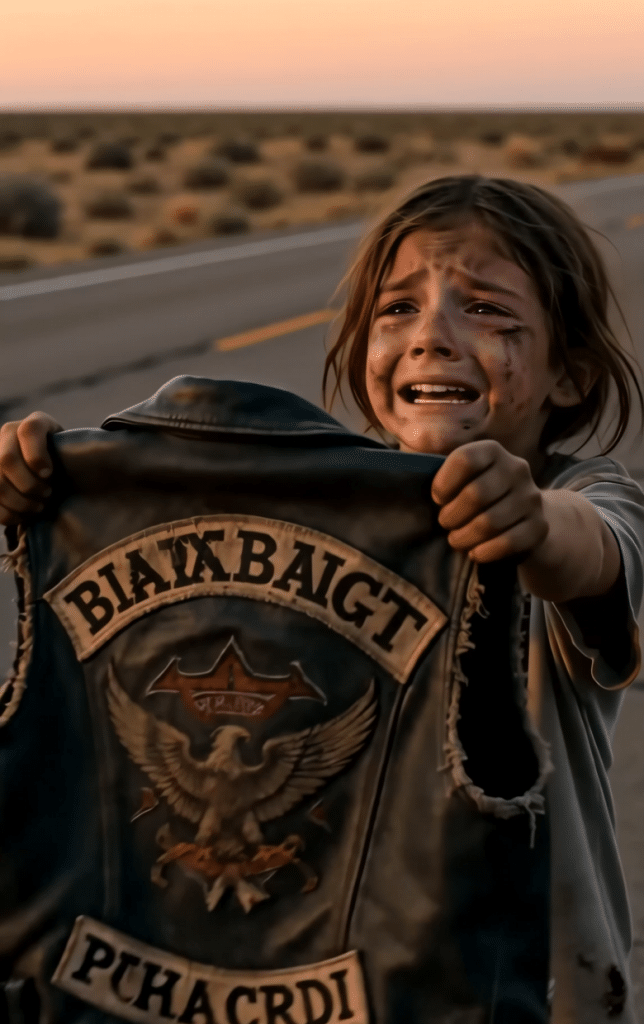
The little girl came running out of the sunset like she had been chased by the end of the world.
Her bare knees were dusty. Her long brown hair whipped across her face in tangled strands. Tear tracks cut through the dirt on her cheeks, and both of her hands shook around the old leather vest she carried against her chest.
Behind her, the desert sky burned red and orange.
Ahead of her, a row of motorcycles stood along the cracked highway like black iron animals cooling in the dusk.
The men beside them stopped talking.
A few turned slowly.
They were large men in leather cuts and denim, with beards, tattoos, and the kind of faces that made strangers cross streets. One flicked ash from a cigarette. Another looked the girl up and down and laughed before she even reached them.
“Please!” she cried. “I need money!”
The laughter grew.
One biker leaned against his handlebars and clapped sarcastically. Another pointed at the filthy gray shirt hanging from her shoulders.
“Wrong lemonade stand, kid.”
The girl flinched, but she did not run.
She hugged the leather vest tighter.
“My daddy wore this,” she said, her voice breaking.
That made them laugh harder.
Only one man did not.
He stood near the center of the group, tall and rigid in a black leather jacket over a white shirt. A tribal tattoo curled along the right side of his neck. On his jacket, silver-bordered patches caught the dying light.
BIG BROTHER.
M.C. NORDI.
His name was Kane Mercer, though most men on that road called him Bishop.
He looked down at the child with cold eyes.
“Then earn it,” he said.
The girl stared up at him.
For a second, the desert seemed to go quiet.
Even the wind stopped dragging dust across the asphalt.
“My daddy…” Her voice shrank into something hollow. “He won’t wake up.”
That sentence should have changed the men.
It did not.
Not at first.
One of them muttered something under his breath. Another looked away, uncomfortable but unwilling to be the first to show it. Kane’s jaw hardened as if pity were a weakness he had trained himself not to feel.
Then he reached down and pulled the vest from the girl’s hands.
She gasped and tried to hold on.
“No! Please!”
But Kane already had it.
He turned the leather over, rough and impatient, ready to dismiss it as stolen trash.
Then he saw the inside lining.
His fingers froze.
The sunset caught the old patch sewn near the heart: a faded eagle, wings spread wide, and one word beneath it in bold cracked letters.
PURGE.
Kane’s breath left him.
The men stopped laughing.
The girl stood in front of him, trembling, her hands empty now.
Kane stared at the patch as if someone had opened a grave in his palms.
“Where did you get this?” he whispered.
The girl’s face tightened with fresh tears.
He looked back at her, suddenly pale beneath the dust and road-worn tan.
“What’s his name?”
The girl did not answer right away.
She only stared at the patch. Then at the man wearing BIG BROTHER on his chest.
When she spoke, her voice was quiet enough to chill the desert air.
“You would know.”
And just like that, the most feared man on that highway looked terrified.
Act II
Twenty years earlier, Kane Mercer had not been called Bishop.
He had been called Kane because his mother said he already had enough anger in him without needing a road name to make it worse.
Back then, he had a brother.
Not by blood.
By choice.
Elias Reed.
Elias was older by three years, louder by ten, and reckless in the way young men become when life has given them more bruises than guidance. He laughed too hard, fought too fast, and rode like the road owed him mercy.
Kane worshipped him.
They grew up in the same dying desert town where jobs came and went with construction contracts, and boys learned engines before algebra. Elias’s father drank. Kane’s father disappeared. Their mothers worked in the same diner until the diner closed and became a boarded-up box on Main Street.
The boys raised each other from there.
When Kane got jumped behind the gas station at thirteen, Elias found the boys responsible and made sure they apologized.
When Elias slept in his truck after his father threw him out, Kane stole blankets from his own house and slept beside him so he would not be alone.
When they were sixteen and nineteen, they found an old motorcycle frame behind a salvage yard and spent an entire summer rebuilding it from parts no one else wanted.
Elias painted an eagle on the tank.
“Why an eagle?” Kane asked.
“Because vultures wait for dead things,” Elias said. “Eagles go hunting.”
By twenty-five, Elias had become a legend among men who lived by engines and loyalty.
His road name was Purge.
Not because he was cruel.
Because he had a way of clearing poison from a room. Liars, thieves, predators, men who wore brotherhood like a costume—Elias saw through them all. He could laugh with a stranger at sundown and know by midnight whether that man would sell his own family for a full tank and a little power.
Kane joined M.C. Nordi because Elias asked him to.
“You got too much fire,” Elias told him. “Ride with us. Let it become something useful.”
For a while, it did.
The club was rough, but it had rules. No hurting children. No stealing from families. No running protection scams on people already struggling to survive. Elias enforced those rules with the kind of calm that made even violent men step back.
Then money entered.
Real money.
A man named Travis Holt began pushing the club toward darker business. Kane, still young and eager to prove himself, believed the lies at first. Holt promised expansion, respect, influence. He said Elias was old-fashioned. Soft. Afraid of success.
Elias saw the trap.
He warned Kane.
Kane did not listen.
The fight happened outside an abandoned freight depot during a storm. Elias accused Holt of betraying the club and using their name to threaten local families. Holt accused Elias of betrayal first.
And Kane, foolish with pride, stood in the wrong circle.
He did not strike Elias.
That was the excuse he used for years.
But he did not stand beside him either.
By dawn, Elias was gone.
His vest was found near a dry riverbed, torn and stained with mud. No body. No goodbye. No explanation.
Holt told everyone Elias had run.
Kane believed him because the alternative was too unbearable.
Weeks later, Kane challenged Holt, not because he had learned the truth, but because guilt had turned him mean. He won control of M.C. Nordi and took the patch BIG BROTHER as penance, though he never told anyone why.
He spent two decades becoming harder.
Men feared him.
Towns recognized his bike.
Younger riders followed him without question.
But every year on the anniversary of Elias’s disappearance, Kane rode alone to the dry riverbed and left a bottle of water beside the rocks.
Not flowers.
Elias would have hated flowers.
Kane told himself his brother was dead.
Then a child walked out of the desert holding Purge’s vest.
Act III
Her name was Ruby.
She told them that after Kane crouched in front of her and forced his voice to become something gentler than command.
Ruby Reed.
Eight years old.
Daughter of Elias Reed.
At the sound of the name, one of the older bikers crossed himself. Another swore softly and stepped away from the row of motorcycles as if the past itself had joined them on the shoulder.
Kane could barely breathe.
“Where is he?” he asked.
Ruby pointed down the highway.
“By the motel.”
“There’s no motel out there.”
“There is,” she said. “It’s broken.”
Kane knew the place then.
The Sunspoke Motor Lodge.
Closed fifteen years. Half-collapsed sign. Empty pool full of sand. The kind of place people used to hide when they did not want to be found.
He stood so fast Ruby stepped backward.
“Bikes up,” he barked.
No one laughed now.
The same men who had mocked the girl scrambled into motion, engines roaring awake one by one. Kane wrapped the old vest around Ruby’s shoulders and lifted her onto the back of his bike with a care that startled even him.
She gripped his jacket.
“You have to hurry,” she whispered. “He was talking, then he stopped.”
Kane did not answer.
He rode.
The desert blurred gold and red around them. Dust rose behind the motorcycles in a long dark plume. Ruby’s small arms tightened around his waist every time the bike leaned, but she did not cry.
Kane kept seeing Elias at nineteen, grinning beside a half-built engine.
Elias at twenty-five, dragging him out of a fight he would have lost.
Elias in the storm, turning once to look at Kane with disbelief more painful than anger.
You standing with him?
Those had been his last words to Kane.
The Sunspoke appeared as a broken shadow against the desert.
Kane killed the engine before the bike fully stopped.
Ruby jumped down and ran toward room six, where the door hung crooked and a strip of cloth had been tied around the handle.
Inside, the air was stale and hot.
A man lay on a thin mattress, one arm across his chest, his face gaunt beneath a beard gone gray at the edges. His hair was longer. His body thinner. Time had carved him down to bone and stubbornness.
But Kane knew him before Ruby even spoke.
“Daddy!”
Elias Reed opened his eyes.
For a moment, he looked through the room without focus.
Then he saw Kane.
His mouth moved.
No sound came.
Kane dropped to his knees beside him.
“Eli.”
The old name broke apart in his throat.
Elias stared at him for a long moment.
Then, in a voice like gravel and smoke, he whispered, “Took you long enough.”
Kane bowed his head.
The other bikers crowded the doorway, suddenly silent in the presence of a man many of them had known only as myth.
Ruby climbed onto the mattress and pressed herself against her father’s side.
“I found them,” she said. “I found the men with patches.”
Elias lifted a weak hand to her hair.
“My brave girl.”
Kane looked at the empty water jug, the cracked medicine bottle, the unpaid clinic papers folded near the wall.
“What happened?”
Elias closed his eyes.
“Later.”
“No.”
Elias’s gaze sharpened, and for one second Purge was back in the room.
“Get my daughter out of here first.”
That was the difference between the man Kane had become and the man Elias had always been.
Kane had ridden in chasing ghosts.
Elias, half-conscious in a ruined motel, was still thinking about the child.
Act IV
The doctor in the nearest town treated Elias in the back room of a small clinic because there was no hospital for forty miles.
Dehydration.
Exhaustion.
An untreated infection from a wound that had never healed right.
Nothing the doctor described sounded dramatic enough for the way Ruby watched every breath her father took, but Kane understood that people did not have to bleed in spectacular ways to be dying. Poverty could do it quietly. Heat could do it. Pride. Delay. A locked door. A phone call no one answered.
Ruby fell asleep in a chair with Purge’s vest wrapped around her.
Kane stood in the hallway, staring at his own hands.
Around midnight, Elias woke fully enough to talk.
Kane entered alone.
For a moment, neither man spoke.
The room smelled of antiseptic and dust. A single fluorescent light buzzed overhead.
Elias looked older than Kane was ready for.
“You believed Holt,” Elias said.
Kane swallowed.
“Yes.”
“No speech?”
“No.”
“No excuse about being young?”
Kane shook his head.
Elias studied him.
“That’s new.”
The words should have stung.
They did.
Kane pulled a chair close and sat.
“What did he do?”
Elias turned his face toward the ceiling.
“Holt was using the club to squeeze money from migrant crews, widows, anyone who couldn’t call cops without risking worse. I found records. Names. Payments. I was taking them to Sheriff Lane.”
Kane’s eyes narrowed.
“Lane was in on it.”
Elias nodded once.
“Holt knew before I got there. They took the documents, left my vest by the river, spread the story that I ran.”
Kane’s jaw clenched.
“I looked.”
“You looked where they told you to look.”
That was worse than blame.
Because it was true.
Elias continued slowly.
“I got out months later. Different county. Different name. I had a woman by then. Mara. She helped me heal. Helped me disappear.”
“Ruby’s mother?”
A softness crossed Elias’s face.
“She died when Ruby was four.”
Kane closed his eyes briefly.
Elias’s voice dropped.
“I thought about coming back. But Holt still had men around you. Lane was still sheriff. And I had Ruby. I wasn’t risking her life to clear my name with men who had already decided I was a coward.”
“You should have sent word.”
“I did.”
Kane looked up.
Elias pointed weakly toward the chair where Ruby slept beyond the half-open door.
“Letters. Three. To the clubhouse. One with an old patch inside so you’d know.”
Kane felt the world narrow.
“I never got them.”
“I figured.”
“Holt.”
“Or someone loyal to him.”
Kane stood.
Elias’s eyes followed him.
“Don’t go stupid.”
Kane almost laughed.
It sounded like pain.
“That used to be your job. Stopping me.”
“Still is, apparently.”
By morning, the old club began to split open.
Kane called every man he trusted and none he did not. He sent riders to the abandoned depot, the old clubhouse, Sheriff Lane’s property records, and Holt’s current garage two counties over. He ordered no violence. No revenge rides. No drunken justice.
“Bring me paper,” he said. “Bring me proof.”
Some men did not like that.
They wanted the old way. The easy way. Engines, fists, fear.
Kane looked at Ruby sleeping in the clinic chair and remembered how the men had laughed when she begged for help.
“No child ever comes to us again and gets mocked,” he said. “Not while I breathe.”
By sunset, the first proof arrived.
A rusted lockbox hidden beneath loose boards in the old clubhouse.
Inside were Elias’s letters.
Unopened.
Each marked RETURNED by someone inside M.C. Nordi.
The last contained a photograph of Ruby as a toddler sitting on Elias’s lap, both of them smiling under a desert sky.
On the back, Elias had written:
Kane, if there’s any brother left in you, help me keep her safe.
Kane read it once.
Then he walked outside behind the clinic and broke down where no one but the desert could see him.
Act V
Three days later, M.C. Nordi rode into town differently.
No roaring show of dominance.
No drunk parade.
No intimidation.
They came in a slow line behind Kane, engines low, flags folded, headlights on in broad daylight. At the courthouse steps, Sheriff Lane watched from behind a glass door with the expression of a man realizing the road had finally turned back toward him.
Kane did not touch him.
He handed the lockbox to a state investigator.
Along with Elias’s letters.
Along with payment ledgers found in Holt’s garage.
Along with testimony from three former riders who had been waiting years for someone powerful enough to admit the club had been poisoned from within.
Travis Holt was arrested that afternoon.
Sheriff Lane followed before nightfall.
People expected Kane to look satisfied.
He did not.
Justice arriving late does not feel like victory to the people who lived under the lie.
It feels like standing in front of a burned house while someone finally admits there was fire.
Elias spent two weeks recovering in the clinic, then another month in a small rented house behind the mechanic’s shop. Ruby got a bed with yellow sheets because she picked them herself. She kept Purge’s vest hanging on the wall where she could see it from the pillow.
Kane visited every day.
At first, Ruby watched him carefully.
She remembered the highway. The laughter. The way he had said, Then earn it.
Children remember the first version of an adult they meet.
Kane knew he deserved that.
So he did not ask her to trust him.
He brought groceries. Fixed the porch step. Installed a better lock. Sat outside while Elias slept. Took Ruby to the diner and let her order pancakes for dinner without saying a word about vegetables.
One evening, she climbed onto the porch beside him with two glasses of lemonade.
“You were mean,” she said.
Kane accepted the glass.
“Yes.”
“You scared me.”
“I know.”
“Daddy said you used to be good.”
Kane stared out at the desert.
“Your daddy remembers better versions of people.”
Ruby thought about that.
“Are you going to be good again?”
He looked at her then.
There were a hundred ways to answer like a grown man: complicated words, promises too big to hold, excuses polished into wisdom.
Kane chose the only honest one.
“I’m trying.”
Ruby nodded.
“Trying is okay if you don’t stop.”
That sounded so much like Elias that Kane had to look away.
When Elias was strong enough, Kane brought him back to the dry riverbed.
The whole club came, but they stood at a distance.
For twenty years, Kane had left water there for a dead man.
Now Elias stood beside the rocks, thinner, older, alive, with Ruby holding his hand and the sunset burning behind them.
Kane removed the BIG BROTHER patch from his jacket.
The men watched in silence.
He held it out to Elias.
“I wore this like punishment,” Kane said. “But it was yours before it was ever mine.”
Elias looked at the patch.
Then at Kane.
“No,” he said.
Kane’s face tightened.
Elias reached into Ruby’s hands and took the old Purge vest. The leather was cracked, scarred, barely holding together in places.
“This was mine,” Elias said. “That one’s yours now. But maybe start living up to it.”
Kane lowered his head.
It was not forgiveness.
Not fully.
But it was a door left unlocked.
Months passed.
The club changed in ways people noticed and ways they did not. The old men who liked cruelty more than brotherhood left. The ones who stayed repainted the clubhouse, cleared debts Holt had created, and began running highway aid through the desert stretches where families broke down without cell service.
Water.
Gas.
Tires.
Rides to clinics.
No questions asked.
Ruby called it “the rescue road.”
Kane pretended not to like the name.
Then he had patches made.
Small ones, stitched with an eagle and a silver border.
RESCUE ROAD.
Ruby got the first.
She wore it on a denim jacket over a yellow dress at the summer memorial ride, where the club gathered not to mourn Elias anymore, but to honor everything stolen from him.
The sun sank low over the asphalt.
Motorcycles lined the shoulder just as they had the day Ruby came running, but the air felt different now. Less cruel. Less hungry.
Elias stood beside Kane, one hand resting on Ruby’s shoulder.
“You know,” Elias said, “when she told me she was going to find bikers, I told her not to.”
Ruby looked offended.
“You were asleep.”
“I was resting my eyes.”
“You were almost dead.”
“Don’t get dramatic.”
Kane laughed before he could stop himself.
The sound surprised him.
Elias glanced over.
“There he is,” he said quietly.
Kane looked at him.
For a moment, they were not old men standing beside a highway full of ghosts. They were boys again, building an engine from scrap, believing the road could still take them somewhere clean.
Ruby tugged Kane’s sleeve.
“Uncle Kane?”
The word hit him harder than any fist ever had.
He crouched so she did not have to look up so far.
“Yes, kid?”
She held out the tattered Purge vest.
“Daddy said I can keep it, but it’s too old to wear.”
Kane touched the cracked leather.
“It earned its rest.”
“Can we put it somewhere safe?”
He nodded.
So they mounted it inside the clubhouse, not behind the bar, not in a dusty corner, but in a glass frame near the entrance where every rider had to pass it.
Underneath, Kane added a brass plate.
ELIAS “PURGE” REED
BROTHER. FATHER. FOUND ALIVE BECAUSE A CHILD WAS BRAVER THAN ALL OF US.
On the day the frame went up, Ruby stood in front of it for a long time.
Then she looked at the men around her.
These were the same kinds of men she had once begged beside the highway. The same kind who had laughed before one patch brought the truth roaring back.
“Don’t laugh at kids anymore,” she said.
No one did.
Kane stepped beside her.
“They won’t.”
Ruby looked up at him.
“You promise?”
Kane thought of the letters he never received. The brother he failed. The little girl who had walked into mockery carrying a vest heavier than her whole body.
Then he placed one hand over the BIG BROTHER patch on his chest.
This time, he understood what the words demanded.
“I promise.”
Outside, the desert wind moved across the highway, warm and restless. The sky turned crimson again, but it no longer looked like an ending.
It looked like a road reopening.
And somewhere beyond the dust, engines waited—not to threaten, not to chase, but to answer the next small voice brave enough to ask for help.