Act I
The golden doors flew open at the exact moment the orchestra reached its softest note.
Every face in the ballroom turned.
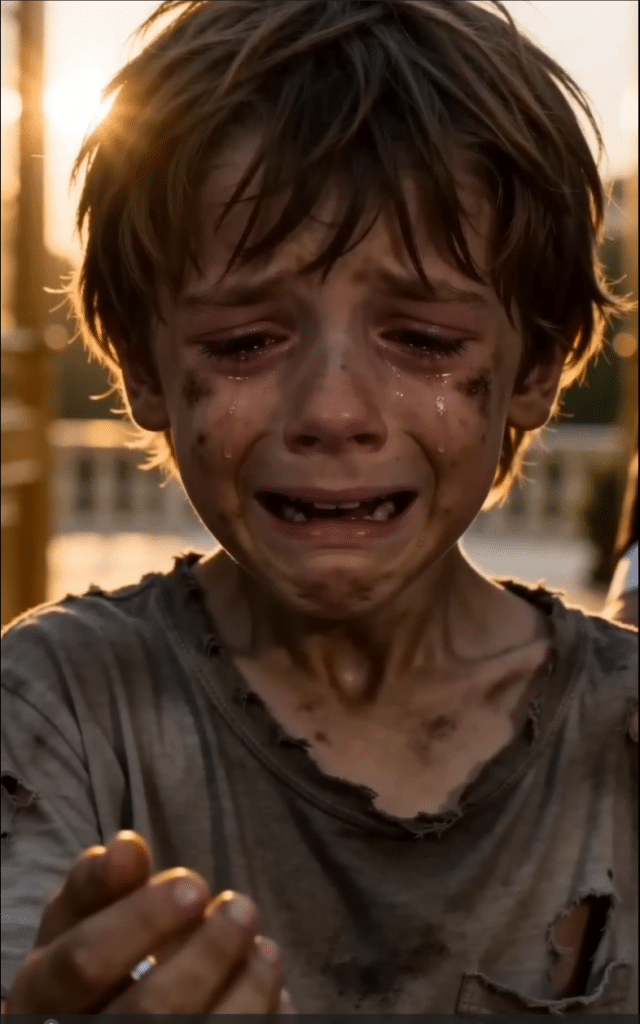
A boy stood at the threshold, held by two security men in black tuxedos, his bare wrists swallowed by their gloved hands. He was small, maybe seven, with messy brown hair, dirt across his cheeks, and a gray shirt so torn that the ballroom lights shone through the holes.
He looked like he had crawled out of another world.
Around him, the gala glittered.
Crystal chandeliers hung from the ceiling like frozen stars. White roses overflowed from gold pedestals. Champagne flutes sparkled in manicured hands. Women in silk gowns lifted their phones, recording before they even understood what they were witnessing.
At the center of it all stood Vivian Raines.
She wore a silver sequined gown that caught every light in the room and threw it back sharper. Diamonds circled her throat in cold, perfect layers. Her dark hair was swept into an elegant updo, and her face had the practiced stillness of a woman accustomed to being obeyed.
Then she saw the boy.
Her expression twisted.
“Get him away from me,” she snapped, pointing toward the doors. “Now!”
The boy flinched as if the words had struck him.
One of the guards pulled him backward, but the child fought with sudden panic. Not violently. Desperately. His shoes slipped on the marble floor. His breath came in broken little gasps.
“No,” he cried. “Please. I have to give it to her.”
Vivian’s jaw tightened.
“This is a private event.”
The guests watched with hungry silence. A few phones rose higher.
The boy looked straight at Vivian, tears cutting pale lines through the grime on his face.
“My mother said…” His voice cracked. “My mother said you’d know this.”
Slowly, he opened his trembling hand.
In his palm lay a small silver trinket shaped like a baby boot.
The room changed.
No one moved.
Even the phones seemed to freeze in the air.
Vivian stared at the object.
For one second, her face showed nothing.
Then the color drained from her lips.
At the side of the room, an elderly woman in a cream high-collared jacket stepped forward. Her pearl earrings trembled as she leaned closer, eyes fixed on the silver boot.
“No,” she whispered.
Vivian did not look at her.
The older woman’s voice dropped into horror.
“That… that was buried with your child.”
A sound passed through the ballroom. Not a gasp exactly. Something lower. Something human.
Vivian’s mouth opened, but no words came.
The boy stood beneath the chandeliers, filthy, shaking, and still holding out the impossible proof.
And the dead son Vivian Raines had mourned for seven years had just walked into her gala wearing rags.
Act II
Before Vivian Raines became a woman people feared, she had been a mother people pitied.
Seven years earlier, the city knew her as Vivian Caldwell, the youngest daughter of an old banking family, married into the Raines hotel empire with a smile beautiful enough for magazine covers and a sadness deep enough to survive them.
Her husband, Julian Raines, was charming in public and absent in private. He loved applause, acquisitions, and the kind of loyalty that looked like silence. Vivian had learned early in their marriage that questions made him cold.
Then she became pregnant.
For the first time, Julian behaved like a husband from a kinder life. He came home early. He bought flowers. He kissed her stomach in front of photographers and announced that the Raines legacy would soon have its future.
A boy.
Raymond Julian Raines.
Vivian called him Ray before he was born.
The silver baby boot had been a gift from her grandmother. Not a toy, but an heirloom. Tiny, polished, engraved with Ray’s hospital code and birth record, meant to sit in the nursery beside his first photograph.
Ray was born too early during a storm that shut down half the city.
Vivian remembered the hospital room only in flashes: white light, Julian’s hand on her shoulder, nurses moving too quickly, the small cry that came from somewhere beyond the blue curtain.
She saw her son once.
Only once.
A nurse lowered him close enough for Vivian to touch his cheek. His skin was warm. His mouth moved as if searching for breath. Vivian whispered his name, and his fingers curled around nothing.
Then they took him away.
“Just to help him breathe,” someone said.
By morning, Julian told her the baby was gone.
Vivian did not believe him at first. Grief came too quickly, too neatly packaged in medical phrases and sympathetic nods. There had been complications. His lungs were weak. They tried everything.
The casket was closed.
Julian said it was kinder that way.
The funeral took place under rain. Vivian stood beside the tiny white coffin with the silver baby boot tucked inside, because her grandmother said a child should not be buried without something that carried love.
Vivian remembered touching the lid.
She remembered wanting to climb into the earth with him.
After Ray’s death, something in her hardened.
The city watched her become elegant again. She smiled at charity dinners. She funded pediatric wings. She wore diamonds because people expected wealth to sparkle, even when the woman beneath it felt hollow.
But she never entered the nursery again.
She locked the door. She dismissed the nanny. She stopped speaking to anyone who tried to tell her time would heal her.
Time did not heal Vivian.
It polished her.
By the seventh anniversary of Ray’s death, she had become the perfect society hostess: composed, untouchable, generous in public, merciless to anyone who disturbed the performance. Her annual gala raised millions for children’s hospitals, and everyone praised her strength.
No one called it grief anymore.
No one knew that before every gala, Vivian stood alone in the locked nursery and touched the empty crib.
That night, before the boy arrived, she had done exactly that.
She had stood in the dark, wearing her silver gown, staring at a room where no child had ever slept.
Then she closed the door and descended the staircase to applause.
She believed the worst thing that could happen to a mother had already happened.
She was wrong.
Because across the city, a dying woman had pressed a silver baby boot into a little boy’s hand and told him to find the woman in diamonds.
Act III
His name was Milo.
Not Ray.
Not Raymond.
Milo.
He told them that in a small sitting room off the ballroom after Vivian ordered everyone out except the elderly woman, the guards, and her private attorney. The guests remained beyond the doors, whispering like wind through silk.
Milo sat on the edge of a velvet chair, both feet dangling above the carpet. Someone had brought him water. He had not touched it.
He still held the silver boot.
Vivian stood across from him, her arms wrapped around herself as if the room had gone cold.
The older woman, Eleanor Raines, lowered herself slowly into a chair. She was Julian’s mother, a woman who had ruled the Raines family for decades with pearls, manners, and secrets.
Her eyes never left the trinket.
“Where did you get that?” Vivian asked.
Milo swallowed.
“My mom gave it to me.”
“Your mother.”
He nodded.
“Her name?”
“Clara.”
Eleanor closed her eyes.
Vivian turned sharply. “You know that name.”
Eleanor’s face went pale.
“Clara Bell was a nurse at St. Aurelia’s. She worked the night Ray was born.”
The room seemed to tilt.
Vivian stepped closer to Milo, then stopped when he shrank back.
She forced her voice lower.
“Where is Clara now?”
Milo looked down.
“She got sick. She said she couldn’t run anymore.”
Vivian’s heart began to pound so hard she could hear it.
“Run from who?”
Milo’s fingers tightened around the silver boot.
“The man with the gold ring.”
Eleanor made a small sound.
Vivian looked at her.
Julian wore a gold signet ring.
He had worn it every day of their marriage.
Milo pulled a folded envelope from inside his ragged shirt. It was damp, creased, and covered in dirt. He held it out with both hands.
“Mom said give you this too. She said don’t give it to the men at the door. Only the lady in silver.”
Vivian took it.
Her fingers shook as she opened the envelope.
Inside was a letter written in uneven handwriting.
Mrs. Raines,
I am sorry. I told myself I was saving him. Then I told myself I was protecting my own daughter. Then I told myself too many years had passed. Every excuse became another chain.
Your son did not die.
Your husband paid Dr. Havel and me to sign the death papers. He said the child was weak and would bring scandal. He said you were unstable and that the family would lose control of the trust if the baby lived. I took him out through the service elevator before dawn.
I named him Milo because I was afraid to say Raymond.
I tried to love him enough to make up for what I stole.
I failed.
The silver boot was in the empty coffin. Julian gave it to me as proof that the burial was done. I kept it because I knew one day the lie would need a key.
Please do not punish the boy for what we did.
He is yours.
Vivian read the letter without breathing.
When she reached the end, she read it again.
Then a third time.
Eleanor whispered, “Vivian…”
Vivian lifted her eyes.
For the first time in years, all the polish was gone from her face.
“Did you know?”
Eleanor’s mouth trembled.
“No.”
But it was not strong enough.
Vivian saw the gap between the word and the truth.
“Did you know?” she asked again.
Eleanor’s eyes filled.
“I suspected Julian was hiding something. After the funeral, he dismissed half the hospital staff. He threatened anyone who asked questions. But I thought…” She swallowed. “I thought he had covered up negligence. I never imagined this.”
Vivian laughed once.
It sounded nothing like laughter.
“You never imagined your son could steal mine?”
Milo flinched at the sharpness.
Vivian saw it and stopped.
The child was watching her the way abandoned children watch adults: carefully, prepared for rage to become his fault.
Her anger did not vanish.
It turned direction.
She knelt in front of him, slowly, her diamond necklace catching the light like ice breaking apart.
“Milo,” she said, though the name hurt her, “how old are you?”
“Seven.”
“When is your birthday?”
He gave the date.
Ray’s date.
Vivian’s hand flew to her mouth.
Milo looked scared.
“Did I do bad?”
The question broke her.
“No,” Vivian whispered. “No, sweetheart.”
For seven years, she had mourned a grave.
For seven years, her son had lived under another name.
And somewhere in that same city, Julian Raines had smiled beside her at charity galas for children.
Act IV
Julian arrived twenty minutes later, furious that the gala had stopped without his permission.
He swept into the sitting room in a black tuxedo, gold ring on his right hand, irritation already sharpened into authority.
“What is going on?” he demanded.
Then he saw Milo.
The irritation vanished.
Only for a second.
But Vivian saw it.
Recognition.
Fear.
Then the mask returned.
“Who is this child?”
Vivian stood.
Her silver gown glittered beneath the lamp, but her face had gone still in a way Julian had never seen before.
“That’s what I was about to ask you.”
Julian looked at Eleanor. “Mother?”
Eleanor did not defend him.
That was the first crack.
Vivian lifted the silver boot.
Julian’s eyes went to it.
His jaw tightened.
“Where did you get that?”
Milo whispered, “The man with the gold ring.”
Vivian turned the trinket in her hand. “He remembers you.”
Julian’s expression hardened. “A frightened child can be coached.”
“By a dying nurse?”
He stopped.
Vivian held up Clara’s letter.
“By your death certificate? Your forged hospital records? Your empty coffin?”
Julian stepped toward her. “Lower your voice.”
The old command.
The old habit.
The old marriage.
Vivian did not move.
“No.”
For years, that word had lived inside her like a bird trapped behind glass. She had swallowed it at dinner tables, in hospital rooms, at press conferences, beside a grave that held nothing.
Now it flew free.
Julian glanced toward the ballroom doors. “You are emotional.”
Vivian smiled faintly.
That was when he should have been afraid.
“Of course I am,” she said. “You stole my child.”
The sitting room door opened behind them.
Her attorney entered with two police detectives.
Julian’s face changed again.
This time, he could not hide it quickly enough.
Vivian had called them before he arrived.
The detectives asked Julian to come with them for questioning. He refused. He threatened. He invoked lawyers, board members, judges, names that had once made rooms bend.
But the ballroom had heard too much.
When the doors opened, the guests were waiting.
Phones were raised.
Champagne forgotten.
The story Julian had buried behind marble, money, and manners walked out into the golden light wearing a torn gray shirt.
Milo clung to Vivian’s hand.
She felt how small his fingers were.
How real.
How alive.
The crowd parted as the detectives escorted Julian through the ballroom. He tried to look offended, as if he were the victim of an unpleasant misunderstanding. Then someone near the floral pedestals whispered loud enough for everyone to hear:
“Is that her son?”
Julian’s head snapped toward the voice.
No one looked away.
That was the moment his power began to leave him.
Not in court.
Not in headlines.
There, beneath the chandeliers, in the silence of people who finally understood what kind of man they had been applauding.
Milo looked up at Vivian.
“Are they taking him because of me?”
Vivian knelt despite the marble floor, despite the diamonds, despite every camera watching.
“No,” she said. “They’re taking him because of what he did.”
Milo’s eyes searched her face.
“What happens to me?”
The question nearly brought her to the floor.
All the years between them stood in that sentence. All the nights he had not been tucked in. All the birthdays she had spent at a grave while he blew out candles somewhere else, if anyone had given him candles at all.
Vivian touched his cheek with a hand that trembled.
“You come home,” she said.
Milo stared at her.
Then, very softly, he asked, “Do I have a home?”
Vivian pulled him into her arms.
The ballroom blurred into gold and white around them.
“You do now.”
Act V
The first night, Milo slept on the floor beside the bed.
Vivian found him there at 2:13 in the morning, curled beneath a blanket he had dragged down with him, the silver baby boot clutched in one hand. The nursery had been reopened, cleaned, warmed, and filled with soft pajamas, fresh sheets, and every comfort money could buy.
But comfort meant nothing to a child who did not yet trust softness.
Vivian lowered herself to the floor beside him.
She did not move him.
She simply stayed.
When he woke before dawn, he looked startled to see her there.
“You didn’t leave,” he said.
Vivian’s throat tightened.
“No.”
“You can sleep in the big bed.”
“I know.”
“Then why are you on the floor?”
She brushed hair from his forehead.
“Because you were.”
He stared at her for a long moment.
Then he scooted closer, just an inch.
It was the first gift he gave her.
The days that followed were not the easy miracle people wanted.
The city wanted a fairy tale. Stolen heir found. Evil husband exposed. Mother and son reunited beneath chandeliers.
Real life was messier.
Milo hid food in drawers. He flinched when doors opened too fast. He did not like baths. He woke from dreams calling for Clara, then looked guilty when Vivian came running.
Vivian learned not to hate Clara simply.
That was harder than hating Julian.
Clara had stolen him.
Clara had also fed him, named him, held him when he was sick, and spent her final strength sending him back.
Love and crime had lived in the same pair of hands.
Vivian did not forgive her.
But she allowed Milo to grieve her.
At the custody hearing, the DNA results confirmed what Vivian already knew from the moment she saw him beneath the ballroom lights.
Raymond Julian Raines was alive.
But Vivian did not force the name on him.
“Ray is yours,” she told him one evening as they sat in the reopened nursery. “Milo is yours too. You don’t have to give one up for the other.”
He thought about this very seriously.
“Can I be Milo Ray?”
Vivian smiled through tears.
“Yes.”
Julian’s trial took months to begin, but his empire collapsed much faster.
Dr. Havel confessed. Old hospital staff came forward. Bank records surfaced. Clara’s letter became the thread investigators pulled until the entire lie unraveled.
Eleanor testified against her own son.
She wore cream in court, pearls at her ears, and grief in every line of her face.
When Julian’s attorney suggested Vivian had been too unstable after childbirth to understand what happened, Vivian stood from the witness chair and looked directly at her husband.
“I was not unstable,” she said. “I was lied to.”
That sentence appeared on front pages the next morning.
But the moment that mattered most to Vivian happened outside the courthouse weeks later.
Milo reached for her hand without being asked.
Small fingers.
Warm.
Certain.
She held on like the world depended on it.
One year after the gala, Vivian returned to the same ballroom.
Not for the old charity.
She had ended that foundation and rebuilt it from the ground up, removing Julian’s name from every wall, every donor plaque, every letterhead. The new organization funded investigations into falsified hospital records, support for separated families, and legal aid for mothers dismissed by institutions that preferred polished lies.
The ballroom looked different that night.
Still beautiful.
Still filled with white roses and chandeliers.
But the guest list had changed. Nurses stood beside attorneys. Social workers beside donors. Families beside reporters. At the front of the room, on a small velvet stand, sat the silver baby boot.
Not hidden.
Not buried.
Witnessed.
Milo stood beside Vivian in a navy suit, his hair still refusing to stay neat. He held her hand until they reached the podium. Then he let go, only because he wanted to stand on his own.
Vivian looked out at the room.
A year ago, she had ordered a filthy child removed from her sight.
That shame would never fully leave her.
It should not.
“I thought grief made me strong,” she began. “But grief made me blind. It made me cold to suffering that did not arrive in the right clothes, through the right doors, with the right manners.”
The room was silent.
“My son came to me in rags, and my first instinct was to reject him. I cannot undo that moment. I can only spend the rest of my life making sure I never mistake poverty for unworthiness again.”
Milo looked up at her.
Vivian placed one hand gently on his shoulder.
“This is my son,” she said. “His name is Milo Ray Raines. He was stolen by lies, returned by courage, and recognized because a dying woman finally chose the truth.”
Milo lifted the silver boot from the velvet stand.
He held it in both hands, just as he had that first night.
But his hands were clean now.
Steady.
Safe.
After the ceremony, when the guests began to leave and the chandeliers dimmed, Milo walked to the massive golden doors and looked back into the ballroom.
Vivian joined him.
“Do you remember coming in?” she asked softly.
He nodded.
“I was scared.”
“I know.”
“You looked mean.”
Vivian winced.
“I was.”
Milo considered this with the blunt seriousness of a child learning how adults break and repair.
“But you’re not now.”
She looked down at him.
“I’m trying not to be.”
He slipped his hand into hers.
“That counts.”
Outside, the city lights shimmered against the tall windows. The same marble floor reflected them. The same golden doors stood open.
But the boy who had once been dragged inside by guards now walked out beside his mother.
No one stopped him.
No one questioned whether he belonged.
And in Vivian’s palm, warm against her fingers, was the living proof that truth can be buried, polished, renamed, and hidden beneath wealth for years.
But it does not stay dead forever.