Act I
The emergency doors burst open so hard they slammed against the wall.
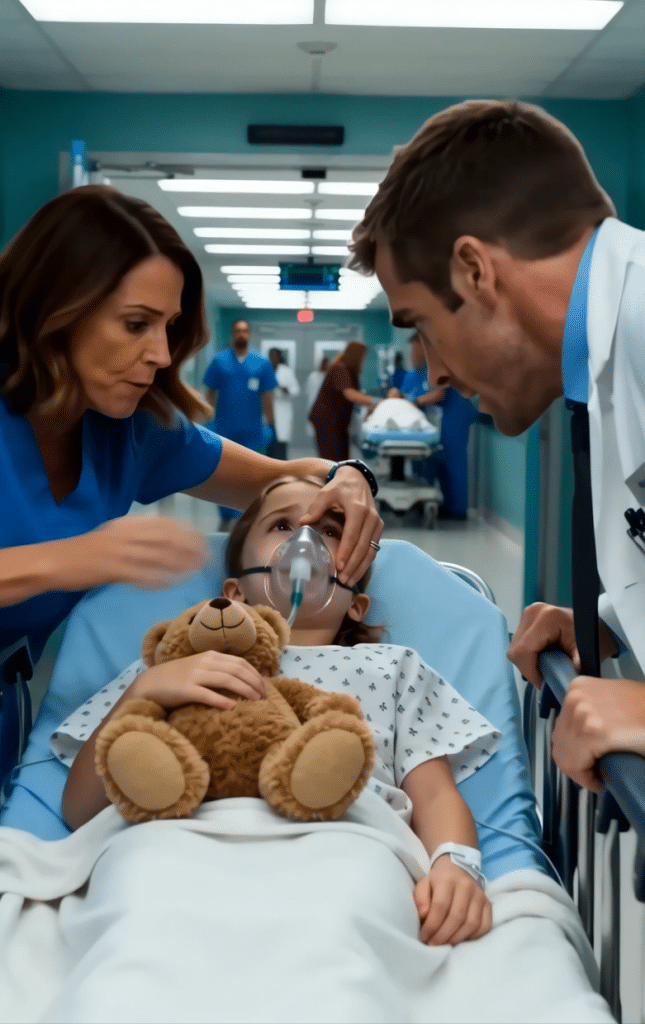
A gurney shot through the corridor, wheels rattling over the polished floor as nurses ran beside it. Monitors screamed. Someone shouted for a crash cart. A woman in blue scrubs leaned over the tiny patient, one hand keeping the oxygen mask in place while the other squeezed the side rail like she could drag the child back from the edge by force.
Dr. Daniel Pierce ran on the other side.
His white coat whipped behind him. Sweat gathered at his temples. His tie had already been pulled loose, and his name badge was gone, ripped off somewhere between the ambulance bay and trauma intake.
On the gurney lay a little girl.
Seven, maybe eight.
Long brown hair spilled across the pillow. Her hospital gown was too large for her small shoulders. One hand clutched a worn brown teddy bear so tightly its stitched ear bent under her fingers.
“Get the crash cart!” the nurse yelled. “Move!”
The corridor parted.
Doctors stepped aside. Patients turned their heads. Fluorescent lights flashed overhead as the gurney raced forward.
Then the girl lifted a trembling hand.
She pulled the oxygen mask slightly from her face.
Daniel leaned closer.
“Hey, sweetheart, keep that on. We’re going to help you.”
Her eyes locked onto his.
Wide.
Tearful.
Terrified.
“Don’t let me die again, Daniel,” she whispered.
The words hit him harder than any alarm.
Daniel stumbled for half a step.
The nurse snapped, “Doctor, stay with us!”
But Daniel was staring at the child.
Not at the monitor.
Not at the chart.
At her face.
“I wasn’t wearing a name plaque,” he said, barely able to breathe. “How do you know my name?”
The girl reached for him.
Her small fingers closed around his hand with shocking strength.
“You promised,” she whispered. “You promised you’d save me this time.”
Daniel’s whole body went cold.
“No way,” he said.
But the past had already opened its eyes.
Act II
Eight years earlier, Daniel Pierce had nearly quit medicine.
He had been a resident then, exhausted, underpaid, and still foolish enough to believe every patient could be saved if the right person cared enough. He lived on vending machine coffee, slept in twenty-minute fragments, and wrote notes in the margins of charts because he was afraid of forgetting anything that mattered.
Then came Rose Whitaker.
She was eight years old.
Brown hair. Green eyes. A teddy bear named Captain. A laugh that made nurses linger in her room even when they had other patients waiting.
Rose had a rare heart condition, the kind that turned childhood into a calendar of hospital stays. But she refused to act fragile. She named every IV pole. She rated hospital pudding like a food critic. She told Daniel once that his hair looked “too serious” and offered to fix it with a pink clip.
Her mother, Claire, rarely left her bedside.
Claire was quiet, pale from worry, and stubborn in the way only exhausted mothers become stubborn. She asked questions no one else asked. She kept copies of every lab result. She noticed when medications changed. She wrote everything down in a blue notebook.
Daniel respected her.
Dr. Warren Keene did not.
Keene was the head of pediatric cardiac surgery, a famous man with famous hands and a reputation powerful enough to silence rooms. He smiled for donors. He shook hands with board members. He spoke to families as if kindness were a gift he was tired of giving.
Daniel had admired him once.
Until Rose.
The night Rose crashed, Daniel was the first doctor in the room. He remembered the lights. The shouting. Claire screaming from the hallway. Keene arriving late, calm and irritated, as if the emergency had inconvenienced him.
Daniel had begged him to reconsider the medication order from earlier that evening.
Keene brushed him off.
“You’re a resident,” he said. “Act like one.”
Rose looked at Daniel through tears and an oxygen mask.
“Promise you’ll save me,” she whispered.
Daniel took her hand.
“I promise.”
He did not save her.
Afterward, the hospital called it unavoidable.
A tragic complication.
A fragile child.
A grieving mother.
But Daniel had seen the chart before it disappeared from the system. He had seen the order Keene signed. He had seen Claire’s blue notebook vanish from Rose’s room before the family could collect her things.
When Daniel raised concerns, doors closed.
His supervisor warned him to be careful. The hospital attorney asked whether grief had impaired his memory. Keene looked him in the eye and said, “A good doctor knows when to stop making noise.”
Daniel stopped.
Not because he believed them.
Because he was afraid.
That fear became the heaviest thing he carried.
He stayed in medicine, but something inside him changed. He became precise, controlled, respected. He saved patients. He taught interns. He won awards. But every time he heard a child cry through an oxygen mask, Rose’s voice returned.
Promise you’ll save me.
Years passed.
Keene retired into consulting.
The hospital buried Rose beneath statistics and polished language.
Daniel buried her beneath work.
Then a girl with Rose’s eyes appeared on his gurney and called him by name.
Act III
Her name on the intake sheet was Lily Hart.
Daniel saw it only after they stabilized her.
Lily Hart. Age eight. Emergency transfer from a rural clinic. Severe cardiac distress. Guardian listed as Claire Hart.
Daniel read the last name three times.
Hart.
Not Whitaker.
But when he stepped into the family consultation room, the woman sitting there lifted her head, and the years folded in on themselves.
Claire.
Older now. Thinner. Hair streaked with gray. Her hands clasped so tightly around a paper cup that it had caved inward.
She saw Daniel and stood slowly.
“You,” she whispered.
Daniel could not speak at first.
Claire’s face hardened.
“I prayed I’d never see this hospital again.”
“Lily is your daughter?”
Claire’s eyes filled.
“She’s Rose’s sister.”
The room seemed to tilt.
Daniel reached for the back of a chair.
Claire looked through the glass toward the emergency bay.
“She was born the year after Rose died. Same condition. Same warning signs. I changed our name because I thought distance could protect us.”
Daniel’s throat tightened.
“And she knows me?”
Claire looked at him strangely.
“She’s been talking about you for months.”
Daniel went still.
Claire opened her purse and pulled out a worn blue notebook.
The same blue notebook.
His chest constricted.
“I thought it was gone,” he said.
“So did they.”
Claire’s voice shook, but her eyes were fierce.
“Rose hid it inside Captain Bear before the last surgery. I found it after the funeral. Every note I took. Every medication change. Every question Keene refused to answer.”
Daniel looked toward Lily’s gurney.
The teddy bear.
The same bear.
Claire followed his gaze.
“I gave it to Lily when she started getting scared,” she said. “I didn’t know what else to do.”
Daniel touched the edge of the notebook.
“Why didn’t you come forward?”
“I tried.”
Her answer carried years of exhaustion.
“No one listened. The records were gone. The hospital said I was unstable. Keene’s lawyers threatened me. Then Lily was born, and I had to survive for the child I still had.”
Daniel lowered his eyes.
“I should have fought harder.”
Claire’s voice broke.
“Yes. You should have.”
The words did not feel cruel.
They felt deserved.
Then she opened the notebook to the final pages.
Daniel’s breath caught.
The handwriting was Rose’s.
Large, uneven, childish.
Dr. Daniel promised.
Underneath it, another line.
If I go to sleep, he will find out why.
Daniel covered his mouth with one hand.
Claire whispered, “Lily found that page last month. She asked me who Daniel was. I told her you were a doctor who tried to help Rose.”
Daniel looked up.
“That doesn’t explain what she said.”
Claire’s eyes moved toward the emergency room.
“No,” she said. “It doesn’t.”
Lily had not said Rose.
She had said me.
Don’t let me die again.
And Daniel, a man of science, a man trained to trust evidence, could not explain why the child’s hand in his had felt like a second chance delivered by something larger than medicine.
Act IV
Dr. Warren Keene entered the hospital at 11:17 p.m.
Daniel had not called him.
Someone else had.
Keene walked into the pediatric unit in a dark overcoat, silver hair immaculate, face composed with the arrogance of a man who believed age had made him untouchable. He was officially retired, but donors still took his calls. Board members still invited him to dinners. His name still hung on a plaque outside the cardiac wing.
Daniel saw him through the glass.
The old fear rose.
Then Lily’s voice rose with it.
You promised.
Daniel stepped into the hall.
Keene smiled faintly.
“Daniel. I hear you have a complicated case.”
“You heard wrong,” Daniel said. “We have an emergency patient. You have no role here.”
Keene’s eyes narrowed.
“Careful.”
That word again.
The word powerful men used when they had no moral defense left.
Daniel took the blue notebook from under his arm.
Keene saw it.
For the first time, his confidence cracked.
“Where did you get that?”
“Rose Whitaker kept better records than you did.”
Keene’s face hardened.
“You have no idea what you’re implying.”
“I’m not implying anymore.”
The nurse in blue scrubs, Mara, stood behind Daniel. So did two residents, a social worker, and Claire, who held herself upright with the strength of a woman who had already lost too much to be afraid of another arrogant doctor.
Daniel turned to Mara.
“Contact risk management. Then the state medical board. Tell them we have evidence tied to the Whitaker case and possible falsification of records.”
Keene laughed quietly.
“You think a child’s notebook can undo my career?”
“No,” Daniel said. “But the archived medication logs might.”
Keene went pale.
Daniel had spent the last hour doing what he should have done eight years ago. He had called an old colleague in hospital IT. He had asked for inactive server backups. He had searched under Rose’s medical record number, then under the emergency medication cabinet logs, then under Keene’s override credentials.
Buried beneath layers of migrated data, the truth had survived.
The order.
The time stamp.
The altered note.
Keene’s signature.
Not enough for a courtroom yet. But enough to open the door.
Keene stepped closer, voice low.
“You’ll destroy this hospital.”
Daniel looked through the glass at Lily.
Small. Fragile. Breathing under oxygen. Still clutching the teddy bear that had carried her sister’s final truth.
“No,” he said. “Silence did that.”
The surgery began before midnight.
Daniel was not the lead surgeon. He knew better than to let guilt pretend to be skill. He assembled the best team in the building, called in a specialist from across town, and stayed where he was needed most: coordinating, checking, questioning every order twice.
No one dismissed Claire this time.
No one removed her notebook.
No one told Lily to be brave as if fear were a failure.
Just before they wheeled her in, Lily opened her eyes and found Daniel.
Her voice was weak.
“You remembered.”
Daniel leaned close.
“I’m sorry it took me so long.”
She blinked slowly.
“Rose says she forgives you.”
Daniel stopped breathing.
Claire sobbed once behind him.
Lily’s fingers loosened around the bear.
“But you have to forgive yourself after.”
Then the doors opened, and the team took her in.
Daniel stood outside the operating room with bloodless hands and a heart full of everything he had spent eight years refusing to feel.
For the first time since Rose died, he did not run from it.
Act V
Lily survived the night.
Not easily.
Not like a miracle wrapped in soft music.
She survived because an entire team refused to miss what had been missed before. Because Claire was finally heard. Because old records surfaced. Because Daniel Pierce, at last, chose truth over reputation.
At dawn, Mara found him sitting on the floor outside the surgical wing, his back against the wall, his white coat wrinkled and his eyes red.
“She’s stable,” Mara said.
Daniel closed his eyes.
The sound he made was not quite a sob and not quite a laugh.
It was the noise of a promise finally breathing again.
Claire came out later.
For a moment, she stood in front of him without speaking.
Daniel rose slowly.
“I know an apology isn’t enough,” he said.
“It isn’t.”
He nodded.
Claire’s face trembled.
“But it’s a beginning.”
Then she held out the blue notebook.
Daniel stared at it.
“I can’t take that.”
“You’re not taking it,” Claire said. “You’re using it.”
The investigation began that afternoon.
This time, no one could bury it quietly. Too many people had seen the records. Too many staff had heard Keene’s threats. Too many backups had already been copied and sent outside the hospital.
The old case reopened.
Families came forward.
Some had questions. Some had documents. Some had only grief that suddenly looked less private and more suspicious than they had ever been allowed to say.
Keene’s portrait came down from the cardiac wing within a week.
The plaque followed.
Daniel did not watch.
He was in Lily’s room, helping her choose a color for the cast on her teddy bear’s stitched arm. She insisted Captain needed “hospital fashion.” Mara found purple tape and made it official.
Lily smiled for the first time.
It was not Rose’s smile.
Daniel needed to remember that.
Lily was not a replacement, not a ghost, not a second version of someone lost. She was herself. A child who liked pancakes, hated the smell of antiseptic, and believed teddy bears should be allowed in staff meetings.
But sometimes, when she looked at Daniel, something ancient passed behind her eyes.
Not frightening.
Gentle.
As if Rose had left a candle burning somewhere inside the world, and Lily had carried it without knowing why.
Weeks later, Lily was discharged.
The corridor that had once swallowed her in chaos now filled with nurses, residents, and patients who had heard pieces of the story. Claire pushed the wheelchair slowly, one hand on her daughter’s shoulder.
Daniel walked beside them.
At the exit, Lily looked up.
“Are you still sad?”
Daniel smiled faintly.
“Yes.”
“Good sad or bad sad?”
He thought about it.
“Honest sad.”
Lily nodded as if that made perfect sense.
Then she held out Captain Bear.
Daniel froze.
“For me?”
“Just for a minute,” she said. “Rose wants to say goodbye.”
Claire covered her mouth.
Daniel took the bear carefully. Its worn fabric was soft from years of being held by frightened children who deserved more time than fear had given them.
He bent his head.
“I’m sorry,” he whispered.
No light flashed.
No voice answered.
No impossible sign appeared.
But Daniel felt something in his chest loosen, like a door opening in a room he had kept locked too long.
When he looked up, Lily was watching him.
“She heard you,” she said.
Daniel handed the bear back.
Outside, morning light spread over the hospital entrance.
Claire helped Lily into the car, then turned to Daniel.
“What will you do now?”
Daniel looked back at the building.
For years, he had treated medicine like a way to outrun one night.
Now it had to become something else.
“I’ll testify,” he said. “Then I’ll help rebuild whatever we broke.”
Claire studied him.
“Not we.”
Daniel accepted that.
“What I broke.”
Months later, the pediatric wing changed its rules.
Parents received real-time access to medication changes. Residents could flag concerns without supervisor approval. Every critical override triggered automatic review. The reforms had boring names and thick policy binders, but Daniel loved them for that.
Real justice often looked like paperwork no one could easily erase.
Lily returned for checkups, stronger each time.
On her final visit that year, she ran down the corridor with Captain tucked under one arm while Claire called after her to slow down. Daniel stepped out of an exam room just in time for Lily to crash into his legs.
“Careful,” he said, laughing.
She looked up at him with serious eyes.
“You still keep promises?”
Daniel crouched.
“I try.”
She seemed to consider whether that was good enough.
Then she nodded.
“Rose says trying counts when you don’t stop.”
And just like that, she ran back to her mother.
Daniel stayed there in the corridor, surrounded by fluorescent lights, rolling equipment, distant voices, and the ordinary chaos of a hospital still learning how to be honest.
He watched Lily disappear around the corner.
Alive.
Laughing.
Carrying the bear.
Years later, people in the hospital would tell the story in whispers.
The little girl who knew the doctor’s name.
The child who said she had died before.
The night an old case reopened because a promise came back wearing a hospital gown and holding a teddy bear.
Daniel never corrected every version.
Some mysteries did not need to be solved to be sacred.
But when new residents asked why he listened so carefully to children, why he checked every order twice, why he stopped when parents said something felt wrong, he would look toward the pediatric wing and answer simply.
“Because sometimes the smallest voice in the room is the one telling the truth.”
And every time he passed the wall where Keene’s portrait used to hang, Daniel remembered Rose.
Not as failure.
Not only as grief.
As the child who kept her promise too.
She had said he would find out why.
And somehow, through a notebook, a teddy bear, and a little girl who refused to let the past stay buried, he finally did.