Act I
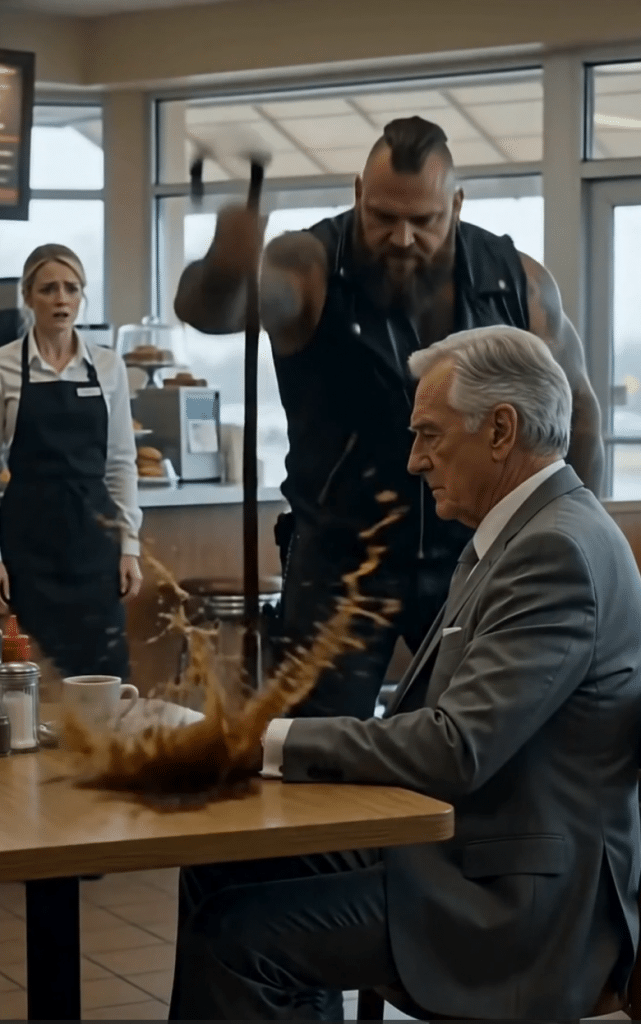
The cane hit the table so hard the coffee cup exploded.
Porcelain cracked. Hot coffee splashed across the wooden surface, ran over the edge, and soaked the sleeve of the old man’s gray suit. The diner went silent for half a second.
Then the bikers laughed.
The man who had done it stood over the table like he owned the room. He was huge, broad through the shoulders, with a black leather vest stretched over his chest and tattoos crawling down both arms. His beard framed a grin that was all teeth and cruelty.
He lifted the old man’s hooked walking cane one more time, twirled it mockingly, then tossed it onto the tiled floor.
It clattered beside the booth.
“Careful,” one of the bikers shouted. “Grandpa might need that to escape.”
The whole corner erupted again.
The waitress behind the counter froze with a pot of coffee in her hand. Her name tag read Emily, and her face had gone pale the moment the biker gang walked in. Everyone in Millstone County knew the Iron Jackals. Everyone knew what happened when someone embarrassed them in public.
So no one moved.
No one spoke.
No one helped the old man.
He sat alone in the booth by the window, silver hair neatly combed, white shirt buttoned under an elegant gray suit now stained at the cuff. He had been eating toast and reading a folded newspaper before the bikers decided his quiet dignity offended them.
The leader leaned closer.
“What’s wrong, old man?” he said. “You deaf too?”
The old man slowly lifted his head.
His eyes were not frightened.
That was the first thing the biker noticed.
Not angry. Not panicked. Not pleading.
Cold.
Sharp.
The kind of gaze that made the laughter around the diner begin to weaken before anyone understood why.
The old man looked at the coffee soaking into his sleeve. Then at the shattered cup. Then at his cane lying on the floor.
At last, he looked back at the biker.
The smile on the biker leader’s face twitched.
The old man reached into the inner pocket of his suit and pulled out a black flip phone.
That made the bikers laugh again.
The leader pointed at it.
“What, old man?” he sneered. “Calling your nurse?”
The old man flipped the phone open.
The diner’s buzzing lights seemed louder suddenly.
He pressed one button, waited, and spoke in a voice so low that everyone leaned in without meaning to.
“It’s me,” he said. “Bring them.”
Then he closed the phone.
The biker leader’s grin faltered.
Outside, the gray afternoon pressed against the diner windows.
For three seconds, nothing happened.
Then the first black SUV came screaming around the corner.
Act II
Before that afternoon, nobody in the diner knew the old man’s name.
To Emily, he was just the polite customer in booth four.
He had arrived alone during the lunch rush, moving slowly but steadily with the help of his cane. He had thanked her for the coffee, asked whether the apple pie was made in-house, and tipped two dollars before his food even arrived.
There was something old-fashioned about him.
Not weak.
Old-fashioned.
He folded his napkin across his lap. He asked for no special treatment. He smiled at the little boy in the booth across from him when the child dropped a crayon. When Emily apologized for bringing his toast slightly burned, he waved it away.
“Nothing worth apologizing for,” he said. “I’ve survived worse toast.”
She laughed despite herself.
The day had been heavy from the start. Rain clouds sat low over the highway. The jukebox was broken. The cook was in a foul mood. Emily had already dealt with two rude truckers and a man who complained that his eggs looked “too emotional.”
Then the bikers arrived.
Six of them, loud before they even opened the door.
Their boots hit the tile. Their jackets smelled of rain, road dust, and arrogance. They shoved two tables together without asking and took the biggest corner of the diner. The leader, Rex Mallory, sat with his back to the wall like a king expecting tribute.
Rex had a reputation.
He liked people to know it.
He ran the Iron Jackals with the confidence of a man who had spent years terrifying people just enough to avoid consequences. Bar owners gave him free drinks. Small business owners looked the other way. Local deputies arrived late whenever his name was involved.
Rex did not need to throw many punches anymore.
His shadow did most of the work.
That day, he was in a mood to be entertained.
It started with comments about Emily’s hands shaking when she poured coffee. Then jokes about the cook. Then he noticed the old man.
“Look at this,” Rex said loudly. “Somebody lost a senator.”
The others turned.
The old man did not react.
That bothered Rex more than fear would have.
He called across the room. The old man continued reading. He mocked the suit. The old man took a sip of coffee. He asked if the old man thought he was better than everyone else.
The old man folded his newspaper.
“Son,” he said calmly, “I don’t know you well enough to think anything about you.”
The diner felt that sentence land.
Emily nearly dropped the coffee pot.
Rex’s men laughed at first, thinking it was part of the show. But Rex did not laugh. His face tightened, not because the words were cruel, but because they were unafraid.
Men like Rex lived on reaction.
The old man had given him judgment instead.
So Rex stood.
He walked to booth four, slow and heavy, enjoying how quiet the room became. He picked up the old man’s cane from where it leaned against the booth.
“Nice stick,” he said.
The old man looked up.
“I’d prefer you put that down.”
Rex smiled.
That was all the permission he needed.
The cane came down on the table.
The cup shattered.
Coffee spilled.
The room froze.
And somewhere behind the old man’s cold eyes, a door opened that had been closed for years.
Act III
The old man’s name was Thomas Whitaker.
Thirty years earlier, everyone in the state knew it.
He had been a prosecutor first, the kind who wore cheap suits and worked late enough for janitors to learn his coffee order. He built cases nobody else wanted. Corruption. organized crime. crooked contracts. men who thought rural counties were too small for anyone important to notice.
Then he became attorney general.
Then governor.
People called him ruthless when he went after powerful donors. They called him stubborn when he refused favors from his own party. They called him dangerous when he signed the first statewide witness protection expansion after a young mechanic was threatened for testifying against a trafficking ring.
Thomas never cared what they called him.
He cared whether people could stand in front of the law without having to be rich or connected enough to survive it.
That belief had cost him.
His wife, Margaret, used to tell him he carried the state on his back like a penance.
He told her she exaggerated.
She told him he avoided mirrors.
Margaret was the reason for the cane.
Not because she had given it to him. Because she had been with him the night he began needing it.
Eight years earlier, after Thomas left office, he was leaving a veterans’ hospital fundraiser when a truck ran a red light and struck his car. The official report called it an accident. Thomas knew better. So did the federal agents who later traced the truck to a man connected to one of the prison contractors he had investigated.
Thomas survived.
Margaret did not.
After that, he vanished from public life.
The newspapers said he retired to recover. Commentators said age had finally humbled him. Former enemies celebrated quietly. Friends sent letters that went unanswered.
The truth was simpler.
Thomas was tired.
Tired of podiums. Tired of threats. Tired of shaking hands with men who smiled in public and sharpened knives in private. He kept only a small protection detail, mostly out of obligation, and spent his days moving between his home, the cemetery, and the diner where Margaret used to order apple pie after Sunday drives.
That diner was supposed to be quiet.
A place where no one bowed.
A place where he could sit near the window and remember being someone’s husband before he had been someone’s governor.
But he had not come alone that day.
Not exactly.
Two blocks away, in an unmarked black SUV, his security detail waited. Thomas had argued with them that morning.
“I’m getting lunch,” he said. “Not invading a country.”
His lead agent, Mara Chen, did not smile.
“Sir, you have active threats.”
“I have had active threats since 1989.”
“And you have ignored them since 1989.”
They compromised. Thomas could eat alone, but the detail stayed nearby.
He hated it.
Until Rex Mallory smashed the cane onto the table.
Until coffee soaked Margaret’s favorite gray suit, the one she had bought him when he won his second term and told him it made him look “less like a courtroom and more like a man.”
Until the biker tossed the cane onto the floor like it was nothing.
Thomas had not called because he was afraid.
He had called because men like Rex never stopped at humiliation unless someone showed them a line they could not cross.
“It’s me,” Thomas said into the flip phone. “Bring them.”
Mara did not ask what happened.
She knew his voice.
Within seconds, the convoy moved.
Act IV
The first SUV stopped so hard outside the diner that water sprayed from the curb.
Then came another.
And another.
Black vehicles with tinted windows boxed in the parking lot, lights flashing against the gray glass. Doors opened in perfect sequence. Men and women in dark suits stepped out, scanning the diner, hands near their jackets, eyes alert.
Inside, every biker stopped laughing.
Rex turned toward the window.
His face changed slowly, like a man watching the punchline of his own joke turn into a warrant.
Emily’s coffee pot trembled in her hand.
She stared outside, then at the old man, then outside again.
“Oh God,” she whispered. “That’s the governor’s security convoy.”
One of the bikers muttered, “Former governor.”
Emily looked at him.
“That doesn’t make it better.”
The diner door opened.
Agent Mara Chen entered first, rain shining on her black coat. Two agents followed. They did not rush. They did not shout. Their calm was worse.
Mara’s eyes went straight to Thomas.
Then to the coffee on his sleeve.
Then to the shattered cup.
Then to the cane on the floor.
Her face became very still.
“Sir,” she said, “are you injured?”
Thomas did not look away from Rex.
“No.”
Mara’s gaze moved to the biker leader.
Rex lifted both hands slowly.
“Now, hold on,” he said. “This was just a joke.”
Thomas finally stood.
He moved carefully, without his cane, one hand resting briefly on the booth for balance. The room watched him rise, and the act itself felt heavier than any threat Rex had made.
“A joke,” Thomas said.
Rex swallowed.
“Yeah. We were messing around.”
Thomas looked down at his ruined sleeve.
“Do you know what makes a man dangerous, Mr. Mallory?”
Rex flinched at the sound of his name.
Thomas had not asked for it.
He already knew.
“A gun?” Rex said weakly.
“No.” Thomas stepped closer. “A crowd that lets him believe cruelty is entertainment.”
No one spoke.
The bikers looked at the floor.
The other customers looked ashamed.
Even Emily lowered her eyes for a moment, though Thomas’s voice was not unkind when he turned toward her.
“Miss, would you please call the sheriff?”
Mara quietly said, “Already done.”
Rex tried to recover.
“You can’t arrest me for breaking a cup.”
Thomas’s expression did not change.
“No. But the outstanding assault warrants in two counties might help.”
Rex went pale.
One of his men cursed under his breath.
Mara nodded to an agent by the door. A phone call was made. Plates were checked. Names were run. The diner became very quiet as the Iron Jackals learned what Thomas had known for years: loud men often mistake a lack of consequence for power.
It took less than five minutes.
One biker had a weapons violation. Another was wanted for intimidation of a witness. Rex had three active warrants, all buried under delays, favors, and local fear.
The sheriff’s cars arrived behind the SUVs.
Rex turned back to Thomas, hatred and terror twisting together on his face.
“You think this makes you a big man?” he said.
Thomas looked at the cane still lying on the floor.
“No,” he said. “I think it makes me a citizen who finished his lunch in peace until you made that impossible.”
The sheriff’s deputy moved toward Rex.
Rex did not fight.
Men like him rarely fought when the room stopped being afraid.
As they led him toward the door, he glanced once at Emily, once at his own men, then at Thomas.
The old man held his gaze.
Not triumphantly.
Not smugly.
With the exhausted patience of someone who had seen bullies in better suits and higher offices.
Outside, cameras had begun to gather. Someone must have recognized the convoy. Reporters stood under umbrellas. Customers pressed near the windows.
Thomas turned away from all of it.
He bent slowly to pick up his cane.
Noah, the teenage busboy, rushed forward and grabbed it first.
“Sir,” he said, voice shaking. “Let me.”
Thomas accepted it.
“Thank you.”
The boy looked like he might cry.
“I’m sorry we didn’t stop him.”
Thomas looked around the diner.
That apology belonged to everyone.
“Yes,” he said quietly. “So am I.”
Act V
The story broke before sunset.
By evening, every local news station was showing footage of black SUVs outside Rosie’s Diner and former Governor Thomas Whitaker standing beneath the awning in a coffee-stained suit while Rex Mallory was placed in the back of a sheriff’s car.
People loved the dramatic version.
Biker humiliates old man.
Old man reveals hidden power.
Convoy arrives.
Bully trembles.
It made a clean little tale. Easy to share. Easy to cheer for.
But Thomas hated clean tales.
They usually left out the part that mattered.
The next morning, he returned to the diner.
No convoy this time, at least none visible from the windows. No reporters. No dramatic entrance. Just an old man with silver hair, a repaired cane, and the same gray suit now cleaned as well as it could be.
Emily froze when he walked in.
Then she hurried from behind the counter.
“Governor Whitaker, I am so sorry.”
“Thomas,” he corrected gently.
She looked confused.
“Sir?”
“My name is Thomas. I came for pie.”
Her eyes filled suddenly.
“I should’ve done something.”
He did not let her look away.
“Yes,” he said.
The honesty hurt more than comfort would have.
Emily nodded, tears slipping down her cheeks.
“I was scared.”
“I know.”
“I hate that I was scared.”
“That’s a start.”
He took his booth by the window.
The table had been replaced. The floor scrubbed. The corner where the bikers had sat looked strangely empty, as if the building itself was relieved.
Noah brought his coffee.
His hands shook slightly.
Thomas noticed.
“You working after school?”
“Yes, sir.”
“What do you want to do after graduation?”
Noah blinked, surprised by the question.
“Law, maybe. I don’t know. My mom says it’s expensive.”
Thomas stirred his coffee.
“Most important things are. That doesn’t mean they’re impossible.”
A week later, Noah received a call from the Whitaker Civic Foundation.
A scholarship interview.
He almost hung up because he thought it was a prank.
It was not.
Over the following months, Thomas did more than watch the headlines fade. He pushed quietly, methodically, the way he always had. The sheriff’s department opened an internal review into delayed warrants tied to the Iron Jackals. Business owners who had been intimidated finally gave statements. A waitress from another town testified about threats. A mechanic admitted he had paid Rex for “protection” for three years.
The gang did not fall in one dramatic sweep.
It broke piece by piece.
That was how fear usually ended.
Not with one brave moment, but with enough people deciding they were tired of bowing.
Thomas kept going to the diner.
Every Thursday, booth four.
He became a regular again, not a symbol. Emily stopped trembling when rough-looking customers walked in. Noah started carrying a notebook full of legal terms he did not yet understand. The cook, who had once hidden in the kitchen during the incident, began keeping a baseball bat under the counter and a phone list by the register.
Thomas told him the phone list was wiser.
Months later, Rosie’s Diner installed a small brass hook beside booth four.
For the cane.
Thomas pretended not to notice the first time he saw it.
Emily pretended not to notice him wipe his eyes.
On the anniversary of Margaret’s death, he came in wearing the same gray suit. The sleeve still held the faintest shadow of a coffee stain if you knew where to look.
Emily brought apple pie without being asked.
“On the house,” she said.
Thomas raised an eyebrow.
“You trying to bribe a former public official?”
She smiled.
“Just feeding a regular.”
That made him laugh.
A real laugh.
Small, but real.
Outside, the sky was gray again. Rain threatened the highway. Trucks rolled past. The world remained imperfect, dangerous, and full of men who confused fear with respect.
But inside the diner, something had changed.
Not because black SUVs had arrived.
Not because a powerful man had revealed himself.
Because everyone in that room had learned the same lesson at the same time.
Cruelty grows in silence.
And silence can be broken.
Years later, people in Millstone County still told the story of the biker who smashed the old man’s cane and discovered, too late, that he had chosen the wrong man to mock.
But Emily told it differently.
She said the most important moment was not when the convoy arrived.
It was not when Rex Mallory went pale.
It was not even when Thomas Whitaker opened that old flip phone and spoke four words that made the whole diner hold its breath.
The most important moment came the next morning, when the old man returned, looked her in the eye, and accepted her apology without pretending fear was harmless.
Because that was when she understood what courage really was.
Not power.
Not revenge.
Not a fleet of black SUVs outside a window.
Courage was an old man in a stained suit coming back to the same booth, asking for pie, and teaching a frightened room that dignity does not need to shout to be heard.