Act I
The safe sat in the middle of the penthouse like a dare.
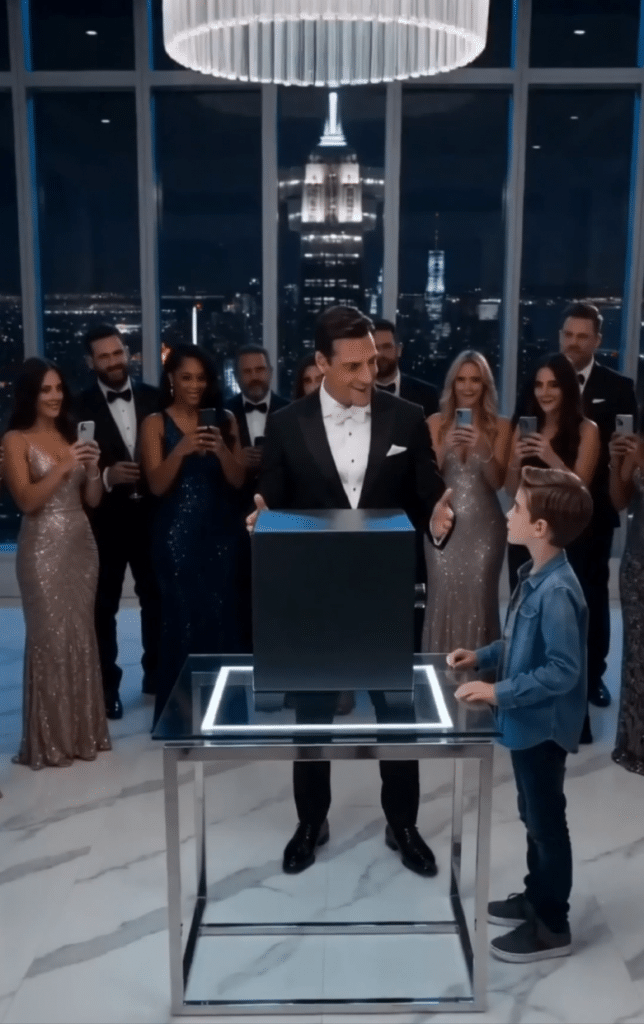
It was black, industrial, and brutally plain, almost ugly against the glass table beneath it. Around it, everything else glittered. A crystal chandelier spilled light over white marble floors. Floor-to-ceiling windows framed Manhattan at night, the Empire State Building rising in the distance like a jewel stuck in the dark.
The guests loved it.
They stood in a loose circle with champagne flutes and phones raised, waiting for humiliation. Men in tuxedos leaned toward women in sequins. Influencers whispered into their cameras. Someone laughed before anything had even happened.
Damian Cross stood beside the safe, smiling like a man who had already won.
He was thirty-six, handsome, rich, and aware of both facts. His tuxedo fit perfectly. His hair was slicked back. His cufflinks flashed whenever he moved his hands.
“This,” he announced, tapping the top of the safe, “is the most secure private vault in New York.”
A few guests applauded politely.
Then Damian looked down at the boy standing across from him.
The child was maybe nine years old, dressed in a blue denim jacket and dark T-shirt, his brown hair combed neatly but not formally. He looked too young for the room, too calm for the attention, too ordinary beside people who wore wealth like armor.
But he did not fidget.
He did not stare at the chandelier.
He studied the safe.
Damian’s grin widened.
“I’ll give you ten thousand dollars if you open it.”
The crowd chuckled.
A woman near the window lifted her phone higher.
The boy looked up.
“Are you sure?”
The laughter grew louder.
Damian leaned forward, amused by what he thought was fear.
“Open it.”
The boy nodded once.
Then he placed both hands near the dial.
The room shifted. Not because anyone believed he could do it, but because his focus was strange. Too precise. Too quiet. He leaned close, listening, pausing, turning, stopping as if the safe were speaking in a language only he understood.
Damian’s smile thinned.
The boy’s expression never changed.
One guest whispered, “Is he actually doing it?”
Damian stepped closer.
“Who taught you that?”
The boy did not look up.
“My father built this safe.”
The words cut through the party cleanly.
Damian’s face changed before he could hide it.
For the first time all evening, the host looked afraid.
Then the safe gave a loud metallic clack.
A line of white light spilled from the door.
And inside was not money.
It was the secret Damian Cross had spent five years burying.
Act II
Five years earlier, Damian had been nobody’s idea of a genius.
He was a salesman with good teeth, better suits, and a gift for making other people’s work sound like his own. He could walk into a boardroom with three borrowed ideas and leave with funding. He could shake hands with investors and make greed feel like vision.
But the mind behind CrossVault Security was not Damian.
It was a quiet engineer named Thomas Reed.
Thomas did not attend rooftop parties. He did not chase cameras. He did not know how to make himself impressive in rooms full of people who valued volume over substance.
He built things.
Locks. Safes. mechanical failsafes. Small systems so clever that other engineers got angry before they got impressed.
His workshop was a narrow space under an old hardware store in Queens. The ceiling leaked in two places. The heater worked only when it felt generous. But Thomas loved it because it was his, and because his son Caleb had grown up there among metal drawers, sketches, and the smell of machine oil.
Caleb learned numbers before he learned baseball.
He learned patience before he learned pride.
Thomas never taught him how to break into anything. He taught him how to understand what had been made with care.
“A lock is not a trick,” Thomas used to say. “It’s a promise. It says something matters enough to protect.”
Caleb believed him.
So did Damian, at first.
Damian met Thomas at a small technology expo where Thomas had entered a prototype safe called the Aster. It looked simple from the outside, but inside it carried a layered security design that could not be rushed, forced, or fooled by ordinary methods. Investors ignored Thomas’s booth until Damian stopped there.
He smiled. He listened. He praised the work.
Then he offered what sounded like rescue.
A partnership.
Funding.
A legal team.
A launch.
“You build,” Damian told him. “I’ll make the world pay attention.”
Thomas wanted to say no. He distrusted men who smiled too easily.
But his wife was ill then. Bills were stacking. Caleb needed stability. The workshop was months behind on rent.
So Thomas signed.
For one year, it almost worked.
CrossVault became the new luxury obsession. Private collectors wanted the safes. Celebrities bought them for watches, diamonds, documents, things they wanted hidden not because they were valuable, but because hiding them made them feel powerful.
Damian became the face.
Thomas stayed in the workshop.
Then the Aster design disappeared from Thomas’s server.
A month later, CrossVault filed new patents without his name.
Thomas confronted Damian in the company’s first real office, a glass-walled floor overlooking the river. Caleb was there that day, sitting outside the conference room with a comic book he was not reading.
He heard voices.
His father’s, low and furious.
Damian’s, smooth and cold.
“You signed control rights,” Damian said.
“I signed production rights,” Thomas answered. “Not ownership of my life’s work.”
Damian laughed.
“Try proving the difference.”
Thomas tried.
Within weeks, he was accused of stealing company property. Then of violating his contract. Then of leaking designs to a competitor that did not exist until Damian’s lawyers needed it.
The lawsuit destroyed him.
The medical bills finished what the lawyers started.
Caleb remembered the night his father came home with bloodshot eyes and sat on the workshop floor among blueprints, holding his head in both hands.
“We’re not beaten,” Thomas told him.
But he sounded like a man trying to convince his son of something he no longer believed himself.
Three months later, Thomas vanished.
Not from guilt.
Not from shame.
From fear.
He left Caleb with his aunt and went underground after warning her that Damian’s people were watching the family. There were files, Thomas said. Proof. Enough to clear his name. Enough to expose Damian.
But the proof had been locked somewhere no one would think to look.
Inside the very safe Damian loved showing off.
And Caleb had waited five years for the right room, the right night, and the right amount of arrogance.
Act III
Damian Cross had built his fortune on performance.
Every year, he hosted a private party in the penthouse to unveil the newest CrossVault model. Every year, the guests arrived ready to drink, flatter, record, and pretend they understood security technology because they owned expensive things.
This year, Damian added entertainment.
He called it a harmless challenge.
A child prodigy from a “community robotics program,” invited as a novelty. Damian had heard Caleb could solve mechanical puzzles quickly, and he thought it would make good content. A poor boy struggling with a millionaire’s safe. A little humility dressed up as charity.
He did not recognize Caleb.
That was his first mistake.
Caleb had changed since the last time Damian saw him outside that conference room. He was taller now. His hair was neater. His face had lost the roundness of early childhood. And Damian had never truly looked at him back then anyway.
Men like Damian rarely remembered children unless they were useful.
Caleb entered the penthouse with his aunt’s old phone in his pocket and a single sentence from his father burned into his mind.
When he asks if you know what you’re doing, tell him who built it.
His aunt had tried to stop him.
“He’s dangerous,” she said.
Caleb’s answer was quiet.
“So was letting him keep lying.”
He had not come to steal anything.
He had come to open what already belonged to the truth.
The safe on the glass table was not the newest model, no matter what Damian told the room. It was the original Aster prototype with cosmetic upgrades, the first one Thomas had built before Damian stripped his name off the design.
Caleb knew it instantly.
Not from the outside.
From the tiny mark near the hinge, almost invisible beneath the black finish.
His father always made that mark.
A small star.
For Caleb’s mother, Stella.
That was why the boy asked, “Are you sure?”
He was not asking about the money.
He was giving Damian one final chance.
Damian missed it.
Now the safe door stood open, white light glowing from within, and the entire penthouse leaned toward it.
Someone laughed nervously.
“What’s inside?”
Damian moved first.
Too fast.
Caleb stepped between him and the safe.
For a second, no one breathed. The host of the party, owner of the company, king of the room, was being blocked by a child in a denim jacket.
“Move,” Damian said softly.
Caleb looked at the phones pointed at them.
“No.”
A murmur passed through the guests.
Damian forced a smile.
“You won. Take your prize.”
“I don’t want your money.”
That unsettled the room more than anything.
Caleb reached into the safe and pulled out a sealed metal case no larger than a book. It was old, scratched, and marked with a strip of tape that had yellowed at the edges.
On it, written in black marker, were three words.
FOR MY SON.
Damian’s face emptied.
Caleb held the case to his chest.
“My father said you kept this because you thought he was too scared to come back for it.”
The phones rose higher.
Damian’s voice dropped.
“Your father is a criminal.”
Caleb looked at him steadily.
“No. He built your empire.”
The room turned cold.
Then the elevator doors opened.
And Thomas Reed walked into the penthouse.
Act IV
He was thinner than Caleb remembered.
That was the first thing the boy noticed.
His father wore a dark coat that hung slightly loose at the shoulders. His hair had gone gray at the temples. His face carried years of running, hiding, and waiting for a moment that might never come.
But his eyes were alive.
Caleb forgot the room.
“Dad.”
Thomas stopped just long enough for the word to hit him.
Then Caleb ran.
The metal case nearly slipped from his hands as Thomas dropped to his knees and caught him. The hug was not graceful. It was desperate. Caleb pressed his face into his father’s coat, shaking so hard that the room blurred around him.
The guests did not laugh now.
No one whispered for him to move.
Even their phones seemed less hungry for humiliation and more frightened of history happening in front of them.
Damian stood frozen beside the open safe.
“How did you get up here?” he demanded.
Thomas looked over Caleb’s shoulder.
“I used the invitation you sent my son.”
Damian’s jaw tightened.
“This is trespassing.”
A woman near the window whispered, “Is that Thomas Reed?”
Someone else said, “The engineer?”
Another voice answered, “I thought he fled the country.”
Thomas stood, one arm still around Caleb.
“I left because your lawyers destroyed every official path I had,” he said. “But I did not leave empty-handed.”
Caleb placed the metal case on the glass table.
Thomas entered a small code on the side, then opened it.
Inside were documents, drives, original design sketches, signed lab records, dated videos, and one thin black notebook with a worn leather cover. Caleb recognized it immediately.
His father’s workshop log.
Thomas lifted it.
“This contains the first complete development record of the Aster safe,” he said. “Dates, revisions, failed mechanisms, corrected flaws, vendor notes, every hour of design work before Damian Cross ever saw it.”
Damian laughed, but the sound came out wrong.
“You expect people to believe a notebook?”
“No,” Thomas said. “I expect them to believe themselves.”
He looked toward the chandelier.
Caleb understood.
The safe had not released smoke.
It had released a signal.
The white light inside was a projector, hidden in the original prototype for one reason: Thomas had built the safe to reveal its own audit record if tampered with by anyone trying to erase its creator.
On the wall of the penthouse, above the champagne table, a video flickered to life.
The room gasped.
There was Damian, five years younger, standing inside Thomas’s workshop.
His voice filled the lounge.
“Listen to me, Reed. I can make you rich, or I can make you disappear from your own invention. Choose carefully.”
The video cut.
Another clip appeared.
Damian at a conference table.
“You think a mechanic with a sick wife and a kid can beat my lawyers?”
Another cut.
A final clip.
Damian holding a folder, smiling.
“By the time I’m done, your name won’t be on anything but a debt notice.”
No one moved.
Damian lunged for the table.
Thomas stepped forward, but he did not need to.
Two guests grabbed Damian before he could reach the case. Not out of heroism, perhaps. More likely because every phone in the room had caught enough truth to make association dangerous.
Damian struggled once, then stopped.
His face had lost all charm.
“You don’t understand,” he said to the guests. “This company would be nothing if I hadn’t made it desirable.”
Thomas looked at him with years of exhaustion.
“You sold the lock,” he said. “You never understood the promise.”
The words landed quietly, but they ended him.
Within minutes, the penthouse doors opened again.
This time, it was not party guests.
It was lawyers, investigators, and a woman in a navy suit who introduced herself as federal counsel.
Damian stared at Thomas.
“You planned this.”
Thomas looked down at Caleb.
“No,” he said. “He finished it.”
Caleb stood straighter.
For the first time in five years, he was not the son of a disgraced man.
He was the son of the man who had been telling the truth all along.
Act V
By morning, Damian Cross’s empire was no longer untouchable.
The party videos spread faster than his lawyers could smother them. Headlines that once praised him as a visionary began rewriting themselves around words he hated: fraud, stolen patents, intimidation, conspiracy.
CrossVault’s board suspended him before breakfast.
Investors called emergency meetings. Former employees came forward. Engineers who had been pressured into silence sent documents they had kept hidden in private folders for years.
The safe on the glass table became famous.
Not because it had been opened by a child.
Because it had opened back.
It had carried the truth inside its own walls, waiting for the one person Thomas trusted to release it.
Caleb did not care about the headlines.
He cared that his father slept in the next room for the first time since he was four.
At first, it felt unreal.
Thomas stayed with Caleb and his aunt in their small apartment in Queens, where the radiator hissed too loudly and the kitchen table leaned slightly to one side. Caleb woke three times the first night and crept into the hallway just to check if his father was still there.
Each time, Thomas was on the couch.
Each time, his eyes opened.
Each time, he whispered, “I’m here.”
The lawsuit took months.
The criminal case took longer.
Justice did not move with the clean drama of a safe clicking open. It crawled through depositions, hearings, expert reports, and financial trails. Damian’s lawyers tried to paint Thomas as unstable, bitter, vengeful.
Then the workshop log was authenticated.
Then the original patent drafts surfaced.
Then Damian’s own messages were recovered from archived servers.
The truth did not need to shout after that.
It simply stood where the lie had been sitting and refused to leave.
Thomas Reed’s name was restored to every core design.
CrossVault was ordered into restructuring. Damian was removed permanently and later charged. The company that had once erased Thomas now issued a public statement praising his “foundational genius,” a phrase Thomas read once and tossed into the trash.
“I don’t want praise from cowards,” he said.
Caleb grinned.
“You sound like Aunt Mara.”
“Your aunt learned it from me.”
But healing was not simple.
Caleb had anger stored in places he did not know how to reach. Sometimes it came out over nothing: a late dinner, a misplaced notebook, a school form asking for a parent signature he was still afraid might disappear again.
Thomas never punished him for it.
He took the storms.
He apologized without making excuses.
“I thought leaving kept you safe,” he told Caleb one night.
Caleb sat on the fire escape beside him, knees pulled to his chest.
“It didn’t.”
“I know.”
“You missed everything.”
“I know.”
“My first real bike. My school play. When I had pneumonia. When I forgot what your voice sounded like.”
Thomas looked away.
His face broke quietly.
Caleb regretted saying it and did not regret it at all.
“I’m sorry,” Thomas whispered.
For a long time, they sat above the street in silence.
Then Caleb leaned against his shoulder.
“Don’t leave again.”
Thomas closed his eyes.
“Never.”
Six months later, the Aster Foundation opened in the old hardware store where Thomas had once kept his workshop. Not as a luxury brand. Not as a monument.
As a training center.
Young engineers came there to learn design, ethics, and craft. Kids from neighborhoods like Caleb’s came after school to build things with their hands and understand that brilliance did not require marble floors or wealthy permission.
On the wall near the entrance, Thomas hung the original safe dial inside a frame.
Beside it was a plaque.
A lock protects what matters. Truth protects everyone.
Caleb pretended not to be proud.
He failed badly.
At the opening, reporters asked Thomas what he felt when he saw his son open the safe in front of Damian Cross.
Thomas looked at Caleb, who stood near the back with his hands in his denim jacket pockets, embarrassed by attention but smiling anyway.
“I felt ashamed,” Thomas said.
The reporters blinked.
Thomas continued.
“Because a child should never have to finish a fight adults were too afraid to finish. But I also felt hope. Because he did not open that safe for money. He opened it because he knew the truth belonged to more than the man who stole it.”
That quote traveled everywhere.
Caleb hated it for three days.
Then he cut it out of a newspaper and taped it inside his desk drawer.
A year after the penthouse party, Thomas took Caleb back to Manhattan.
Not to Damian’s tower.
To a small repair shop near the river, one of the last places that had sold Thomas parts when no supplier wanted Damian Cross angry at them. The owner was old now, slower, but he remembered Thomas immediately.
“You made it back,” the man said.
Thomas looked at Caleb.
“We both did.”
That evening, they walked past a building where a private event glittered behind tall windows. Caleb could see people in tuxedos laughing beneath chandeliers, champagne catching the light.
He paused.
Thomas noticed.
“You okay?”
Caleb nodded.
“It looks smaller from outside.”
Thomas smiled faintly.
“It always was.”
Caleb reached into his pocket and pulled out the ten-thousand-dollar check Damian had been forced to sign as part of the original bet, witnessed by half the room and too public to deny.
He had never cashed it.
“What should I do with this?” he asked.
Thomas looked at the check, then at his son.
“That depends. Is it money or a memory?”
Caleb thought about the glass table. The white light. Damian’s face when the safe opened. His father walking through the elevator doors like someone returning from a ghost story.
Then he folded the check and put it back in his pocket.
“A memory.”
Years later, people would tell the story as if it were about a boy who cracked a millionaire’s safe.
Caleb never liked that version.
The safe was never the point.
The point was the room full of people waiting to laugh at a child, and the man who thought money could turn theft into genius. The point was the father who hid truth inside his own invention because he believed one day his son would be brave enough to find it.
And the point was this:
Some doors do not open because they are forced.
They open because the right person finally stands in front of them.
And when Caleb Reed stood beneath that chandelier, in a room built to worship power, he did not just open a safe.
He opened the past.
He opened his father’s name.
And he closed Damian Cross’s empire for good.