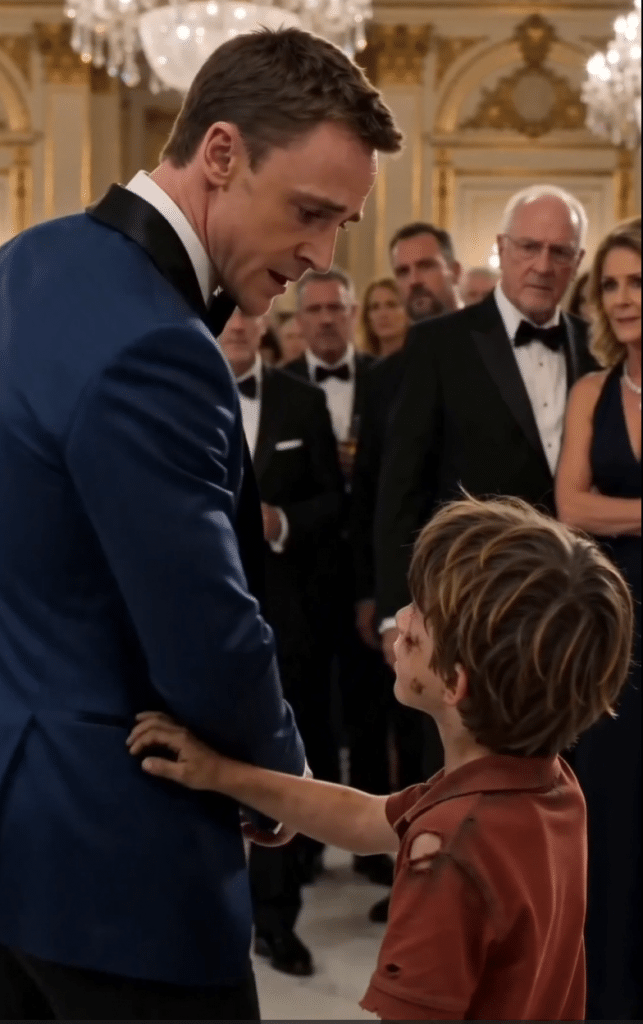
The boy did not belong beneath the chandeliers.
Everyone in the ballroom knew it the moment he stepped onto the marble floor. His red polo shirt was torn at the collar. His hair was messy from wind and rain. Dirt smudged his cheeks, his hands, even the thin wrists poking out from sleeves that should have been retired months ago.
Around him, women in diamonds paused mid-conversation.
Men in tuxedos looked over champagne glasses with the quiet disgust of people who believed poverty was contagious.
The boy ignored them.
He moved through the golden lobby with a strange, determined calm, passing waiters, donors, executives, and socialites until he reached the man standing near the center of the room.
Adrian Vale.
Thirty-six years old. Billionaire hotel heir. The face of the Vale Foundation. A man whose navy tuxedo fit like it had been sewn directly onto power itself.
On his left wrist gleamed a silver Rolex.
The boy stared at it.
Then he reached out with a grimy hand and tugged the back of Adrian’s tuxedo jacket.
Adrian turned.
Security moved instantly, but the boy spoke before anyone could grab him.
“You have a watch like my father’s.”
The room quieted in a ripple.
Adrian looked down at the child. At the torn red shirt. At the dirty face. At the eyes that were too serious for someone so young.
Then he glanced at his watch.
Something small shifted in his expression.
Curiosity first.
Then caution.
“What’s your father’s name?” Adrian asked.
The boy lifted his chin.
“Scott.”
The name landed so softly that most people barely heard it.
But Adrian did.
His entire body froze.
The color left his face. His hand dropped from his glass. The champagne spilled across the marble, but he did not notice. His eyes widened as if the chandeliers, the guests, the music, the whole room had vanished around him.
Only the boy remained.
“What did you say?” he whispered.
“My father’s name is Scott.”
Adrian’s breath caught.
For years, he had trained himself not to react when old memories rose without warning. He had built towers, signed deals, delivered speeches, smiled for magazines, and buried the worst night of his life beneath money, distance, and polished manners.
But one name opened the grave.
Scott.
Adrian sank to one knee.
A gasp traveled through the ballroom.
Slowly, with shaking fingers, he unclasped the Rolex from his wrist. For the first time in over a decade, his skin beneath it looked pale and bare, marked by the shape of something he had never taken off.
He placed the watch into the boy’s small cupped hands.
The child stared down at it, stunned by its weight.
“Keep it,” Adrian said, his voice thick. “Your father saved my life.”
The boy pressed the watch against his chest.
A single tear cut through the dirt on his cheek.
Adrian reached for him then, not caring who watched. He pulled the boy into his arms with a desperate force that made several guests look away. His hands gripped the child’s ragged shirt. His face bent into the boy’s hair.
And for the first time anyone in that room had ever seen, Adrian Vale wept openly.
The boy held him back.
Then he leaned close to Adrian’s ear.
“My dad said…” he whispered, “ask if you still keep promises.”
Adrian went still.
The boy’s voice dropped even lower.
“My dad isn’t dead.”
Act II
Adrian Vale had been nineteen years old the first time Scott Mercer saved him.
Back then, Adrian was not yet the polished man in the magazine profiles. He was a reckless son of wealth, spoiled by comfort and furious at expectations. His father, Conrad Vale, owned half the city’s luxury skyline and expected Adrian to inherit not only the company, but the discipline that came with it.
Adrian inherited the money.
The discipline took longer.
He drank too much. Drove too fast. Mocked board meetings. Disappeared for weekends. He thought consequences were things that happened to people without family attorneys.
Then, one December night, he crashed his car off an icy service road outside one of the Vale construction sites.
The vehicle flipped near an unfinished hotel wing and caught fire before anyone from the main road could see it.
Scott Mercer saw it.
He was a night security supervisor then, thirty-two years old, former military, the kind of man who kept his uniform pressed even when no one important was expected. He had a wife, a baby daughter, and a second child on the way. He worked nights because it paid extra. He carried a cheap thermos and a small silver watch his father had left him.
Scott ran toward the burning car while everyone else shouted for help from a safe distance.
Adrian remembered almost nothing clearly.
Glass.
Smoke.
Heat.
A hand breaking through the window.
A man’s voice saying, “Stay with me, kid.”
Scott dragged him out seconds before the car collapsed inward. He burned his hands badly enough to scar them for life, though he never mentioned that when the newspapers came.
Vale Heir Rescued by Hero Security Guard.
That was the headline.
Conrad hated it.
Not publicly. Publicly, he praised Scott. He called him a brave employee, arranged a photo, handed him an envelope, and promised the Vale family would never forget his service.
Privately, he told Adrian to stop embarrassing him.
Adrian did not listen.
Not at first.
But Scott did something Conrad never had.
He spoke to Adrian like a person who could still become decent.
During the weeks after the accident, Adrian visited the construction site under the excuse of thanking him. In truth, he came because Scott did not flatter him. Scott did not fear him. Scott made coffee on a portable burner, sat on overturned crates, and told Adrian the truth without polishing it.
“You got money,” Scott once said, “but that doesn’t mean you got weight.”
Adrian had frowned. “Weight?”
“Something inside you heavy enough to keep you from floating into stupidity.”
Adrian had laughed then.
Years later, he would understand.
Scott became the first man Adrian tried not to disappoint.
When Adrian left for college, Scott gave him a small card with a phone number written on it.
“If you ever get yourself in real trouble,” Scott said, “call before pride makes it worse.”
Adrian promised he would.
Then, three years later, Scott Mercer died.
At least, that was what everyone was told.
There had been an explosion at the same hotel site, nearly finished by then. A gas leak, the reports said. One night guard lost. Body unrecovered due to the severity of the collapse. Tragic, but accidental.
Conrad handled everything.
The funeral costs.
The press statement.
A quiet settlement with Scott’s widow.
Adrian was twenty-two and still naive enough to believe official grief meant official truth. He stood at the memorial service under black umbrellas and watched Scott’s pregnant wife clutch a folded flag she had no military right to receive but accepted because she had no strength left to question anything.
Her name was Elena.
Her daughter stood beside her.
And in Elena’s arms was a newborn boy Adrian had never seen before.
Caleb.
Adrian promised Elena he would help them.
Whatever they needed.
School. Rent. Medical bills. Anything.
But promises made in grief are easy to speak and hard to honor when powerful people want silence.
Within months, Elena Mercer disappeared from Adrian’s life.
Phone disconnected.
Apartment empty.
Letters returned.
Conrad told Adrian she had moved away with the children and wanted privacy.
“She resents us,” Conrad said. “Let the family grieve without your guilt making it worse.”
Adrian wanted to believe him.
So he did.
He built a life on the ruins of that choice.
And for fourteen years, the watch on his wrist reminded him of a dead man.
Until a hungry boy in a torn red shirt walked into a ballroom and told him the dead man had sent a message.
Act III
The boy’s name was Caleb Mercer.
He was nine years old, though hunger made him look younger in some lights and fear made him look older in others. He did not cry after whispering the words. He simply stood in front of Adrian while the ballroom blurred around them.
Security hovered nearby.
Adrian lifted one hand without looking at them.
“Don’t touch him.”
The authority in his voice stopped everyone.
Adrian led Caleb out of the ballroom and into a private lounge behind the lobby. The music faded behind closed doors. The chandeliers became muffled gold through frosted glass.
Caleb sat on the edge of a velvet chair, clutching the Rolex like someone might steal it back.
Adrian knelt in front of him again.
“Where is your father?”
Caleb swallowed.
“He said not to say in front of people.”
“Is he hurt?”
The boy’s eyes flickered.
“He’s sick.”
Adrian felt the room tilt.
“Where is your mother?”
Caleb looked down.
“She died last winter.”
The sentence was quiet, but it struck harder than any accusation.
Adrian closed his eyes.
Elena.
The widow he had promised to protect.
The woman his father had convinced him to leave alone.
Dead.
“And your sister?” Adrian asked.
Caleb’s mouth tightened.
“With Mrs. Bell. She watches us sometimes. But Dad said I had to find you tonight because tonight was the only time I could get close.”
“How did you know I’d be here?”
Caleb reached beneath his shirt and pulled out a folded piece of paper wrapped in plastic.
It was soft from being carried too long.
Adrian unfolded it carefully.
Inside was an old photograph.
Adrian at twenty-two, standing beside Scott at the construction site. Scott had one arm thrown around him, grinning like a man who believed the boy beside him could still become something good.
On the back, in Scott’s handwriting, were six words.
Adrian Vale. Ask if he remembers.
Adrian’s hands began to shake.
Caleb watched his face closely.
“My dad said you made a promise,” he said.
“I did.”
“He said he waited.”
Adrian could not speak.
“He said he didn’t blame you at first. Then Mom got sick. Then we lost the apartment. Then he said maybe you never got the letters.”
“What letters?”
Caleb reached into his pocket and pulled out another envelope, folded small. Inside were copies of three letters, all addressed to Adrian at Vale headquarters.
Scott’s handwriting.
The dates spanned years.
I am alive.
Conrad lied.
I need help.
Adrian read the words once.
Then again.
The room seemed to lose air.
“My father got these,” he whispered.
Caleb nodded.
“Dad said he thinks so.”
Adrian stood abruptly and walked to the window. Outside, the city glittered with cold indifference. In the reflection, he saw himself in the navy tuxedo, rich and immaculate, while a child sat behind him with dirt on his hands and an impossible message in his pocket.
For the first time, Adrian understood that guilt had been too small a word.
He had not merely failed to find Scott.
He had inherited the life built over Scott’s disappearance.
The hotels.
The contracts.
The foundation galas.
The reputation for charity.
All of it standing on ground that suddenly felt rotten beneath the marble.
“Caleb,” he said, turning back. “Tell me where your father is.”
The boy hesitated.
Adrian softened his voice.
“I won’t let anyone take him.”
Caleb stared at him for a long moment.
Then he said, “Under the old Vale theater. In the basement.”
Adrian knew the place.
Everyone in the family knew it.
The Marlowe Theater had been abandoned for years, owned by a Vale subsidiary and left untouched because Conrad refused to sell it. Adrian had never understood why his father cared about a ruined building in a forgotten part of town.
Now he did.
Before Adrian could ask another question, the lounge door opened.
Conrad Vale stepped inside.
Seventy years old. Silver hair. Black tuxedo. A smile that had disciplined rooms for half a century.
His eyes moved from Adrian to the boy.
Then to the Rolex in Caleb’s hands.
For one brief second, Conrad’s face showed naked fear.
Then the mask returned.
“Adrian,” he said smoothly, “what is this child doing with your watch?”
Caleb shrank into the chair.
Adrian stepped between them.
And suddenly, the promise he had broken years ago began to burn back to life.
Act IV
Conrad closed the lounge door behind him.
The click sounded final.
“Send the boy away,” he said.
Adrian stared at his father. “You knew.”
Conrad’s expression hardened.
“Lower your voice.”
“You knew Scott was alive.”
Conrad looked toward Caleb with irritation, not surprise. That was answer enough.
Adrian felt something inside him snap cleanly.
“What did you do?”
“I protected this family.”
“No,” Adrian said. “What did you do?”
Conrad stepped closer, his voice dropping into the tone he used in boardrooms before destroying people politely.
“Scott Mercer was going to ruin us. He found records at the hotel site. Bribes. Safety violations. Payments that would have destroyed thousands of jobs and your future with them.”
“He saved my life.”
“And then he became inconvenient.”
The sentence was so cold that even Conrad seemed to hear it after he spoke.
Caleb clutched the watch tighter.
Adrian’s face went pale with fury.
“You let the world think he died.”
“I offered him money.”
“You buried an empty grave.”
“I gave his wife enough to disappear.”
“She died poor.”
Conrad’s jaw moved.
For the first time, he had no polished answer ready.
Adrian moved toward the door.
Conrad grabbed his arm. “Think carefully. Everything you are exists because I made hard decisions.”
Adrian looked down at his father’s hand.
Then back at his face.
“No,” he said. “Everything I am is what happened while I was too afraid to question them.”
He pulled free.
Conrad’s voice sharpened. “If you walk out now, you are choosing a dead guard’s family over your own blood.”
Adrian opened the door.
“He’s not dead.”
The ballroom was still full when Adrian stepped back into it with Caleb beside him.
Every conversation died.
Conrad followed, smiling too tightly, trying to reclaim the room through posture alone.
Adrian did not go to the exits.
He went to the stage.
The foundation gala had been arranged to honor the Vale family’s “legacy of service.” A gold podium stood beneath a banner bearing his name. Behind it, a giant screen waited for the evening’s tribute video.
Adrian took the microphone.
His event director shook her head frantically from the side.
He ignored her.
“Ladies and gentlemen,” he said.
The room settled into confused silence.
Caleb stood beside the stage steps, barefoot in one shoe and one sock, the Rolex still pressed to his chest.
Adrian looked at him.
Then at the guests.
“Fourteen years ago, a man named Scott Mercer saved my life. My family called him a hero in public.”
Conrad’s face tightened.
“In private, we let him disappear.”
A murmur rolled through the ballroom.
Adrian continued before fear could stop him.
“I was told he died in an accident. Tonight, his son found me and told me the truth. Scott Mercer is alive.”
Gasps broke across the room.
Conrad moved toward the stage. “Adrian, stop.”
Adrian looked down at him.
“No.”
A single word.
A lifetime late.
But it landed.
Adrian pulled the folded letters from his pocket and held them up.
“These letters were sent to me. I never received them. Someone made sure of that.”
Conrad’s eyes turned flat and dangerous.
“You have no idea what you’re doing.”
Adrian’s voice shook now, but not from weakness.
“Yes, I do. For the first time in my life.”
He turned to the head of security.
“Call Detective Maren. Tell her to meet me at the Marlowe Theater. Now.”
The room erupted.
Guests whispered. Phones appeared. Conrad barked orders that no one obeyed quickly enough. Years of fear still lived in the staff, but something stronger had entered the room.
Witnesses.
Within minutes, Adrian was outside in the cold, tuxedo jacket open, Caleb wrapped in a hotel blanket beside him. A black SUV pulled to the curb.
Caleb hesitated at the door.
“What if he’s gone?” he asked.
Adrian crouched in front of him.
The question was not childish.
It was the question of someone who had learned that adults arrived too late.
Adrian placed one hand over the boy’s dirty fingers.
“Then I’ll keep looking.”
Caleb searched his face.
“You promise?”
Adrian looked at the bare pale mark on his wrist where the watch had been.
This time, the word did not come easily.
That was how he knew it mattered.
“I promise.”
Act V
The Marlowe Theater smelled of wet brick, dust, and old secrets.
Police lights washed the alley red and blue as officers forced open the basement entrance beneath the ruined marquee. Adrian stood behind the line with Caleb pressed close to his side, the boy’s breathing shallow and fast.
Conrad had not come.
That frightened Adrian more than if he had.
Men like his father rarely ran unless they believed the room had already turned against them.
The detectives entered first.
Then came the waiting.
Five minutes.
Ten.
Fifteen.
Caleb did not speak. He only held the Rolex with both hands, as if the watch were a prayer made of steel.
At last, a voice came from below.
“We’ve got someone!”
Caleb surged forward, but Adrian caught him gently.
A stretcher emerged from the basement.
The man on it looked nothing like the hero from the photograph.
Scott Mercer was thin, bearded, and gray at the temples. His face had the worn look of someone who had spent years surviving on stubbornness alone. But his eyes were open.
And when they found Caleb, they filled with tears.
“Dad!”
The boy broke free.
The officers tried to stop him, then let him pass.
Caleb threw himself against Scott’s side, careful and desperate at once. Scott lifted one weak arm and wrapped it around his son.
“My brave boy,” Scott whispered.
Adrian stood frozen.
For fourteen years, Scott Mercer had existed in his memory as a dead man beneath rain and funeral flowers.
Now he was breathing in front of him.
Alive.
Stolen.
Waiting.
Scott’s eyes moved to Adrian.
For a moment, neither man spoke.
Adrian stepped closer, his tuxedo shoes sinking into dirty slush.
“I’m sorry,” he said.
It was not enough.
They both knew it.
Scott looked at him for a long time.
Then his gaze dropped to Adrian’s bare wrist.
“Caleb found you.”
Adrian nodded.
“He did.”
Scott closed his eyes briefly.
“I told him you’d remember.”
Adrian’s voice broke. “I should have remembered sooner.”
Scott did not absolve him.
That would have been too easy.
But he reached out his hand.
Adrian took it with both of his.
The old scars on Scott’s fingers were still there, pale and raised from the night he had pulled Adrian out of the fire. Adrian held that hand and finally understood the full shape of his debt.
Not money.
Not charity.
Truth.
The investigation that followed tore through the Vale empire like winter through thin cloth.
The Marlowe basement contained files Conrad had kept hidden for years: forged death reports, payoff ledgers, private security contracts, and records of illegal confinement disguised through shell companies. Scott had not been trapped there the whole time. He had been moved between properties, threatened, drugged, dismissed as unstable whenever he tried to escape.
Conrad’s mistake had been assuming poverty made people invisible forever.
But Caleb had watched. Listened. Remembered names. Followed delivery men. Learned which hotel hosted the richest gala of the year.
Then he walked through the front door with nothing but a photograph and hope.
Conrad Vale was arrested two days later at a private airfield.
He said nothing when cameras caught him.
For the first time in his life, silence did not protect him.
Adrian resigned from the board of the Vale Group before anyone could ask him to. He turned over documents, gave testimony, and signed away portions of his inheritance into a restitution trust for Scott, Caleb, Caleb’s sister Nora, and the families harmed by Conrad’s buried crimes.
Reporters called it a dramatic fall.
Adrian hated that phrase.
A fall made it sound sudden.
This was a descent that had begun years ago, one compromise at a time.
Scott spent six weeks in the hospital. Caleb visited every day, wearing clean clothes he did not yet trust and carrying the Rolex in a small blue pouch. Nora, twelve years old and thin from too many hard seasons, arrived from Mrs. Bell’s apartment and sobbed when she saw her father alive.
Adrian stayed outside the room at first.
He paid bills.
Handled attorneys.
Answered detectives.
But he did not assume he had earned a place near the bed.
One afternoon, Scott asked for him.
Adrian entered quietly.
Scott sat propped against pillows, Caleb asleep in a chair beside him, one hand still wrapped around the pouch holding the watch.
“You look terrible in guilt,” Scott said.
Adrian almost laughed, but it came out broken.
“I deserve worse.”
“Probably.”
The honesty hurt. It also steadied him.
Scott looked toward the window.
“Elena wrote to you for years.”
“I know.”
“She believed you’d come.”
Adrian lowered his head.
“I didn’t.”
“No,” Scott said. “You didn’t.”
The room went quiet.
Then Scott turned back to him.
“But Caleb did.”
Adrian looked at the sleeping boy.
“He saved me,” Scott said. “Not you. Not your money. Him.”
“I know.”
“So don’t make this about paying me back.”
Adrian swallowed.
“What should I make it about?”
Scott’s eyes sharpened with a trace of the man from the photograph.
“Keeping the promise right this time.”
Months later, the Vale Foundation held no gala.
No chandeliers.
No champagne.
No black-tie speeches beneath banners.
Instead, Adrian stood in the restored lobby of the Marlowe Theater, now converted into a legal and housing center for families displaced by corporate abuse. The marble had been cleaned but not replaced. The old brick remained visible in places, a reminder that beauty meant nothing if it required hiding the damage underneath.
Scott arrived with Caleb and Nora just before the doors opened.
He walked with a cane.
Slowly.
Proudly.
Caleb wore a blue sweater, new sneakers, and the silver Rolex on his wrist even though it was far too big. It slid toward his hand every few steps, and he kept pushing it back with great seriousness.
Adrian smiled when he saw it.
“That’s still too heavy for you.”
Caleb lifted his chin.
“I’m growing into it.”
Scott laughed softly.
Adrian felt the sound like forgiveness beginning somewhere far away, not yet close enough to hold, but real enough to follow.
During the opening ceremony, Adrian did not speak first.
Scott did.
He stood at the podium beneath the restored theater lights and looked out at a crowd of families, workers, lawyers, former Vale employees, and reporters who had come expecting scandal but found something quieter.
“My son found the man I told him to find,” Scott said. “But what he really found was the truth. And truth, once it gets inside a locked room, has a way of breaking the door.”
Caleb sat in the front row, swinging his feet.
Adrian stood at the side, his left wrist still bare.
He had never replaced the watch.
People asked him why.
He never gave the full answer.
Because the mark it left reminded him that comfort could become cowardice.
Because a promise was not something you wore.
Because a child with dirt on his face had walked into a room full of wealth and carried more honor than anyone under the chandeliers.
After the ceremony, Caleb ran up to Adrian and held out his wrist.
“Can you fix it again? It’s loose.”
Adrian knelt, just as he had in the ballroom months before.
This time, no one gasped.
He adjusted the clasp carefully.
Caleb watched him.
“My dad says you’re trying,” the boy said.
Adrian looked up.
“I am.”
“Trying counts?”
Adrian glanced at Scott, who stood near the doors with Nora beside him.
“Only if you keep doing it.”
Caleb considered this seriously.
Then he nodded.
Outside, evening settled over the city. The lights came on one by one, not golden and blinding like the ballroom chandeliers, but warm enough to guide people home.
Adrian stepped out onto the sidewalk beside Scott.
For a moment, they stood in silence.
Fourteen lost years between them.
One impossible second chance ahead.
Scott looked at Adrian’s bare wrist.
“You gave him the watch.”
“It was never really mine,” Adrian said.
Scott did not answer immediately.
Then he placed a scarred hand on Adrian’s shoulder.
“No,” he said. “But the promise is.”
Across the lobby, Caleb laughed as Nora chased him between the rows of folding chairs, the oversized Rolex flashing silver on his wrist.
Adrian watched the boy who had walked into a ballroom as if he had nothing, when in truth he had carried the one thing no fortune could buy.
A message from the past.
A father’s faith.
And the power to make a rich man remember who he was supposed to become.