Act I
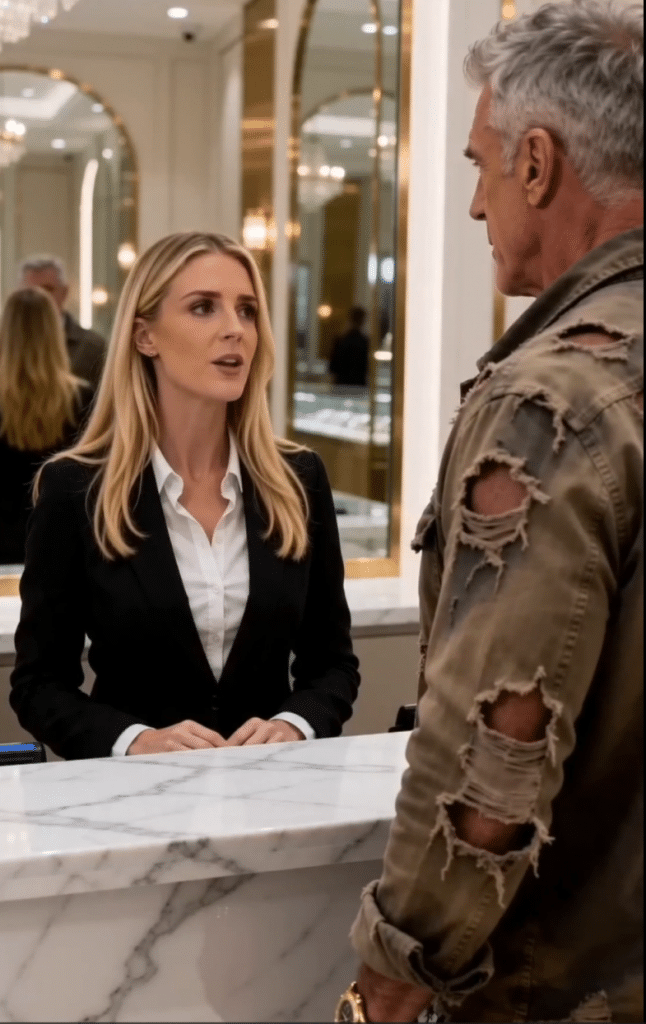
The old man looked out of place the moment he stepped into the boutique.
Everything around him was polished to perfection. White marble floors. Gold-trimmed walls. Crystal lighting designed to make every watch behind the glass shimmer like treasure. Even the mirrors were arched and elegant, reflecting a world where people did not walk in unless they knew exactly how much they were worth.
He wore a ripped olive-brown jacket.
The sleeves were frayed. One shoulder had a tear near the seam. His shoes were clean but old, the kind of shoes a man kept repairing because buying new ones felt wasteful.
At the center counter, Clarissa Vane looked up from the appointment tablet.
Her smile disappeared.
She was blonde, polished, and perfectly dressed in a black blazer with a white shirt so crisp it looked untouched by real life. Her eyes moved over the man once, from his worn jacket to his weathered hands, and she made her decision before he spoke.
The old man approached the marble counter calmly.
“Good afternoon,” he said. “I have an appointment.”
Clarissa did not even reach for the tablet.
“I’m sorry,” she said, though nothing in her voice sounded sorry. “We don’t serve people like you here.”
The boutique went quiet.
A young couple near the diamond collection paused. A businessman pretending to inspect a rose-gold chronograph looked up. Behind the counter, another receptionist froze with a stack of catalogues in her arms.
The old man blinked once.
Not offended.
Not angry.
Just disappointed, as if he had hoped the world might be better than it was.
“But I have an appointment,” he repeated gently.
Clarissa’s lips tightened.
“With us?”
“Yes.”
She gave a small laugh, the kind designed to make everyone nearby understand he had become a joke.
“Sir, this is a private luxury boutique. Our clients schedule weeks in advance. They arrive appropriately. They understand the environment.”
The old man glanced down at his jacket.
Then, almost unconsciously, he touched the gold watch on his left wrist.
It was beautiful. Heavy. Old. The kind of watch that did not beg for attention because it already knew its value.
Clarissa saw it.
For half a second, uncertainty crossed her face.
Then pride swallowed it.
“Counterfeit pieces are not uncommon,” she said quietly.
The old man’s hand lowered.
A few guests looked away, embarrassed on his behalf but not brave enough to interfere.
Then a second woman stepped from behind the side counter.
Her name was Maya Bennett.
She was brunette, younger than Clarissa, wearing a white button-down shirt and black skirt. She had been hired only three weeks earlier and still carried herself with the nervous care of someone who needed this job more than she wanted anyone to know.
She walked directly to the old man and placed a gentle hand on his arm.
“Sir,” she said softly, “please, let me help you.”
Clarissa turned sharply.
“Maya.”
But Maya did not move.
The old man looked at her.
For the first time since entering the boutique, his face softened.
“Thank you,” he said.
Maya smiled.
“May I have your name for the appointment?”
The old man held her gaze for a long moment.
“Arthur,” he said. “Arthur Belmont.”
Clarissa’s expression changed so quickly it almost cracked.
But by then, it was already too late.
The man she had tried to throw away had just given the name on the building.
Act II
Belmont & Co. was not just a watch boutique.
It was a dynasty.
Three generations of craftsmanship, auctions, private collectors, royal clients, and timepieces locked in vaults with security codes longer than phone numbers. People did not simply shop there. They were approved there.
Clarissa believed that approval began with appearances.
She had built her entire career on recognizing expensive fabric from across a room. She knew the difference between new money and old money by the way a man held his shoulders. She could spot a borrowed handbag, a rented tuxedo, a nervous husband trying to impress his wife.
And she hated anyone who made the store feel accessible.
To Clarissa, luxury was not service.
It was a gate.
Maya had learned luxury differently.
Her mother had cleaned hotel rooms for thirty years and polished marble floors she would never walk across as a guest. Her father had been a watch repairman in a small neighborhood shop where people brought broken clocks, cracked straps, and old wristwatches that mattered more than money.
He used to tell Maya, “A watch tells time. But the person wearing it tells the story.”
When he died, he left her nothing expensive. Just his loupe, his repair tools, and a habit of treating every object like it had passed through someone’s heart before reaching her hands.
That was why she noticed what Clarissa ignored.
Arthur Belmont’s jacket was ragged, yes.
But his posture was not.
He did not shuffle like a man begging to be allowed inside. He stood like someone who had survived enough storms to no longer fear weather. His hands were calloused, but steady. His eyes moved around the boutique with recognition, not wonder.
And his watch was not counterfeit.
Maya knew it the second she saw the case shape.
A Belmont Heritage 1969.
Only twelve existed.
Her father had once shown her a magazine clipping of that exact model and told her the story. The first one had been assembled by Theodore Belmont for his son Arthur, back when the company still operated from a narrow workshop behind a train station.
It was not just rare.
It was family history.
Maya felt her pulse jump, but she did not say anything. Not yet.
She simply guided Arthur toward the display cases with the same warmth she would have offered anyone.
“Were you looking for something specific today, Mr. Belmont?” she asked.
Behind them, Clarissa stood rigid at the counter.
The businessman by the chronographs had stopped pretending not to listen.
Arthur walked slowly beside Maya, passing rows of watches worth more than most homes. Platinum tourbillons. Diamond-set complications. Limited editions displayed beneath glass like museum relics.
“Tell me,” Arthur said, “which piece do clients ask to see most often?”
Maya considered the question carefully.
“The most expensive one, usually,” she said. “But not always for the right reasons.”
Arthur’s eyes warmed.
“And what is the right reason?”
Maya looked down at the watches.
“When someone chooses one because it means something. A promotion. A wedding. A second chance. A promise they want to remember every time they check the hour.”
Arthur stopped walking.
For a moment, the glittering boutique seemed to fall away from him.
Maya worried she had said too much.
“My father repaired watches,” she explained. “He believed people don’t really buy timepieces. They carry memories.”
Arthur looked at her then, and the disappointment Clarissa had put in his eyes began to fade.
“What was your father’s name?”
“Samuel Bennett.”
Arthur went still.
Maya noticed.
“You knew him?”
Arthur turned his wrist slowly, revealing the gold watch more clearly.
“He serviced this piece once,” he said. “Many years ago.”
Maya’s throat tightened.
Her father had told her that story too, though he never used the client’s name. Only that an old man came into his tiny shop with a priceless watch and asked to be treated like a regular customer.
“He said the gentleman tipped him with a handwritten note,” Maya whispered.
Arthur smiled faintly.
“Your father refused the money.”
“He said respect wasn’t something he charged extra for.”
Arthur nodded.
“No. He didn’t.”
Across the boutique, Clarissa’s face had lost all color.
She finally reached for the tablet and typed Arthur’s name.
The appointment appeared immediately.
Arthur Belmont. Founder. Private Review.
Her fingers froze above the screen.
Private Review.
Not a shopping appointment.
An inspection.
A test.
And she had failed before it had even begun.
Act III
Arthur Belmont had not planned to reveal himself immediately.
That was the entire point.
For the last two years, he had watched his company change into something he barely recognized. Sales had risen. Social media attention had exploded. The boutiques looked more expensive than ever.
But the complaints had changed too.
A retired teacher ignored at the front door until her wealthy son arrived.
A young athlete asked three times if he was “sure” he could afford a model he had already reserved.
A grieving widow treated like a nuisance when she came in to repair her late husband’s watch because it was not one of the boutique’s newest pieces.
Each complaint reached Arthur’s desk.
Each one hurt more than the last.
He had built Belmont & Co. on patience, craft, and service. His father had taught him that a person walking through the door was never just a transaction. Maybe they were celebrating. Maybe they were mourning. Maybe they had saved for ten years.
Maybe they were wearing a torn jacket because the most precious thing they owned was not their clothing, but the memory on their wrist.
Arthur knew that better than anyone.
The gold watch he wore had belonged to his wife, Elena, in a way no legal document could explain.
He had received it from his father at twenty-one, but Elena was the one who made it matter. She had worn it during their poorest years, when the company was almost bankrupt and Arthur had sold his car to pay employees. She used to joke that the watch was heavier than their savings account.
When Elena got sick, she made him promise something.
“Never let this company become cruel,” she told him from a hospital bed, her fingers thin around his. “Luxury without kindness is just expensive emptiness.”
After she died, Arthur tried to keep that promise.
But grief made men tired.
He stepped back. Let executives run things. Let managers chase numbers. Let people like Clarissa rise because they sold well, smiled beautifully, and made wealthy clients feel superior.
Then one morning, Arthur read a complaint written by an old veteran who had been asked to leave the flagship boutique because his coat smelled faintly of rain.
The man had come in to repair the watch his wife gave him before his first deployment.
Arthur closed the report and sat alone for a long time.
Then he took an old jacket from the back of his closet.
He made the appointment under his real name, knowing any employee who cared to check would see it.
Clarissa had not checked.
Maya had not needed to.
Arthur stopped in front of the central display case, where the boutique’s most expensive watch sat beneath a halo of light.
The Belmont Astral Regent.
White gold. Hand-set diamonds. Midnight-blue dial. A mechanism so complex it took eighteen months to assemble.
Price available upon request.
Clarissa had shown it only to clients who arrived in private cars.
Arthur pointed to it.
“That one,” he said.
Maya blinked.
“The Astral Regent?”
“Yes.”
She glanced at him, still professional, still careful.
“Would you like to view it in the private salon?”
“No.”
Arthur’s voice remained calm.
“I’ll take it.”
Maya’s lips parted.
The couple near the diamond case whispered. The businessman lowered his phone. Clarissa stepped away from the counter as if pulled by a rope.
Arthur turned to Maya.
“And credit it to your sales.”
Maya stared at him.
“Sir, I didn’t do anything except help you.”
“That,” Arthur said, “is exactly what you did.”
Tears gathered in her eyes before she could stop them.
For weeks, Clarissa had made her feel small. Corrected her tone. Mocked her plain shoes. Told her kindness was not a sales strategy. Told her people like Maya needed to toughen up or leave luxury to those who understood it.
Now the most powerful man in the company was standing beside her, saying the opposite.
Arthur looked back toward the counter.
“Let’s process the payment.”
Clarissa rushed behind the marble station, her hands shaking as she tried to recover some version of herself.
“Mr. Belmont,” she began, voice suddenly sweet. “There seems to have been a misunderstanding.”
Arthur walked toward her.
“No,” he said. “There was understanding. That was the problem.”
The silence became unbearable.
Then he reached into the inner pocket of his torn jacket and pulled out a card.
Gold.
Not gold-colored.
Gold.
The Belmont Founder’s Card, issued only once, coded to the private accounts of the family office. Every senior employee knew about it. No one below executive level had ever seen it in person.
Arthur placed it on the marble counter.
The sound was soft.
But Clarissa flinched as if it had struck her.
And at last, every person in the boutique understood the reversal had only just begun.
Act IV
Clarissa stared at the card.
Her mouth opened, but no words came out.
All the confidence that had made her cruel began to drain away under the lights she once believed belonged to people like her. Her reflection stared back from the arched mirror behind Arthur, pale and frightened, framed by gold trim she no longer looked worthy to stand beneath.
Arthur did not raise his voice.
He did not need to.
“Process the payment,” he said.
Clarissa reached for the card with trembling fingers.
The machine accepted it instantly.
A receipt printed.
The total was so large that Maya looked away, embarrassed by the number even though it now carried her name as the credited associate.
Clarissa placed the receipt on the counter.
“Mr. Belmont,” she whispered, “I am deeply sorry.”
Arthur looked at her for a long moment.
“Are you sorry because you judged a man by his clothes,” he asked, “or because the man owned the store?”
Clarissa’s face crumpled.
No one moved.
Maya stood near the display case with both hands clasped tightly in front of her, torn between pity and justice. She had been humiliated by Clarissa enough times to imagine this moment differently. She had imagined satisfaction.
But seeing it happen in real life felt heavier.
Arthur continued.
“When I walked in, I told you I had an appointment. You did not check. You saw a torn jacket and decided I was not a person worth serving.”
Clarissa swallowed.
“I made a mistake.”
“No,” Arthur said. “A mistake is typing the wrong client name. What you did was a choice.”
The words landed with quiet force.
He turned slightly, addressing not just Clarissa but everyone in the boutique.
“This company sells watches. But what we truly sell is trust. A client leaves us with an heirloom, an anniversary, a memory, a dream. If we make dignity conditional on appearance, then we are not a luxury house. We are a costume shop with security lights.”
The businessman by the chronographs lowered his gaze.
The young couple said nothing.
Even the security attendant near the entrance stood straighter.
Clarissa’s eyes filled.
“Please,” she said. “I need this job.”
Arthur’s expression shifted, but did not soften fully.
“I believe you need the lesson more.”
He picked up the receipt.
Then he looked directly at her.
“You can leave now.”
Clarissa’s breath hitched.
“Mr. Belmont—”
“Your access will be deactivated before you reach the staff room. Human resources will contact you regarding final paperwork.”
It was final.
Not loud.
Not dramatic.
Worse.
Final.
Clarissa stepped back from the counter as if the marble itself had rejected her. She looked once at Maya, and for a second, there was no arrogance left in her face. Only humiliation.
Maya did not smile.
That may have hurt Clarissa more.
She walked toward the staff room with her shoulders low, passing the same glass cases she had once guarded like they were proof of her superiority.
When she disappeared, the boutique remained silent.
Arthur turned to Maya.
“I apologize for making you part of a test you did not know you were taking.”
Maya blinked away tears.
“Did I pass?”
Arthur’s face softened.
“You reminded me what this place was supposed to be.”
He removed the gold watch from his wrist.
Maya’s eyes widened.
“Sir?”
Arthur held it carefully, as if it were alive.
“This was the first watch my father gave me. Your father repaired it once when I could barely afford the service. He treated me with respect before he knew my name mattered.”
He placed the watch in her hands.
Maya almost stepped back.
“I can’t take this.”
“You’re not taking it,” Arthur said. “You’re carrying it to the service room. I want you to document it for restoration training. Every new employee will study it.”
Maya looked down at the worn gold case, at the small scratches no polishing could erase.
“And what will they learn?”
Arthur glanced toward the door Clarissa had used.
“That the most valuable thing in this building may not look new. And the most important client may not look rich.”
Maya held the watch with both hands.
For the first time since she had started working there, she did not feel like an outsider trying to earn her place.
She felt like someone her father would have been proud of.
Then Arthur gave her one more instruction.
“Lock the front door for ten minutes,” he said. “We’re going to have a staff meeting.”
And every employee in the boutique knew the old world had just ended.
Act V
By the next morning, the story had already escaped the boutique.
Not because Arthur leaked it.
He hated publicity built on humiliation. But one of the clients had recorded enough of the exchange for the truth to travel. By sunrise, luxury blogs were whispering. By noon, business reporters were calling. By evening, the phrase “people like you” had become a headline the company could not ignore.
Arthur released only one statement.
Belmont & Co. will never measure a person’s worth by the clothes they wear. We failed our own standard. We are correcting it.
Inside the company, the correction was not symbolic.
Arthur returned to work.
Not as a distant founder whose portrait hung in boardrooms, but as a living presence. He visited boutiques unannounced. He rewrote service policies. He removed managers who rewarded snobbery and promoted those who understood patience.
Every employee, from sales directors to security staff, had to complete a new training program.
Maya helped design it.
At first, she resisted.
“I’m not qualified,” she told Arthur.
He gave her a familiar look.
“That is what people say when they have spent too long being underestimated.”
So she stayed late after shifts, writing what her father had taught her in simple, steady language.
Greet the person before you assess the purchase.
Ask why the piece matters.
Never confuse wealth with worth.
Never make someone prove they deserve respect.
Arthur read the pages without speaking. When he finished, he removed his glasses and folded them slowly.
“Samuel Bennett raised you well,” he said.
Maya looked down.
“He would have loved this place,” she whispered. “Not the marble. Not the gold. The watches.”
Arthur smiled sadly.
“Then let’s make it a place he could love.”
The Astral Regent sale changed Maya’s life overnight, but not in the way people expected.
Yes, the commission paid off her mother’s medical debts and the last loan from her father’s repair shop. Yes, it let her replace her worn shoes, though she still kept the old pair in her closet as a reminder. Yes, people who once ignored her suddenly remembered her name.
But the money was not what stayed with her.
What stayed was the moment Arthur handed her his father’s watch.
The trust of it.
The weight of it.
The proof that dignity, once given, could become inheritance too.
Three months later, Belmont & Co. reopened the flagship boutique after a quiet renovation.
The marble floors remained. The gold panels remained. The arched mirrors still caught the light in elegant curves. But something had changed near the entrance.
A small plaque had been installed beside the door.
It did not list prices, awards, or famous clients.
It read:
Every person who enters here carries a story. Serve the story first.
Below it, in smaller letters, was a name.
Samuel Bennett.
Maya stood in front of the plaque the morning it was unveiled, unable to speak.
Arthur stood beside her in a dark suit this time, though he still wore the repaired gold watch on his wrist. The torn jacket was gone, but not forgotten. He had framed a small piece of its fabric in the training room, where new employees would see it before they saw a single sales chart.
“Your father’s words deserved a place here,” Arthur said.
Maya wiped her cheek quickly.
“He would say you’re being too sentimental.”
Arthur chuckled.
“He would be right.”
Later that day, the first client after reopening walked in.
An elderly woman in a faded blue coat.
She stood just inside the entrance, uncertain, clutching a small velvet pouch in both hands. Her eyes moved over the chandeliers, the glass cases, the marble floor. She looked ready to apologize for taking up space.
Maya approached her with a warm smile.
“Good morning,” she said. “Welcome to Belmont & Co.”
The woman swallowed.
“I don’t know if this is worth anything,” she said, opening the pouch. “It was my husband’s. It stopped working last winter.”
Inside was a scratched old watch with a cracked crystal and a strap that had been repaired more than once.
Maya did not glance at the woman’s shoes.
She did not judge the coat.
She did not ask if the woman had an appointment before deciding whether kindness was appropriate.
She held out both hands.
“May I see it?”
The woman placed the watch in her palms.
“It isn’t fancy.”
Maya looked at the worn case, the aged dial, the tiny marks left by years of ordinary living.
Then she thought of her father.
She thought of Arthur in his ripped jacket.
She thought of Clarissa’s cold voice and the silence that had followed.
Most of all, she thought of how close the boutique had come to forgetting what time was supposed to mean.
“It’s his,” Maya said gently. “That makes it important.”
The woman’s eyes filled.
Across the room, Arthur watched from near the central counter.
He said nothing.
He did not need to.
The lesson had survived him.
That evening, after the boutique closed, Maya placed the elderly woman’s watch in the service tray beside Arthur’s restored Heritage 1969. One was worth a fortune. The other might never appear in an auction catalogue.
Under the soft workroom light, they looked strangely equal.
Two lives measured in seconds.
Two stories waiting to be honored.
Arthur stepped into the doorway.
“You understand now,” he said.
Maya looked up.
“Understand what?”
He tapped the gold watch on his wrist.
“Why I wore the old jacket.”
Maya smiled faintly.
“To expose Clarissa?”
“No,” Arthur said. “She exposed herself.”
He looked out through the glass wall toward the quiet boutique, where chandeliers reflected in empty display cases.
“I wore it because I needed to know whether my company still had a soul.”
Maya followed his gaze.
“And did it?”
Arthur looked at her.
“It does now.”
The next morning, Maya arrived early.
She unlocked the door, turned on the lights, and watched the watches awaken one by one beneath the glass. Gold, steel, platinum, leather, diamonds. Each one catching the light differently.
Outside, people passed on the sidewalk in suits, uniforms, old coats, running shoes, work boots.
Any one of them could walk in.
Any one of them could carry a story.
And this time, the boutique was ready.