Act I
The hallway went silent before Marcus even reached the lockers.
At Westbrook Academy, silence was not unusual. The students had been trained into it from seventh grade: quiet shoes on polished floors, quiet voices beneath yellow banners, quiet respect for the kind of tradition that hung above them like a chandelier.
But this silence was different.
It had weight.
Marcus walked down the center of the hallway in khaki trousers, white sneakers, and a navy blue varsity jacket trimmed in gold. Across his chest, the Westbrook Tigers emblem caught the morning light. Around his neck hung a large gold medal on a blue ribbon, heavy enough to knock softly against the zipper with every step.
Students lined both sides of the hallway.
Some smiled.
Some whispered.
Most just watched.
Then Miss Davis stepped in front of him.
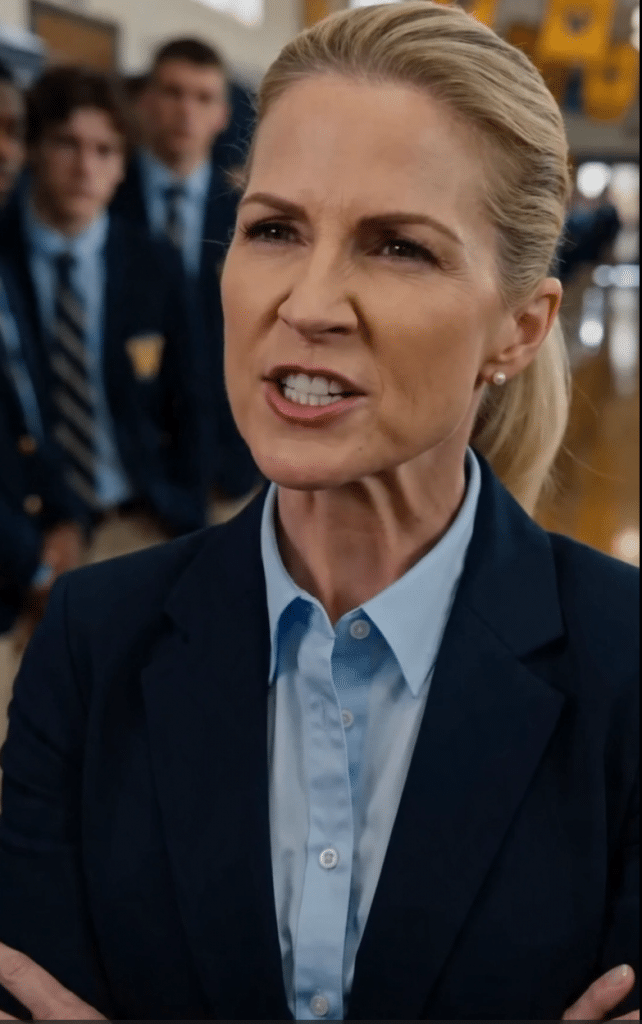
She wore her navy suit like armor, her blonde hair pulled so tightly back that not a strand dared move. Her arms crossed over her chest. Her eyes dropped to the jacket, then to the medal, then back to his face.
“Marcus,” she said sharply, “where did you get that jacket?”
Marcus stopped.
Not stumbled. Not shrank.
Stopped.
“It’s my jacket, Miss Davis,” he said.
A few students exchanged looks.
Miss Davis gave a thin smile that was not a smile at all.
“Westbrook Tigers jackets are only given for exceptional achievement.”
The words traveled down the hallway like a slap no one wanted to admit they heard.
Marcus’s hand tightened around the black leather-bound book he carried at his side. It was old, older than anything in that shining hallway, with worn corners and a brass clasp dulled by years of touch.
He lifted it calmly to his chest.
For one second, he held it there.
Not like a shield.
Like proof.
Then he lowered it again.
Miss Davis’s eyes narrowed. She did not look at the book. She looked at him, as if waiting for him to apologize for standing in a place she had already decided he did not belong.
Marcus glanced at the rows of students.
The banners overhead.
The tiger logo stitched above his heart.
Then he looked back at her.
“Yeah,” he said. “I got it for exactly that.”
Something flickered across Miss Davis’s face.
Annoyance first.
Then disbelief.
Then a confusion she tried to bury beneath authority.
Marcus gave her a small, knowing smile.
“Have a good day, Miss Davis.”
He walked past her before she could answer.
Behind him, she turned slowly, frozen in the middle of the hallway, watching the word WESTBROOK stretch across the back of a jacket she thought he had no right to wear.
But the jacket was only the beginning.
Act II
Westbrook Academy did not let people forget what it was.
Every hallway had oil portraits of donors. Every classroom had mahogany trim and framed Latin mottos. Every trophy case was polished so brightly that a student could see his own face reflected beside decades of victories.
And Marcus had spent two years learning what it meant to be reflected without being seen.
He arrived at Westbrook on scholarship in tenth grade, carrying a canvas backpack, secondhand textbooks, and a recommendation letter from a public school principal who had written, “He is the kind of student institutions claim to want, but rarely know how to keep.”
His mother cried the day the acceptance letter arrived.
Not in front of him.
Marcus found her in the laundry room, sitting on an overturned basket with the paper in her hands. She had worked double shifts at St. Mary’s Hospital for most of his life, first in housekeeping, then patient transport, then administration after night classes she never mentioned unless someone else brought them up.
“You earned this,” she told him.
Marcus believed her.
For about a week.
Then came Westbrook.
The small corrections. The soft exclusions. The teachers who praised him with surprise in their voices. The classmates who asked whether he was there for basketball even though he had never tried out. The parents who mistook his mother for staff at orientation.
And Miss Davis.
She was Dean of Student Excellence, which meant she controlled awards, honors, ceremonies, and the invisible gates students had to pass through before the school decided they were exceptional.
She never called Marcus rude.
She never raised her voice without witnesses.
She simply watched him as if he were a mistake still waiting to reveal itself.
When he aced his first history exam, she asked whether he had received tutoring.
When he won the regional debate qualifier, she said the judges must have appreciated his “natural passion.”
When his essay on civic memory was selected for publication in a national student journal, she told him to be careful with “outside assistance.”
Marcus learned to answer politely.
Yes, ma’am.
No, ma’am.
Thank you for the feedback, Miss Davis.
But at home, he kept a notebook.
Not the black leather one.
That came later.
His own notebook was blue and cheap, filled with dates, names, comments, small moments that would have disappeared if he had not written them down. His mother found it once while cleaning the kitchen table.
She read one page.
Only one.
Then she closed it and sat across from him.
“You don’t have to prove your pain to me,” she said.
Marcus looked away.
“I’m not trying to prove pain.”
“What are you trying to prove?”
He thought about Westbrook’s motto carved over the main doors.
Honor Through Merit.
Then he thought about how often people with power changed the meaning of merit when someone like him came close to it.
“I’m trying to prove I was here,” he said.
His mother did not answer immediately.
The next morning, she placed a small key beside his breakfast plate.
Marcus looked at it, confused.
“It opens a trunk in your grandfather’s closet,” she said. “There’s something in there you should read.”
His grandfather had died when Marcus was six. Marcus remembered large hands, peppermint candy, and a voice that turned bedtime stories into thunder. He remembered an old man who wore pressed shirts even to sit on the porch.
He did not remember the trunk.
Inside, beneath church programs, faded photographs, and a military cap wrapped in tissue, Marcus found the black leather-bound book.
On the first page, in careful handwriting, was a name.
Isaiah Freeman.
Marcus knew that name only as his grandfather’s.
But on the next page, tucked into the binding, was an old black-and-white photograph of a much younger Isaiah standing in front of Westbrook Academy.
Wearing a janitor’s uniform.
Holding a set of keys.
Marcus stared at the picture until the room seemed to tilt.
His mother stood in the doorway.
“He worked there?” Marcus asked.
“For thirty-one years,” she said.
Marcus looked back at the book.
“Why didn’t anyone tell me?”
His mother’s face tightened with something older than anger.
“Because Westbrook never did.”
That night, Marcus opened the leather book and found a history the school had buried under trophies.
And by the time he finished reading, he understood exactly why Miss Davis feared the wrong student wearing the right jacket.
Act III
Isaiah Freeman had started at Westbrook in 1968, when the school still called itself “traditional” in the way institutions do when they mean closed.
He was hired to clean classrooms, shovel snow from the front steps, polish the auditorium floor before donor galas, and disappear before parents arrived.
But Isaiah did not disappear.
He listened.
He watched.
And when students left crumpled papers in trash cans, he read the questions teachers asked them. When textbooks were discarded, he rescued them. When the library threw out damaged volumes, he repaired them with glue and patience, then carried them home.
By the early seventies, Isaiah Freeman knew more about Westbrook’s curriculum than some of the men paid to teach it.
The leather book began as a work log.
Broken window, east hall.
Boiler repair delayed again.
Library lock sticking.
Then the entries changed.
September 14, 1972. Found Thomas Whitmore crying outside Room 204. Couldn’t read the Latin passage. Sat with him after closing. He got it by 5:40.
October 3, 1972. Miss Langley says no child from “that side of town” could survive Westbrook. She does not know I hear everything.
November 9, 1973. They rejected Ruth Bennett again. Highest test score in the county. Said her “background may not align with school culture.”
Marcus read that sentence four times.
His grandfather had underlined it.
Beneath it, in darker ink, Isaiah had written:
If merit bends for comfort, it is not merit.
Marcus felt the words enter him like a match struck in a dark room.
Page after page revealed the quiet war Isaiah fought from beneath the notice of men who thought prestige belonged only to them. He tutored students after hours. He wrote anonymous letters to trustees. He documented names of qualified applicants denied for reasons no one dared put plainly on official forms.
And then Marcus found the newspaper clipping.
Westbrook Academy Establishes Freeman Merit Medal.
The article was dated 1985.
According to the clipping, the medal was created after an anonymous donation funded a new scholarship and honor program for “students of exceptional achievement, character, and service.”
Freeman.
Marcus stared at the word.
His mother sat beside him.
“It was him?” Marcus whispered.
She nodded.
“He saved for years. Every bonus, every holiday check, every dollar he earned fixing things after hours. When he retired, he donated it back to Westbrook under one condition.”
“What condition?”
“That the award go to students who proved excellence even when the school failed to recognize them.”
Marcus’s throat tightened.
The gold medal around his neck had not been made for legacy kids with famous last names.
It had been born from a janitor who refused to let a school confuse privilege with achievement.
But Westbrook had changed the story.
Over the years, the Freeman Merit Medal became just another elite symbol. The name remained, but the man vanished. The program brochure described “Freeman” as a founding trustee. The annual speech praised “Westbrook’s long-standing commitment to excellence.”
No one mentioned Isaiah.
No one mentioned the uniform.
No one mentioned the notebook.
That was why Marcus submitted his national competition project under the title The Man Who Kept the Keys.
It began as a history essay.
Then it became something larger.
He used Isaiah’s notebook, public archives, old board minutes, letters, and county records to reconstruct the hidden origins of the Freeman Merit Medal. He proved that the honor Westbrook guarded most fiercely had been created by a Black custodian whose name the school had polished into myth and stripped of truth.
The project won the state prize.
Then the national one.
At the final ceremony in Washington, the judges awarded Marcus first place for historical research and civic impact. They placed the gold medal around his neck. They sent the announcement to Westbrook before Marcus even boarded the bus home.
That was when the school had no choice.
The Freeman Merit Medal came with a Westbrook Tigers jacket.
Not a sports jacket.
Not a popularity jacket.
A jacket reserved for exceptional achievement.
The very jacket Miss Davis had questioned in the hallway.
And the book in Marcus’s hand held the one history she could not control.
Act IV
By lunch, the hallway confrontation had become a whisper moving through Westbrook faster than any official announcement.
Did you see what Miss Davis said?
She thought he stole it.
He had the medal on.
He walked right past her.
Marcus did not respond to any of it.
He sat alone in the library, the black leather book open in front of him, while sunlight fell across the old pages.
At 12:18, a message arrived.
Dean’s Office. Immediately.
He closed the book.
For a moment, he considered calling his mother. Then he placed the phone in his pocket and stood.
When he reached the office, Miss Davis was waiting beside Headmaster Whitmore, whose family name appeared on three buildings and at least two portraits near the auditorium.
Miss Davis looked composed again.
Too composed.
“Marcus,” Headmaster Whitmore said, gesturing toward a chair. “Please sit.”
Marcus remained standing.
Miss Davis’s mouth tightened.
The headmaster cleared his throat. “There seems to have been some confusion this morning.”
“No confusion, sir,” Marcus said.
Miss Davis lifted her chin. “You created a spectacle in the hallway.”
Marcus looked at her.
“I answered your question.”
“You were disrespectful.”
“I said have a good day.”
“That tone,” she snapped, then stopped herself.
The headmaster glanced at her.
Marcus noticed.
So did she.
Headmaster Whitmore folded his hands on the desk. “Your project has received significant attention.”
“Thank you, sir.”
“It also raises sensitive claims about the school’s history.”
Marcus nodded. “True claims.”
Miss Davis leaned forward. “History is not a weapon, Marcus.”
“No,” Marcus said quietly. “Erasure is.”
The room went still.
Headmaster Whitmore looked at the leather book under Marcus’s arm.
“Is that the source material?”
“One of them.”
“May I see it?”
Marcus hesitated.
Not because he feared what the headmaster would find.
Because the book felt like the last thing his grandfather had left in his hands.
Then he remembered Isaiah’s sentence.
If merit bends for comfort, it is not merit.
Marcus placed the book on the desk.
Headmaster Whitmore opened it carefully.
At first, his expression was administrative. Polite concern. Controlled interest.
Then he saw the handwriting.
The dates.
The names.
His own family name appeared more than once.
Thomas Whitmore. Helped with Latin. Bright boy, but afraid of failure.
The headmaster’s face changed.
“My father,” he whispered.
Marcus said nothing.
Miss Davis looked between them. “What is it?”
Headmaster Whitmore turned another page.
There was a photograph tucked near the back.
Isaiah Freeman standing beside a teenage boy in a Westbrook blazer. The boy had one arm around Isaiah’s shoulders, grinning into the camera.
On the back, written in faded blue ink:
Tommy passed. First in his class. Told him he already had the mind. Just needed someone to say it.
Headmaster Whitmore sat down as if his knees had given him no choice.
For the first time, Miss Davis seemed unsure.
“My father never told me this,” he said.
Marcus’s voice stayed calm.
“Maybe he was embarrassed that the person who helped him most was someone the school told him not to see.”
Miss Davis’s face flushed. “That is an unfair accusation.”
Marcus turned to her.
“No, Miss Davis. An unfair accusation is asking where I got a jacket while I’m wearing the medal that earned it.”
The words did not land loudly.
They landed cleanly.
Headmaster Whitmore closed the book with both hands resting on it.
That afternoon, he canceled the alumni luncheon schedule and called an emergency assembly instead.
By two o’clock, every student at Westbrook Academy sat in the auditorium beneath velvet curtains and carved balconies.
Miss Davis stood near the side wall, pale and rigid.
Marcus sat in the front row with the leather book on his lap.
His mother arrived five minutes before the assembly began, still wearing her hospital ID badge, breathing hard from the rush. Marcus saw her searching the crowd, stood, and raised one hand.
When she reached him, she touched his cheek once.
Then she saw the jacket.
Her eyes filled.
“You look like him,” she whispered.
Marcus did not have to ask who.
The headmaster stepped to the podium.
He began with the usual phrases.
Community.
Tradition.
Excellence.
Then he stopped.
Looked at Marcus.
Looked at Marcus’s mother.
And put the prepared notes aside.
“What I am about to say should have been said decades ago.”
The auditorium shifted.
Miss Davis lowered her eyes.
Headmaster Whitmore gripped the podium.
“The Freeman Merit Medal, Westbrook’s highest student honor, was not created by a trustee, as our materials have long claimed. It was created by Mr. Isaiah Freeman, a custodian at this school for thirty-one years, who gave his savings to establish an award for students whose excellence might otherwise be overlooked.”
A murmur moved through the room.
Marcus stared straight ahead.
His mother covered her mouth.
The headmaster’s voice roughened.
“I learned today that Mr. Freeman also helped my own father complete his education here. My family benefited from his generosity while this institution failed to honor his name honestly.”
He looked toward the front row.
“Marcus Freeman, please stand.”
For a second, Marcus could not move.
Then his mother squeezed his hand.
He stood.
Every eye in the auditorium turned toward him.
Headmaster Whitmore continued.
“Marcus has won the National Hartwell Prize for historical research, bringing Westbrook its first national humanities championship in twenty-seven years. More importantly, he has returned a truth to this school that we had no right to lose.”
The applause began in the back.
One clap.
Then another.
Then the whole auditorium rose.
Students.
Teachers.
Even parents gathered near the doors.
Miss Davis remained seated.
And that became its own kind of confession.
Act V
The next morning, the yellow banners in the hallway were still there.
The polished floors still shone.
The lockers remained dark blue, the windows bright, the portraits stern.
But something had shifted.
Not enough to make Westbrook suddenly fair. Institutions did not transform overnight because one assembly forced them to say a name correctly.
But the air felt different.
Less untouchable.
Marcus arrived before first period, wearing the jacket again.
This time, no one asked where he got it.
Students moved aside as he walked, not out of fear, not exactly out of admiration, but out of the dawning awareness that they had witnessed a line being redrawn.
Near the trophy case, a small crowd had gathered.
Marcus slowed.
Inside, beneath the football cups and debate plaques, there was a cleared space. In it sat a temporary display: a printed photograph of Isaiah Freeman, a copy of the 1985 article, and a card that read:
The Freeman Merit Medal was founded by Isaiah Freeman, Westbrook custodian, mentor, and donor, in honor of students whose excellence demands recognition.
Marcus stared at the word custodian.
They had not hidden it.
They had not softened it.
For the first time, the truth stood behind glass where everyone had to pass it.
Miss Davis appeared at the end of the hallway.
The crowd thinned without being told.
She walked toward Marcus with a folder held tightly against her chest. Her hair was perfect. Her suit was perfect. But her face had lost the hard certainty it wore so easily the day before.
“Marcus,” she said.
He turned.
“Yes, Miss Davis?”
She looked at the display, then at his jacket.
“I owe you an apology.”
The hallway quieted again.
Marcus waited.
Miss Davis swallowed.
“I questioned your right to wear something you earned. I did so publicly, and I was wrong.”
It was not warm.
It was not enough.
But it was the first sentence she had ever said to him without making him feel like he had to defend his existence.
Marcus nodded once.
“Thank you.”
Miss Davis seemed to expect more. Anger, perhaps. A speech. A chance to make herself the center of forgiveness.
Marcus gave her none of that.
He turned back to the display.
After a moment, she walked away.
A younger student stepped beside Marcus. A seventh grader, small in his blazer, with nervous hands and wide eyes.
“Was he really your grandfather?” the boy asked.
Marcus looked at Isaiah’s photograph.
“Yeah.”
“That’s cool,” the boy said softly. Then, after a pause, “I didn’t know people like that could be part of school history.”
Marcus looked down at him.
“They always were,” he said. “The school just didn’t always write it down.”
The boy nodded as if he would remember that.
Weeks passed.
The school board voted to rename the annual award ceremony the Isaiah Freeman Convocation. A permanent plaque was commissioned. The archives opened a student research fellowship in his name.
Some people complained quietly.
They said Westbrook was becoming political.
They said old mistakes should remain in the past.
They said Marcus had embarrassed the school.
But every time Marcus heard that word, embarrassed, he thought of his grandfather buffing floors under portraits of men who never imagined his name would one day hang beside theirs.
And he smiled.
On the night of the convocation, the auditorium was full.
Marcus stood backstage in his Westbrook jacket, the gold medal around his neck and the leather book in his hands. His mother stood beside him in a blue dress, her eyes fixed on the curtain as if she could see through it into another lifetime.
“You nervous?” she asked.
“A little.”
“Good,” she said. “Means it matters.”
Headmaster Whitmore introduced him not as a scholarship student, not as a diversity success story, not as a symbol.
As a historian.
Marcus stepped into the light.
For a moment, the applause blurred into a single wave of sound. He saw classmates in the front rows. Teachers. Trustees. Alumni. Miss Davis near the aisle, her hands folded, her expression unreadable.
Then he saw the empty chair in the front row with a small framed photograph placed upon it.
Isaiah Freeman.
Marcus opened the leather book.
He did not read the most painful entries.
He did not need to.
Instead, he read the sentence his grandfather had underlined all those years ago.
“If merit bends for comfort, it is not merit.”
The room fell silent.
Marcus looked up.
“My grandfather did not build a building here,” he said. “He did not have his portrait painted. He did not sit on the board. For thirty-one years, he carried keys to rooms he was rarely invited to enter as an equal.”
His voice stayed steady.
“But he understood this school better than the people who thought they owned it. He understood that excellence is not proven by who already has a place at the table. It is proven by what people do when the door is closed.”
His mother wiped her eyes.
Marcus closed the book gently.
“Yesterday, some people saw this jacket and wondered if I deserved it. My grandfather spent his life around people who wondered the same thing about him. But he kept showing up. He kept helping. He kept writing things down.”
He looked toward Miss Davis then.
Not with hatred.
With clarity.
“So I’m going to keep wearing it.”
The applause came slower this time.
Deeper.
Not the automatic thunder of a school trained to celebrate itself, but the sound of people understanding that celebration without truth was just decoration.
After the ceremony, Marcus walked back into the hallway.
The same hallway.
The same blue lockers.
The same yellow banners with the W logo hanging overhead.
But now, at the far end near the trophy case, a new banner had been added.
A black-and-gold one.
On it was a tiger, the Westbrook crest, and beneath it a name that had waited decades to be spoken without shame.
ISAIAH FREEMAN.
Marcus stopped beneath it.
His mother stood beside him.
For a while, neither of them said anything.
Then she reached up and straightened the collar of his jacket, the way mothers do even when their sons are nearly grown and the world has just learned their name.
“You earned this,” she said again.
This time, Marcus believed her completely.
Behind them, students moved through the hallway, laughing softly, glancing at the display, reading the plaque, learning the story they should have been taught from the beginning.
And across the back of Marcus’s jacket, the word WESTBROOK no longer looked like a question.
It looked like an answer.