Act I
“You deaf, old man?”
The shout tore through the prison cafeteria.
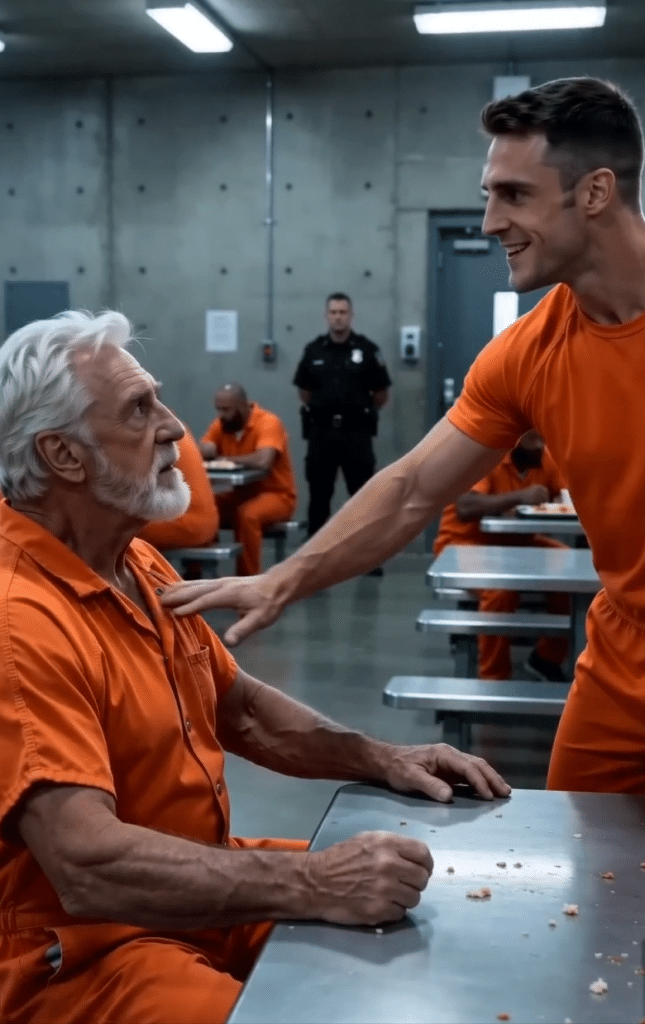
Forks stopped scraping. Conversations died. Under the harsh fluorescent lights, every inmate in orange turned toward the metal table near the center of the room.
The young man walking toward it was built like a weapon.
Broad shoulders. Thick arms. A cocky grin that said he had already won every fight in his head before throwing a single punch. Two men followed behind him, one bald and tattooed, the other with long dark hair and a beard.
At the table, an older inmate sat alone.
White hair. White beard. Calm hands.
He did not look up.
That made the young man angrier.
In one violent motion, he grabbed the old man’s tray and slammed it onto the floor. Food scattered across the gray tiles. A cup rolled beneath the table.
Then he shoved his palm into the old man’s chest.
Hard.
The old inmate rocked back, but he did not fall.
For a moment, he only looked at the ruined meal.
Then he slowly raised his eyes.
No fear.
No surprise.
Just a cold stillness that made the men behind the aggressor stop smiling.
The old man stood.
He was taller than he had looked sitting down. Stronger, too. His shoulders squared beneath the orange jumpsuit, and the room seemed to shrink around him.
His voice came low and rough.
“You just made a big mistake.”
The young aggressor laughed, loud enough for the guards to hear.
“Yeah?” he said, leaning close. “And what are you gonna do about it?”
The old man looked past him at the silent cafeteria.
Then he said one name.
And the laughter vanished.
Act II
The young inmate’s name was Darius Knox.
He had been inside for eleven months and had already built himself a kingdom out of fear. He took cigarettes, desserts, seats, respect. If someone looked away, he called it weakness. If someone looked back, he called it a challenge.
The guards knew him.
The inmates avoided him.
That was enough to make Darius believe he owned the room.
The old man had arrived three days earlier.
His paperwork said his name was Walter Briggs, sixty-eight, transferred from a lower-security facility after a clerical review. No gang ties listed. No disciplinary reports. No visitors. No noise.
To Darius, that meant easy prey.
An old man with no crew was a message waiting to be sent.
But prison has a strange memory.
It forgets nothing.
By the time Walter stood up from that table, three inmates near the back wall had already pushed their trays away. One of them whispered something under his breath and crossed himself.
Darius did not notice.
His henchmen did.
The old man’s gaze moved to the bald tattooed inmate first.
“Mason,” Walter said.
The bald man’s face changed.
Darius turned slightly.
“You know him?”
Mason did not answer.
Walter looked at the second man.
“Luis.”
The long-haired inmate swallowed.
Darius’s grin faltered.
Walter leaned closer, not touching him.
“Your friends know who I am.”
Act III
Walter Briggs was not his name.
Not really.
For twenty-seven years, men inside the state system had known him as Walter “The Judge” Brennan.
Not because he was loud.
Because he was final.
Before prison, he had been a decorated investigator who exposed corruption inside a private security company tied to weapons smuggling, stolen evidence, and paid protection. Then his partner was murdered, the case collapsed, and Walter took the blame for a crime he swore he did not commit.
Inside, he became something else.
Not a gang leader.
Not a bully.
A line.
He stopped younger inmates from being extorted. He forced predators to back away without turning the prison into a battlefield. He knew which guards were dirty, which inmates were desperate, and which men were pretending to be monsters because fear was easier than shame.
Then he vanished into a quiet facility after winning an appeal review.
People assumed he had died.
He had not.
He had been transferred back because his old case had reopened.
And Darius Knox had just shoved the one man every serious inmate in the cafeteria knew not to touch.
Darius looked around.
No one stepped forward.
Not one person.
Even his two men had shifted half a step back.
Walter lowered his voice.
“You wanted an audience,” he said. “Now you have one.”
Darius’s jaw tightened.
“You think I’m scared of some old prison story?”
Walter’s eyes did not blink.
“No,” he said. “I think you’re scared they believe it.”
Act IV
The guard by the door finally moved closer.
“Back off,” he ordered.
Walter raised one hand calmly.
“I’m not the problem.”
Darius seized the chance to laugh again, but it came out wrong.
“See? Even the guard knows you’re done.”
Walter looked at the guard.
“Officer Bell, check his left pocket.”
Darius froze.
The guard’s eyes narrowed.
“What?”
Walter did not look away from Darius.
“Left pocket.”
Darius stepped back.
“Don’t touch me.”
That was enough.
The guard signaled another officer. Together, they moved in, fast and controlled. Darius struggled, cursed, twisted his shoulders, but the confidence was gone.
From his pocket, they pulled a folded packet.
Inside were pills wrapped in plastic.
The cafeteria erupted in whispers.
Walter looked at Mason.
“Your sister still clean?”
Mason’s face tightened.
Walter nodded toward the packet.
“He’s been selling through the laundry line. Your sister’s block got hit last week.”
Mason turned slowly toward Darius.
Darius went pale.
“You lying old—”
Walter cut him off.
“I listened for three days. That’s all it took.”
The guard stared at Walter now with a different kind of recognition.
Darius was pulled away shouting, but nobody followed.
Not Mason.
Not Luis.
Not the men who had laughed with him.
By the time the heavy door slammed shut behind him, his kingdom was already gone.
Act V
The cafeteria stayed silent after Darius left.
Walter bent down, picked up his overturned tray, and set it back on the table.
A young inmate from the next row quietly brought him a clean one.
No speech was made.
No fight was needed.
That was the part Darius never understood.
Power was not the loudest man in the room.
It was the man who could end the noise without raising his voice.
Later that week, Darius was moved to segregation pending investigation. His two henchmen requested new housing. The laundry route was searched. Three more names surfaced.
And Walter Brennan’s old case continued moving toward court.
A month later, the warden asked why he had not defended himself physically.
Walter looked through the office window at the yard below.
“Because boys like Knox want violence,” he said. “It gives them a story where they still look strong.”
The warden frowned.
“And what did you give him?”
Walter picked up his cane and stood.
“The truth.”
Back in the cafeteria, inmates still talked about that day.
How the young man came in roaring.
How the old man stood up slowly.
How the whole prison seemed to remember him at once.
But Walter never corrected the rumors.
He returned to his table. Ate his meals. Read old paperbacks. Waited for the court date that might finally clear his name.
And every new inmate learned the same lesson before sitting down.
In prison, danger did not always arrive shouting.
Sometimes it had white hair, steady hands, and a voice quiet enough to make the whole room listen.