Act I
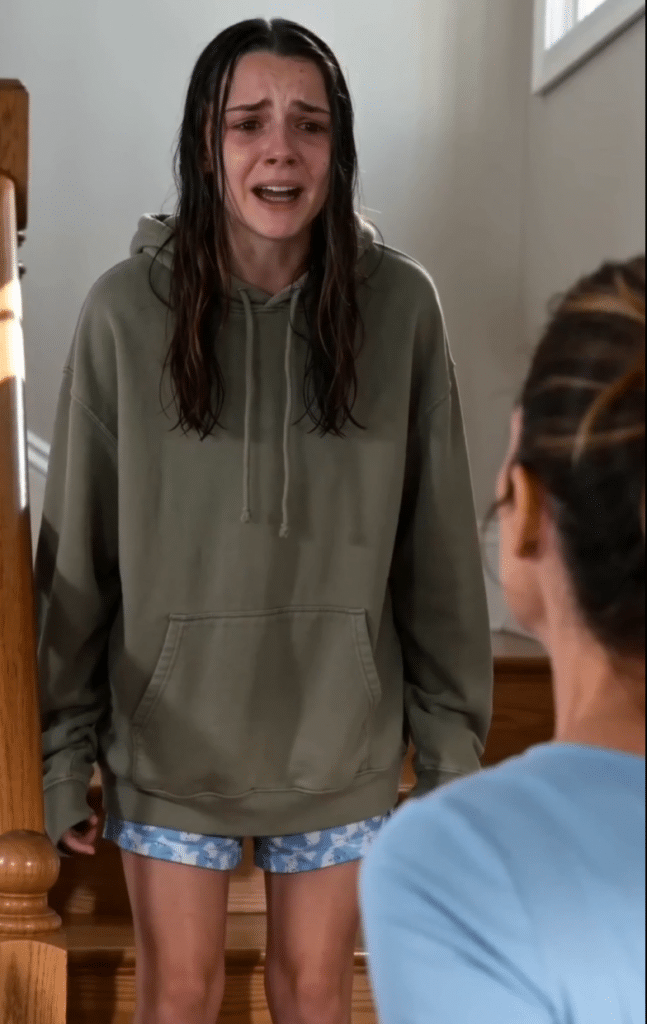
“I’m not going to church and pretending you’re not sleeping with Pastor Reynolds!”
The words exploded from the top of the stairs.
Clara stood barefoot on the landing, wet hair dripping onto her oversized green hoodie, her face flushed and streaked with tears. She looked less like a rebellious teenager than someone whose heart had cracked open and turned sharp.
In the kitchen below, her mother froze beside the sink.
Sunlight poured through the windows. The white cabinets gleamed. A dish towel hung twisted in her mother’s hands.
“Clara!”
It was not a warning.
It was panic.
But Clara was past being stopped.
“Everybody knows, Mom!” she shouted. “Everybody!”
The house went silent after that.
Not peaceful silent.
Destroyed silent.
Her mother looked down at the towel in her hands. For one strange second, she seemed older than she had that morning. Smaller, too. Then her face changed.
The shock disappeared.
Something colder took its place.
“Before you judge me,” her mother said, voice steady now, “look in the kitchen drawer.”
Clara blinked.
“What are you talking about?”
Her mother pointed without moving from the sink.
“The drawer beside the stove.”
Clara came down the stairs slowly, each step creaking under her feet.
She wanted the truth.
At least, she thought she did.
Act II
Clara had not always hated Sundays.
When she was little, church meant powdered donuts, coloring pages, and falling asleep against her mother’s side during long sermons.
Pastor Reynolds had been there through everything. Baptisms. Food drives. Hospital visits. Her father’s funeral when Clara was eight.
Back then, Clara thought he was kind.
But over the last year, kindness had begun to look suspicious.
Her mother took late calls from him. She met him in the church office after service. She stopped talking whenever Clara entered the room.
Then the whispers started.
Two women in the restroom.
A comment from a boy at school.
A church elder’s wife looking at Clara with pity so heavy it felt like a hand on her throat.
Your mother is very close to Pastor Reynolds these days.
By the time Clara found the folded note in her mother’s purse, she did not need proof anymore.
She had already built the whole betrayal in her mind.
Meet me after Wednesday service. Come alone. Don’t tell Clara yet.
That was all it said.
Enough to ruin everything.
So when her mother laid out Clara’s church dress that morning and said, “We need to be there early,” something inside Clara snapped.
Now she stood in the kitchen, breathing hard, staring at the drawer.
Her mother did not stop her.
Clara yanked it open.
Inside were ordinary things at first.
Measuring spoons. Birthday candles. Rubber bands. A takeout menu.
Then she saw the envelope.
It was old, cream-colored, and sealed in a plastic sleeve.
Her name was written across the front.
Clara Anne Whitaker.
Not Clara Hayes.
Whitaker.
Her hand went cold.
“Mom,” she whispered, “why is my name on this?”
Her mother closed her eyes.
“Because it should have been yours from the beginning.”
Act III
The envelope held a birth certificate.
Clara read it once.
Then again.
Her father’s name was not the man in the framed photo above the fireplace.
Her father’s name was Daniel Whitaker.
Pastor Reynolds was listed as witness.
Clara stepped back like the paper had burned her.
“No.”
Her mother reached toward her, then stopped.
“I wanted to tell you differently.”
“No.” Clara’s voice rose. “No, this is fake.”
“It isn’t.”
Clara looked at her mother with horror.
“Who is Daniel Whitaker?”
Her mother’s lips trembled.
“He was my fiancé before your dad. Before the man who raised you.”
The room tilted.
Her mother began to explain, slowly, painfully.
Daniel Whitaker had died before Clara was born. A car accident on a rain-slick road outside town. He had never known he was going to be a father.
Clara’s mother had been young, grieving, and alone.
Then Robert Hayes stepped in.
He married her. Raised Clara. Loved her completely.
“He was your father in every way that mattered,” her mother said. “I never wanted you to doubt that.”
Clara stared at the certificate.
“And Pastor Reynolds?”
“He knew Daniel,” her mother said. “He was helping me contact Daniel’s parents.”
Clara’s throat tightened.
“Why?”
Her mother looked toward the backyard window.
“Because Daniel’s mother is dying. She found out about you. She wants to meet her granddaughter before it’s too late.”
Clara sank into a chair.
The accusation she had screamed from the stairs still hung in the air, ugly and irreversible.
Everybody knows, Mom.
But nobody had known the truth.
Act IV
Clara did not apologize immediately.
She was too stunned.
Too embarrassed.
Too angry at the whole world for shifting under her feet without warning.
“You lied to me my whole life,” she said.
Her mother nodded.
“Yes.”
That simple answer hurt more than a defense.
“I thought I was protecting you,” she said. “Then I thought I was protecting your father’s memory. Then too many years passed, and I became afraid of the truth I had waited too long to tell.”
Clara’s eyes filled again.
“Were you ever going to tell me?”
“This morning,” her mother whispered. “At church. Pastor Reynolds arranged for Daniel’s parents to come after service.”
Clara looked at the note again.
Come alone. Don’t tell Clara yet.
It had not been a secret meeting.
It had been a planned confession.
Her mother reached into the drawer and pulled out a second item.
A small silver bracelet.
“Daniel bought this when he found out I wanted children someday,” she said. “He said if we ever had a daughter, she should have it.”
Clara touched it with shaking fingers.
The metal was cool.
Real.
Her rage began to collapse into grief.
“I said horrible things.”
Her mother’s eyes shone.
“Yes.”
Clara flinched.
But her mother stepped closer.
“And I should have trusted you with the truth before strangers got close enough to wound you with lies.”
That was when Clara broke.
She covered her face and sobbed, not like someone trying to win a fight, but like a child who had found a locked room inside her own life.
Her mother wrapped her arms around her.
For the first time all morning, Clara did not pull away.
Act V
They did not go to church early.
They went late.
Clara wore jeans instead of the dress laid out on her bed. Her hair was still damp. Her eyes were still swollen. Her mother did not correct her.
Pastor Reynolds met them near the side entrance with a face full of worry.
Clara could barely look at him.
“I’m sorry,” she said quietly.
He nodded.
“Truth has a way of arriving badly when adults wait too long.”
Inside the small chapel room, an elderly couple sat holding hands.
The woman looked fragile, wrapped in a pale blue cardigan, her eyes fixed on the door as though she had been waiting eighteen years for it to open.
When Clara stepped in, the woman covered her mouth.
“Oh,” she whispered. “You have his eyes.”
Clara stood frozen.
Then the old woman held out a trembling hand.
“My name is Margaret,” she said. “I’m your grandmother.”
Clara looked back at her mother.
Her mother nodded through tears.
So Clara crossed the room.
Not quickly.
Not easily.
But she crossed it.
Later, Clara would still be angry. There would be questions, hard conversations, and days when forgiveness felt close, then far away again.
But that morning, in a quiet room behind the church, she learned that truth could hurt without being betrayal.
She learned that rumors can sound like facts when pain is already listening.
And she learned that the drawer beside the stove had not been hiding proof of shame.
It had been holding the missing half of her name.