Act I
“Before the assets are distributed,” the lawyer said, “there is one final condition.”
Thomas Mitchell smiled.
Not openly. Not foolishly. Just enough for everyone in the room to understand that he believed the meeting was already over.
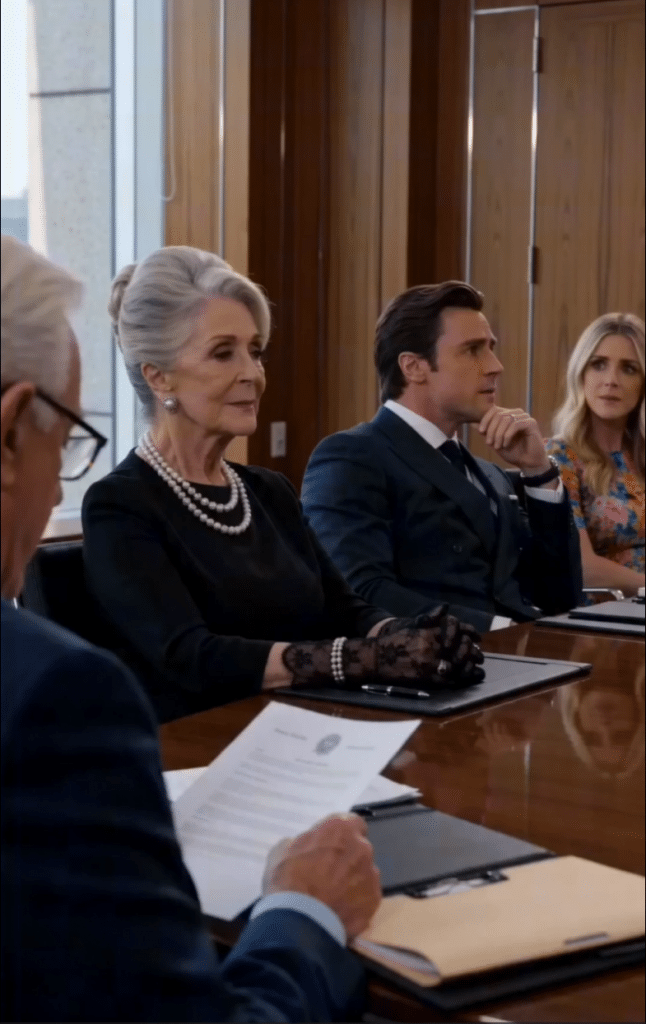
He leaned back in the leather chair at the head of the polished mahogany table, one hand resting near his chin, his dark suit cut perfectly, his tie knotted like a man born into boardrooms. Behind him, the city glittered through the wide glass windows, all steel towers and cold morning light.
Mitchell Shipping owned half the view.
By noon, Thomas expected to own Mitchell Shipping.
Across from him, his mother sat perfectly still.
Mrs. Eleanor Mitchell wore black from throat to wrist, her silver hair swept into a flawless shape, pearls resting against the high collar of her mourning dress. A white handkerchief lay folded in her gloved hands.
She had not cried at the funeral.
She had not cried at the graveside.
She was not crying now.
The lawyer, Mr. Alden Price, adjusted his glasses and continued reading.
“Mr. Mitchell left this decision entirely to Mrs. Eleanor Mitchell.”
Thomas’s smile faded.
He leaned forward.
“Mother,” he said, sharper than he meant to, “what decision?”
Beside him, the blonde woman in the floral dress shifted nervously. Vanessa had been smiling too a moment earlier, already picturing charity galas, private islands, and her name printed beside his in society pages.
Now she looked at Eleanor.
Everyone did.
The old lawyer looked down at the paper one last time.
“Mrs. Eleanor Mitchell has chosen to enforce the moral clause,” he said. “Thomas Mitchell will not inherit control of Mitchell Shipping.”
The room stopped breathing.
Thomas stood so violently his chair struck the wall behind him.
“What?”
Vanessa gasped.
Mr. Price did not flinch.
Eleanor turned her head slowly toward her son.
For the first time that morning, she smiled.
It was small. Almost elegant.
And colder than the glass behind her.
“Your father gave you everything, Thomas,” she said. “You couldn’t even give him goodbye.”
Thomas stared at her as if the woman who had raised him had vanished, and in her place sat the judge of his entire life.
But the clause was only the beginning.
Act II
Charles Mitchell had built his empire from rust, saltwater, and debt.
He was not born rich. He was born above a bait shop in Maine, the son of a fisherman who died owing money to men who did not forgive. At sixteen, Charles unloaded cargo at dawn and slept in a room that smelled of rope and diesel.
By forty, he owned three vessels.
By sixty, he controlled shipping routes across the Atlantic.
People called him ruthless.
They were not wrong.
But Charles had one private weakness.
His son.
Thomas Mitchell grew up with every door opened before he touched the handle. Tutors, chauffeurs, summer homes, sailing lessons, Ivy League contacts, internships created just for him. Charles did not simply give Thomas money. He gave him a name heavy enough to crush any room.
Eleanor warned him.
“You are not raising a son,” she once told her husband. “You are raising an appetite.”
Charles ignored her.
He believed discipline could come later. He believed Thomas would mature when responsibility finally arrived. He believed blood would call to blood.
But Thomas learned something else.
He learned that apologies could be outsourced.
He learned that scandals could be buried.
He learned that if he smiled at the right photographers and shook hands at the right charity dinners, people would call him promising no matter what he destroyed behind closed doors.
The first real fracture came when Thomas was twenty-six.
A dockworker named Samuel Reed was injured during a rushed overnight loading operation. The investigation found safety violations. Thomas, who had been overseeing the project, claimed he had not approved the shortcut.
But Eleanor knew he had.
So did Charles.
The difference was that Eleanor wanted consequences.
Charles wrote a check.
After that, Thomas became harder to reach.
He stopped returning calls unless money was attached. He skipped family dinners. He missed Eleanor’s birthday three years in a row. He arrived late to board meetings and left early from hospital visits.
Then Charles got sick.
At first, he hid it beneath tailored suits and stubborn pride. Then came the tremor in his hand. The canceled trips. The private nurses. The quiet doctors entering through side doors.
Eleanor stayed with him.
Thomas sent flowers.
Once.
The card was printed by his assistant.
When Charles asked to see his son, Thomas was in Monaco.
When Charles asked again, Thomas was “in negotiations.”
When Charles’s condition worsened, Eleanor called him herself.
“Your father is asking for you,” she said.
Thomas sighed on the other end of the line.
“Mother, I can’t drop everything every time he has a bad night.”
Eleanor closed her eyes.
“It may be his last.”
There was a pause.
Then Thomas said, “I’ll come tomorrow.”
Charles died at 2:13 that morning.
Thomas arrived two days later.
Tanned. Rested. Irritated that the funeral arrangements had already begun.
And Eleanor, standing in the hallway outside her husband’s room, decided her son would never sit in Charles’s chair.
Act III
The moral clause had been Charles’s idea.
That was what Thomas did not understand.
He looked at his mother in the boardroom with pure hatred, convinced she had ambushed him. But the document in Mr. Price’s hands had been signed eighteen months before Charles died.
Charles had known.
Perhaps not everything.
Enough.
The clause was simple but devastating: Thomas could inherit personal assets, family properties, and a financial trust, but he could not assume control of Mitchell Shipping if Eleanor determined he had acted in a way that endangered the company, dishonored the family, or abandoned essential filial duty during Charles’s final illness.
Thomas laughed when Mr. Price read that part.
A desperate, disbelieving laugh.
“Filial duty?” he snapped. “This is medieval.”
Eleanor folded her handkerchief once.
“No,” she said. “It is merciful. Your father wanted the word ‘betrayal.’ I softened it.”
Vanessa looked at Thomas.
He did not look back.
Because now he understood there was more.
Mr. Price opened a second folder.
“Mrs. Mitchell has also submitted supporting evidence.”
Thomas’s face tightened.
“What evidence?”
The old lawyer removed a stack of documents.
Travel records.
Emails.
Board memos.
Hospital logs.
Phone transcripts.
Each one placed on the table with quiet precision.
The first showed Thomas had been less than twelve miles from the hospital the night Charles begged to see him, despite claiming he was overseas.
The second showed he had attended a private investor dinner that same evening.
The third revealed the purpose of that dinner.
Thomas had been secretly negotiating with a rival conglomerate to sell controlling influence in Mitchell Shipping the moment he inherited.
Vanessa’s hand flew to her mouth.
Eleanor watched her son carefully.
Thomas’s eyes moved over the papers, faster and faster, as if speed could undo ink.
“This is confidential business strategy,” he said.
“It was treason,” Eleanor replied.
“You don’t know anything about business.”
For the first time, something flickered behind Eleanor’s eyes.
Not pain.
Memory.
“Thomas,” she said softly, “who do you think kept your father’s company alive the first time he nearly lost it?”
The room went still again.
Thomas frowned.
Eleanor reached into the black leather folder beside her and withdrew an old photograph.
It showed a much younger Eleanor standing on a dock beside Charles, her hair pinned under a scarf, a ledger tucked beneath her arm.
“This company did not begin with your father alone,” she said. “I managed the contracts. I negotiated the first insurance lines. I signed the loans when no bank would trust him without collateral.”
Thomas swallowed.
Eleanor laid the photograph down.
“You inherited arrogance from him,” she said. “But not his courage.”
Act IV
Thomas lunged for the documents.
Mr. Price pulled them back before his hand touched the paper.
“Sit down, Mr. Mitchell.”
“I will sue every person in this room.”
Eleanor’s smile vanished.
“You may try.”
He turned on Vanessa.
“Say something.”
She stared at him, pale now, her floral dress suddenly absurd against the dark wood and mourning clothes.
“Thomas,” she whispered, “you told me your father wanted the sale.”
“He did.”
“No,” Eleanor said. “He begged you not to dismantle his life’s work.”
Thomas slammed his palm on the table.
“He was dying. He didn’t know what he wanted.”
Eleanor stood.
It was not dramatic. It was worse. It was controlled.
The room seemed to rearrange itself around her.
“Your father knew exactly what he wanted,” she said. “He wanted one hour with his son.”
Thomas’s jaw worked, but no words came.
“He asked the nurse to shave him that morning,” Eleanor continued. “He changed into his blue robe because you once said it made him look like the captain of a ship. He made me move the chair closer to the door so he could see you when you arrived.”
Her voice remained steady.
But Vanessa began to cry.
“He waited until midnight,” Eleanor said. “Then until one. Then he asked me whether traffic was bad.”
Thomas looked down.
“At 1:47,” Eleanor said, “he stopped asking.”
The city beyond the windows glittered without mercy.
Eleanor picked up the folded handkerchief, but she did not use it.
“He forgave you before he died,” she said. “That was your father’s final weakness.”
Thomas lifted his eyes.
For one brief second, he looked almost like a boy.
Then greed returned.
“And what happens now?” he asked bitterly. “You run the company? You?”
“No,” Eleanor said.
Mr. Price read the final page.
“Control of Mitchell Shipping will transfer into a protected family trust. Eleanor Mitchell will serve as chair for a three-year transition. Operational authority will be granted to the executive board, with Samuel Reed appointed as ethics and labor oversight director.”
Thomas blinked.
“Samuel Reed?”
Eleanor nodded.
“The man you left broken on a dock and blamed for your mistake.”
Thomas’s face twisted.
“You’re giving my company to a dockworker?”
“No,” Eleanor said. “I am saving your father’s company from his son.”
Act V
Thomas left without the empire.
Not quietly.
He threatened lawsuits, shouted into his phone, accused his mother of manipulation, accused the lawyer of fraud, accused Vanessa of betrayal when she refused to follow him out fast enough.
But no one chased him.
That was what broke him most.
For the first time in his life, Thomas Mitchell stormed out of a room and the room became calmer without him.
The doors closed.
Eleanor remained standing.
Only then did her hand tremble.
Mr. Price saw it, but said nothing.
Vanessa stood slowly from her chair.
“I didn’t know,” she said.
Eleanor looked at her.
“Now you do.”
The younger woman nodded, ashamed, and left without another word.
When the room emptied, Eleanor walked to the window. Below, cargo trucks moved along the avenue like pieces on a board. Somewhere beyond the skyline, ships carrying the Mitchell name cut through gray water, still moving, still working, still alive.
Mr. Price approached gently.
“Charles would have understood.”
Eleanor’s face tightened.
“Charles would have hated it.”
“Perhaps,” the lawyer said. “But he signed it.”
She closed her eyes.
For a moment, the powerful widow disappeared, and only the wife remained.
“He kept asking me whether Thomas was coming,” she said.
Mr. Price lowered his head.
Eleanor opened her hand. Inside her black lace glove, the white handkerchief was crushed.
“I wanted to lie,” she whispered. “At the end, I wanted to tell him his son was on the way.”
“But you didn’t.”
“No,” she said. “I had already given Thomas too many lies.”
Three months later, Mitchell Shipping announced the largest worker safety investment in its history.
Samuel Reed stood beside Eleanor at the press conference. He walked with a cane, but he stood tall.
Thomas filed suit.
He lost.
Then he appealed.
He lost again.
The judges found the clause valid, the evidence clear, and Eleanor’s authority absolute.
Years later, people would still talk about that morning in the mahogany boardroom. They would talk about the son who arrived expecting a throne and left with an allowance. They would talk about the widow in pearls who destroyed him with one sentence.
But Eleanor never called it revenge.
Revenge was loud.
This had been quieter.
This had been a wife honoring the man she loved by protecting what he built.
This had been a mother finally refusing to mistake blood for character.
And on the first anniversary of Charles Mitchell’s death, Eleanor visited his grave alone.
She placed one hand on the cold stone.
“He didn’t come,” she whispered. “So I said goodbye for both of us.”
Then she turned, lifted her chin, and walked back toward the waiting car.
Behind her, the Mitchell name remained carved in stone.
But for the first time in decades, it no longer belonged to Thomas.