Act I
The check slid across the white linen table like a verdict.
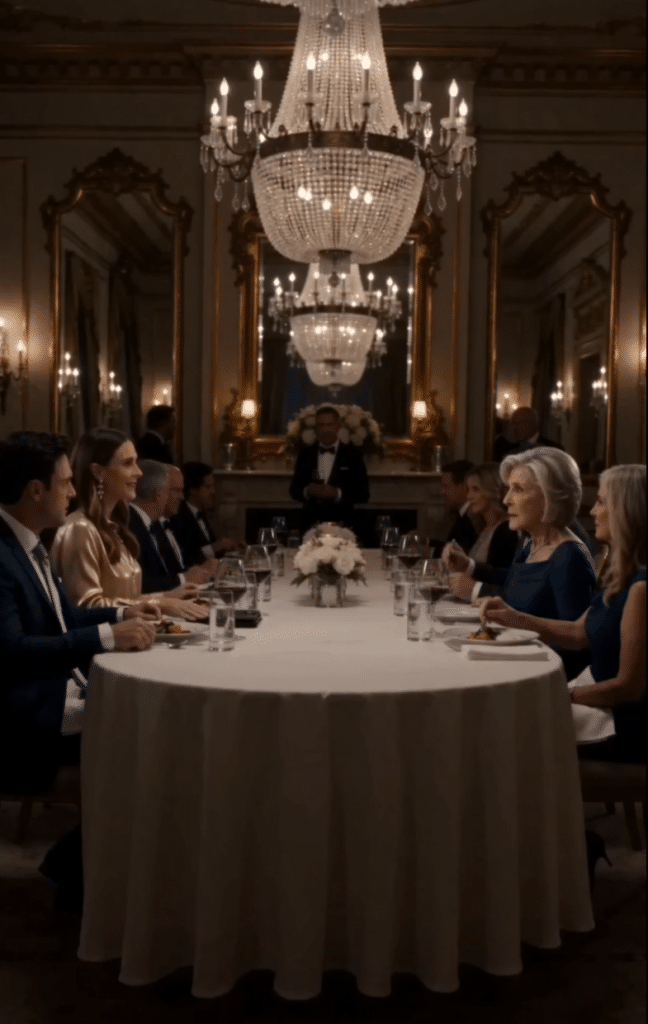
Carol stared at the black leather folder as it stopped in front of her plate. Around her, crystal glasses caught the chandelier light. Men in tailored suits paused with forks halfway lifted. Women in diamonds leaned closer without pretending not to watch.
Across the table, Miranda Vale smiled.
“Cash or card, Carol?” she asked. “The waiter is waiting.”
A few guests chuckled softly.
Carol’s fingers touched the edge of the folder. Her hands trembled just enough for everyone to see.
Inside, the total glared up at her.
$8,342.68.
It was not a bill. It was a trap.
Miranda had arranged the whole thing with the precision of a woman who had confused wealth with power. She had ordered the oldest wine, the rarest courses, the private service, the imported flowers. Then, just as dessert arrived, she had pushed the entire evening onto Carol.
The elderly widow.
The woman they had invited only because her late husband’s name still opened doors.
The woman Miranda believed was too proud to make a scene and too broke to survive one.
Beside Miranda, Adrian Vale stared down at his plate.
He did not laugh. But he did not stop her either.
That hurt Carol more than the bill.
She looked at him for a long moment, at the man she had once welcomed into her home like a son. His jaw was tight. His eyes stayed lowered.
Miranda leaned forward, pearl earrings swinging.
“Well, Carol?”
The room held its breath.
Carol closed the folder.
Then she looked up.
“No.”
Miranda’s smile widened.
“No?” she repeated, savoring it.
Carol’s expression changed.
The shock drained from her face, leaving something colder behind. Older. Sharper.
“Not to pay,” Carol said.
The laughter died.
Miranda blinked.
Adrian finally looked up, alarm flashing across his face.
Carol reached slowly into her navy evening purse.
“I brought something with me.”
And for the first time that night, Miranda stopped smiling.
Act II
Carol Whitaker had not always been treated like a relic.
Twenty years earlier, people stood when she entered a room. Not because she demanded it, but because she had earned it. She and her husband, Henry, had built Whitaker House from one failing hotel into a private hospitality empire known across three countries.
Henry was charm.
Carol was steel.
He shook hands. She read contracts. He made guests feel important. She remembered which investor lied about numbers and which charity director inflated costs. Together, they became the kind of couple society admired because it did not understand how much work love could be.
Then Henry died.
And everything softened around her in the cruelest way.
People stopped asking Carol for advice and started asking if she was “managing.” Men who once feared her judgment began explaining her own company to her. Younger wives smiled too brightly, as if old age were an illness they might catch.
Miranda was the worst of them.
She had married Adrian Vale two years after Henry’s funeral. Adrian was Henry’s godson, raised close enough to the Whitaker family to know where the silver was kept and far enough away to believe he deserved it.
Carol had helped him once.
She had paid for his first business license. She had given him introductions. She had even allowed him to manage a small charity gala under the Whitaker name.
That was her mistake.
Because Miranda saw kindness and mistook it for weakness.
Slowly, the invitations changed. Carol was placed farther from the center of tables. Her opinions were interrupted. Her late husband’s stories were retold without her name in them.
Then rumors began.
Carol was lonely.
Carol was confused.
Carol’s accounts were shrinking.
Carol was selling jewelry quietly.
None of it was true.
But in wealthy rooms, truth mattered less than repetition.
Tonight was supposed to finish her.
Miranda wanted Carol embarrassed in front of donors, bankers, and board members. She wanted witnesses. She wanted a number shocking enough to make Carol look desperate and refusal shameful.
And Adrian had allowed it.
That was why Carol had come prepared.
Not with anger.
With proof.
Before dinner, she had sat in her car beneath the hotel awning and held a small envelope in both hands. Henry’s handwriting was still on the front, faded but unmistakable.
For Carol, when the room forgets who built it.
She had waited six years to open it.
Tonight, at last, the room had forgotten.
So Carol opened her purse.
Act III
The first thing Carol placed on the table was not a checkbook.
It was a photograph.
The old glossy print slid across the linen until it stopped beside the untouched dessert. Several guests leaned in.
It showed Henry Whitaker standing in front of the same dining hall thirty years earlier, younger and laughing, with Carol at his side in a black dress. Behind them were construction workers, bare walls, rolled carpets, and no chandelier.
Carol tapped the image once.
“This room,” she said, “was not rented tonight.”
Miranda gave a tight laugh. “What is that supposed to mean?”
Carol placed a second document beside the photograph.
The hotel manager, standing discreetly near the wall, went pale.
“This dining hall belongs to the Whitaker Foundation,” Carol said. “It was never available for private use without board approval.”
A murmur moved around the table.
Miranda’s eyes flicked toward Adrian.
Carol continued.
“The wine was charged to a foundation account. The flowers were charged to a foundation account. The private staff, the security, the imported menu, all charged under a donor outreach code.”
She opened the black folder again and turned the bill toward Miranda.
“So no, I will not be paying $8,342.68.”
Her voice did not rise.
“That bill has already been paid with stolen charity funds.”
The room went still.
Adrian stood halfway from his chair.
“Carol—”
She looked at him, and he sat down again.
Miranda’s face hardened. “You’re confused.”
Carol smiled faintly.
“There it is.”
From her purse, she removed the envelope with Henry’s handwriting. Then she drew out a flash drive, a printed audit, and a letter bearing Adrian’s signature.
“The foundation accountant called me three weeks ago,” Carol said. “She was afraid. She said someone had been using event budgets to cover personal expenses.”
Miranda’s throat moved.
Carol looked at Adrian.
“I hoped it wasn’t you.”
His shame finally had nowhere to hide.
The guests were no longer amused. Bankers stared. Donors whispered. One woman quietly set down her wine as if the glass had become evidence.
Miranda tried to laugh again, but this time it broke in the middle.
“You can’t prove intent.”
Carol’s eyes sharpened.
“No,” she said. “But he can.”
Every face turned to Adrian.
And the handsome man who had avoided Carol’s eyes all night finally understood that silence would not save him anymore.
Act IV
Adrian looked at Miranda as if asking permission to breathe.
That told Carol everything.
For years, she had wondered how a boy she once knew had become so small inside his own expensive suit. Now she saw it clearly. Greed had not entered him like a storm. It had entered like a whisper, repeated daily in Miranda’s voice.
You deserve more.
Carol owes you.
Old women do not need empires.
Miranda leaned toward him. “Don’t say a word.”
Carol did not look away from Adrian.
“Henry loved you,” she said quietly. “He left you chances, not ownership.”
Adrian’s face crumpled for half a second.
Then Miranda struck the table with her palm.
“This is pathetic,” she snapped. “An old woman dragging family business into a gala because she can’t handle one bill.”
Carol reached into the folder and removed the final page.
“This is not family business,” she said. “This is a criminal referral.”
The hotel manager stepped forward.
Two foundation board members rose from their seats.
Adrian whispered, “Miranda told me it was temporary.”
Miranda froze.
He looked at Carol then, eyes wet with humiliation.
“She said we could move the money back after the merger. She said nobody checked old foundation accounts.”
Carol’s expression did not soften, but something sad passed through it.
“I checked,” she said.
Miranda pushed back her chair.
“You ungrateful little man,” she hissed at Adrian.
There it was.
Not love.
Not partnership.
Possession.
Carol turned to the guests.
“I invited every donor here tonight for a reason. Not to embarrass anyone. To protect the foundation before more money vanished.”
Miranda’s face went white.
“You invited them?”
Carol lifted her chin.
“This was never your gala.”
The sentence landed harder than a shout.
The chandelier glittered above them. The mirrors reflected every stunned face, every collapsed smile, every secret dragged into gold light.
Carol stood slowly.
“For six years, I let people call me fragile because it was useful. Men speak freely around fragile women. Ambitious wives underestimate fragile women. Thieves get careless around fragile women.”
She looked at Miranda.
“And you were very careless.”
The doors opened at the far end of the hall.
Two investigators entered with the foundation’s attorney between them.
Miranda looked at Adrian, then at Carol, then at the bill still lying on the table.
For the first time all evening, she looked exactly like what she was.
Caught.
Act V
No one remembered the dessert.
By morning, the story had traveled through every private club, boardroom, and charity committee that had once treated Carol like a decorative widow.
Miranda Vale resigned from three boards before lunch.
Adrian issued a statement through his lawyer, admitting misuse of foundation funds and agreeing to cooperate. It did not save his reputation, but it saved the foundation from a long public fight.
Carol did not celebrate.
She returned to Whitaker House alone, removed her silver necklace, and placed Henry’s envelope in the top drawer of his old desk.
For Carol, when the room forgets who built it.
She smiled at that.
Not because she had won.
Because Henry had known.
He had known the world would eventually try to make her smaller. He had known people would confuse grief with weakness. He had known she might one day need reminding that she had never been the shadow beside him.
She had been the foundation.
A week later, Carol walked back into the same dining hall.
The chandelier was dimmed. The tables were bare. Morning light spilled across the polished floor where Miranda’s humiliation had turned into her own undoing.
The hotel manager approached carefully.
“Mrs. Whitaker,” he said, “the board is ready.”
Carol looked around the room one last time.
She remembered the laughter.
The bill.
The way Adrian had lowered his eyes.
Then she remembered the first night the hall opened, Henry taking her hand beneath that chandelier and whispering, “Look what you built.”
Carol straightened her shoulders.
“Let’s begin,” she said.
Behind the closed doors, the board waited for the old widow they thought they understood.
But Carol was done being invited to rooms she owned.