Act I
“Trash kid. This is not your family table.”
The words cut through the applause just as the restaurant’s grand-opening celebration reached its loudest moment. Beneath crystal chandeliers and towering arrangements of white roses, thirteen-year-old Ethan Cole sat frozen in a chair at the center table, clutching an invitation with both hands.
He looked up at the man standing over him.
“I’m not doing anything wrong,” Ethan said quietly. “My dad told me to wait here.”
The man in the black suit did not bother to look at the invitation. His name badge identified him as Daniel Mercer, the restaurant’s general manager, and he carried himself with the rigid confidence of someone accustomed to making people obey before they had time to ask questions.
To Daniel, the boy was an inconvenience. The table had been reserved for the restaurant’s founder, his family, and a handful of important guests. The opening ceremony was about to begin, the dining room was filling with investors and local dignitaries, and a child in a navy jacket was sitting in the most prominent chair as if he belonged there.
Daniel had spent three weeks preparing for this evening. Every tablecloth had been inspected, every employee had been warned about mistakes, and every detail had been arranged to impress the people who could determine his future.
He was not about to let what he considered a random child ruin his perfect opening.
“Get up,” he ordered.
Ethan glanced toward the glass entrance, then back at the manager. He had arrived early because his father had sent him a message asking him to wait at the family table. The boy had even checked the invitation twice before sitting down, making certain that the name printed across its front matched the one his father had told him to look for.
He had no reason to believe that following instructions could become a problem.
“My dad said he’d meet me here,” Ethan explained. “He’s coming through those doors.”
Daniel’s mouth tightened.
“Your dad?” He gave a short, contemptuous laugh. “You think that means you can sit wherever you want?”
Several guests turned toward them. A server carrying a tray slowed beside a flower stand, uncertain whether to intervene. At a nearby table, a woman lowered her champagne glass, her expression changing from polite curiosity to discomfort.
Ethan felt every pair of eyes on him.
He wanted to disappear, but he refused to stand without understanding what he had done wrong. That small hesitation was enough to make Daniel lose the last of his patience.
“Wait outside like everyone else.”
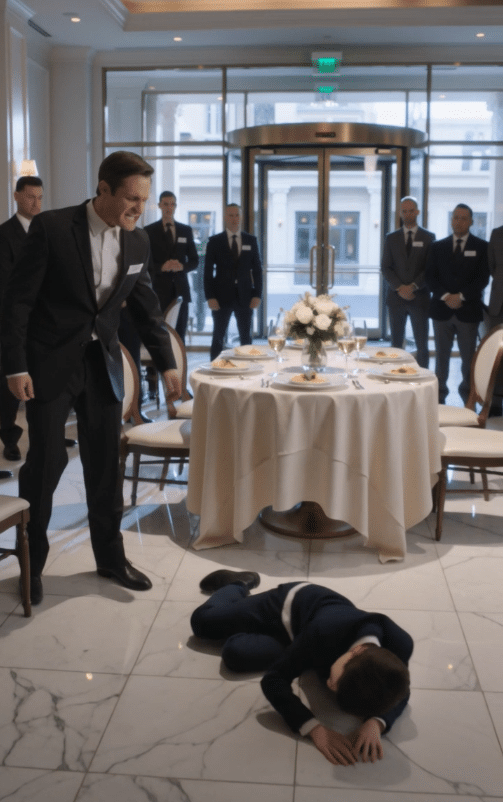
Before Ethan could answer, Daniel yanked the chair backward from beneath him.
The boy lost his balance. Daniel stepped in front of him and drove a hard kick straight into his chest, sending him crashing onto the floor beside the founder’s table.
The impact knocked the breath from Ethan’s lungs. His forearm struck the floor as he tried to protect himself, leaving a thin trace of blood near the invitation that had slipped from his hand.
For one suspended second, the entire room seemed unable to comprehend what had happened.
Then Daniel stepped around the fallen boy and delivered exactly two more forceful kicks, one into Ethan’s back and another into his side.
A guest gasped. Someone near the entrance whispered, “Oh my God.”
Nobody moved.
Ethan curled instinctively around himself, struggling to draw a full breath. His invitation lay faceup beside him, its elegant lettering visible against the polished floor.
Daniel looked down at him with open disgust.
“I told you to leave.”
Ethan tried to push himself upright, but pain forced him to stop. His eyes were bright with tears he desperately wanted to hold back.
He had come to see his father celebrate something important. He had imagined walking through the restaurant together, meeting the people his father worked with, and perhaps hearing a few words about the business that had occupied so much of their family’s life.
Instead, he was on the floor while a room full of strangers watched him being treated like he had no right to exist.
Daniel adjusted his jacket and glanced toward the entrance, where the applause was beginning to rise again.
“Someone get this child out of here,” he said.
Then the glass doors opened.
And the man walking through them saw his son on the floor.
Act II
Richard Cole had spent twenty-six years building his restaurant business from a single neighborhood dining room into one of the most respected hospitality groups in the country.
He had opened restaurants in cities where he knew nobody, negotiated leases with money he could barely afford to lose, and survived the kind of financial setbacks that had forced other founders to close their doors. Every successful location represented years of risks, compromises, and decisions that had rarely been visible to the customers enjoying their meals.
Tonight’s grand opening was meant to celebrate how far he had come.
The new restaurant stood at the heart of a redevelopment project that Richard had championed for years. Its opening would bring jobs to the surrounding neighborhood, introduce a new dining concept, and serve as the flagship for the company’s next phase of expansion.
Investors had flown in from several states. Local officials had accepted invitations. Senior executives were waiting to congratulate him.
And Richard had promised his son that, for once, Ethan would not have to spend the evening watching his father work.
Ethan was thirteen, old enough to understand that his father’s name carried weight, but young enough to wish it did not follow him everywhere. At school, he rarely mentioned the restaurants. He did not want classmates treating him differently, and he had learned that some people became unusually friendly when they discovered who his father was.
He preferred being known for ordinary things.
He liked old mystery novels, played basketball badly but enthusiastically, and had recently developed an interest in cooking after spending a summer watching one of Richard’s chefs prepare pasta from scratch. He was not particularly interested in inheriting a company. What mattered to him was having a father who occasionally made it home before dinner.
Richard understood that, at least more than he once had.
When Ethan was younger, Richard had missed birthdays, school performances, and an important science fair because a restaurant opening had gone wrong. He had apologized every time, promising that the next month would be different.
Eventually, Ethan stopped asking when his father would be home.
That silence had frightened Richard more than any business failure.
So when the invitation for the new restaurant arrived, Richard had written a note on the back himself.
Come early. Sit at our family table. I’ll be there before the ceremony starts.
It was a small promise, but Richard intended to keep it.
He had been delayed by a call from the company’s legal department and another from the regional operations team. By the time his car pulled up outside, the opening applause was already underway.
He entered through the glass doors with his dark coat over an expensive black suit, expecting to find Ethan sitting at the table near the center of the room.
Instead, he saw a crowd standing strangely still.
Then he saw the invitation on the floor.
Then he saw the boy beside it.
Richard did not notice the photographers or the investors who had come to greet him. He barely registered the manager standing nearby. His attention narrowed to the navy jacket, the brown hair, and the familiar face turned toward him in pain.
“Ethan?”
His son tried to answer, but the words came out as a strained breath.
Richard crossed the room immediately and dropped beside him. He put one hand behind Ethan’s shoulders without moving him unnecessarily, his expression changing as he saw the blood near the boy’s forearm and the fear in his eyes.
“I’m here,” Richard said. “I’m right here.”
Ethan gripped his father’s sleeve.
“Dad, I was just waiting.”
Those five words struck Richard harder than any accusation could have.
He looked at the invitation lying beside them. He recognized the handwriting on the note because he had written it himself.
Then he looked up.
Daniel Mercer was standing less than six feet away, his face already rearranging itself into the professional expression he used whenever a customer complained.
“Mr. Cole,” Daniel began, “I’m glad you’re here. We had an unfortunate security issue with a child who—”
Richard rose slowly.
He positioned himself between Daniel and Ethan, shielding his son with his own body.
“You kicked my son from my family table?”
The question carried across the room without a shout. That made it worse.
The applause died. A waiter stopped moving. One of the investors lowered his glass. Every person who had watched Daniel’s cruelty now turned toward the man who owned the restaurant, the company, and the very position Daniel had used to humiliate a child.
Daniel stared at Richard.
His eyes flickered toward Ethan, then back to the chairman.
“Your family table?”
For the first time that evening, Daniel Mercer had no prepared response.
But his mistake was about to become much bigger than he understood.
Act III
The restaurant had a rule about the founder’s family table.
It was not written on a sign or printed in the staff handbook. It was part of the company’s culture, established years earlier when Richard still worked in his first restaurant and his young family sometimes ate at a small table near the kitchen after closing.
Richard had insisted that every new location preserve one table for the people who mattered beyond the business. At first, it was a sentimental tradition. Later, as the company grew, the table became a quiet reminder that the people behind a successful restaurant were more important than the image it presented to the public.
At the flagship opening, that tradition had taken on particular significance.
The table had been reserved for Richard, his wife, Ethan, and Richard’s elderly mother, who had helped finance his first restaurant when nobody else believed in him. A small engraved plaque beneath the centerpiece read: The Cole Family Table.
The plaque was partly hidden by a flower arrangement.
Daniel had never bothered to move it.
He had worked for Richard Cole’s company for six years, beginning as an assistant manager at a suburban location. He was ambitious, organized, and skilled at making a restaurant appear flawless when executives visited. Those qualities had helped him rise quickly through the company.
But Daniel had also developed a dangerous belief: that the people who looked important deserved patience, while everyone else deserved obedience.
He had learned to judge guests by their clothes, their confidence, and the likelihood that they could influence his career. A wealthy customer received an apology before finishing a complaint. A delivery worker who arrived at the wrong entrance received a lecture. A nervous young employee could be made an example of over a minor mistake.
Daniel called it maintaining standards.
Several employees called it surviving Daniel.
In the weeks leading up to the opening, he had become especially concerned with the founder’s visit. He had heard rumors that Richard planned to review management performance before approving the next round of promotions. Daniel had been quietly lobbying for a regional director position, a role that would put him in charge of multiple restaurants and significantly increase his salary.
He believed that one perfect opening could secure his future.
The child at the family table had seemed like an immediate threat to that perfection.
Daniel had not asked for a name. He had not checked the invitation. He had not called security or consulted the event coordinator.
He had simply decided that the boy did not belong.
Now, standing before the chairman, he tried to turn that decision into a misunderstanding.
“Sir, I apologize for the confusion,” he said. “The table was reserved for family, and I believed the boy had entered a restricted area. I was trying to protect the event.”
Richard stared at him.
“You believed he was trespassing, so you kicked him?”
Daniel’s lips parted, but no convincing answer came.
“I didn’t know who he was.”
Richard glanced down at the invitation in his hand. He had picked it up before approaching Daniel, and now he held it where the manager could see it.
“You didn’t know who he was,” Richard repeated, “because you never bothered to ask.”
A low murmur moved through the guests.
Daniel looked toward the employees lined up near the service station. He expected someone to confirm that he had been dealing with a difficult situation. He expected one of them to say that the boy had refused instructions or become aggressive.
Nobody did.
They had watched Ethan explain himself. They had heard him say that his father told him to wait. They had seen Daniel pull the chair away and kick a child who had never threatened him.
Their silence had protected Daniel for a few terrible seconds.
Now that Richard stood between them, the silence began to change.
One of the servers, a young woman named Olivia, stepped forward. Her hands were shaking, but her voice was clear.
“Mr. Cole, the boy showed him the invitation.”
Daniel turned sharply.
“Olivia, this is not the time.”
She flinched at the sound of his voice, then continued.
“He didn’t even let him finish explaining. I saw the whole thing.”
A second employee nodded. Then another guest raised a hand and said she had recorded part of the incident on her phone.
Daniel’s expression tightened.
The event he had tried to control was slipping beyond his reach. Every attempt to silence the witnesses only made his conduct more obvious.
Richard looked toward his son again.
“Can you tell me where it hurts?”
Ethan swallowed. “My chest. My side. My arm.”
Richard’s jaw tightened, but he kept his voice gentle.
“Don’t try to stand. We’re getting you checked.”
He turned to the event coordinator and instructed her to call emergency medical services. He asked another employee to contact security and preserve any available footage. His orders were precise, calm, and impossible to mistake.
Then he faced Daniel once more.
“You are not going to explain this away as protecting the restaurant.”
Daniel tried to speak, but Richard raised one hand.
“No. You had a choice. You could have asked a question. You could have checked the invitation. You could have called another manager. Instead, you chose to hurt a child because you thought nobody important would care.”
For the first time, Daniel looked genuinely afraid.
He still believed the worst part of his night was discovering that Ethan was the chairman’s son.
He had not yet understood that the witnesses, the invitation, and the company’s own records were about to expose a pattern he had spent years hiding.
Act IV
The paramedics arrived within minutes.
Richard stayed beside Ethan while they assessed him, answering questions when his son struggled to speak. The boy’s chest hurt with each deep breath, and his forearm needed attention, but he remained conscious and responsive.
When the paramedics prepared to take him for further examination, Ethan reached for his father’s hand.
“Are you going to stay?”
Richard looked at him as if the question had revealed something far more painful than the injury.
“I’m going wherever you need me.”
He accompanied Ethan out through the glass entrance, leaving the chairman’s guests, the unfinished ceremony, and the restaurant’s carefully arranged flowers behind.
The moment he disappeared, Daniel tried to reclaim control.
He approached the event coordinator and demanded that the employees return to their positions. He told the guests that the situation was being handled and insisted that the restaurant could not allow one incident to destroy months of work.
But the guests were no longer watching him as a manager.
They were watching him as the man who had kicked a thirteen-year-old boy on the floor.
The recording from the guest’s phone spread through the room before Daniel could finish his first explanation. It captured his insult, the violent fall, and the two follow-up kicks. It also captured Ethan’s invitation lying beside him.
The video left little room for the version of events Daniel wanted to tell.
Security arrived and separated him from the staff. A senior operations executive, who had been scheduled to introduce Richard during the ceremony, informed Daniel that he was being removed from duty pending an investigation.
“You cannot suspend me over a misunderstanding,” Daniel protested.
“This isn’t a misunderstanding,” the executive replied. “We have witnesses and video.”
Daniel’s face reddened.
“I have given this company six years.”
“And the child you attacked has given you nothing to justify what you did.”
That evening, the grand opening continued only in the most technical sense. Guests departed early, the planned speeches were canceled, and the flower stands remained beside the tables as staff members quietly cleared untouched glasses.
But the most important events were happening elsewhere.
At the hospital, doctors examined Ethan and monitored his injuries. Richard sat beside the bed, his expensive coat folded over the back of a chair, his phone facedown on the table.
Several executives called him. He did not answer.
A lawyer sent a message about preserving the restaurant’s surveillance footage. Richard replied with one sentence: Preserve everything, and do not interfere with the investigation.
He had no interest in protecting the company from embarrassment by concealing what had happened. If the restaurant had a culture that allowed Daniel to believe cruelty was acceptable, then the company needed to examine that culture as honestly as it examined the video.
Late that night, Ethan finally spoke about what had happened.
“I thought maybe I sat at the wrong table.”
Richard leaned forward.
“You followed what I told you to do.”
“But everyone was looking at me.” Ethan’s voice cracked. “Nobody said anything.”
Richard struggled to find words that would not sound like another empty promise.
He could not explain away the guests’ fear or the employees’ hesitation. He could not make his son forget the moment he had looked around the room and realized that nobody was coming to help him.
So Richard did not try.
“You deserved help before anyone knew who your father was,” he said. “You deserved to be safe because you’re a child. Not because of my name.”
Ethan looked down at his bandaged arm.
“Would he have done it if he knew?”
Richard took a long breath.
“I don’t know,” he admitted. “But if the only thing stopping someone from hurting you is who your family is, then something is terribly wrong.”
Those words stayed with him long after Ethan fell asleep.
The next morning, Richard returned to the restaurant with the company’s legal counsel and head of human resources. Daniel had been instructed to attend a formal meeting, and he arrived wearing the same polished shoes and black suit he had worn during the opening.
He looked exhausted. His confidence had been replaced by the rigid stillness of someone waiting for a door to close.
Richard sat at the head of the conference table.
On the screen behind him were security stills from the previous evening. One showed Ethan holding the invitation. Another captured Daniel standing over the boy. A third showed the manager looking toward the crowd while Ethan remained on the floor.
Beside the photographs lay a written report from employees who had witnessed the incident.
Then human resources presented something Daniel had not expected: complaints from three former employees, all describing a pattern of intimidation, public humiliation, and threats against anyone who challenged his authority.
The complaints had been dismissed as personality conflicts or performance disputes. No single report had been considered serious enough to trigger a broader investigation.
Together, they told a different story.
Daniel stared at the documents.
“These people had problems with me,” he said. “They were unhappy with their jobs.”
Richard did not raise his voice.
“And that gave you the right to kick my son?”
“No, sir. I didn’t mean—”
“You had no reason to kick any child. You had no reason to humiliate any guest. And you had no reason to believe that the rules applied differently depending on who was sitting in front of you.”
Daniel looked around the table, searching for an ally.
There were none.
Richard continued, “Your employment is terminated, effective immediately. The company will cooperate fully with the authorities and provide all relevant evidence. Any further decisions about legal consequences will be made through the proper process.”
Daniel’s face went pale.
“You’re destroying my career over one mistake.”
Richard studied him for a moment.
“No. You made a choice in front of a room full of people. Now you’re facing the consequences of that choice.”
Daniel opened his mouth, but the argument died before it reached his lips.
For six years, he had believed his position made him powerful.
Now, for the first time, he understood the difference between authority and respect.
And the most devastating part was that the boy he had treated as worthless had never needed to prove who he was.
Act V
Ethan did not return to the restaurant for several weeks.
His physical injuries gradually improved, but the experience left a mark that was harder to measure. For a while, he hesitated whenever someone approached him too quickly. He became uncomfortable in crowded rooms and disliked being the center of attention, even when people were trying to be kind.
Richard adjusted his schedule without making a public announcement about it. He moved meetings when he could, delegated responsibilities he had once insisted on handling himself, and made sure he was home for dinner more often.
It was not a grand gesture. It was the work of keeping a promise after the cameras had gone away.
The company also began reviewing its management practices. Employees were given a confidential way to report intimidation, complaints were examined by people outside their immediate reporting lines, and managers were retrained on how to handle difficult situations without using humiliation as a weapon.
Richard insisted that the changes apply to every location, not just the flagship restaurant where his son had been attacked.
He knew that firing Daniel would be easy compared with changing the habits that had allowed him to flourish. A company could remove one cruel manager and still produce another if it continued rewarding appearances over character.
The investigation into Daniel’s conduct proceeded separately from the company’s internal review. The available footage and witness statements were preserved, and the company cooperated with the authorities as they assessed the incident under applicable law.
Richard did not promise the public a dramatic punishment or use his position to dictate an outcome. He wanted the facts established and the consequences determined through the proper process.
What mattered most to him was that the truth could no longer be rewritten.
One month after the opening, Ethan asked to visit the restaurant.
Richard was surprised.
“Are you sure?”
Ethan nodded, though his fingers tightened around the sleeve of his jacket.
“I don’t want him to be the reason I never go back.”
So they returned on a quiet afternoon, when the dining room was nearly empty and the staff had time to greet them without an audience. The white roses were gone. The glass entrance reflected the soft afternoon light, and the founder’s family table stood in its usual place near the center of the room.
The engraved plaque was now fully visible.
The Cole Family Table.
Ethan stopped when he saw it.
For a moment, Richard thought his son might turn around. Instead, Ethan walked forward and ran his fingers lightly across the edge of the table.
“This is where I was sitting?”
“Yes,” Richard said.
Ethan looked at the chair.
“I thought if I just explained it better, he would stop.”
Richard felt his throat tighten.
“You shouldn’t have had to explain anything better.”
He pulled out the chair and waited. Ethan sat down slowly, looking toward the entrance as if some part of him still expected the same man to appear.
But Daniel was gone.
The restaurant was quiet, and nobody demanded that Ethan prove he belonged there.
A server approached with two menus. She was Olivia, the employee who had spoken up during the confrontation. She greeted Ethan without making a fuss, then placed a glass of water in front of him.
“It’s good to see you again,” she said.
Ethan gave her a small, uncertain smile.
“Thank you for telling the truth.”
Olivia’s eyes softened.
“I should have spoken sooner.”
“You did speak.”
She nodded, accepting the answer without pretending that everything had been perfect.
After she left, Richard sat across from his son. He had spent years thinking about the legacy he wanted to leave behind: restaurants that lasted, a company that created opportunity, and a name that meant something in an industry where reputations could disappear overnight.
Now he understood that the most important measure of his work was not the size of the business or the elegance of its dining rooms.
It was what happened to someone who entered one of them without power.
A stranger. A nervous employee. A child sitting in the wrong place.
Would they be treated with dignity before anyone knew their name?
That was the question Richard intended to make the company answer.
Ethan opened the menu, then looked up.
“Dad?”
“Yes?”
“Can we just eat? Like a normal dinner?”
Richard smiled, and for the first time in weeks, the expression reached his eyes.
“That’s exactly why we’re here.”
They ordered pasta, bread, and a dessert Ethan had been talking about for days. No speeches were made. No cameras appeared. Nobody stood to announce the chairman’s arrival.
They simply ate together.
At one point, Ethan laughed at a story Richard told about burning the first meal he had ever tried to cook for his mother. The sound was quiet at first, then easier, until it filled the small space between them.
Richard listened as if it were the most important sound in the building.
The incident would remain part of the restaurant’s history. People would remember the manager who mistook cruelty for authority, the boy who was attacked because someone assumed he did not belong, and the chairman who arrived in time to protect his son.
But the truth was larger than the reveal.
Daniel had believed that a child’s worth could be measured by his clothes, his confidence, and the people he knew. He had assumed that power belonged to the person who could make others afraid.
He had been wrong on both counts.
Ethan had been entitled to safety before his father walked through those doors. He had deserved kindness before anyone recognized the family name on his invitation. And no title, no expensive suit, and no position in a successful company could make violence acceptable.
The invitation had never been a pass that made Ethan worthy of the table.
It had simply been a reminder that he was expected there.
And that was the part Daniel Mercer had never understood: the boy he tried to throw out did not need to become important to deserve a seat.
He had deserved one all along.