Act I
“Learn your place in the back.”
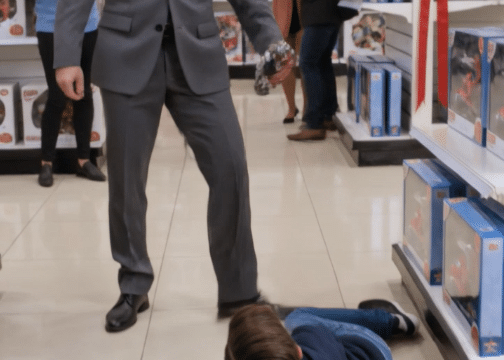
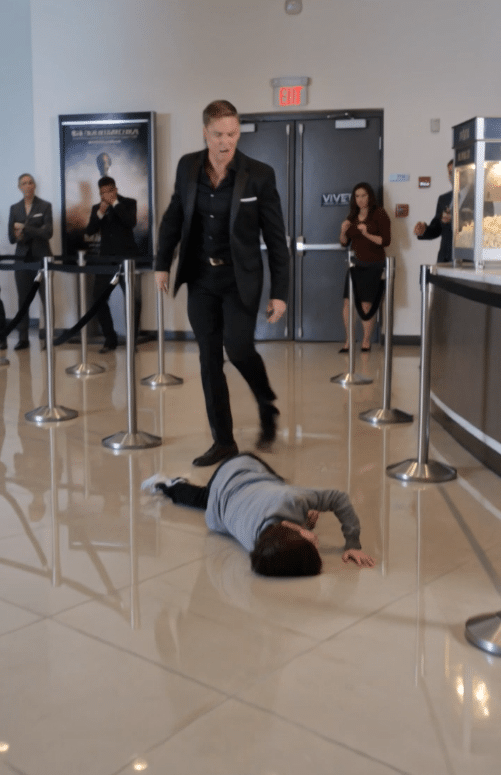
The words rang across the premium movie theater lobby just before a middle-aged man kicked a fifteen-year-old boy from behind, sending him stumbling toward the low popcorn counter.
The boy’s VIP ticket slipped from his hand and skidded across the polished floor. His elbow struck the ground as he fell, leaving a thin scrape and a faint trace of blood. For a moment, he simply stared at the ticket lying beside him, as if he couldn’t understand how a trip to the movies had turned into a public humiliation.
The man standing over him wore a black blazer, an open-collar shirt, and a silver watch that caught the lobby lights every time he moved his arm. His name was Richard Cole, and he had the practiced confidence of someone accustomed to getting what he wanted.
Behind him stood his wife and their teenage son, both holding tickets for a private screening. Richard had been in a foul mood since arriving, irritated by the crowd, the wait at the popcorn counter, and the fact that even the VIP entrance required people to follow a queue.
Then the boy had stepped in front of his family.
It had been an innocent mistake. A black queue rope divided the lobby into separate lanes, and the small floor marker indicating the VIP line was partly hidden by a promotional stand. The teenager had approached from the side, holding several family tickets, and failed to notice that he had stopped directly ahead of Richard.
When he realized someone was behind him, he turned immediately.
“I’m sorry,” he said. “I didn’t see the line marker.”
Richard looked him up and down.
The boy wore a gray jacket over a white T-shirt, black trousers, and clean white sneakers. He looked neat, polite, and slightly embarrassed. There was nothing threatening about him, nothing suggesting that he had deliberately cut ahead of anyone.
But Richard had already decided what kind of person he was.
“Trash kid. VIP is not for you.”
The boy’s expression changed.
“I’m not trying to cut in. I just didn’t see—”
“Do you know how much people pay to get into this section?”
The teenager glanced at the tickets in his hand.
“Yes, sir. These are our tickets.”
Richard gave a contemptuous laugh.
“Everyone has an excuse.”
A woman near the popcorn counter turned to look. Two employees behind the register stopped talking. The boy’s face reddened as he became aware of the growing audience.
He could have argued. He could have pointed to the tickets or demanded that Richard read them. Instead, he took a small step backward.
“I’m sorry,” he repeated. “I’ll move.”
That should have ended the encounter.
Richard could have accepted the apology, pointed out the correct lane, and continued toward the screening room. His family would have entered the theater, bought their snacks, and forgotten the entire incident before the previews ended.
Instead, he stepped closer.
“You people always think the rules don’t apply to you.”
The boy frowned, confused.
“I said I was sorry.”
“And I’m telling you to move.”
“I am moving.”
Richard’s son shifted uncomfortably behind him.
“Dad, come on. It’s fine.”
Richard ignored him.
He had begun to feel that the boy’s calm explanation was an insult. In his mind, the teenager was not correcting a misunderstanding; he was refusing to accept Richard’s authority.
The manager in Richard had never been a manager. He was simply a customer with money, connections, and an inflated belief that spending more than other people entitled him to treat them as lesser.
He glanced at the VIP rope, then at the boy.
“Learn your place in the back.”
Before the teenager could respond, Richard moved behind him and drove a forceful kick into his back.
The boy lurched forward toward the popcorn counter. His arms shot out instinctively, but he could not catch himself before hitting the floor.
The VIP tickets scattered around him.
A sharp gasp rose from the lobby.
Richard did not step away.
As the boy struggled to gather himself, the man delivered exactly two more forceful kicks into his back and side.
The teenager curled inward, trying to protect himself. His elbow scraped against the floor, and his breath caught as he tried to move away from the man.
A woman covered her mouth.
One employee stood frozen behind the counter, staring as if her mind had refused to accept what her eyes were seeing. A father pulled his young daughter closer, while several customers stepped back from the scene.
Nobody intervened before the attack was over.
Richard straightened his jacket.
“Maybe now you’ll remember.”
The boy looked up at him, frightened and bewildered.
“I didn’t do anything.”
Richard pointed toward the far end of the lobby.
“Then stop acting like you belong where you don’t.”
The words seemed to hang in the air longer than they should have.
Behind Richard, a private screening door opened sharply.
An older man with silver hair stepped into the lobby, wearing a navy suit and white shirt. He had been inside the private screening suite with several executives when the commotion reached the corridor.
He looked toward the popcorn counter.
Then he saw the boy on the floor.
“Ethan?”
The older man moved immediately, crossing the lobby with an urgency that made people step aside.
He dropped beside the teenager, carefully reaching for his shoulder.
“Ethan, look at me. Are you hurt?”
The boy lifted his head.
“Grandpa?”
The older man’s expression changed. He helped Ethan sit up without forcing him to stand, then moved between the boy and Richard.
His voice was quiet, but every person nearby heard the anger beneath it.
“You kicked my grandson in my theater?”
Richard’s face went blank.
He knew the man standing in front of him.
Every executive in the entertainment industry knew him.
Arthur Bennett was the chairman of GrandView Cinemas, one of the largest theater chains in the country. The building around them, from the premium screening rooms to the marble-floored VIP lobby, belonged to the company he had spent decades building.
Richard stared at Arthur, then at the boy.
His mouth opened, but the words seemed to disappear before he could speak.
“Your theater?”
For the first time that afternoon, Richard looked genuinely afraid.
And for the first time, everyone watching understood that the boy he had treated as an intruder was not a stranger who had wandered into the wrong line.
He was Arthur Bennett’s grandson.
But Arthur’s first concern was not Richard’s expression, his wealth, or the humiliation now spreading across his face.
It was the teenager sitting on the floor, trying to understand why an adult had hurt him over a mistake that could have been corrected with a single sentence.
Act II
Arthur Bennett had spent forty years building GrandView Cinemas from a small regional business into a national entertainment company.
He remembered when theaters had been simple places: rows of seats, a modest concession stand, and a screen large enough to make an ordinary evening feel extraordinary. Over the years, he had watched the industry transform through digital projection, luxury seating, private screenings, and elaborate premium experiences.
GrandView had grown with those changes.
Its VIP lounges were designed for guests who wanted privacy and comfort. Its private screening rooms hosted premieres, corporate events, and family celebrations. The theater where Ethan had been attacked was one of the chain’s newest flagship locations.
But Arthur had never believed that a more expensive ticket made a person more valuable.
He had built his business around the idea that the moviegoing experience should belong to everyone who entered through the doors. Some customers bought the cheapest seats for a weekday matinee. Others reserved private rooms for entire families.
Both deserved to be treated with respect.
Arthur had repeated that principle so often at management meetings that his executives could quote it from memory.
Apparently, not everyone who visited GrandView had learned it.
Ethan was Arthur’s only grandson, the son of his daughter, Claire, who had deliberately raised him away from the constant attention that followed the Bennett name.
Claire did not want her son growing up believing that wealth made him special. Ethan attended an ordinary private school, had his own responsibilities, and was expected to speak politely to people regardless of their jobs or income.
Arthur agreed with her.
When Ethan visited his grandfather’s office, he was not allowed to interrupt meetings simply because he was family. When he wanted something expensive, he was expected to explain why he wanted it. And when he made a mistake, he was expected to own it.
Those lessons were part of why Ethan had apologized so quickly when he realized he had entered the wrong lane.
He had not expected an apology to become a reason for an adult to attack him.
Now Arthur crouched beside him in the VIP lobby, studying his face.
“Can you breathe normally?”
Ethan nodded cautiously.
“My back hurts.”
“Don’t try to get up yet.”
Arthur kept one hand near his grandson’s shoulder, careful not to move him unnecessarily. Then he looked toward a nearby employee.
“Call for medical assistance. And have someone contact security and preserve the camera footage.”
The employee hurried to comply.
Arthur turned back to Ethan.
“I’m here. You’re safe.”
The teenager’s eyes were wet, though he seemed determined not to cry in front of the strangers watching him.
“I didn’t mean to cut the line.”
“I know.”
“I couldn’t see the marker.”
“I believe you.”
Ethan swallowed.
“Is everyone looking at me?”
Arthur glanced around. Several customers immediately looked away.
“Some people are,” he said. “But you don’t owe them an explanation.”
The simple answer seemed to loosen something in Ethan’s expression. He had been trying to defend himself since the moment Richard accused him of cutting in line. Even after being kicked, he seemed worried that someone might still believe he had done something wrong.
Arthur knew that feeling could linger long after the physical pain faded.
He had seen adults carry the memory of public humiliation for years. He had watched employees apologize for mistakes they had not made because they feared losing their jobs. He understood how quickly a person could begin questioning their own worth when someone more aggressive insisted they were inferior.
He would not allow his grandson to believe that being polite meant accepting cruelty.
Once the medical team arrived, Arthur gave them room to examine Ethan. The boy was able to answer their questions, though he was sore and shaken. His elbow had been scraped, and the pain in his back and side required assessment.
Arthur stayed close.
Richard remained several feet away, watching the scene unfold.
He looked from the security staff arriving near the entrance to the chairman kneeling beside the boy. The confidence he had displayed moments earlier was gone, replaced by the frantic calculation of a man trying to work out how much trouble he was in.
Finally, he approached.
“Mr. Bennett, I can explain.”
Arthur rose slowly.
“Then explain.”
Richard glanced toward the employees, as though he wanted the conversation moved somewhere private.
“I thought he was cutting the VIP line.”
Arthur waited.
“I was trying to keep order. People pay a great deal to use this section, and I assumed he was trying to get ahead of everyone.”
“Did you ask him?”
Richard hesitated.
“He said he hadn’t seen the marker.”
“So he apologized and explained what happened.”
“He was still standing in front of my family.”
“And you decided that justified kicking him?”
Richard’s jaw tightened.
“I didn’t know who he was.”
Arthur stared at him.
“Would you like to try that sentence again?”
Richard looked confused.
Arthur took a measured breath.
“You keep telling me you didn’t know who my grandson was. You haven’t explained why you thought you had the right to attack any fifteen-year-old boy.”
Richard opened his mouth, then closed it.
His own son stood behind him, staring at the floor.
Arthur noticed the boy’s expression. He also noticed that Richard’s wife had moved several steps away from her husband, looking horrified by what she had witnessed.
No one appeared eager to defend him.
Arthur turned to the theater’s general manager, who had arrived from the main lobby.
“Secure the relevant footage and identify the witnesses. Make sure the incident is documented properly. We will cooperate fully with the appropriate authorities.”
“Yes, Mr. Bennett.”
“Do not allow anyone to delete or alter the recordings. And make sure Ethan’s family receives the incident report through the proper channels.”
The manager nodded.
Arthur returned to his grandson.
Richard watched him, visibly unsettled by the fact that Arthur had stopped speaking to him.
He had expected an argument, perhaps a threat, or even an offer to settle the matter quietly. Instead, Arthur was treating the incident as something that needed to be documented, investigated, and addressed.
That made Richard more frightened than a shouted threat would have.
Because Arthur was not reacting like a grandfather seeking revenge.
He was reacting like a man who intended to make sure the truth could not be buried.
Act III
The private screening was canceled before the previews began.
Guests who had been waiting near the VIP doors were redirected to other seating areas while staff handled the incident. The popcorn counter remained open, but the cheerful atmosphere that had filled the lobby was gone.
No one was discussing the movie anymore.
They were discussing the man who had kicked a teenager in front of a crowd.
Arthur accompanied Ethan to receive medical attention and called his daughter, Claire. He kept his explanation brief until he could speak with her privately, but the moment she heard that Ethan had been hurt, she insisted on coming to the theater.
When she arrived, Ethan tried to reassure her before she could ask any questions.
“I’m okay, Mom.”
Claire knelt beside him and gently brushed his hair away from his forehead.
“You don’t have to pretend you’re okay for me.”
That was when his composure began to crumble.
“I didn’t even cut the line on purpose.”
Claire wrapped her arms around him carefully.
“I know, sweetheart.”
“He kept calling me trash.”
Her face tightened, but she kept her voice steady.
“None of that was your fault.”
Arthur stood nearby, looking at the floor for a moment. He had spent decades learning how to remain composed during hostile negotiations and corporate crises. Yet nothing had prepared him for watching his grandson apologize for being hurt.
When the medical team finished its initial assessment, Arthur returned to the management office.
The theater’s general manager, security supervisor, and regional operations director were waiting. Richard had been asked to remain in a separate area while the incident was documented.
The first witness accounts were consistent.
Ethan had approached the VIP queue from the side and stopped in front of Richard’s family. He had apologized when the mistake was pointed out. Richard had insulted him, and the confrontation had escalated into a physical attack.
The security footage supported those accounts.
It showed the boy turning toward Richard and attempting to explain himself. It showed Richard moving behind him and kicking him forward. It also recorded the two additional kicks after Ethan fell.
There was no evidence that Ethan had threatened Richard or behaved aggressively.
There was no indication that the teenager had tried to provoke a confrontation.
The footage left little room for the story Richard was preparing to tell.
Arthur watched the relevant segment once, then asked the security supervisor to preserve the original recording and restrict access to authorized personnel.
“Make sure the footage is retained according to our procedures,” he said. “No one is to share it casually or turn this into a spectacle.”
He wanted the evidence preserved, not circulated for entertainment.
The regional director cleared his throat.
“Mr. Bennett, we can arrange a private discussion with the guest if you’d prefer to resolve this internally.”
Arthur turned toward him.
“What does ‘resolve this internally’ mean?”
The director shifted in his chair.
“I mean we can gather statements, determine what happened, and address any conduct that violated our guest policies.”
“Then do that. But this is not a customer-service complaint.”
Arthur placed the preliminary incident report on the table.
“A man physically attacked a teenager in our lobby. The fact that the victim is my grandson makes this personal, but it doesn’t change what happened.”
The director nodded.
Arthur continued.
“I want the witnesses heard, the footage preserved, and the appropriate authorities given the information they need. We will not hide the incident because the guest involved is wealthy, and we will not exaggerate anything because he attacked my family.”
That last sentence mattered to Arthur.
He knew the danger of allowing anger to control the process. Richard had done something serious, and there needed to be consequences. But those consequences had to follow the evidence, not the chairman’s personal fury.
As the review continued, staff began describing earlier interactions with Richard.
He had visited GrandView’s premium locations several times. Employees remembered him complaining about seating assignments, demanding special treatment, and insisting that other guests be moved when they inconvenienced him.
Some complaints had been handled with routine apologies. Others had been dismissed because Richard spent heavily on premium screenings and often arrived with influential business contacts.
No previous complaint had established the kind of physical conduct now documented.
Still, the pattern raised an uncomfortable question.
Had staff members become so eager to keep an important customer happy that they had learned to tolerate behavior they should have challenged?
Arthur ordered a review of the theater’s complaint records, including how staff were instructed to handle aggressive guests.
The company needed to distinguish between ordinary dissatisfaction and intimidation. It also needed to make clear that premium status did not grant a customer permission to threaten employees or other patrons.
Meanwhile, Richard was attempting to build a defense around his own assumptions.
He told staff that he had believed Ethan was cutting the line deliberately. He claimed he had been protecting his family’s place in the queue. He described the lobby as crowded and insisted the situation had escalated faster than he expected.
But when asked why he had kicked the boy, he could not give an answer that matched the footage.
“I lost my temper,” he finally admitted.
That statement was more honest than his earlier excuses, but it was not an explanation that erased the harm.
The security supervisor recorded it in the incident documentation.
Richard’s wife was asked to provide a witness account. She did not attempt to defend her husband. She confirmed that Ethan had apologized and that Richard had continued insulting him.
Their son gave a similarly straightforward account.
He had told his father that the mistake did not matter.
His father had ignored him.
When Richard learned that his own family members were not supporting his version of events, his face darkened.
“They’re making this worse than it was,” he muttered.
His wife looked at him.
“You kicked a boy who was already trying to move out of your way.”
“He cut in front of us.”
“By accident.”
“You don’t know that.”
“I heard him apologize. I watched you attack him.”
Richard stared at her, but she did not look away.
For once, his money and confidence could not force the people closest to him to agree with him.
The truth had become too clear.
And the more Richard tried to defend himself, the more obvious it became that he was not truly sorry for what he had done.
He was frightened of what it might cost him.
Act IV
By the following morning, GrandView’s corporate office had received messages from customers who witnessed the incident.
Some praised the employees who had cooperated with the investigation. Others asked whether wealthy guests were allowed to behave differently from everyone else. Several parents wanted reassurance that their children would be safe in the company’s theaters.
Arthur did not respond with a dramatic public speech.
He authorized a short statement confirming that a serious incident had occurred at the flagship location, that the company was cooperating with the appropriate authorities, and that the safety of guests remained a priority.
He did not release Ethan’s private medical information.
He did not identify the teenager publicly.
And he did not use the incident to promote himself as a protective grandfather.
The company’s responsibility was to address what had happened and make sure the process remained fair.
Behind the scenes, however, Arthur insisted on a full review.
The theater’s general manager was required to explain why the initial response had been slow. Employees had witnessed the attack, but fear and confusion had left them uncertain about what to do. Some had been worried that intervening might escalate the situation. Others had assumed security would arrive before the confrontation became physical.
Arthur understood that people could freeze during a frightening event.
He did not blame every witness for failing to react perfectly in the moment.
But he did expect the company to provide clear procedures for responding to violence.
“We can’t expect employees to improvise under pressure,” he told the regional leadership team. “They need to know how to summon help, protect people from further harm, preserve evidence, and report what they witnessed.”
The company began revising its staff guidance and reviewing emergency-response training. Managers were reminded that premium guests remained subject to the same conduct standards as everyone else.
A private screening reservation did not confer authority over other customers.
An expensive watch did not make an accusation true.
And a queue dispute did not justify physical violence.
Richard’s own situation deteriorated quickly.
The incident had been documented, witness accounts collected, and relevant footage preserved. GrandView restricted his access to the private screening facilities while the matter was reviewed, and the company made clear that future access would depend on the outcome of the investigation and its guest-conduct policies.
The company did not claim to determine any criminal penalty. That would be for the appropriate authorities and legal process.
But Arthur could decide whether GrandView would continue welcoming someone who had attacked a guest inside its premises.
He had no intention of allowing Richard’s spending history to outweigh the safety of other customers.
Richard tried to contact Arthur through a business associate.
He asked for a private conversation, insisting that the situation could be settled without unnecessary embarrassment.
Arthur declined to discuss the incident outside the formal process.
That refusal left Richard increasingly desperate.
He had spent years believing that money could smooth over almost any problem. If a reservation was wrong, someone could be persuaded to fix it. If a business partner was offended, an expensive dinner could soften the disagreement. If a complaint threatened his reputation, a private conversation could often make it disappear.
But the footage existed.
The witnesses had spoken.
And the boy had not been an anonymous customer who could be dismissed as unreliable.
Even so, Arthur’s decision did not depend on Ethan’s family name.
That point became clear during a meeting with the theater’s leadership.
One executive suggested that the company should emphasize the fact that the victim was the chairman’s grandson, arguing that the relationship made the incident particularly damaging.
Arthur rejected the idea.
“The relationship explains why I was present,” he said. “It does not explain why the conduct was unacceptable.”
He looked around the room.
“If that had been the child of one of our cleaners, the response should have been the same. If it had been a teenager whose family could not afford a VIP ticket, the response should have been the same. If nobody important had witnessed it, the response should still have been the same.”
No one interrupted him.
“We cannot tell customers that everyone is welcome and then allow someone to decide that certain people deserve less dignity.”
That became the guiding principle for the company’s response.
Richard, meanwhile, was forced to confront a consequence he had never seriously considered: people no longer trusted his version of events simply because he spoke with confidence.
His wife remained angry.
His son had become distant.
And the business contacts who had once enjoyed his invitations to private screenings were suddenly reluctant to be associated with the incident.
When he complained that everyone was abandoning him, his wife finally answered with a question.
“Who was standing beside that boy when you kicked him?”
Richard stared at her.
“No one,” she continued. “He was alone on the floor, and you were still standing over him.”
“I’ve already said I lost my temper.”
“You lost it three times.”
He looked away.
She did not raise her voice.
“You had time to stop after the first kick. You chose not to. Then you told him he didn’t belong there.”
Richard rubbed his forehead.
“I didn’t know who he was.”
His wife shook her head.
“That is what you keep saying. You still don’t understand why it matters.”
The words stayed with him long after the conversation ended.
For years, Richard had treated status as a kind of permission. He believed that paying more entitled him to better treatment, and that being important meant other people should accommodate him.
In the theater lobby, he had looked at a teenager who made a small mistake and seen someone beneath him.
He had not seen a child.
He had not seen a fellow customer.
He had seen someone he believed he could humiliate without consequence.
The chairman’s arrival had changed the balance of power, but it had not changed what Richard had done.
And that was the truth he could no longer escape.
Act V
Several weeks later, Ethan returned to GrandView Cinemas with his mother and grandfather.
Arthur had offered to arrange a private screening if Ethan wanted to avoid the public lobby. Instead, Ethan asked to attend an ordinary showing.
He did not want the incident to decide where he could go.
Claire agreed, and Arthur respected his choice.
They arrived early on a quiet afternoon. The lobby smelled of fresh popcorn, and a new movie poster stood beside the ticket scanners. The black queue ropes had been rearranged, with clearer signs showing where each line began.
Ethan noticed the changes.
“Did they move the ropes because of what happened?”
“Partly,” Arthur replied. “They wanted the lines to be easier to understand.”
Ethan looked at the floor marker.
“It was hard to see before.”
“That doesn’t excuse what Richard did,” Arthur said. “But it’s still worth fixing the sign.”
Ethan nodded.
They joined the correct line, and an employee checked their tickets with a friendly smile. No one stared. No one demanded to know who they were. The transaction was ordinary and quick.
At the concession counter, Ethan ordered popcorn and a drink.
When the employee handed them over, he said thank you.
Then he turned toward his grandfather.
“Can we still come here again?”
Arthur felt the question settle heavily in his chest.
“Of course.”
“Even if you’re not with me?”
“Absolutely.”
Ethan looked at him, searching his face for certainty.
Arthur crouched slightly so he could meet his grandson’s eyes.
“You have just as much right to be here as anyone else with a ticket. You don’t need me standing beside you to deserve respect.”
Ethan seemed to think about that.
Then he nodded and headed toward the screening room with his mother.
Arthur followed a few steps behind, watching the boy walk through the lobby without looking over his shoulder.
It was a small moment.
But after what had happened, small moments mattered.
Ethan had not been forced to abandon his love of movies. He had not been told to avoid crowded places or stay away from premium areas. His family had helped him understand that the attack was not his fault, and that one cruel person’s behavior did not define every person he would meet.
The experience had left him shaken, but it had not taken away his right to enjoy ordinary things.
That was what Arthur wanted most for him.
Not revenge.
Not a public apology designed to satisfy strangers.
Not the knowledge that his family name could make powerful people tremble.
He wanted Ethan to grow up knowing that dignity was not something granted by wealth or status.
It was something every person deserved.
The review at GrandView concluded with the company confirming that Richard’s conduct violated its guest standards. His access to the chain’s premium facilities was withdrawn under the company’s policies, and the incident remained subject to any separate proceedings handled by the appropriate authorities.
Arthur did not announce the decision as a personal victory.
He made no attempt to humiliate Richard in return.
He simply ensured that the company would not reward a customer for using violence against another guest.
For Arthur, that was enough.
The chain continued its staff training and improved its procedures for reporting and responding to aggressive behavior. Managers were reminded that customer status could never override safety, and employees were given clearer guidance on how to summon assistance when a confrontation became dangerous.
The changes did not erase what had happened to Ethan.
They could not guarantee that every future guest would behave well.
But they made the company’s expectations harder to misunderstand.
Months later, Ethan would remember the incident in fragments: the sudden impact, the scattered tickets, the feeling of the cold floor beneath his hand, and the terrible moment when he realized the people around him were watching.
He would also remember his grandfather kneeling beside him.
Arthur had not begun by asking whether Richard knew who Ethan was. He had not demanded that the manager explain himself before checking on the boy. He had not treated the family relationship as the most important fact in the room.
He had reached for Ethan first.
That was the part the teenager carried forward.
One evening, after a movie with his mother, Ethan asked Arthur a question he had been holding for weeks.
“Grandpa, do you think Richard would have done it if he knew who I was?”
Arthur considered the question carefully.
“Maybe not.”
Ethan looked down at the ticket in his hand.
“Then he was only scared because you were there.”
“That’s possible,” Arthur said. “But what he should have been afraid of was hurting someone.”
Ethan was quiet.
Arthur continued.
“People sometimes behave well when they think someone powerful is watching. The real test is how they treat people when they believe there will be no consequences.”
Ethan looked toward the lobby, where families were lining up for the next showing.
“So it wasn’t really about the line.”
“No,” Arthur said. “The line was just the excuse he used.”
The boy nodded slowly.
Then he followed his mother toward the exit.
Arthur remained behind for a moment, watching families move between the ticket counters and the concession stands. Some wore designer coats. Others carried backpacks and held children’s hands. Some had bought premium seats, while others were heading toward the least expensive screening of the day.
To Arthur, they all belonged there.
That was the promise behind GrandView’s doors, and it was a promise he intended the company to keep.
Richard Cole had believed that a VIP ticket placed him above everyone else. He had mistaken money for authority and a minor inconvenience for an insult that demanded punishment.
When he kicked a teenager in the back, he thought he was teaching the boy a lesson about status.
Instead, he exposed his own character.
The chairman’s arrival had made the consequences impossible for him to ignore. But Arthur’s power was not what made Richard’s actions wrong.
They were wrong before the private screening door opened.
They were wrong before the witnesses recognized the chairman.
They were wrong even if nobody had ever discovered the boy’s identity.
And that was the lesson Arthur wanted to leave behind.
A VIP ticket can buy a better seat.
It cannot buy the right to treat another human being as less deserving of respect.
Because the boy Richard had ordered to “learn his place” already belonged exactly where he was: in a public theater, holding a valid ticket, waiting to watch a movie.
The person who truly needed to learn his place was the man who believed that a little money gave him the right to hurt someone smaller than himself.