Act I
“Crawl away before I call security.”
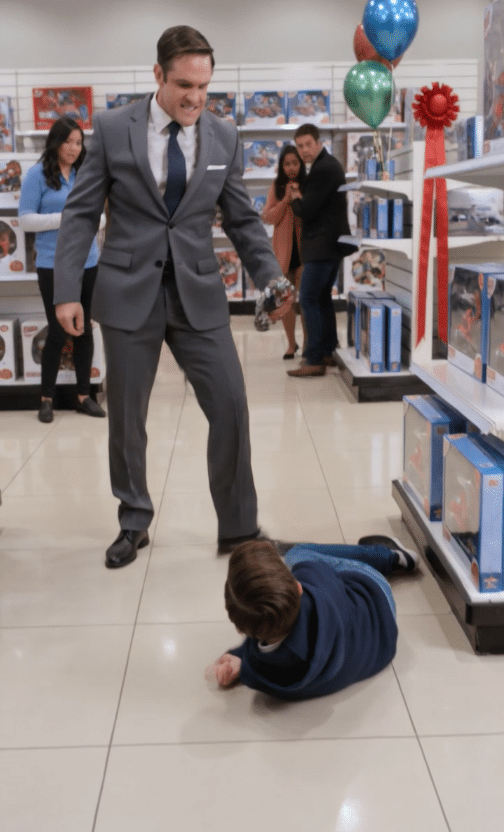
The words echoed through the bright new toy store, cutting through the cheerful music and the excited chatter of children gathered beneath colorful balloons.
A twelve-year-old boy sat on the floor beside a low display shelf, staring up at the man standing over him. His navy hoodie was twisted at the shoulder, his blue jeans were dusty, and one forearm bore a thin scrape that had left a faint trace of blood.
A few feet away lay the sample robot he had been examining.
The boy’s name was Ethan Hayes.
He had come to the grand opening because the store had fascinated him since the first advertisements appeared online. Towering shelves displayed remote-controlled cars, collectible figures, model spaceships, and advanced robotic toys that could walk, speak, and respond to commands.
But Ethan had been especially interested in one machine: a silver-and-blue robot displayed on a low shelf near the center aisle.
It was the prototype for a new product line, and a small sign beside it invited customers to ask staff members for a demonstration.
One of the employees had handed Ethan the model a few minutes earlier, explaining how its joints moved and how its sensors responded to nearby objects. Ethan had listened carefully, turning the robot in his hands while the employee described its features.
Then the employee had been called away to assist another customer.
Ethan had continued examining the model, waiting for someone to return.
That was when the store manager appeared.
“Put that down.”
The man wore a gray suit, a polished name badge, and the rigid expression of someone who believed his position entitled him to unquestioned obedience.
His name was Marcus Reed.
At thirty-six, Marcus had worked his way up from assistant manager to oversee the new location. He took pride in the store’s immaculate displays, its premium clientele, and the attention the opening had attracted.
He also had a habit of judging customers before they spoke.
Ethan’s clothes were ordinary. His sneakers were clean but inexpensive, and he carried no shopping bag. To Marcus, the boy looked like someone who had wandered into the store to play with merchandise he could never afford.
“The staff said I could look at it,” Ethan explained.
Marcus stepped closer.
“Did I ask you what the staff said?”
Ethan blinked.
“No, sir.”
“Then put it down.”
“I was just waiting for the employee to come back.”
Marcus snatched the robot from his hands.
“Trash kid. Don’t steal what you can’t buy.”
The words seemed to strike Ethan harder than the insult itself.
“I wasn’t stealing it.”
Marcus glanced at the model, then at the boy.
“Children like you always have an excuse.”
A mother standing nearby turned toward them. Two children who had been waiting to take photographs beside the opening display stopped whispering.
Ethan slowly rose to his feet.
“I can show you the sign,” he said. “It says customers can ask to try it.”
Marcus gave a cold laugh.
“Are you telling me how to run my store?”
“No. I’m just telling you what happened.”
The manager’s face hardened.
He had expected the boy to apologize, lower his eyes, and disappear. Instead, Ethan was trying to explain himself, and the presence of other customers made Marcus feel as though his authority were being challenged.
He had spent weeks preparing for the opening. Senior executives were expected to attend the ribbon ceremony, and the store’s performance would be closely watched.
He was determined that nothing should make him look incompetent.
And now, in his mind, a child holding an expensive robot had become a threat to his reputation.
Marcus stepped into the robot aisle, blocking Ethan’s path.
“Do you know how much that thing costs?”
Ethan shook his head.
“Then you have no business touching it.”
“But your employee—”
“Enough.”
Marcus shoved the robot behind him and drove a forceful kick straight into Ethan’s chest.
The boy stumbled backward into the low display shelf and fell hard to the floor. Several small boxes rattled off the edge, while his forearm struck the ground.
A sharp gasp rose from the surrounding customers.
Ethan tried to sit up, but pain made him hesitate. He looked toward the robot, which Marcus had placed out of reach.
Then the manager stepped beside him and delivered two more forceful kicks into his back and side.
A woman covered her mouth.
A father reached for his young daughter and pulled her behind him. An employee near the checkout counter stood motionless, her face drained of color.
Nobody had intervened before the attack was over.
Ethan curled inward, frightened and confused.
Marcus looked down at him.
“Crawl away before I call security.”
The boy stared at the man who had just attacked him.
“I didn’t do anything.”
His voice shook.
Marcus adjusted his jacket.
“Tell that to the police.”
Then the main entrance doors opened.
A man in a black blazer and white shirt strode into the store from the ribbon-cutting area. He had been greeting local officials and business partners when he noticed the sudden commotion inside.
His eyes moved across the aisle.
He saw the fallen display boxes.
He saw the robot on the shelf.
Then he saw Ethan on the floor.
“Ethan?”
The man moved so quickly that the employees barely had time to step aside.
He dropped beside the boy, checking his face and placing a protective hand on his shoulder.
“Son, look at me. Where does it hurt?”
Ethan looked up.
“Dad?”
The man’s expression changed.
He helped Ethan sit up carefully, then stood and positioned himself between his son and the manager.
His voice was low, controlled, and unmistakably furious.
“You kicked my son in my store?”
Marcus stared at him.
He knew that face.
Everyone in the management team knew it.
Daniel Hayes was the chief executive officer of PlayForge, the national toy store chain whose newest flagship location they were standing in.
Marcus’s lips parted.
“Your son?”
Daniel did not look away.
And in that instant, the manager finally understood that the boy he had treated like a thief was the child of the man who could determine the future of every store in the company.
But Daniel was not thinking about firing anyone.
He was thinking about the fact that his twelve-year-old son was hurt, frightened, and sitting on the floor of a store that carried his family’s name.
And Marcus had just made the worst mistake of his life.
Act II
Daniel Hayes had built PlayForge around a simple idea: toys should make children feel curious, capable, and welcome.
When he opened his first small store years earlier, he had spent long days assembling display shelves himself and learning which products made children stop in their tracks. He remembered the way their faces lit up when a toy did something unexpected, or when an employee took the time to explain how it worked.
Those moments mattered to him more than the glossy advertisements.
As PlayForge grew into a national chain, Daniel insisted that the stores preserve that sense of discovery. Sample products were meant to be handled under reasonable supervision. Staff were encouraged to demonstrate toys rather than guard them as though every curious child were a potential criminal.
The company was not a charity, and its products were not free. But Daniel believed that a child should be allowed to explore a toy without being humiliated for not looking wealthy enough to buy it.
That belief had shaped the company.
It had also shaped the way he raised Ethan.
Daniel’s son had grown up around product designers, engineers, and retail staff. He loved machines that moved, especially robots that could respond to simple commands. He would spend hours watching demonstrations and asking questions that sometimes left adults scrambling for answers.
Daniel could easily have bought him every toy in the store.
He rarely did.
Instead, he encouraged Ethan to learn how things worked and to understand the difference between owning something and appreciating it.
Ethan’s mother, Rachel, had been equally firm about manners. If he wanted to examine something in a store, he should ask first. If someone helped him, he should say thank you. If he made a mistake, he should apologize.
Ethan had followed those rules that morning.
A store employee had given him permission to inspect the robot. He had handled it carefully and waited when the employee was called away.
He had done nothing that justified what followed.
Daniel knew none of these details when he first reached his son. All he knew was that Ethan was on the floor, visibly shaken, while a manager stood above him.
“Get medical assistance,” Daniel told the nearest employee. “Now.”
The employee hurried toward the front counter.
Daniel crouched again.
“Can you breathe comfortably?”
Ethan nodded, though his eyes were wet.
“My arm hurts.”
“Okay. Don’t try to stand yet.”
Daniel kept his voice gentle, fighting the urge to turn around and unleash the anger rising inside him. His son needed him calm, not explosive.
Once help had been called, Daniel looked toward Marcus.
“Step away from him.”
Marcus obeyed, taking two steps backward.
“Mr. Hayes, there has been a misunderstanding.”
Daniel’s gaze moved to the robot resting on the shelf.
“What misunderstanding?”
“He was handling unreleased merchandise.”
“Was he stealing it?”
Marcus hesitated.
“I believed he intended to.”
“Did you see him conceal it? Did you see him attempt to leave with it?”
“No, but—”
“Did an employee give him permission to inspect the model?”
Marcus glanced at the employee standing near the next aisle.
She looked terrified, but she nodded.
“Yes,” she said quietly. “I gave him the demonstration unit. I told him he could look at it while I helped another customer.”
Daniel absorbed that answer.
Then he looked back at Marcus.
“So you had no evidence he was stealing.”
Marcus straightened his shoulders.
“I was protecting the store.”
“By kicking a child?”
“I was trying to control the situation.”
Daniel’s jaw tightened.
“You attacked him.”
A hush spread through the aisle.
Customers who had been pretending not to watch now stood openly staring. One woman held her phone at chest height, recording the aftermath. A second employee had begun collecting the fallen display boxes, though her hands were shaking.
Marcus lowered his voice.
“Sir, I understand how this looks, but I have been under enormous pressure preparing this opening. We have expensive inventory, a high-profile launch, and strict instructions to prevent theft.”
Daniel stared at him.
“Then you should have called security. You should have asked a question. You should have checked with your employee.”
He paused.
“None of those options involved kicking a twelve-year-old.”
Marcus’s face reddened.
“I didn’t know he was your son.”
Daniel’s expression became even colder.
“Stop saying that.”
Marcus fell silent.
“You keep acting as though his identity is the problem. Would you have been justified if he belonged to someone else?”
No answer came.
Daniel turned toward the store’s operations director, who had just arrived from the opening ceremony.
“Preserve all security footage from this aisle and the surrounding areas. Identify every witness, record their accounts, and document exactly what happened. Do not edit or delete anything.”
“Understood.”
“Contact the appropriate authorities and follow our incident procedures. I also want Ethan examined before anyone asks him another question.”
The director nodded and immediately began coordinating with staff.
Marcus looked around, searching for a sympathetic face.
He found none.
The employee who had given Ethan the robot was staring at him in disbelief. The customers who had witnessed the assault were no longer merely surprised; they looked angry.
Daniel returned to his son.
“I’m right here,” he said.
Ethan swallowed.
“Am I in trouble?”
The question nearly broke Daniel’s composure.
“No, buddy. You’re not in trouble.”
“But he said I was stealing.”
“I heard him.”
Ethan looked toward the robot.
“I didn’t want to break it.”
Daniel followed his gaze.
“I know.”
“I was being careful.”
“I know that, too.”
For a moment, Daniel forgot the manager, the opening ceremony, and the dozens of people watching. He saw only a frightened boy who was trying to prove he had been good.
He placed an arm around Ethan’s shoulders.
“You don’t have to prove that to me.”
Ethan finally let himself lean against his father.
Behind them, Marcus stood beneath the bright store lights, surrounded by balloons and carefully arranged displays that had been designed to make children happy.
He had spent the morning worrying about protecting the company’s merchandise.
Now he was watching the company’s CEO protect a child from him.
And the difference between those two responsibilities could not have been clearer.
Act III
The opening ceremony was canceled before the afternoon rush.
No dramatic announcement was made over the store speakers. The music was simply turned off, the ribbon-cutting photographs were postponed, and staff were instructed to assist customers while management handled the incident.
Daniel accompanied Ethan to receive medical attention. The boy’s forearm had been scraped, and he was sore from the kicks. The injuries required proper evaluation, but there was no need to describe them as anything other than what they were: the consequences of an adult using force against a child.
Daniel remained beside him throughout the examination.
Ethan kept asking whether the store would close.
“Did I ruin the opening?” he asked.
Daniel shook his head.
“You didn’t ruin anything.”
“But everyone was here because of you.”
“And they will understand that something serious happened.”
Ethan looked down at his hands.
“I didn’t mean to make the manager angry.”
Daniel pulled a chair closer.
“Listen to me. You are not responsible for another person’s decision to hurt you.”
Ethan said nothing.
“Even if you had touched something you weren’t supposed to touch, the right response would have been to explain the rule. Nobody has the right to attack you because they’re angry.”
The boy nodded, but Daniel could tell he was still struggling to understand how a simple visit to a toy store had turned into something frightening.
When they returned to the main office, the first witness statements had begun arriving.
The employee who had demonstrated the robot confirmed that Ethan had been given permission to inspect it. She explained that the model was a sample unit specifically intended to help customers understand the product.
Another staff member said Marcus had been complaining about theft prevention throughout the week. He had repeatedly warned employees that the flagship store could not afford to lose expensive merchandise during its opening period.
Those concerns were legitimate in themselves.
But witnesses also described how Marcus had begun treating ordinary customer behavior as suspicious, especially when he believed someone looked unable to afford the merchandise.
One employee remembered him making a dismissive comment about a family who had spent several minutes examining a high-priced remote-control vehicle.
Another said he had once accused a teenager of damaging packaging before checking whether the box had already been torn.
None of those incidents had involved physical violence. Some had been dismissed as the behavior of a demanding manager under pressure.
Now they formed a pattern that deserved closer examination.
The security footage provided a clear record of what had happened to Ethan.
It showed the boy holding the robot in the display aisle. It showed Marcus approaching, snatching the model away, and confronting him.
It showed the kick that knocked Ethan into the shelf.
And it showed the two additional kicks while he was down.
The footage was preserved for the investigation and internal review. Daniel insisted that it be handled carefully, with no unnecessary circulation of images showing his son in distress.
He did not want Ethan’s pain turned into promotional material for the company or entertainment for strangers.
But he also refused to let concern for the company’s reputation become a reason to hide the truth.
When the operations director presented the preliminary findings, Daniel listened without interruption.
“Has Marcus provided a statement?” he asked.
“Yes. He says he believed Ethan was attempting to steal the prototype.”
“Does he claim he saw Ethan trying to leave?”
“No.”
“Does he claim he saw him conceal the model?”
“No.”
“Does he dispute that the employee gave Ethan permission?”
“He says he didn’t know about the permission.”
Daniel leaned back.
“So he acted on an assumption, ignored the employee who could have clarified the situation, and used physical force against a child.”
The director nodded.
“That is consistent with the available footage and witness accounts.”
Daniel looked toward the window overlooking the store floor.
The opening balloons were still tied near the entrance. A red ribbon remained stretched across the ceremonial display, its neat bow now looking strangely out of place.
He had imagined the launch as a celebration of the company’s next chapter.
Instead, it had exposed a problem inside the organization.
PlayForge had grown quickly. Its managers were trained to protect inventory, meet sales targets, and maintain a polished customer experience. But somewhere along the way, Marcus had come to believe that protecting the store meant protecting his own authority at any cost.
Daniel had approved the company’s policies.
He had appointed the people responsible for enforcing them.
If a manager felt entitled to humiliate a child in front of customers, then the company needed to ask how such behavior had been allowed to develop.
That did not make Daniel responsible for Marcus’s personal choices.
It did make him responsible for addressing the conditions that could allow those choices to go unchallenged.
Later that afternoon, Marcus was called to a formal meeting with human resources and the operations director.
He entered the room expecting a chance to explain himself.
Instead, he was informed that he had been removed from duty pending the investigation and that the incident would be referred to the appropriate authorities.
“This is because he’s your son,” Marcus said when Daniel joined the meeting.
Daniel sat opposite him.
“No. This is because you attacked a child.”
“You wouldn’t be doing this if he were some random kid.”
Daniel held his gaze.
“Then let’s make the question very simple. If the boy had been the son of a cashier, would your actions have been acceptable?”
Marcus looked away.
“If he’d been the child of a single mother shopping on a budget, would it have been acceptable?”
Silence.
“If he’d been a foster child with no powerful family to call, would it have been acceptable?”
Marcus’s face tightened.
Daniel leaned forward.
“You seem to believe my son’s identity is what makes this serious. It isn’t. His identity is why I was there when it happened. The assault would have been just as serious if I had never arrived.”
For the first time, Marcus seemed unable to find a useful argument.
He had expected a powerful executive to defend his own family.
He had not expected that executive to insist that the same standard apply to every child who entered the store.
And that was when Marcus began to understand the real danger he faced.
The company could survive a bad opening day.
It could replace a manager.
What it could not afford was a culture in which employees believed that cruelty became acceptable whenever the victim looked powerless.
Act IV
By the next morning, the story had spread beyond the store.
Customers who had witnessed the incident contacted the company. Several parents asked whether staff had been trained to handle suspected theft without escalating confrontations. Others wanted to know whether the manager had been removed and whether the company would cooperate with the investigation.
Daniel refused to turn the matter into a public spectacle.
He issued a brief statement confirming that a serious incident had occurred, that the company was cooperating with the appropriate authorities, and that the safety of customers and employees remained a priority.
He did not reveal unnecessary details about Ethan’s medical condition.
He did not identify the witnesses.
And he did not promise a particular legal outcome before the process had run its course.
Inside PlayForge, however, the response was extensive.
Human resources began reviewing Marcus’s employment history, including earlier customer complaints. The company also examined how managers were trained to respond when merchandise was damaged or suspected theft occurred.
The review uncovered several warnings that had been handled informally.
One customer had complained that Marcus accused her teenage son of stealing a collectible figure, even though the item had been purchased minutes earlier. Another family had described being followed through the store after their child touched a demonstration vehicle.
In each case, the complaints had been resolved with apologies from lower-level staff or explanations that Marcus was strict about inventory.
No one had documented a pattern of intimidation serious enough to trigger a formal review.
That failure troubled Daniel.
He called a meeting with regional managers.
“I want to know why customer complaints were treated as isolated annoyances,” he said, “when the same behavior kept appearing.”
One manager explained that the complaints had seemed minor at the time.
Daniel shook his head.
“A complaint doesn’t have to involve physical harm before we take it seriously. If an employee repeatedly humiliates customers, we need to understand why.”
He asked for a review of reporting procedures, better training for store leaders, and a clear escalation process for complaints involving children.
He also directed the company to clarify the purpose of demonstration products. Staff should be able to explain the rules, but no employee should treat a child’s curiosity as evidence of criminal intent.
The changes were not a substitute for addressing the assault.
They were a way to prevent the same assumptions from becoming routine elsewhere.
Meanwhile, Marcus was struggling to accept that his position might not save him.
He had expected the company to consider his years of service, his sales figures, and the pressure he had faced during the launch.
Instead, investigators were examining his actions.
His attorney advised him to preserve relevant communications and cooperate with the process. Marcus was also warned not to contact witnesses or attempt to influence their accounts.
He wanted to call the employee who had given Ethan the robot.
He wanted to ask why she had not intervened more forcefully.
He wanted to tell the parents that they had misunderstood his intentions.
But each impulse carried the same problem: the witnesses had seen what happened, and the footage documented it.
He could explain his pressure.
He could explain his fear of theft.
He could explain that he had believed Ethan was taking an expensive product.
None of those explanations changed the fact that he had kicked a child three times.
At home, Marcus’s wife asked him a question he had not expected.
“What would you have done if that had been our son?”
Marcus stared at her.
“He shouldn’t have been touching merchandise.”
She looked at him in disbelief.
“You don’t know that. What if an employee had told him he could look at it?”
He had no answer.
“What if he tried to explain and the manager called him a thief?”
Marcus rubbed his face.
“I made a mistake.”
“Three times?” she asked quietly.
He looked up.
She did not shout. She did not threaten to leave. Her disappointment was harder to dismiss than anger would have been.
“You didn’t just make a mistake when you kicked him the first time. You had time to stop. You didn’t.”
Marcus looked away.
He remembered the boy’s frightened expression, the scrape on his arm, and the way he had asked whether he was in trouble.
He had told himself that he was protecting the store.
But the store had not been in danger.
A twelve-year-old had been examining a demonstration robot with permission.
Marcus had turned a routine customer interaction into an assault because he wanted to prove that he was in charge.
For the first time, he considered that the problem was not merely his temper.
It was the contempt underneath it.
He had looked at Ethan’s ordinary clothes and assumed the boy was dishonest. He had treated his own suspicion as proof, then used his position to punish a child who could not easily defend himself.
And when the CEO arrived, Marcus’s first instinct had been to argue that he did not know whose son Ethan was.
That was the part he could no longer ignore.
He had been frightened of consequences because Ethan belonged to Daniel Hayes.
He had not been frightened enough of what he had done to Ethan.
Several days later, Marcus received formal notice that his employment was terminated following the company’s review. The decision was based on the documented conduct and the breach of company policy, separate from any legal proceedings.
He read the letter twice.
Then he sat in silence, staring at the store manager badge that had once made him feel untouchable.
It had never given him the right to hurt anyone.
It had only given him a responsibility he had failed to understand.
Act V
A month later, Ethan returned to a PlayForge store.
Not the flagship location where the assault had happened, and not for a public appearance. He went with his father to a smaller branch on a quiet afternoon, hoping to find a model robot kit he had seen in a catalog.
Daniel had asked him more than once whether he wanted to wait.
Ethan had thought about it carefully before answering.
“I don’t want to stop liking robots because of what happened.”
Daniel smiled.
“Then we won’t let that decide what you enjoy.”
They entered the store without an announcement. No one had been told to gather around them, and no cameras followed their movements.
A young employee greeted them and asked whether they needed help.
Ethan paused near a shelf of robotic toys.
“Can I try the demonstration model?”
“Of course,” the employee replied. “Let me show you how it works.”
The answer was ordinary.
That was why it mattered.
The employee demonstrated how the robot responded to hand movements and explained which parts customers could handle. Ethan listened, asked two questions, and carefully tested the controls.
When he finished, he returned the model to the display.
“Thank you.”
“You’re welcome,” the employee said.
Daniel watched from a few feet away.
He felt relief, but also sadness that such a simple exchange had become something his son needed to experience again in order to feel comfortable.
Ethan glanced toward him.
“Dad?”
“Yeah?”
“Do you think the manager really believed I was stealing?”
Daniel considered the question.
“I think he decided what he believed before he checked the facts.”
“Why?”
“Sometimes people become so focused on being in control that they stop listening. Sometimes they judge people unfairly because of how they look. And sometimes they let anger make decisions that should never be made in anger.”
Ethan looked at the robot.
“But he could have just asked me.”
“Exactly.”
“Or asked the employee.”
“Exactly.”
Ethan was quiet for a moment.
“I still don’t understand why he kicked me.”
Daniel crouched so they were at eye level.
“You may never find an explanation that makes it make sense. What he did was wrong, and it wasn’t your fault.”
Ethan nodded slowly.
Then he picked up the box containing the robot kit he wanted to buy.
At the register, he placed it on the counter and waited while the employee scanned it.
There was no confrontation.
No accusation.
No one demanded to know whether he could afford it.
He walked out of the store carrying the box himself.
For Daniel, the moment was more meaningful than any ribbon-cutting ceremony could have been.
He had spent years building PlayForge into a company that brought children joy. He had imagined success in terms of new locations, better products, and the number of families who came through the doors.
Now he understood that the company’s character was revealed in a much smaller moment.
A child touched a toy.
An employee explained how it worked.
A child learned something new.
That was the experience PlayForge was supposed to offer.
The flagship store eventually reopened its full program of events, with revised staff procedures and clearer guidance for handling customer concerns. The company continued reviewing its practices, and the incident remained part of the internal training used to remind managers that suspicion was not proof and authority was not permission to intimidate.
Daniel did not pretend those changes could guarantee that no employee would ever behave badly again.
But he wanted the people who worked for him to understand the standard.
Protecting merchandise did not mean treating customers like criminals.
Maintaining order did not mean humiliating children.
And leadership did not mean being the person everyone feared.
It meant being responsible for what happened when people trusted you with power.
As for Ethan, the experience faded unevenly. Some days, he could talk about robots for an hour without thinking about the assault. Other days, the memory returned when he entered a crowded store or heard an adult raise his voice.
Daniel never told him to get over it.
He listened when Ethan wanted to talk and gave him space when he did not.
Slowly, the boy began to remember the things he loved about toys: the clever mechanisms, the hidden sensors, the way a machine could be designed to solve a problem no one had thought to ask about.
One evening, Ethan spread the pieces of his new robot kit across the kitchen table.
Daniel sat beside him while he sorted the components.
“Do you want help?” his father asked.
Ethan shook his head.
“I think I can figure it out.”
Daniel smiled.
“Then show me what you discover.”
The boy bent over the instructions, concentrating as he connected the first two pieces.
For the first time in weeks, he looked completely absorbed in the task.
Daniel watched him work and thought about the day at the flagship store.
Marcus had looked at his son and seen a child he believed was too poor to belong near an expensive toy.
He had seen a display model and imagined a theft without evidence.
He had seen a frightened boy trying to explain himself and mistaken that fear for weakness.
Then Daniel had walked through the entrance.
“You kicked my son in my store?”
The manager’s expression had changed instantly.
“Your son?”
But that final question revealed more than Marcus’s fear of losing his job.
It revealed what he had believed all along: that a person’s importance depended on who stood behind them.
He had treated Ethan as disposable because he thought the boy had no power.
He had assumed that a child with ordinary clothes and no visible connections could be insulted without consequence.
The CEO’s arrival shattered that assumption.
Yet Daniel knew the lesson had to reach beyond his own family.
If Ethan had been the son of a cashier, a delivery driver, a single parent, or a family struggling to pay rent, the assault would have been just as wrong.
The toy would still have been a demonstration model.
The boy would still have been twelve.
And the manager would still have been responsible for his choices.
That was the truth Daniel wanted every PlayForge employee to remember.
A child should never have to prove that his family is powerful before an adult treats him with basic dignity.
And no manager should mistake a name badge for the right to decide who deserves respect.
Because the moment Marcus kicked Ethan, he did more than attack a child.
He revealed exactly what he believed about people who could not fight back.
And when the CEO finally arrived, the real question was no longer whether Ethan belonged in the store.
It was whether Marcus had ever understood what it meant to deserve the position he held.