Act I
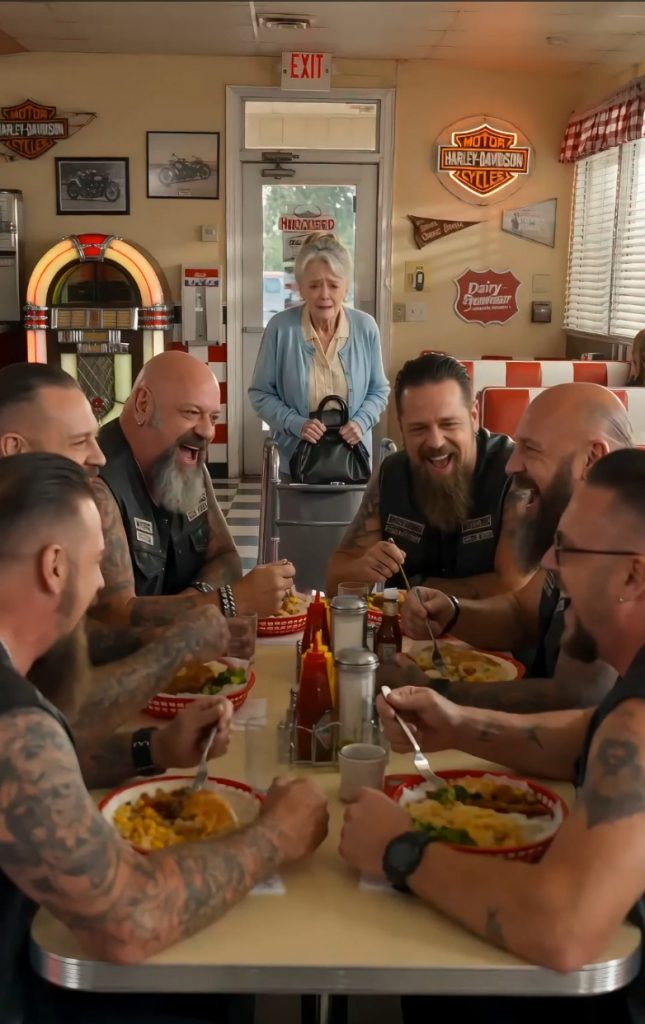
The bikers were laughing so loudly that the spoons trembled in the coffee cups.
Six of them crowded around the corner table at Miller’s Diner, a retro little place with red leather booths, checkered floors, and old metal signs nailed to the walls. The biggest man at the table had a shaved head, a gray goatee, and a black leather vest stretched across shoulders wide enough to block a doorway.
Their patches read KICKERS — EST. 1982.
To most people, they looked like trouble.
To Rose Callahan, they looked like her last chance.
She stood near the entrance with both hands wrapped around the handles of her walker. Her gray hair was pinned in a neat bun. Her light blue cardigan hung loose over a patterned blouse. A black leather handbag rested against her wrist, though her fingers trembled so badly the strap kept slipping.
The waitress noticed her first.
“You all right, Miss Rose?”
Rose tried to answer.
Nothing came out.
At the biker table, a younger man with dark hair glanced over. Then the laughter faded one voice at a time until the whole diner seemed to lean toward her.
Rose swallowed.
She had rehearsed the sentence all morning.
In the bathroom mirror. In the kitchen. On the bus ride downtown. Outside the diner door while she almost turned back twice.
Now the words felt impossible.
The lead biker stood slowly.
The chair scraped against the checkered floor.
“Ma’am?” he asked, his voice deep but gentle. “You need help?”
Rose looked at the men.
Big hands. Leather vests. Heavy boots. Beards, tattoos, scars, coffee cups, half-eaten burgers. Men the people threatening her would notice.
Men they might fear.
She clutched her handbag tighter.
“I need to ask you for one favor,” she said.
Her voice shook, but it did not break.
The younger biker leaned forward, confused. “Sure. What is it?”
Rose lifted her chin just enough to keep her dignity from collapsing.
“Would you boys pretend to be my sons for one afternoon?”
The diner went silent.
A fork stopped halfway to someone’s mouth.
The ceiling fan turned lazily above them.
The younger biker blinked. “Ma’am… what?”
Rose’s lips trembled.
“They’re trying to take my house,” she whispered. “They think I’m helpless and alone.”
The words landed harder than any shout.
The lead biker’s face changed.
Not with pity.
With recognition.
He stepped away from the table, slowly, carefully, like a man approaching a wounded bird.
“What’s your name, ma’am?”
“Rose Callahan.”
The moment she said it, something moved through the oldest biker’s eyes.
“Callahan?” he repeated.
Rose nodded.
“My husband was Patrick Callahan. He passed eight years ago. My son, Danny…” Her voice caught. “My son is gone too.”
The biker stared at her as if a door had opened in his memory.
Then he looked at the others.
“Boys,” he said, voice low.
All five stood.
Chairs scraped back. Leather creaked. Coffee sloshed in mugs.
Rose took a small frightened breath.
The lead biker stepped in front of her, not towering over her, but sheltering her from the room.
“You’re not helpless,” he said.
Then the others gathered around her in a loose protective circle.
“And you’re not alone.”
Rose pressed one hand to her mouth.
The younger biker smiled, eyes suddenly wet.
Then, all at once, the men said the word she had not heard in years.
“Mom.”
Rose almost fell against her walker.
The diner’s warm lights blurred.
Because she had asked strangers for a lie.
But the way they said it sounded like the truth had been waiting longer than she had.
And outside the window, across the street, a black sedan had already pulled up beside her house keys.
Act II
Rose Callahan’s house sat at the end of Maple Hollow Road, behind two old oak trees and a mailbox her husband had painted green thirty years earlier.
It was not a grand house.
White siding. Small porch. Crooked garden gate. A kitchen window that stuck in the summer. A hallway floorboard that squeaked no matter how many times Patrick tried to fix it.
But every inch of it held a life.
Patrick had carried Rose over the threshold after their wedding. Their son Danny had learned to walk between the couch and the coffee table. Birthdays, Christmases, arguments, apologies, soup during flu season, coffee before sunrise — all of it lived in that little house.
After Patrick died, people told Rose it was too much for one woman.
After Danny died, they told her again.
“You should sell.”
“You should move closer to town.”
“You should consider a facility.”
Rose smiled politely and ignored them.
She could still manage.
Slowly, yes. With a walker, yes. With neighbors helping after snowstorms, yes.
But she could still make tea in her own kitchen, sleep under her own roof, and sit on her porch beneath the oak trees while the evenings turned gold.
Then the letters came.
At first, they looked official.
Property review.
Assessment adjustment.
Outstanding lien inquiry.
Rose did not understand half the words, which was the point.
Then a man named Victor Hale started visiting.
He wore expensive shoes and smiled with too many teeth. He said he represented a neighborhood revitalization group. He said Maple Hollow Road was changing. He said elderly homeowners often found transitions stressful.
Rose told him she was not selling.
His smile stayed.
His eyes did not.
Two weeks later, a second man came with him. This one was named Neil Granger, a lawyer who spoke as if each sentence had already been approved by a judge. He claimed there was an unpaid debt attached to the house from years ago. He claimed Patrick had signed documents Rose did not remember. He claimed if she cooperated quickly, they could “protect her dignity.”
That was when Rose became frightened.
Not because she believed them.
Because she realized they expected her not to fight.
She called her nephew first.
He did not answer.
She called the county office and spent forty minutes on hold before being transferred to a voicemail that never called back.
She called a neighbor who meant well but said, “Maybe they know something you don’t.”
That night, Rose sat at her kitchen table with the letters spread in front of her and cried for the first time since Danny’s funeral.
There was one photograph beside her.
Danny at twenty-two, standing beside a motorcycle in a leather vest, grinning like trouble had personally invited him to dinner. On the back of the picture, in Patrick’s handwriting, were three words.
The Kickers boys.
Rose had not thought of the club in years.
Back then, they had been young men with loud bikes and no sense, always pulling into her driveway with scraped knuckles and hungry faces. Danny rode with them before the accident. Rose fed them chili, patched their jackets, and scolded them for cursing at her table.
They called her Mrs. C.
Then, after Danny died, the visits slowed.
Grief does that.
It makes even love awkward.
But that morning, when Victor Hale called and said he would arrive at three o’clock with papers for her to sign, Rose took one look at Danny’s old photograph and thought of the diner where bikers still gathered every Friday.
She put on her blue cardigan.
She took the bus.
And she asked a table of strangers to become sons for one afternoon.
Only they were not all strangers.
The lead biker’s real name was Hank Doyle.
But Danny had called him Bear.
And when Rose said Callahan, Hank remembered exactly who she was.
He remembered her kitchen.
Her chili.
Her voice shouting, “Boots off my clean floor, you animals.”
Most of all, he remembered the day Danny died.
Because Danny Callahan had not died in a random accident, no matter what Rose had been told.
And the man now trying to take her house had been there.
Act III
Rose did not learn the whole truth in the diner.
Not right away.
Hank only asked if she still had the letters. When she nodded, he told the waitress to pack their food to go and helped Rose toward the door like she was made of glass and steel at the same time.
The bikes outside were lined up in front of the diner, black and chrome beneath the winter sunlight.
Rose looked at them and gave a shaky laugh.
“I haven’t been on one of those in forty years.”
The younger biker grinned. “Today you ride in the truck, Mom.”
“Don’t you start,” she said softly.
For the first time all morning, the men laughed.
Not at her.
With her.
They drove to Maple Hollow in a battered pickup with three motorcycles following behind. Rose sat in the passenger seat beside Hank, her handbag on her lap, watching the fog thin over the wooded road.
“You knew my Danny?” she asked.
Hank’s hands tightened on the wheel.
“Yes, ma’am.”
“He loved you boys.”
“We loved him too.”
Rose looked at his face. “There’s something you aren’t saying.”
Hank was quiet for a long moment.
Then he said, “Not until we know what those men want.”
At two-fifty, the black sedan pulled into Rose’s driveway.
Victor Hale stepped out first, wearing a charcoal overcoat and a smile built for frightened people. Neil Granger followed with a leather folder tucked under one arm.
They stopped when they saw the porch.
Six bikers stood across it.
Hank was in the center, arms folded. The younger biker leaned against the rail. Two others stood near the steps. One held Rose’s walker as carefully as if it were a flag.
Rose sat in her porch chair beneath a plaid blanket.
Her chin was raised.
Victor recovered quickly.
“Mrs. Callahan,” he said. “I didn’t realize you had company.”
Rose’s voice trembled, but only a little.
“My sons are visiting.”
The younger biker smiled.
“Yes, ma’am.”
Victor’s eyes moved over the vests.
He recognized trouble when it had boots.
Granger cleared his throat. “This is a private legal matter.”
Hank stepped forward. “Then talk legal.”
Granger opened the folder and began explaining the supposed lien. Patrick had allegedly borrowed against the house years before. The debt had allegedly been sold. The current holder allegedly had the right to force payment or transfer.
He used the word allegedly too often.
That was his mistake.
Hank held out one hand. “Show me Patrick Callahan’s signature.”
Granger hesitated.
Victor’s smile faded.
Rose watched, confused.
Hank’s voice dropped. “Show it.”
The lawyer removed a copy and handed it over.
Hank looked at the page.
Then he looked at Rose.
“Ma’am,” he said, “your husband didn’t sign this.”
Granger scoffed. “And you’re a handwriting expert?”
“No,” Hank said. “But Patrick Callahan lost the tip of his right index finger in 1991. After that, his signature changed. Everybody who ever saw him sign a check knew it.”
Rose’s hand flew to her mouth.
Patrick had joked about that finger for years.
The signature on the page was smooth.
Old.
Wrong.
Victor’s eyes narrowed. “That proves nothing.”
“No,” Hank said. “This does.”
He pulled a folded photograph from inside his vest.
Danny Callahan stood beside three young bikers in front of a garage.
Behind them, half-hidden near a car, was Victor Hale.
Younger.
Thinner.
But unmistakable.
Rose stared.
“I don’t understand,” she whispered.
Hank did not look away from Victor.
“Twenty-three years ago, Danny found out somebody was running fake loan papers through a garage on County Line Road. He told me he was going to report it.”
Victor’s face went pale.
Hank’s voice hardened.
“The next week, Danny was dead.”
Rose stopped breathing.
The porch seemed to tilt beneath her.
Victor pointed at him. “That is a disgusting accusation.”
“I didn’t say you killed him,” Hank replied. “I said Danny knew you forged papers.”
Granger closed the folder too quickly.
The younger biker took a step down the porch.
Victor saw the movement and stepped back.
Rose whispered, “Danny knew?”
Hank turned to her, eyes full of grief.
“He tried to protect you before any of us knew you needed it.”
And behind Victor’s sedan, a county sheriff’s cruiser turned slowly into the driveway.
Act IV
The sheriff who stepped out of the cruiser was older than Rose expected.
White mustache. Weathered face. Hat low over his eyes.
His name was Sheriff Tom Alvarez, and the moment he saw Hank Doyle on Rose’s porch, he sighed like a man who had just found the missing piece to a case that had haunted him too long.
“Hank,” he said.
“Sheriff.”
Victor exploded first.
“Good. Officer, these men are intimidating my client.”
Rose lifted her head. “I am not your client.”
The sheriff looked at her.
Then at the bikers.
Then at Granger’s folder.
“Mrs. Callahan,” he said gently, “may I see the documents they brought?”
Granger tried to object.
The sheriff held out his hand.
“Neil, don’t make me ask twice.”
That changed everything.
Rose noticed it.
So did Hank.
Granger gave him the folder.
The sheriff read for a while in silence. The wind moved through the trees. One of the bikes ticked softly as its engine cooled.
Then the sheriff looked at Victor.
“You’re using the same shell company.”
Victor said nothing.
Granger looked like he wanted to disappear into his own overcoat.
Rose’s voice was small. “Same as what?”
The sheriff removed his hat.
“Mrs. Callahan, after your son died, there were rumors he had been looking into forged property loans. We never had enough to charge anyone. Witnesses got quiet. Records vanished.”
His eyes moved to Victor.
“But recently, similar documents started appearing again. Elderly homeowners. Old signatures. Pressure to sell fast. We’ve been waiting for someone to bring us a fresh copy.”
Rose looked at the folder.
“You mean… they didn’t just come for my house?”
“No, ma’am,” the sheriff said. “But your house may help stop them.”
Victor laughed bitterly. “This is absurd.”
Hank stepped down from the porch.
The sheriff gave him one warning glance.
Hank stopped, but his voice carried.
“You came after the wrong mother.”
The word mother struck Rose so hard her eyes filled.
For years, she had lived with an empty chair at the kitchen table. An unopened bedroom door. A phone that never rang with Danny’s voice again.
Now six men in leather stood between her and the people trying to erase the last thing her family had left.
The sheriff turned to Granger.
“Are you willing to explain where you got these papers?”
Granger looked at Victor.
Victor gave him the wrong look.
Too sharp.
Too threatening.
Granger folded immediately.
“I was retained to deliver documents,” he said. “I didn’t prepare them.”
Victor swore.
The younger biker smiled without humor. “That sounded a lot like a man jumping off a sinking boat.”
The sheriff’s deputy, who had arrived silently behind the cruiser, moved toward Victor.
“This doesn’t end anything,” Victor snapped at Rose. “You’re old. You can’t maintain this place. Sooner or later, people like you lose.”
Rose stood.
It took effort.
The younger biker rushed to support her elbow, but she lifted one hand.
She wanted to say this herself.
“You’re right about one thing,” she said. “I am old.”
Victor’s jaw tightened.
“I have buried a husband and a son. I have survived winters that froze the pipes and summers when I ate toast for dinner because the roof needed fixing. I have outlived loneliness you wouldn’t last a week inside.”
The bikers went quiet.
Rose’s voice steadied.
“But I am not helpless. And I am not yours to move out of the way.”
Victor said nothing.
The sheriff nodded to the deputy.
Victor Hale was escorted to the cruiser in the same driveway where he had expected to frighten an old woman into surrender.
As the door shut behind him, Rose finally sank back into her chair.
Her hands shook.
Hank knelt in front of her.
“I’m sorry,” he said.
“For what?”
“For not coming sooner.”
Rose reached out and touched his weathered face with trembling fingers.
“Oh, Bear,” she whispered, using the name she had not said in twenty-three years. “You came when I asked.”
Hank’s eyes filled.
Behind him, the younger biker looked toward the house.
“Mom?”
Rose turned.
He smiled gently. “You got any coffee inside?”
The question broke her.
Not with pain.
With memory.
With relief.
With the sudden impossible feeling that her kitchen might not stay empty after all.
Act V
That night, Rose’s house smelled like coffee, bacon, and motorcycle leather.
The bikers filled the kitchen as if they had never left.
One fixed the back door latch. Another carried firewood from the shed. The younger one, whose name was Jesse, washed dishes badly until Rose told him he was an embarrassment to dishwashing everywhere.
He grinned.
“Yes, Mom.”
She pointed a spoon at him. “Don’t get fresh.”
The men laughed, and the sound filled corners of the house that had been silent for years.
Hank stayed at the kitchen table with the old photographs spread between them.
Danny on his bike.
Danny at Christmas.
Danny with grease on his cheek.
Danny standing beside the Kickers boys, all of them young and reckless and alive.
Rose touched the edge of the picture.
“I thought everyone forgot him.”
Hank’s voice was rough.
“No, ma’am. Some of us just didn’t know how to come back after he was gone.”
Rose looked at him.
“Grief makes cowards of good people sometimes,” she said.
Hank nodded.
Then she added, “But it doesn’t have to keep them that way.”
The investigation widened over the next few weeks.
Victor Hale’s forged documents connected to more than a dozen attempted property seizures. Neil Granger cooperated to save himself. The sheriff reopened Danny’s old file, not with promises, but with evidence that finally had somewhere to go.
Rose gave three statements.
Each time, Hank drove her.
Each time, at least two Kickers came along and sat in the waiting room like a wall of leather and loyalty.
The town changed too.
People who had driven past Rose’s house for years suddenly stopped by with casseroles, apologies, and offers to repair things they had ignored until shame gave them manners.
Rose accepted the help.
But not the apologies that came too easily.
She had learned the difference between kindness and guilt.
By spring, Maple Hollow Road looked brighter.
The porch had been repaired. The oak trees were trimmed. A new mailbox stood at the gate, painted green just like Patrick’s old one.
Below the name CALLAHAN, Jesse added a small metal plate.
Protected by Sons.
Rose pretended to be annoyed.
She cried when no one was looking.
On the first warm Sunday of the season, the Kickers returned to Miller’s Diner.
This time, Rose came with them.
Not by bus.
In the truck, with Hank driving and Jesse holding her walker in the back seat like precious cargo.
The moment they entered, the waitress smiled.
“Morning, Miss Rose.”
Rose lifted her chin. “Morning, sweetheart.”
The bikers took their old table.
Then Jesse pulled out the chair at the head of it.
For her.
Rose sat slowly, one hand on the tablecloth, the other on her handbag. Around her, the men settled in, loud and ridiculous, arguing over pancakes, coffee, and whether Jesse had ever successfully washed a plate in his life.
The diner felt warm again.
Not because it had changed.
Because Rose had.
She no longer felt like a woman begging strangers to pretend.
She felt like a woman who had remembered family could sometimes arrive late, loud, tattooed, hungry, and wearing motorcycle boots.
Halfway through breakfast, Hank placed something on the table.
Danny’s old Kickers patch.
Rose stared at it.
“I found it in the clubhouse,” he said. “Should’ve brought it to you years ago.”
Rose picked it up with both hands.
The stitching was worn. The leather smelled faintly of smoke and rain.
She pressed it to her heart.
Then she looked around the table.
“You boys listen to me.”
Every biker straightened.
Even the waitress paused.
Rose’s eyes shone.
“You don’t get to disappear again.”
Hank smiled through tears.
“No, ma’am.”
Jesse raised his coffee cup.
“To Mom.”
The others lifted theirs.
“To Mom.”
This time, the whole diner heard it.
And this time, Rose did not cover her mouth in disbelief.
She smiled.
Outside, motorcycles gleamed beneath the morning sun. Inside, plates clattered, coffee poured, and laughter rose beneath the vintage signs on the wall.
The world had not given Rose back her husband.
It had not given her back Danny.
But it had given her something she had stopped believing could still happen.
A knock on the door.
A full kitchen.
A table waiting.
And six men who had once looked like strangers standing up in a diner and proving that alone is not always the end of the story.
Sometimes it is only the word people use before family finds its way back.