Act I
The marble floor was so polished it reflected the chandeliers like trapped stars.
Guests in tuxedos and evening gowns drifted through the Grand Aurelia lobby, speaking in soft voices beneath gold moldings and crystal light. Champagne glasses flashed. Pearls glittered. Somewhere near the ballroom doors, a string quartet played something delicate enough to sound expensive.
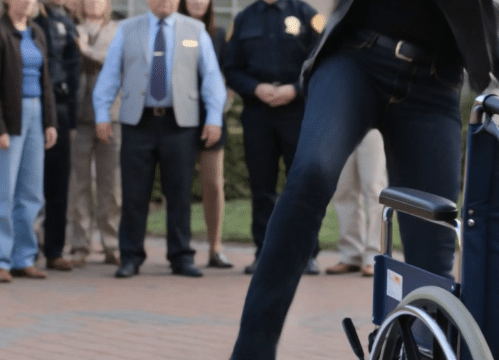
Then the wheelchair crashed.
Metal scraped against marble. A wheel spun violently in the air. Gasps tore through the lobby as a young woman in a modest white dress fell hard beside the overturned chair, her long brown hair spilling across her face.
For one second, no one moved.
Isabelle Voss stood above her in a sleeveless white midi dress, pearls at her ears, blonde hair pinned into a perfect low bun. She looked like the kind of woman magazines described as elegant before anyone heard her speak.
“Get out of here, you piece of trash!” she screamed.
The words cracked louder than the crash.
The woman on the floor did not answer. She pushed one trembling hand against the cold marble, trying to lift herself enough to breathe. Her dress had spread around her like a broken flower.
Isabelle stepped closer, her heel grinding near the edge of the fallen wheelchair.
A few guests looked away.
Most did not.
They were too shocked, too polished, too trained by money to pretend ugly things were misunderstandings until someone important named them otherwise.
Isabelle bent toward the woman, her face twisted with disgust.
“A person like you is polluting my entire hotel.”
The woman looked up.
Her eyes were wide, but not empty. Not weak. Behind the shock was something else, something Isabelle was too angry to recognize.
Recognition.
As if this cruelty had confirmed a truth she had come there to find.
A security guard near the entrance shifted but did not step forward. He looked toward the concierge desk, waiting for someone with higher authority to decide whether a disabled woman thrown onto the lobby floor was worth interrupting a gala.
Isabelle saw his hesitation and smiled.
That smile told everyone what she believed.
She believed the room belonged to her.
She believed the hotel belonged to her.
She believed the woman on the floor belonged nowhere.
Then the glass entrance exploded inward.
A black luxury sedan burst through the front doors in a storm of glittering shards and shrieking tires. Guests screamed and scattered as the car skidded across the entry area and stopped just short of the central marble medallion.
The driver’s door opened.
A tall man in a black suit stepped out, his face hard with controlled fury.
He did not look at the chandeliers.
He did not look at the guests.
He ran straight to the woman on the floor.
“Miss Pirmone,” he said, dropping to one knee beside her. His voice was deep, shaken, and deeply respectful. “Please forgive our late arrival.”
The lobby went silent.
Isabelle’s smile vanished.
The man placed himself between her and the fallen woman, then slowly turned his head.
“You should be very careful,” he said, “about who you decide to humiliate.”
Only then did Isabelle understand that the woman she had pushed was not a nobody.
She was the reason the hotel existed.
Act II
Isabelle Voss had been raised to believe that luxury was proof of worth.
Her father, Conrad Voss, served as acting chairman of the Aurelia Hospitality Group, and for most of Isabelle’s life, that title had worked like a master key. Doors opened before she touched them. Staff lowered their voices when she entered. Managers laughed at jokes that were not funny.
By twenty-seven, Isabelle no longer understood the difference between being respected and being feared.
At the Grand Aurelia, she was treated like royalty.
Not because she owned it.
Because everyone believed she might one day control the man who did.
Conrad Voss had spent eight years positioning himself near the Pirmone family fortune. The Pirmones had built the Grand Aurelia from a single coastal hotel into a private empire of marble lobbies, rooftop restaurants, and old-world service. But the last true Pirmone heir had vanished from public life after a car accident three years earlier.
Her name was Amara Pirmone.
Isabelle had heard stories.
Everyone had.
The poor heiress. The tragic recluse. The girl in the wheelchair whose grandfather left her too much power and not enough strength to use it.
Conrad told people Amara was fragile. Unwell. Too traumatized to run anything.
He told investors the board needed stability.
He told Isabelle, in private, that the Pirmone name was valuable mostly because guests still liked old money better than new ambition.
“If Amara ever appears,” he once said over breakfast, “smile at her. Pity works better than hostility.”
But Isabelle did not like pity.
Pity required looking down softly.
She preferred looking down openly.
The gala that night was meant to celebrate the Grand Aurelia’s hundredth anniversary. Three hundred guests. Press in the ballroom. Donors from six countries. A tribute wall showing black-and-white photographs of the Pirmone family standing proudly beneath the original hotel awning.
Isabelle had chosen the flowers herself.
White orchids.
Gold ribbon.
Clean lines.
No wheelchairs in sight.
Then, twenty minutes before the ballroom opened, she saw a young woman in a manual wheelchair near the center of the lobby.
Plain white dress.
No jewelry.
No attendant.
No visible invitation.
To Isabelle, that was enough.
She did not see a guest.
She saw disruption.
Worse, she saw the woman looking up at the lobby ceiling as if she knew it. As if the chandeliers were not decorations but memories.
Isabelle crossed the marble with sharp, angry steps.
“Can I help you?” she asked, though her voice made clear she wanted no such thing.
The woman turned her head.
“I’m waiting for someone.”
“Not here, you’re not.”
The woman’s expression did not change.
“I was told to come through the front entrance.”
Isabelle laughed.
“By whom?”
Before the woman could answer, Isabelle saw several guests watching. That made her crueler. Public attention always did.
She stepped behind the wheelchair.
“You people always know where to place yourselves,” Isabelle said quietly. “Right where everyone has to look.”
The woman’s hand tightened on the wheel.
“Please don’t touch my chair.”
Isabelle heard only defiance.
And defiance from someone she considered beneath her felt like theft.
So she shoved.
The crash stopped the lobby.
But it started something much larger.
Because Amara Pirmone had not come to the Grand Aurelia to be pitied.
She had come to take it back.
Act III
The man in the black suit was Gabriel Rojas.
Most people in the lobby knew his face, though few understood why.
To guests, he was security. Elegant security, perhaps. Expensive security. The kind of man who could remove a drunk billionaire from a private event without wrinkling his jacket.
But to the Pirmone family, Gabriel had been something else.
Protector.
Witness.
Confidant.
He had served Amara’s grandfather for twelve years, first as head of private security, then as the only employee trusted with matters the board never saw. He knew which executives lied politely. He knew which managers treated staff well only when inspected. He knew which board members had begun calling Amara “unstable” the moment she stopped appearing in public.
He also knew the truth about the accident.
Three years earlier, Amara’s car had been forced off a mountain road after she left a board meeting where she had refused to sell controlling interest to Conrad Voss’s investment group. The police report called it weather, speed, and bad luck.
Gabriel never believed that.
Neither did Amara.
She survived, but recovery took pieces of her life and rearranged them brutally. For months, she could not walk. Then she could walk a little. Then pain forced her back into the chair. Doctors spoke in cautious language. Reporters spoke in pity. The board spoke in strategy.
Conrad Voss spoke of responsibility.
“We must protect Miss Pirmone from pressure,” he told shareholders.
What he meant was simple.
Keep her away.
Keep her quiet.
Keep the hotel.
But Amara had inherited more than shares. She had inherited her grandfather’s patience.
From her private rehabilitation residence, she began reading everything.
Staff complaints.
Guest conduct reports.
Insurance audits.
Internal emails.
Security logs.
The deeper she looked, the clearer the pattern became. Under Conrad’s temporary control, the Grand Aurelia had become beautiful on the surface and rotten underneath. Employees were silenced. Disabled guests were redirected to side entrances. Abuse from wealthy patrons disappeared into “hospitality resolutions.”
One memo chilled her more than the others.
Avoid lobby visibility complications during prestige events.
The phrase was Conrad’s.
Amara knew what it meant.
People like her were bad for the picture.
So she made a plan.
She would attend the anniversary gala quietly, not as a board figure, not with cameras, not with a formal entrance. She wanted to see what the hotel did when the woman who owned it looked like someone they could ignore.
Gabriel argued against it.
“You already know enough,” he said.
“No,” Amara replied. “I know what they write down. I need to see what they do when they think no one important is watching.”
They were supposed to arrive together.
But ten minutes before Amara reached the entrance, her car was blocked in the private drive by a valet order that did not exist. Gabriel was delayed at the security gate by a new clearance requirement no one could explain.
Amara entered alone.
Conrad’s system worked perfectly.
Until Isabelle shoved her.
When Gabriel finally broke through the blocked drive, he saw Amara through the glass doors on the marble floor.
Something in him went cold.
He did not think about protocol.
He did not think about the car.
He drove through the only barrier left between her and help.
Now, kneeling beside her under the chandeliers, Gabriel lifted his eyes to Isabelle and saw the whole corrupt structure wearing a white dress and pearls.
“Who is she?” Isabelle whispered.
Gabriel did not answer her.
Amara did.
Her voice was quiet, but it carried through the lobby.
“My name is Amara Pirmone.”
The guests began to murmur.
Isabelle’s lips parted.
Amara drew a careful breath.
“And this is not your hotel.”
Act IV
For the first time in her life, Isabelle looked around a room and found no one rushing to save her.
The security guard near the entrance had gone pale. The concierge stood frozen behind the desk. The guests who had ignored the woman on the floor now stared at Isabelle with the dawning horror of people realizing they had just witnessed a powerful person commit cruelty against someone even more powerful.
But Amara did not look powerful in the way Isabelle understood it.
She was still on the marble.
Still shaken.
Still breathing carefully through pain.
That made it worse.
Because her authority did not come from posture, pearls, or volume.
It came from fact.
Gabriel helped her sit upright with practiced care. Another security officer brought the wheelchair, now bent at one wheel. Gabriel looked at it once, and his jaw tightened.
“Get another chair,” he ordered.
No one hesitated this time.
Isabelle swallowed.
“Miss Pirmone, I didn’t know.”
Amara looked at her.
The sentence seemed to disgust her more than the shove had.
“You didn’t know what?” Amara asked. “That I mattered?”
Isabelle’s face flushed.
“I mean, I thought—”
“Yes,” Amara said. “You thought.”
The lobby fell into a silence so complete that the chandelier crystals could be heard settling faintly above them.
Conrad Voss arrived from the ballroom at that moment, drawn by the crash, the screams, and the sudden death of music. He came fast, silver-haired and furious, until he saw Amara.
Then he stopped.
“Amara,” he said, recovering quickly. “Thank God. We were not informed you would be attending.”
“No,” she said. “You were not.”
His eyes flicked to Isabelle.
That tiny glance told Amara everything.
He was not shocked by what Isabelle had done.
Only by who had seen it.
Conrad stepped forward, lowering his voice into the warm tone he used for donors.
“There has clearly been a terrible misunderstanding. Let’s move somewhere private.”
Amara smiled faintly.
“No.”
Conrad’s expression tightened.
“This lobby is full of guests.”
“I know.”
“Press is in the ballroom.”
“I know that too.”
Gabriel stood at her side now, one hand resting lightly near the back of the replacement wheelchair, his body angled protectively toward Conrad and Isabelle.
Amara looked past them to the gathered crowd.
“My grandfather built this hotel because he believed service was sacred,” she said. “Not servitude. Service. There is a difference, and some of you have forgotten it.”
No one moved.
She turned to the concierge.
“Please bring me the anniversary program.”
The concierge obeyed at once.
Her hands shook as she passed it to Gabriel, who gave it to Amara.
Amara opened it to the first page. There, printed in gold script, was Conrad’s welcome message.
On behalf of the Pirmone legacy, we invite you to celebrate a century of excellence.
Amara touched the word legacy.
Then she looked at Conrad.
“You put your name on my grandfather’s history while ordering staff to hide guests who did not match your idea of elegance.”
Conrad’s face hardened.
“That is not true.”
Gabriel removed a slim folder from inside his jacket.
“It is.”
Conrad’s eyes snapped toward him.
Gabriel handed the folder to Amara.
She opened it.
“Emails,” she said. “Accessibility complaints. Guest removals. Staff retaliation reports. A memo recommending that wheelchair users be directed through the side entrance during high-profile events.”
A murmur rolled through the lobby.
Isabelle’s face drained.
Conrad stepped closer.
“Those documents are confidential.”
Amara looked up.
“So was my arrival.”
The words landed like a door locking.
Gabriel’s phone buzzed. He checked it once, then leaned toward Amara.
“The board members are in the east conference room.”
Amara nodded.
“Good.”
Conrad tried to smile.
“Amara, surely you don’t intend to make decisions tonight while emotional.”
There it was.
The old cage.
Fragile.
Emotional.
Unwell.
Words used to turn a woman’s pain into a reason to steal her power.
Amara placed both hands on the wheels of her chair.
Then, slowly, with visible effort, she pushed herself forward.
Gabriel did not move to help until she asked.
She did not ask.
The lobby watched Amara Pirmone roll across the marble floor she owned, past the woman who had thrown her down, toward the man who had spent three years trying to erase her.
When she stopped in front of Conrad, her voice was steady.
“You should have worried less about whether I could walk,” she said, “and more about whether I could read.”
Act V
By midnight, Conrad Voss was no longer acting chairman.
The official language was elegant, as official language always is when powerful people fall. Immediate suspension. Emergency governance review. Temporary transfer of executive authority. Independent investigation.
But everyone in the Grand Aurelia knew what had happened.
Amara Pirmone had returned.
And she had returned through broken glass.
The anniversary gala never resumed in the way Conrad intended. The string quartet stopped playing. Champagne went untouched. Guests who had come to be photographed beneath chandeliers found themselves witnessing something far rarer than luxury.
Accountability.
Isabelle Voss gave three apologies before midnight.
The first was to Gabriel, because he frightened her.
The second was to the board, because they mattered.
The third was to Amara, because someone finally told her it was required.
Amara accepted none of them as truth.
“You are sorry there were consequences,” she said. “That is not the same as remorse.”
Isabelle cried then.
Quietly, beautifully, with one hand pressed beneath her eye so her makeup would not run.
Amara had seen women like Isabelle cry before. They cried when control failed them. They cried when mirrors became windows. They cried when a room finally saw what their beauty had been used to cover.
By morning, Isabelle’s access to all Aurelia properties was revoked.
Conrad’s office was sealed.
The security team was replaced.
The valet manager who had blocked Gabriel’s car admitted the order came from Conrad’s assistant. The concierge produced copies of guest complaints she had been told to delete. Three housekeepers came forward with stories of being punished for helping disabled guests use the main entrance.
The hotel began to speak.
Not in press releases.
In people.
The bellman who had been told not to make eye contact with certain guests.
The banquet server who had watched wealthy donors insult staff and then receive free champagne.
The night auditor who kept a private list of incidents because she knew someone would need proof one day.
Amara listened to all of them.
She did not pretend listening fixed what had happened.
But it began the work.
A week later, she held a staff meeting in the lobby.
Not the ballroom.
The lobby.
The same place where she had fallen.
The broken glass had been replaced, but Amara ordered one piece preserved. It sat now in a clear case near the entrance, beneath a small brass plaque.
A threshold is only honorable if everyone may cross it with dignity.
Some board members hated it.
Amara did not care.
She sat before the entire staff in a new chair, black and elegant, chosen for comfort rather than concealment. Gabriel stood nearby, though not too close. He had learned, long ago, that protecting Amara meant knowing when to step forward and when to let the world see she needed no one to speak over her.
Amara addressed the employees first.
Not the executives.
Not the donors.
The doormen. The housekeepers. The kitchen staff. The desk clerks. The maintenance workers. The people who made luxury possible and were rarely allowed to define it.
“What happened to me in this lobby was not an isolated act,” she said. “It was the visible part of a culture that many of you have endured quietly for years.”
No one spoke.
Several employees cried without hiding it.
“That ends now.”
The changes came quickly.
Guest conduct rules were rewritten and enforced.
Accessibility was audited across every Aurelia property.
Staff could report abuse directly to an independent office outside hotel management.
Any executive who used the phrase prestige risk in reference to a human being was invited to resign before being removed.
Gabriel suggested softer wording for the last policy.
Amara refused.
“Let them be afraid of ugly language for once,” she said.
Months later, the Grand Aurelia looked almost the same to outsiders.
The chandeliers still burned like crystal fire. The marble still shone. The gold moldings still curled across the high ceiling. Guests still arrived in tailored coats and evening dresses, expecting beauty.
But those who paid attention noticed the difference.
Wheelchair users entered through the front doors without being redirected.
Staff no longer lowered their eyes when insulted.
Security moved faster toward cruelty than toward embarrassment.
And in the lobby, near the place where Isabelle had once stood over Amara, there was always a fresh arrangement of white flowers.
Not orchids.
Amara hated orchids now.
Roses.
Simple ones.
The kind her grandfather used to keep on his desk.
One evening, after the hotel had quieted and rain streaked the glass entrance, Amara rolled alone to the center of the lobby. Gabriel found her there, staring up at the chandeliers.
“You should be resting,” he said.
She did not look at him.
“You drove a sedan through my front doors.”
“Yes.”
“My insurance team still mentions it twice a week.”
“I was in a hurry.”
At that, Amara smiled.
A small smile.
The kind that had taken three years to return.
“You were late,” she said.
Gabriel’s expression softened.
“I know.”
She turned toward him.
“You came.”
His eyes lowered briefly.
“Always.”
The word sat quietly between them, not romantic, not dramatic, but deeper than both. Loyalty did not need applause. It only needed to arrive when called, even through glass.
Amara looked back toward the doors.
“I used to think coming back meant walking into this lobby again,” she said.
Gabriel waited.
“But that was never it. Was it?”
“No,” he said.
She touched the wheel of her chair, feeling the cool metal beneath her fingers.
“Coming back meant making sure no one else was thrown out of it.”
The rain tapped softly against the new glass.
Outside, a car pulled up. A doorman stepped forward with an umbrella. The rear door opened, and an elderly woman emerged slowly with a cane. Before she could look uncertain, the doorman smiled and offered his arm.
“Welcome to the Grand Aurelia,” he said.
The woman smiled back.
Amara watched her cross the threshold beneath the chandeliers.
No side door.
No lowered gaze.
No apology for needing time.
Just entrance.
Just dignity.
Just the quiet correction of a world that had once mistaken cruelty for class.
Amara turned her chair toward the elevators.
Behind her, the marble floor reflected the lights, the flowers, and the glass doors rebuilt stronger than before.
The lobby was still opulent.
Still breathtaking.
Still filled with the kind of beauty people traveled across oceans to see.
But now, for the first time in years, it was also hers.