Act I
The waiter smiled as he insulted her.
That was what made it unbearable.
Not the words alone. Not the twenty-five minutes she had spent sitting at the white-linen table with nothing but an empty plate, an untouched water glass, and a small silver bread knife aligned neatly beside her hand.
It was the smile.
Polished. Handsome. Careful.
The kind of smile that had been trained in front of mirrors and used on people he considered worth the effort.
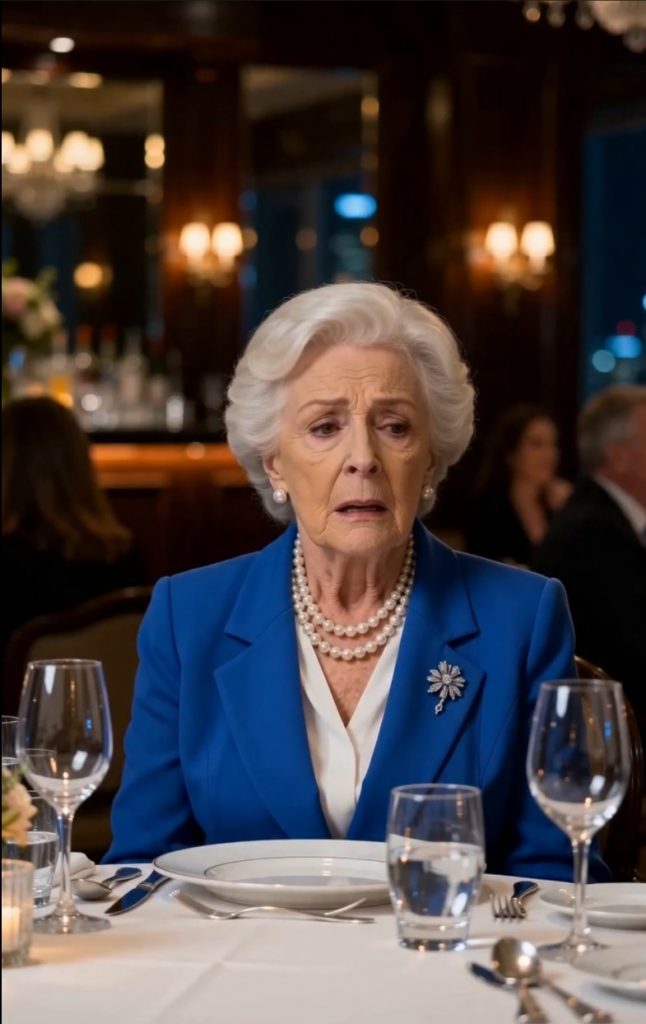
Eleanor Whitcomb sat beneath the chandelier in a royal blue suit, her white hair arranged perfectly, pearls resting in soft strands around her neck. A silver brooch glinted at her shoulder whenever the light shifted.
Around her, the restaurant shimmered.
Dark wood walls. Crystal chandeliers. Waiters moving like shadows between tables. Wine glasses catching the glow of the city lights beyond the windows.
Everything looked expensive.
Everything sounded civilized.
Silverware clinked gently. Guests murmured over veal, oysters, and glasses of red wine that cost more than some families spent on groceries in a week.
Eleanor looked up at the young waiter standing beside her table.
“I’ve already been waiting for twenty-five minutes,” she said. “What kind of service is this?”
Her voice was firm, not rude.
She had spent seventy-nine years learning the difference.
The waiter’s name tag read Adrian.
He held a silver tray with two empty wine glasses and looked down at her as if she had interrupted something more important than her own dignity.
He leaned in slightly.
“Sorry for the wait,” he said smoothly. “We’re very busy tonight.”
Then his smile thinned.
“There are customers here who are more important than you. And younger.”
The nearby table went quiet.
Eleanor’s hand tightened once around the edge of the napkin in her lap.
Adrian continued, soft enough to pretend he had not meant the whole room to hear, loud enough for shame to travel.
“I’ll come back for your order later.”
Then he turned on his heel and walked away.
Confident footsteps crossed the plush red carpet. His tray did not wobble. His shoulders did not lower. He moved like a man proud of having put an old woman in her place.
A few diners glanced after him.
Then, one by one, they looked back down at their plates.
That was the second cruelty.
The silence.
Eleanor sat very still.
Her anger did not vanish. It sank. It passed beneath her ribs and turned into something colder, something older than the humiliation of one rude boy in a tailored vest.
For a moment, she was no longer in La Couronne, the restaurant she had chosen for reasons no one in the dining room understood.
She was twenty-three again, standing behind a dishwashing station in a borrowed apron, listening to men tell her women did not belong in kitchens unless they were cleaning them.
She was forty-one, signing payroll with a fever because the chef had quit and thirty employees needed to be paid.
She was sixty, burying her husband and returning to the restaurant three days later because grief did not stop rent.
Now, at nearly eighty, she was being told she did not matter because her hair was white.
The melancholic piano began somewhere near the bar.
Eleanor lowered her gaze to the empty plate in front of her.
And beneath the tablecloth, her fingers moved to the small black velvet purse resting beside her knee.
Inside was a sealed envelope.
Inside that envelope was a document Adrian would have recognized if arrogance had not made him blind.
Because Eleanor Whitcomb had not come to La Couronne as a forgotten old woman.
She had come as the last person in the city who could destroy it.
Act II
Thirty-seven years earlier, La Couronne had opened with twelve tables, a broken espresso machine, and a kitchen ceiling that leaked whenever it rained.
No chandeliers then.
No red carpet.
No wine cellar with bottles locked behind glass.
Just Eleanor and her husband, Thomas, standing in an empty dining room at two in the morning, holding paintbrushes and pretending not to be terrified.
Thomas had been the chef.
Eleanor had been everything else.
Hostess. Accountant. Baker. Floor manager. Flower arranger. Plumber when she had to be. Peacekeeper when guests complained. Fighter when suppliers tried to cheat them.
The restaurant became famous slowly.
Not because it was fashionable.
Because people felt cared for there.
Thomas remembered anniversaries. Eleanor remembered allergies. If a young couple looked nervous over the menu, she would quietly send over a small dessert and call it “a gift from the kitchen.” If an elderly guest came alone, she made sure the table was never rushed, never pitied, never ignored.
“Restaurants are not about food first,” Thomas used to say.
Eleanor always corrected him.
“They are about how people feel while eating it.”
That became the soul of La Couronne.
Then Thomas died.
The city sent flowers. Critics wrote paragraphs about legacy. Former employees came back from other states to stand in line at the funeral home and tell Eleanor that Thomas had changed their lives.
Afterward, her son, Martin, took over daily operations.
Eleanor tried to step back.
She told herself every generation deserved room to breathe. She told herself a restaurant could change without betraying itself. She told herself Martin’s ideas were not wrong simply because they were new.
At first, she was proud.
Martin brought in younger diners. Private events. A social media team. A rebrand so subtle only Eleanor noticed the warmth being polished out of the place.
Then came the investors.
Then the consultant.
Then the new service director, who believed elderly customers occupied tables too long, asked too many questions, and tipped too modestly.
Eleanor heard rumors.
Old regulars stopped coming.
Mrs. Patel, who had eaten there every Thursday since her husband passed, said she was seated near the kitchen door twice in a row.
Mr. Greenfield, a retired music teacher, said a waiter laughed when he asked for help reading the wine list.
A widow named Celia called Eleanor in tears after being told the main dining room was “fully committed,” only to watch three younger couples walk in without reservations.
Eleanor did not want to believe it.
Not at La Couronne.
Not in the room Thomas had built with his hands and heart.
So she made a reservation under her maiden name.
Eleanor Vale.
One guest.
Seven-thirty.
Table for dinner.
She wore the blue suit Thomas had loved most.
She put on the pearls he gave her on their thirtieth anniversary.
And before leaving her apartment, she slipped the sealed envelope into her purse.
The envelope contained the majority ownership transfer Thomas had left in trust for her.
Martin managed La Couronne.
But Eleanor still owned it.
He knew that in theory.
He had forgotten it in practice.
The dinner was meant to be a quiet test.
A chance for Eleanor to see whether the stories were exaggerated.
A chance, perhaps, for the restaurant to prove it still knew how to recognize a human being without checking age, status, or follower count.
Instead, she waited twenty-five minutes.
Then Adrian told her younger customers mattered more.
And somewhere across the dining room, behind a frosted glass partition near the kitchen entrance, Martin Whitcomb stood with two investors and watched the whole exchange.
He did not step forward.
Not at first.
That was the moment Eleanor understood the rot had not started with the waiter.
It had been permitted from above.
And permission, in a place like La Couronne, was the same as policy.
Act III
Adrian did not know who Eleanor was.
That was his first mistake.
His second was bragging before the night was over.
Near the service station, he set down his tray beside another waiter and laughed under his breath.
“Table twelve is another museum piece,” he said. “Wants fine dining but complains like she’s at a bus station.”
The other waiter, a young woman named Claire, stiffened.
“Don’t talk about guests like that.”
Adrian rolled his eyes. “Relax. She’ll order soup and hot tea, sit for two hours, and leave five dollars.”
Claire glanced toward Eleanor’s table.
The old woman sat alone, composed but visibly wounded, her hands folded in her lap.
“That’s not the point,” Claire said.
“The point is revenue,” Adrian replied. “Ask Martin. We’re not running a retirement cafeteria.”
Claire’s face changed.
Because she had heard enough.
She had worked at La Couronne for eight years, long enough to remember when Eleanor still visited weekly, greeting dishwashers by name and sending handwritten notes after weddings, illnesses, and funerals.
Claire knew the pearls.
She knew the blue suit from the framed photograph in the upstairs office.
Most of all, she knew the woman.
“Adrian,” she said quietly, “do you know who that is?”
He gave a small laugh. “Someone who should have stayed home?”
Claire stared at him.
Then she walked away.
A minute later, Eleanor felt a gentle presence beside her table.
“Mrs. Whitcomb?”
Eleanor looked up.
Claire stood there with tears bright in her eyes, trying very hard to remain professional.
Eleanor’s expression softened. “Hello, Claire.”
The younger woman lowered her voice. “I am so sorry.”
Eleanor studied her face.
There it was.
The proof she needed that La Couronne was not dead.
Not entirely.
Just frightened.
Mismanaged.
Taught to serve money before people.
“You have nothing to apologize for,” Eleanor said.
“Yes,” Claire whispered. “I do. We all do.”
Before Eleanor could answer, Martin approached.
He had always looked like his father from a distance and like himself up close. Same dark hair, same broad shoulders, same strong brow. But Thomas’s warmth had never fully settled in him. Martin had inherited the restaurant without inheriting its reason for existing.
“Mother,” he said quietly.
The nearby tables went still.
Adrian, halfway across the room, stopped walking.
Eleanor did not look surprised.
“Martin.”
He gave a strained smile. “You should have told me you were coming.”
“I made a reservation.”
“Under another name.”
“My name.”
His jaw tightened.
The investors behind him exchanged glances.
Adrian stood frozen near the bar, the blood draining slowly from his face.
Martin leaned closer. “Let’s discuss this privately.”
Eleanor looked at the empty plate before her, then at the room full of diners pretending not to listen.
“Privately?” she said. “Your waiter humiliated me publicly. Your staff watched publicly. You watched publicly.”
Martin’s face flushed.
“Mother.”
“No,” she said.
It was not loud.
It stopped him anyway.
Eleanor reached for her purse and removed the sealed envelope.
“I came tonight hoping I was wrong,” she said. “I hoped the calls from old guests were bitterness. I hoped the stories were misunderstandings. I hoped Thomas’s restaurant still knew the difference between elegance and cruelty.”
Her fingers rested on the envelope.
“Now I know.”
Adrian stepped forward suddenly, panic replacing charm.
“Ma’am, I didn’t realize—”
Eleanor turned to him.
“That I owned the restaurant?”
He swallowed.
“No, ma’am.”
“That I was connected to someone powerful?”
His mouth opened, but nothing came out.
Eleanor’s eyes hardened.
“You should have realized I was a person.”
The silence that followed was complete.
Even the piano seemed to hold its breath.
Act IV
Martin tried to recover the room.
He had learned that from board meetings. When something unpleasant happened, lower the voice, smile slightly, guide the problem out of view.
But Eleanor had spent her life watching men try to move inconvenient women into side rooms.
She did not move.
“Adrian,” Martin said coldly, “go to the office.”
Eleanor lifted one hand.
“No.”
Adrian froze.
Martin stared at her. “Mother, I will handle this.”
“That is exactly what you have been doing.”
The words struck harder than a shout.
Claire stood nearby, shoulders tight, eyes lowered.
Eleanor noticed.
“Claire,” she said, “how many complaints have been ignored?”
The young woman looked at Martin.
He said her name sharply. “Claire.”
Eleanor did not look away from her. “Tell the truth.”
Claire’s breath shook.
“At least eleven written complaints in six months,” she said. “Mostly from older guests. Some longtime regulars. We were told to mark them as preference issues.”
A murmur moved through the dining room.
One of the investors stepped back slightly, as if distance could protect him from responsibility.
Eleanor looked at Martin.
“My friends were preference issues?”
Martin’s expression hardened into something defensive and ugly.
“The market has changed,” he said. “We need younger clientele. We need high-spend tables. We cannot build the future around people who order one course and reminisce for three hours.”
Eleanor’s face did not change, but her eyes dimmed.
For a moment, he was not a manager defending policy.
He was a son calling his mother’s generation obsolete in the restaurant built from her labor.
“And what,” she asked softly, “do you think those people gave this place before you decided they were no longer profitable?”
Martin said nothing.
So she answered for him.
“They gave it loyalty. They gave it birthdays, anniversaries, funerals, proposals, retirement dinners. They gave it their children’s first grown-up meals and their last dinners with people they loved.”
Her hand trembled slightly over the envelope.
“They gave us a life.”
The room was motionless.
Eleanor stood.
Claire instinctively reached to help, but Eleanor gave her a small, grateful shake of the head. She wanted to stand on her own.
She turned to the diners.
“I apologize,” she said. “Not for the disruption. For the fact that any of you witnessed someone being treated as less valuable because of age.”
Adrian looked at the floor.
Eleanor faced him again.
“You are dismissed from service tonight.”
Relief flickered across his face, as if he thought that was all.
Then Eleanor added, “Tomorrow, you will meet with Human Resources. Your employment will be reviewed with every complaint attached.”
His head snapped up.
Martin spoke through clenched teeth. “You can’t make staffing decisions without—”
Eleanor placed the envelope on the table.
“Yes,” she said. “I can.”
Martin stared at it.
He knew that envelope.
Maybe not the exact one, but the kind. Heavy cream paper. Thomas’s old legal seal. The handwriting from the firm that had handled every Whitcomb document since the beginning.
Eleanor opened it.
“The trust gives me full authority to remove management if the restaurant’s founding principles are violated.”
Martin’s face lost color.
“You wouldn’t.”
Eleanor looked at her son for a long time.
There was love in her eyes.
That made it worse.
“I should have done it sooner.”
The investors began whispering.
Martin’s lips parted, but the words failed him.
Eleanor turned to Claire.
“Please ask the kitchen to prepare dinner for table twelve,” she said. “Chef’s choice. And bring a pot of tea for Mrs. Patel’s table.”
Claire blinked through tears. “Mrs. Patel isn’t here tonight.”
“She will be,” Eleanor said. “I called her before I came.”
At that exact moment, the front doors opened.
An elderly woman in a burgundy coat stepped inside, followed by an old man with a cane, a retired teacher, a widower, and three other familiar faces the staff had not seen in months.
The forgotten regulars.
The witnesses Eleanor had invited.
Martin stared at them as if the past itself had walked into the restaurant and demanded a table.
And for the first time all night, Adrian understood the room was not laughing at an old woman.
It was judging him for failing to recognize a queen without her crown.
Act V
The next morning, La Couronne did not open for lunch.
A handwritten sign appeared on the front door.
Closed for staff training and reflection. Dinner service resumes tomorrow under restored management.
People stopped to read it.
Some took pictures.
By noon, the story had already traveled farther than Eleanor wanted. A diner had recorded part of the exchange. Someone posted it online. Comments came quickly, most outraged, some cruel, some telling stories of parents and grandparents dismissed in places that should have known better.
Eleanor ignored most of it.
Public attention was weather. Useful sometimes, dangerous other times, never stable enough to build a house on.
She spent the morning in Thomas’s old office.
The office still smelled faintly of wood polish and paper. His photograph stood on the desk: Thomas in his chef’s coat, younger than she now remembered him, smiling beside Eleanor on opening night.
She touched the frame.
“I let it drift too far,” she whispered.
But grief, guilt, and age had taught her something.
Regret was only useful if it became action.
Martin came in just before noon.
He looked tired. Not humbled yet. That would take longer. But tired enough to listen.
“I thought I was saving the business,” he said.
Eleanor sat behind the desk that had once been hers before she allowed herself to become a portrait on the wall.
“No,” she said. “You were making it impressive to people who did not love it.”
He looked down.
“I didn’t think you’d actually remove me.”
“That was part of the problem.”
His face tightened, and for a moment she saw the boy who used to fall asleep under table sixteen while she and Thomas counted receipts after closing.
“I failed Dad,” he said.
Eleanor’s voice softened.
“You failed the living first.”
That landed.
Martin covered his face with one hand.
She let him sit with it.
Then she told him the terms.
He would step down as managing director for six months. He would attend every service training, not as owner’s son, not as executive, but as staff. Claire would become interim floor manager. Every complaint would be reviewed. Every regular who had left would receive an apology, not a coupon disguised as one.
And La Couronne would establish a simple rule.
No guest would be ranked by age, appearance, fame, or presumed spending power.
Martin listened.
For once, he did not interrupt.
Adrian did not return.
His dismissal was not dramatic. He arrived for the meeting in the same polished shoes, carrying the face of a man prepared to call his cruelty a joke, a misunderstanding, a bad moment.
Then he heard the recorded complaints.
He heard Mrs. Patel’s voice explaining how small she felt after being seated by the restroom three times.
He heard Mr. Greenfield describe pretending he was no longer hungry because the waiter sighed when he asked for help with the menu.
He heard Eleanor’s silence after his own words played back.
There are customers here who are more important than you and younger.
By the end, he did not look smug.
But Eleanor did not mistake embarrassment for remorse.
She had lived too long for that.
A week later, La Couronne reopened properly.
Not with a gala.
With dinner.
The chandeliers glowed the same, but the room felt different. Warmer somehow. Less like a stage and more like a place people could enter without auditioning for respect.
Mrs. Patel returned to her old table.
Mr. Greenfield brought sheet music for the pianist.
Celia came alone and was greeted by name.
Eleanor sat at table twelve.
This time, she did not wait twenty-five minutes.
Claire arrived with tea almost immediately, then smiled.
“Chef says he hopes you’re hungry.”
Eleanor looked around the dining room.
A young couple at one table. Two businesswomen at another. A family celebrating a grandmother’s birthday near the window. Old regulars. New guests. People with diamonds. People with discount parking vouchers tucked in their coat pockets.
All of them equal beneath the light.
That was what Thomas had wanted.
Not a museum.
Not a fortress.
A room where people could be seen.
Martin approached near the end of the evening.
He wore a waiter’s apron.
It looked strange on him.
Good.
He set a small plate in front of Eleanor.
Lemon tart.
Thomas’s recipe.
For a moment, neither of them spoke.
Then Martin said quietly, “I’m sorry, Mom.”
Eleanor looked at the dessert, then at her son.
“Do you know what your father used to say when a sauce broke?”
Martin gave a faint, sad smile. “Start again. But pay attention this time.”
Eleanor nodded.
“That is all any of us can do.”
He stood there, eyes wet, until she picked up her fork.
Only then did he step away.
Later, after the last guests left and the staff began resetting tables, Eleanor remained by the window. City lights blurred beyond the glass. The chandelier reflected faintly over her face.
Claire came to collect the teapot.
“Mrs. Whitcomb?”
“Yes, dear?”
“I’m glad you came.”
Eleanor smiled, though her eyes were tired.
“So am I.”
She looked across the dining room, where the tablecloths lay smooth and waiting for another night, another chance, another guest who might arrive carrying loneliness beneath a good coat.
The insult had wounded her.
Of course it had.
Age did not make humiliation painless. Dignity did not make cruelty harmless.
But that night had also reminded Eleanor of something she had almost forgotten.
She was not fragile because she had grown old.
She was powerful because she had endured long enough to know what was worth defending.
Before leaving, she paused beside table twelve.
The empty plate was gone now.
In its place stood a small white card in a silver holder.
Claire had written it by hand.
Reserved.
Eleanor touched the edge of the card.
Not for herself.
For every person who had ever been made to feel invisible in a room full of people.
Then she walked out beneath the chandeliers, pearls shining softly at her throat, while La Couronne stood behind her again as what it had always been meant to be.
Not a place for the important.
A place where no one had to prove they were.