Act I
The doctor exhaled like the room had already become a memory.
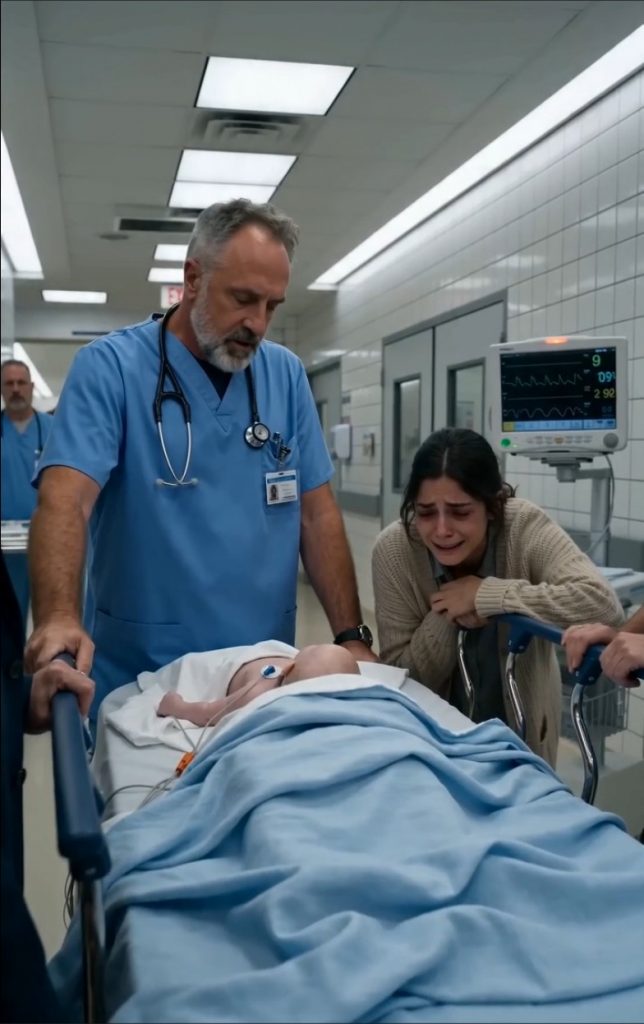
Around him, the emergency intake area had fallen into that terrible hospital silence that comes after urgency runs out. The fluorescent lights hummed over white-tiled walls. A heart monitor stood beside the bed, its screen still glowing, its wires trailing across the sheet.
On the bed lay a baby boy, impossibly small beneath the white cover.
His mother gripped the railing with both hands.
Her face was red from crying, her dark hair coming loose from its tie, her tan cardigan pulled crookedly around her shoulders. She had been begging for the last twenty minutes. Begging the nurses. Begging the doctor. Begging God.
The baby’s father stood beside her in a navy blazer, one arm around her back as if he could hold her together by force.
The lead doctor, Dr. Malcolm Hayes, looked down at the child with exhausted eyes.
“We’ve done everything we can,” he said.
The mother made a sound no one in that corridor would ever forget.
A nurse turned away.
Another reached for the brakes on the bed.
The father lowered his head, jaw trembling, trying to be strong and failing in the most human way possible.
Then the double doors opened.
A boy stepped through.
He was twelve, maybe thirteen, with messy dark hair and an oversized olive-green jacket hanging off his thin shoulders. Dust clung to the sleeves. A brown canvas bag crossed his chest, heavy enough to drag one side of him down.
No one knew him.
No one had called for him.
He walked straight toward the bed.
“Why is no one looking at his neck?” he demanded.
Every head turned.
The father’s grief hardened instantly into anger.
“This is not a place for you,” he snapped.
The boy did not flinch.
He kept walking.
A nurse moved to block him, but the boy slipped around her, eyes fixed on the baby with terrifying certainty.
“Please,” he said, pointing now. “Look at his neck.”
Dr. Hayes had been a physician for twenty-four years. He had heard desperate family members suggest impossible things. He had watched strangers burst into emergency rooms with prayers, theories, accusations, and miracles they wanted him to perform.
But this boy’s voice did not sound like hope.
It sounded like memory.
Slowly, Dr. Hayes leaned over the bed.
The nurse adjusted the light.
The baby’s head was turned slightly to one side. Beneath the soft fold of skin near his neck, almost hidden by shadow, there was a dark irregular patch. At first glance, it looked like dirt. Or a bruise. Or something caught in the crease.
Then the light hit it.
Dr. Hayes froze.
The mother gasped. “Oh my God.”
The patch was not dirt.
It had texture.
A strange dark bloom, clinging where no one had thought to check because every symptom had screamed something else. The doctor’s face changed from defeat to shock in half a second.
He straightened so fast the stethoscope jumped against his chest.
“Wait!” he shouted toward the nurse leaving with the equipment tray. “Get the emergency tray back here. Now!”
The corridor exploded back into motion.
The mother sobbed the baby’s name.
The father stared at the boy as if the floor had opened between them.
And the boy, who had no badge, no family, and no reason to be believed, whispered one thing no one else heard.
“Not this one too.”
Act II
His name was Caleb Reed, though most people at the hospital entrance called him nothing at all.
For nearly a year, he had lived in the spaces adults pretended not to see.
Bus stations. Church basements. The heated corner by the public library. The gap behind the laundromat where warm air spilled from a vent if you sat close enough and tucked your knees under your coat.
He had learned which security guards yelled and which only sighed.
He had learned which restaurants threw away bread at midnight.
He had learned how to look small without looking weak.
But before all that, before the streets and shelters and the canvas bag he never let anyone touch, Caleb had lived at a place called Willow House.
It was not on any official sign.
On paper, it was a private foster residence for children awaiting placement. In brochures, it had yellow walls, smiling volunteers, and words like safe, temporary, and family-centered.
In real life, Willow House sat behind a locked gate at the end of a road lined with dead hedges.
The children slept in narrow rooms.
The babies slept downstairs.
And the adults spoke in whispers whenever cars with tinted windows came after dark.
Caleb was nine when he arrived there. Old enough to understand that something was wrong. Too young for anyone to believe him.
He had a little sister then.
Mara.
She was two months old, with tiny fists and a cry that stopped only when Caleb hummed against her forehead. Their mother had disappeared into the system after an overdose that no one explained to him gently. Their father was a name on a form and nothing more.
So Caleb became what he could.
He became the person who counted bottles.
The person who listened when babies coughed.
The person who hid crackers in his pillowcase for younger kids who were punished without dinner.
Mara had been healthy when they came.
Then one winter, babies at Willow House began getting sick.
Not all at once. That would have forced questions.
One by one.
A fever. Pale skin. Trouble breathing. A limpness that made the adults move quickly but speak calmly. Each time, Ms. Voss, the woman who ran the house, told the older children not to panic.
“Some babies are fragile,” she said.
Caleb did not believe her.
He watched.
He saw the tiny dark marks appear near the neck first, hidden beneath collars or soft folds of skin. He heard the babies rasp before they stopped crying. He noticed Ms. Voss changing blankets and hiding them in black trash bags.
When he tried to tell a visiting nurse, Ms. Voss smiled and placed a hand on his shoulder hard enough to bruise.
“Caleb tells stories,” she said.
The nurse did not look twice.
Mara got the mark in February.
Caleb found it while changing her onesie. A dark patch, small as a coin, tucked just under her jaw. He screamed until one of the caretakers dragged him into the hallway.
By dawn, Mara was gone.
Ms. Voss told him his sister had been placed with a good family.
But Caleb had heard the ambulance leave without sirens.
After that, something inside him stopped being a child.
He ran away two weeks later with three things in his bag: Mara’s knitted hat, a stolen envelope from Ms. Voss’s office, and a memory of the mark no doctor had checked in time.
The envelope contained names.
Not all of them. Just enough.
Families who had paid for “private placements.” Doctors who signed forms. A charity board that looked generous from the outside. A hospital donor whose signature appeared again and again.
Caleb did not understand the whole machine.
He only knew Willow House was still open.
He tried going to the police once.
The officer at the desk glanced at his dirty clothes, then at the envelope, then asked where his guardian was.
Caleb ran before they could call Ms. Voss.
After that, he stopped trusting desks.
He trusted doors left ajar. He trusted overheard conversations. He trusted his own eyes.
That was why he was at St. Bartholomew’s Hospital that morning.
He had not come for the baby.
He had come because the old envelope contained the hospital’s name, and because one nurse who volunteered at a winter shelter had said something that made his blood go cold.
“Another private-placement infant came in last night,” she had whispered to a colleague. “The parents are devastated. No one knows what’s wrong.”
Private placement.
Infant.
No one knows.
Caleb had followed her through the staff entrance during a shift change. He kept his head down, walked like he belonged, and slipped past a janitor pushing a cart.
By the time he found the emergency corridor, the doctor was already giving up.
Then Caleb saw the baby’s neck.
And the past came running at him with teeth.
Act III
The baby’s name was Oliver Whitcomb.
His parents, Nathan and Claire, had waited seven years to hold him.
Seven years of appointments, losses, forms, disappointments, and rooms painted too early. Claire had folded baby clothes in drawers, then unfolded them months later because looking at them hurt too much. Nathan had become an expert at saying, “We’re okay,” in a voice that convinced no one.
Then came the call from the private agency.
A newborn needed a home.
The process was urgent. The birth mother wanted privacy. The window was small. If they hesitated, another family was ready.
They did not hesitate.
They met Oliver in a quiet room with pale blue curtains and a social worker who cried beautifully on cue. The baby was wrapped in a white blanket, sleeping with one hand tucked under his cheek.
Claire held him and felt the whole world narrow into the weight of him.
Nathan signed every paper placed in front of him.
When a woman named Vivian Voss entered the room, introduced herself as a child welfare consultant, and said speed was necessary to protect everyone involved, they believed her.
Why wouldn’t they?
They were good people.
And good people often assume paperwork means truth.
Oliver came home on a Friday.
By Sunday night, he would not feed.
By Monday morning, his skin looked pale, and his breathing sounded wrong.
By Monday afternoon, Claire was screaming in the emergency room while doctors ran tests, asked questions, and searched for causes that did not explain him.
Infection.
Allergic reaction.
Undetected condition.
Reaction to formula.
Anything.
Everything.
Nothing worked.
By the time Caleb stepped through the double doors, Oliver’s life had narrowed to seconds.
The emergency team moved fast after Dr. Hayes saw the mark. Orders snapped across the corridor. Nurses returned. The bed was turned. Lights shifted. A specialist was called from upstairs.
Caleb backed away, suddenly aware of how many adults were in the room.
Nathan grabbed his arm.
“Who are you?” he demanded.
Caleb tried to pull free. “Let go.”
“How did you know?”
“I said let go.”
Nathan released him, ashamed by the fear in the boy’s face.
Claire looked from the bed to Caleb, tears shaking on her lashes.
“Please,” she whispered. “Do you know what this is?”
Caleb swallowed.
He had imagined this moment a hundred times, but never with a mother looking at him like he held the last match in a dark room.
“I’ve seen it before,” he said.
Dr. Hayes heard him.
He turned from the bed. “Where?”
Caleb’s jaw tightened.
“Willow House.”
The name moved through the room quietly, but it struck one person like a slap.
A nurse near the medical cart dropped a roll of tape.
Dr. Hayes noticed.
So did Caleb.
The nurse’s name tag read Anna Bell.
She was young, maybe twenty-five, with tired eyes and a face that had gone suddenly white.
“You know it,” Caleb said.
Anna’s lips parted, but no sound came out.
Dr. Hayes stepped toward her. “Nurse Bell?”
Anna shook her head. “I only worked there for six months.”
The room stilled.
Nathan’s voice went low. “Worked where?”
Anna looked at the baby, then at Caleb, and something inside her finally broke.
“At Willow House,” she said. “Before I got licensed. I was an aide. I didn’t know what they were doing at first.”
“What were they doing?” Claire asked.
Anna pressed a hand to her mouth.
Caleb answered for her.
“They were selling babies.”
The words landed in the corridor with brutal simplicity.
Not placing.
Not helping.
Selling.
Nathan staggered back as if struck.
Claire gripped the bed rail so hard her knuckles whitened. “No.”
Caleb reached into his canvas bag and pulled out the old envelope. The paper was creased, stained, guarded by a boy who had slept with it against his chest through rain and winter and hunger.
He handed it to Dr. Hayes.
Inside were photocopies, payment lists, names of families, initials of infants, transport dates, and medical codes Caleb could not read. But Dr. Hayes could.
His face darkened.
At the top of one page was the name of the hospital’s largest pediatric charity partner.
The Whitcomb Foundation had donated to it for years.
Nathan saw the letterhead and went still.
“My father sits on that board,” he whispered.
Claire turned to him.
Nathan looked sick. “I didn’t know.”
But ignorance no longer sounded clean in that room.
It sounded expensive.
Then Anna said the sentence that changed everything again.
“Oliver wasn’t supposed to survive long enough to come here.”
Claire stared at her.
Anna began crying. “The sick babies were never offered to regular families. They were hidden. Moved. Sometimes used to pressure donors. But after the state started auditing Willow House, Voss began rushing placements. She needed the rooms cleared.”
Caleb pointed toward Oliver.
“That mark means he came from the basement nursery.”
Anna nodded miserably.
“The basement had water damage,” she said. “Mold, insects, old insulation. I reported it. They told me it was fixed.”
Caleb’s voice went cold. “It wasn’t.”
Dr. Hayes looked back at the baby.
The medical mystery was no longer mysterious.
It had an address.
And the boy everyone wanted removed from the corridor had just given them the one thing they had not found in any test.
A beginning.
Act IV
Oliver survived the first hour.
That was not a miracle yet.
It was a door left open.
Dr. Hayes and his team treated what they now understood, calling in infectious disease specialists, toxic exposure experts, and child protective services. The dark patch on Oliver’s neck became evidence, not a mystery. His tiny body, which had been failing under a hidden cause, began to respond in fragile increments.
Claire refused to leave the bed.
Nathan stood behind her, one hand on her shoulder, the other pressed over his mouth, as if holding in every apology he had no right to ask anyone to accept.
Caleb sat on a plastic chair against the wall.
No one had asked him to sit.
He simply ran out of strength.
For the first time all day, he looked twelve.
A security guard appeared at the end of the corridor, summoned by someone who had decided the dirty boy with the bag was a problem again. Nathan saw him and stepped into his path.
“He stays,” Nathan said.
The guard hesitated.
“He stays,” Nathan repeated.
Caleb looked up, surprised despite himself.
By evening, police cars were outside Willow House.
By midnight, the locked gate had been cut open.
What they found behind it did not need dramatic exaggeration. The truth was cruel enough.
Rows of cribs in rooms that smelled of bleach and damp walls.
Cabinets of incomplete files.
Children whose names did not match their documents.
A basement nursery sealed behind a door marked Storage.
And in Ms. Voss’s office, a shredder still warm.
But Vivian Voss had not run fast enough.
Detectives found her at a private airport forty miles away with two passports, seventy thousand dollars in cash, and a list of infants scheduled for “transfer” before the end of the month.
One of those initials matched Oliver.
Another matched Mara.
Caleb’s sister.
When the detective told him, Caleb did not cry at first.
He only nodded, like a part of him had already known and had spent years waiting for adults to catch up.
Then Claire walked out of Oliver’s room and found him standing alone by the vending machines.
“Caleb,” she said gently.
He wiped his face with his sleeve. “I don’t want your money.”
She stopped.
“I wasn’t going to offer you money.”
“Everybody does when they feel bad.”
Claire absorbed that.
Then she sat on the floor beside him in her cardigan and hospital socks, right there under the harsh fluorescent lights.
“I was going to say thank you,” she said.
Caleb stared at the vending machine.
“You don’t have to.”
“Yes,” she whispered. “I do.”
He shook his head. “I didn’t save my sister.”
Claire’s eyes filled.
“No,” she said. “But you saved my son.”
That was when he cried.
Not loudly.
Not like a child seeking comfort.
Like someone finally putting down a weight he had carried so long it had become part of his bones.
A week later, Oliver was moved out of emergency care.
His color slowly returned. His breathing steadied. The monitors still watched him, but they no longer sounded like countdowns. Claire learned to sleep in ten-minute pieces in a chair. Nathan learned the names of every nurse on the floor and stopped assuming kindness could be delegated.
Dr. Hayes visited Caleb twice a day.
At first, he said it was because detectives needed clarification.
Then because child services had questions.
Eventually, he stopped pretending.
He brought sandwiches.
Caleb pretended not to be hungry for exactly three seconds.
The case widened.
Willow House was not one building with one bad woman. It was a network wrapped in charity language and protected by people who liked their crimes written in clean fonts. Doctors had signed forms without examining children. Lawyers had sealed files for clients who preferred silence. Donors had funded programs they never visited because the photographs looked convincing.
Nathan’s father resigned from the foundation board before he was forced out.
Then investigators found emails proving he had ignored complaints about Willow House for years because the scandal would damage several “promising partnerships.”
Nathan went to see him once.
He returned to the hospital pale and shaking.
Claire did not ask what was said.
He told her anyway.
“He knew there were complaints.”
Claire closed her eyes.
“He called them administrative noise.”
Nathan looked through the glass at Oliver.
“I grew up believing my family built good things.”
Claire’s voice was tired but clear. “Then build something good without them.”
So he did.
But the first person he asked was Caleb.
Not as a symbol.
Not as a headline.
As the boy who had seen the truth before anyone else wanted to.
“What do the kids need?” Nathan asked.
Caleb looked suspicious. “Which kids?”
“All of them.”
Caleb thought for a long time.
Then he said, “People who come back.”
Nathan did not understand.
Caleb looked at him, older than any child should be.
“Adults show up when there are cameras,” he said. “Then they leave. Kids need people who come back when nobody is watching.”
Nathan had no answer for that.
So he made it a promise.
Act V
Three months later, the courtroom was packed.
Reporters filled the back rows. Former board members sat stiffly in expensive coats. Social workers whispered over files. Foster parents held children who did not yet understand why the adults looked so tense.
Caleb sat beside Dr. Hayes.
He wore a clean sweater Claire had bought him, though he had refused the blazer. His hair was combed badly. His canvas bag was under his chair, one foot hooked through the strap.
He still did not let it out of reach.
Vivian Voss entered in a gray suit, her face arranged into sorrow.
She looked smaller without the locked gate, the office, the keys, the power to decide which child disappeared into which file. But when she glanced at Caleb, her eyes carried the same warning they had years ago.
Be quiet.
Caleb looked back.
This time, he did not lower his eyes.
Anna Bell testified first.
Her voice trembled, but she told the truth. She spoke of falsified logs, hidden illnesses, babies moved at night, children coached to lie when inspectors came. She admitted her silence. She admitted her fear.
Then Dr. Hayes testified.
He did not dramatize. He did not need to.
He explained how close Oliver had come to being lost because crucial background information had been withheld. He explained how the mark Caleb identified changed the medical response. He explained that without the boy’s intervention, the outcome would likely have been very different.
Claire gripped Nathan’s hand until it hurt.
Then Caleb was called.
The courtroom seemed to hold its breath as he walked to the stand.
He was sworn in by a clerk who looked like she wanted to cry.
The prosecutor asked him about Willow House.
Caleb answered quietly.
He did not make himself sound brave. He told the truth in plain pieces. The basement. The babies. The mark. Mara’s hat. The envelope. The police station that did not listen. The hospital corridor where he had almost turned around because he was tired of adults looking through him.
Vivian’s lawyer tried to make him seem unreliable.
“You were living on the street at the time, correct?”
“Yes.”
“You had no formal medical training?”
“No.”
“You had run away from lawful supervision?”
Caleb looked at Vivian.
Then back at the lawyer.
“I ran away from people who were hurting babies.”
The courtroom went silent.
The lawyer changed direction.
But the damage was done.
By the end of the hearing, Willow House was finished. Its records were seized. Its network was exposed. Vivian Voss and several others were charged, and the charity that had hidden behind beautiful language collapsed under the weight of what it had allowed.
But justice, Caleb learned, was not one moment.
It was paperwork.
Hearings.
Therapy appointments.
Children waking up screaming.
Babies with new names.
Parents learning that love was not enough unless it was willing to look closely.
Oliver came home in spring.
Not to the perfect nursery Claire had once imagined, but to something better. A room with sunlight on the floor, a rocking chair by the window, and a framed photograph on the dresser.
In the photograph, Caleb stood awkwardly beside Claire and Nathan outside the hospital. He was not smiling, exactly. But he was not running either.
Caleb did not move in with them right away.
Trust did not work that way.
At first, he stayed in a temporary youth home supervised by people Dr. Hayes personally checked on. Nathan came every Tuesday and Thursday. Claire came every Saturday with Oliver bundled against her chest. They did not bring cameras. They did not bring reporters.
They brought food.
Books.
Socks.
Stories about Oliver grabbing Nathan’s beard and refusing to let go.
Every time they left, Caleb assumed they would not come back.
Every time, they did.
One rainy afternoon in May, Nathan found Caleb sitting on the steps outside the youth home, watching water run along the curb.
“I have something for you,” Nathan said.
Caleb’s shoulders tightened. “I don’t want a reward.”
“It’s not a reward.”
Nathan handed him a small laminated card.
Caleb looked down.
It was a hospital visitor badge.
Permanent pediatric family access.
His name was printed beneath Oliver’s.
Caleb Reed.
Big Brother.
His face went blank with shock.
Claire stepped from the car, holding Oliver under a yellow blanket.
“We didn’t want to assume,” she said softly. “But he should know the person who saved him.”
Caleb stared at the badge.
For a moment, the world seemed to tilt around him.
He thought of Mara’s knitted hat tucked inside his canvas bag. He thought of the basement nursery. He thought of every adult who had told him to move, leave, be quiet, stop making trouble.
Then Oliver made a small sleepy sound from Claire’s arms.
Caleb looked up.
“Can I hold him?”
Claire smiled through tears.
“Yes.”
She placed Oliver carefully in Caleb’s arms.
The baby blinked up at him, warm and real and alive. Caleb held him stiffly at first, afraid of doing something wrong. Then Oliver’s tiny fingers curled around one of his.
Caleb’s mouth trembled.
“Hey,” he whispered. “You made it.”
Nathan looked away, crying openly now.
Claire rested one hand on Caleb’s shoulder.
No one rushed him.
No one pulled the baby away.
Months later, when Caleb finally agreed to stay with the Whitcombs on weekends, he chose the smallest bedroom in the house. It had a window facing the street and a lock he was allowed to control. Claire painted nothing without asking him. Nathan knocked every time.
On the first night, Caleb placed Mara’s knitted hat on the shelf beside his bed.
Then he placed Oliver’s visitor badge next to it.
Two children.
One he could not save.
One he had.
The ache of that never fully left him, but it changed shape. It became purpose instead of punishment.
Years from then, people would still tell the story of the strange boy who walked into an emergency room and challenged a doctor when everyone else had given up.
Some would call it a miracle.
Dr. Hayes never did.
“A miracle is something you can’t explain,” he once said. “That boy paid attention when the rest of us missed what mattered.”
And Caleb, who hated speeches, would always shrug when anyone called him a hero.
But sometimes, when Oliver was older and ran through the Whitcomb kitchen shouting his name, Caleb would stop in the doorway and watch him.
Alive.
Laughing.
Safe.
The world had tried to bury the truth under files, money, and locked doors.
But a homeless boy had carried it in a canvas bag.
And when the moment came, he opened it.