Act I
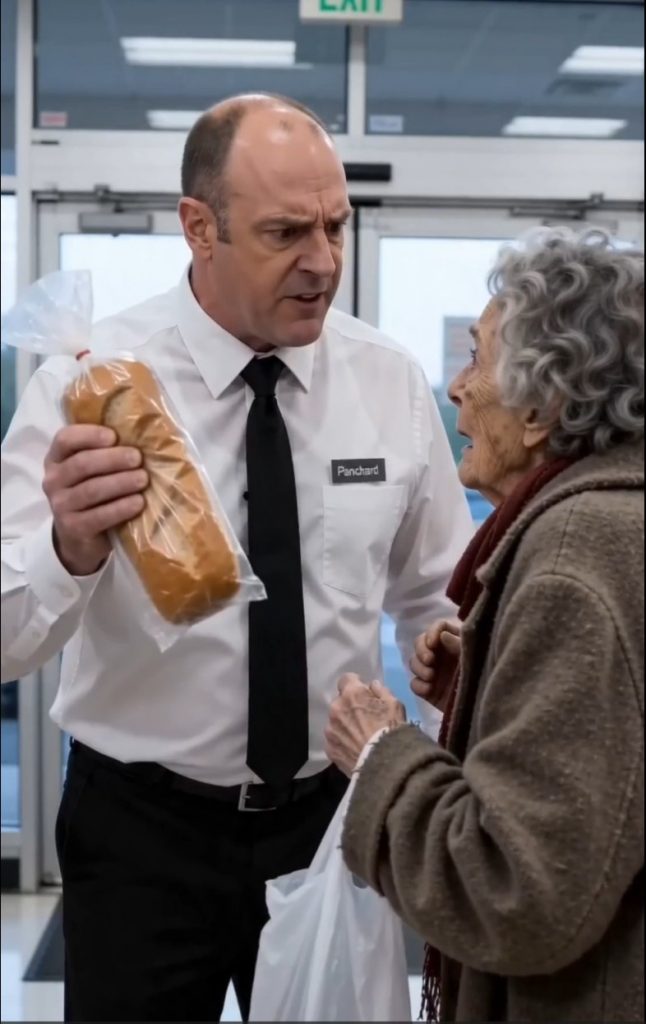
The loaf of bread was almost at the door when the manager snatched it away.
The automatic glass doors were only a few feet in front of Eleanor Whitaker, sliding open and shut with every customer who passed. Above them, the green EXIT sign glowed like a promise she had nearly reached.
Then Mr. Panchard stepped in front of her.
He was a thin-haired man in a white shirt and black tie, the kind of manager who smiled at people with expensive shoes and narrowed his eyes at everyone else. His name tag flashed under the fluorescent lights as he reached into Eleanor’s plastic bag and yanked out the bread.
“You didn’t pay for this!” he barked. “Put it back!”
The whole checkout lane froze.
Eleanor did too.
She was seventy-two years old, wrapped in a brown wool coat so worn the cuffs had begun to fray. A faded red scarf covered the hollow at her throat. Her grey curls trembled as she lifted both hands, not in anger, but in fear.
“That’s not true,” she whispered. “I already paid you for it.”
Behind her, the line of customers shifted with irritation.
A woman in a green blazer rolled her eyes. A man in a blue jacket checked his watch like poverty had personally inconvenienced him. Someone muttered, “Unbelievable.”
But the boy beside Eleanor did not care about their impatience.
He only saw the bread.
Noah was eight, barefoot on the cold supermarket floor, his blue hoodie stained and too thin for the weather outside. Dirt smudged his cheeks in dark streaks. His eyes were fixed on the loaf held high in Panchard’s hand.
“No!” he cried, reaching up. “Don’t take it! Grandma, I’m so hungry!”
The sound went through the lane like a crack in glass.
For half a second, Eleanor looked as if she might collapse from shame alone.
Panchard did not soften.
“Pay for it again right now,” he said, lifting the bread farther from Noah’s reach, “or you’re leaving without it.”
Eleanor slowly opened her hand.
Three small silver coins lay in her palm.
That was all.
Not enough for bread. Not enough for a bus ride. Not enough to preserve her dignity in a checkout lane full of strangers.
Panchard looked at the coins and scoffed.
“Exactly what I thought.”
Eleanor’s eyes filled.
“I gave you my cash,” she said. “All of it. You counted it right there.”
Panchard leaned closer, lowering his voice just enough to sound cruel instead of professional.
“Ma’am, stealing is still stealing, even when you bring a child.”
Noah stopped crying for one stunned second.
Then his face crumpled.
Eleanor pulled him against her coat, trying to shield him from the stares, but there was nowhere to hide under those bright supermarket lights. Bottles of juice gleamed on the shelves behind them. Bakery rolls sat warm in clear plastic boxes. Everywhere Noah looked, there was food.
Everywhere except in his hands.
Panchard turned toward the other customers with a practiced sigh.
“I apologize for the delay, folks. Some people think rules don’t apply to them.”
That was when the cashier moved.
Her name was Maddie Lane, and until that moment, everyone had treated her like part of the register. Young, blonde, quiet. White uniform shirt, black apron, eyes down, scanning groceries and saying thank you in the voice employees used when they needed a paycheck more than pride.
But Maddie had been watching.
She had watched Eleanor count the cash.
She had watched Panchard step in and say, “I’ll handle this one.”
She had watched his hand hover over the register, then move away before the bread was entered.
And she had watched him pocket something.
Now Maddie grabbed the receipt printer so hard the plastic casing rattled.
“Wait,” she said.
Panchard turned.
Maddie pulled a long strip of paper from the machine and thrust it between him and Eleanor.
Her voice shook, but it did not break.
“I have the record here,” she said loudly. “You took her cash personally, but you purposely didn’t ring up the bread on her bill.”
The store went silent.
Not quieter.
Silent.
The receipt fluttered under the fluorescent lights.
Gallon Milk — $3.89.
Large Eggs — $2.50.
Red Apples — $4.00.
No bread.
Panchard’s face emptied.
And Maddie knew, from the terror in his eyes, that this was not the first time he had done it.
Act II
Eleanor Whitaker had not always counted coins under strangers’ stares.
Years earlier, she had lived in a yellow house with flower boxes and a kitchen that smelled like cinnamon on Sundays. Her husband, Frank, worked maintenance at the old textile plant until the plant closed and took half the neighborhood’s stability with it.
Eleanor raised one son, Daniel.
Daniel was the kind of boy who carried groceries for elderly neighbors without being asked. He grew into the kind of man who joined the fire department because he did not know how to walk away from danger if someone else was trapped inside it.
Noah was Daniel’s son.
And for the first five years of Noah’s life, he was surrounded by noise and warmth. Birthday candles. Firehouse cookouts. Daniel lifting him onto his shoulders. Eleanor teaching him how to crack eggs into a bowl without getting shells in the batter.
Then one call changed everything.
A late-night apartment fire. A stairwell full of smoke. A mother and baby trapped on the second floor. Daniel went in with his crew and came out carrying someone else’s child.
He did not come home the same.
After months of hospitals and paperwork, he was gone.
Noah’s mother, already struggling, drifted out of his life piece by piece until one morning she left a note on Eleanor’s kitchen table and did not return. Eleanor never spoke badly of her. She simply folded the note, put it in a drawer, and became a mother again at sixty-nine.
She sold the yellow house to pay debts.
She moved into a room behind an old church.
She learned which food pantry opened on Thursdays, which bus driver looked the other way when she was short a fare, and which grocery stores marked down bread after 7 p.m.
Hartwell Market used to be safe.
That was why she came there.
The old owner, Mr. Alvarez, had known Daniel. He used to slip extra apples into Eleanor’s bag and pretend he miscounted. When Noah was smaller, he gave him stickers from behind the counter and called him “little captain.”
But Mr. Alvarez had sold the store six months earlier.
The new manager was Panchard.
Under him, the store became colder without changing a single light. Employees stopped laughing near the registers. The donation bin by the entrance stayed full, but the local shelter complained they had not received deliveries in weeks. Customers with coupons were treated like suspects. Elderly people counted change with shaking hands while Panchard watched like a hawk.
Maddie noticed all of it.
She had taken the cashier job after her father lost work. She was twenty-two, studying accounting at night, and tired in the way young people get tired when they realize adulthood is mostly bills wearing different names.
At first, she thought Panchard was just mean.
Then she saw patterns.
Cash transactions that did not match the drawer.
Voided items that had been paid for.
Elderly customers accused of miscounting.
Mothers told their cards had declined when Maddie was certain they had not.
And always, somehow, Panchard was nearby.
Maddie started keeping notes.
Not because she wanted to be a hero.
Because her little brother had once gone to bed hungry for three nights after their father’s injury claim was delayed, and she remembered the helpless rage of watching adults pretend not to see.
That evening, when Eleanor and Noah entered the checkout lane, Maddie recognized them.
Everyone in that neighborhood knew the barefoot boy and the grandmother in the brown coat, even if most pretended not to.
Noah stood close to Eleanor, eyes locked on the loaf of bread as it moved along the belt. Not candy. Not soda. Bread.
Eleanor counted her money twice before handing it over.
Milk. Eggs. Apples. Bread.
The kind of groceries a person bought when she was trying to stretch survival into another day.
Maddie reached for the bread to scan it.
Panchard appeared at her shoulder.
“I’ll take over,” he said.
His voice was pleasant, but his hand pressed hard into the counter near her wrist.
Maddie stepped back because she needed the job.
She hated herself for it instantly.
Panchard counted Eleanor’s cash. He smiled just enough to look helpful from a distance. Then he entered the milk, eggs, and apples, but not the bread.
Maddie saw it.
She saw the extra bills vanish beneath the receipt tray.
She saw Eleanor gather the bag with exhausted gratitude.
And then she saw Panchard follow them toward the exit.
That was when Maddie made her decision.
She reached under the register and hit reprint.
The paper came out like evidence.
But the receipt was only the first crack in the wall.
Because Maddie had something much worse than paper.
Act III
Panchard tried to laugh.
It came out wrong.
Thin. Dry. Too late.
“That’s not what happened,” he said, reaching for the receipt. “She must have confused the transaction.”
Maddie pulled it back.
“No,” she said. “She didn’t.”
The woman in the green blazer stopped rolling her eyes.
The man in the blue jacket lowered his phone.
Eleanor stared at Maddie as if someone had opened a window in a room where she had been suffocating.
“I paid,” Eleanor whispered.
Maddie looked at her.
“I know.”
Noah wiped his face with his sleeve and stared up at the bread still in Panchard’s hand.
Panchard noticed the customers watching him now. Not Eleanor. Him.
His voice sharpened.
“Maddie, you are very close to losing your job.”
That sentence changed something in her face.
For months, she had swallowed little humiliations because she needed rent. She had accepted extra shifts that disappeared from payroll. She had watched him berate employees in the break room where cameras did not reach.
But threatening her now, in front of a hungry child whose bread he had stolen, was the last mistake he would make with authority in his mouth.
Maddie reached beneath the counter again.
This time she pulled out her phone.
“I sent the drawer reports to corporate last week,” she said. “And to Mr. Alvarez.”
Panchard went still.
That name hit harder than anything else.
Because Mr. Alvarez had not vanished after selling Hartwell Market. He still owned the building. He still had friends in the neighborhood. And he had told Maddie, quietly, two weeks earlier, to send him anything that looked wrong.
Panchard forced a smile.
“Corporate receives nonsense complaints every day.”
“Not like this,” Maddie said.
She tapped her screen and turned it toward the customers.
The video was from the overhead checkout camera. Grainy, silent, but clear.
Eleanor placing cash on the counter.
Panchard counting it.
Maddie stepping back.
Panchard moving the bread aside.
The register screen showing only three items.
Then his hand sliding folded bills into the space beneath the receipt tray.
No one breathed.
Eleanor covered her mouth.
The coins in her palm slipped and scattered across the floor.
Noah bent to grab them automatically, but the man in the blue jacket knelt first. His face was red now, not with anger at the delay, but with shame.
“I’ve got them,” he said softly.
Panchard stared at the phone.
Then at Maddie.
“You recorded company equipment?”
Maddie did not flinch.
“The camera recorded it. I saved it.”
“That’s illegal.”
“No,” said a voice behind them. “Stealing from customers is.”
Everyone turned.
An older man in a navy coat stood near the bakery display, holding a cane in one hand and a small paper bag in the other. His white hair was thinner than before, his shoulders more stooped, but Eleanor recognized him instantly.
“Mr. Alvarez,” she whispered.
Panchard’s mouth opened.
Nothing came out.
Mr. Alvarez walked slowly toward the checkout lane, his eyes not leaving the manager.
“I came because Maddie asked me to review something,” he said. “I hoped she was mistaken.”
He looked at Eleanor.
His face softened with grief.
“Mrs. Whitaker, I am so sorry.”
Eleanor shook her head, overwhelmed.
“I didn’t steal.”
“I know,” Mr. Alvarez said. “Daniel’s mother would never steal bread.”
At Daniel’s name, Noah looked up.
Mr. Alvarez turned to the boy.
“I knew your dad,” he said gently. “He once carried a woman twice his size down three flights of stairs and apologized because he broke her lamp doing it.”
Noah’s eyes filled again, but this time the tears were different.
Panchard tried to step away.
Maddie saw him.
So did Mr. Alvarez.
“Don’t leave,” the old man said.
Panchard’s expression hardened.
“With respect, you no longer manage this store.”
“No,” Mr. Alvarez replied. “But I own the property, and I kept one office upstairs.”
He reached into his coat and removed a folder.
Inside were printed reports.
Voided cash items.
Missing donation totals.
Employee complaints.
Customer statements.
And on top of it all, a photograph from three weeks earlier: Panchard loading boxes from the community donation bin into the trunk of his own car.
The store seemed to tilt around him.
Panchard had not just stolen a loaf of bread.
He had been stealing hunger itself.
Act IV
The first person to speak was the woman in the green blazer.
“Oh my God,” she whispered.
She looked at Eleanor, then at Noah’s bare feet, then at the bread still clutched in Panchard’s hand.
All the annoyance drained from her face, leaving something uglier behind.
Recognition.
She had been ready to believe the worst about the person with the least power.
Panchard set the bread down on the counter as if it had burned him.
“This is being exaggerated,” he said. “Inventory mistakes happen.”
Mr. Alvarez opened the folder.
“Twenty-seven times?”
Panchard’s eyes flicked toward the exit.
Maddie stepped out from behind the register, blocking his path just enough to make him stop.
She was not large. She was not intimidating.
But she had the truth in her hand, and for the first time that evening, that was enough.
Mr. Alvarez continued.
“Seven elderly customers. Four single parents. Three people using food vouchers. Two shelter volunteers. And now Mrs. Whitaker.”
Eleanor swayed slightly.
The man in the blue jacket stood and offered her his arm. She took it because her knees were no longer certain.
Noah pressed into her side.
“Grandma,” he whispered. “Can we still have the bread?”
The question broke something open.
Not loudly. Not dramatically.
Just enough that several people looked away.
Mr. Alvarez lifted the loaf and placed it gently in Noah’s hands.
“Yes,” he said. “And you will not pay for it twice.”
Panchard’s voice rose.
“You can’t give away merchandise.”
Mr. Alvarez turned on him.
“It was already paid for.”
The cashier lane erupted, not in chaos, but in truth arriving all at once.
A woman near the back said Panchard had accused her father of shorting him ten dollars the week before. Another customer said the donation bin had been full every Monday but empty by Tuesday with no delivery truck ever arriving. A teenage stock clerk stepped forward, pale but determined, and admitted Panchard made employees mark good food as damaged before taking it through the back.
Each voice made Panchard smaller.
For months, he had survived because each victim thought they were alone.
Now they were standing in the same bright lane, realizing the pattern had a name.
Maddie opened the register drawer.
“The cash is short by the exact amount of the bread,” she said. “Plus the two dollars he didn’t give back from her change.”
Panchard snapped, “Enough!”
The word echoed off the sterile white ceiling.
Noah flinched.
That was when Eleanor changed.
Until then, she had looked fragile. Humiliated. Bent under the weight of being judged by strangers when she had already been carrying too much.
But when Noah flinched, Eleanor straightened.
She took one step away from the man supporting her and faced Panchard herself.
Her voice was still soft.
But it reached everyone.
“My grandson has lost enough,” she said. “You don’t get to scare him too.”
Panchard stared at her.
For the first time, he looked uncertain.
Eleanor continued, her fingers trembling at her scarf.
“My son died saving people he didn’t know. He believed this neighborhood was worth protecting. I came here tonight because I had just enough money to feed his child one more meal. And you looked at us and saw an opportunity.”
No one interrupted.
Not one customer.
Not one employee.
Eleanor’s eyes shone, but she did not cry.
“You thought shame would keep me quiet.”
Panchard looked away.
Maddie’s phone rang.
She glanced at the screen.
Then she put it on speaker.
A woman’s voice came through, firm and official.
“This is Karen Holt from Hartwell Corporate Loss Prevention. Mr. Panchard, remain on site. Police have been notified. Do not touch the register, the receipt printer, the office computer, or any store records.”
Panchard’s face went grey.
The automatic doors opened.
Two police officers walked in beneath the green EXIT sign.
And suddenly, the door he had used to humiliate others became the door through which consequence arrived.
Act V
Panchard did not shout when they led him out.
That was the strangest part.
A man who had been so loud when accusing an old woman over bread became silent when every camera in the store seemed to find his face. His tie was crooked. His name tag hung slightly sideways. The customers parted for him without sympathy.
Noah watched from behind Eleanor’s coat.
Maddie turned his eyes away gently.
“You don’t have to look at him,” she said.
Noah nodded, clutching the bread to his chest.
Outside, the last of the sunset glowed through the glass doors. For a moment, the whole front of the store turned gold, softening the hard edges of the registers and the polished floor.
But inside, something had shifted permanently.
Mr. Alvarez took off his glasses and wiped them with a handkerchief.
“I should have been here,” he said.
Maddie looked exhausted now that the fight had left her body.
“You’re here now.”
He nodded, but his eyes stayed on Eleanor.
“Mrs. Whitaker, there is an office upstairs. It’s quiet. Please let us call someone for you.”
Eleanor shook her head out of habit.
“We don’t want trouble.”
Mr. Alvarez’s face tightened.
“You didn’t cause trouble. You revealed it.”
The woman in the green blazer approached slowly, holding a shopping basket she seemed to have forgotten was in her hand.
“I’m sorry,” she said.
Eleanor looked at her, uncertain.
The woman swallowed.
“I judged you. I saw what he wanted me to see.”
Eleanor did not absolve her right away.
That mattered.
Forgiveness offered too quickly can become another burden placed on the wounded.
After a moment, Eleanor simply said, “Then see my grandson now.”
The woman looked at Noah.
Really looked.
Bare feet on cold tile. Dirty face. Bread held like treasure. A child who had learned the price of dinner before learning long division.
Her eyes filled.
“I do,” she whispered.
By closing time, the store had changed into something almost unrecognizable.
The man in the blue jacket bought socks and sneakers for Noah without making a performance of it. A mother from the line added soup, rice, and chicken to Eleanor’s bag. The teenage stock clerk brought out boxes of food that had been falsely marked damaged and set them aside for the shelter, under Mr. Alvarez’s direct supervision.
Maddie rang up Eleanor’s groceries properly.
Milk. Eggs. Apples. Bread.
Then Mr. Alvarez added a store credit so large Eleanor stared at the screen and shook her head.
“I can’t accept that.”
He leaned on his cane.
“You can. And you will. Daniel once pulled my sister out of a burning kitchen. I never got to repay him.”
Eleanor’s lips trembled.
“He never wanted repayment.”
“I know,” Mr. Alvarez said. “That’s why it matters.”
Noah, now wearing new socks and sneakers, looked down at his feet as if they belonged to someone else.
“Grandma,” he whispered. “They fit.”
Eleanor bent slowly and pressed one hand to his cheek.
For the first time all evening, she smiled.
It was small.
But it was real.
The investigation lasted months.
Panchard’s theft turned out to be bigger than anyone had guessed. He had skimmed cash, stolen donations, manipulated refunds, and targeted customers he believed would be too embarrassed or too powerless to challenge him. The company tried at first to call it an isolated failure.
Maddie refused to let them.
So did Mr. Alvarez.
So did the customers who had stood in that line and learned what silence could cost.
Hartwell Market was forced to repay victims, restore the shelter donations, and install a policy that no manager could override a cashier’s transaction without a digital record. Maddie was offered a promotion. She accepted only after Mr. Alvarez agreed to fund an employee ethics hotline and a weekly community pantry.
She ran both.
Every Thursday morning, Eleanor volunteered at that pantry.
At first, she came because Mr. Alvarez asked. Then she came because she knew how people looked when they were hungry and trying not to show it. She knew how to place food in someone’s hands without making them feel small.
Noah came with her after school.
He stacked bread carefully.
Always bread.
One afternoon, months after the night in the checkout lane, Maddie found him placing loaves into paper bags near the front table.
“You’re getting good at that,” she said.
Noah shrugged, but he smiled.
“I don’t want anybody to have to beg for it.”
Maddie had to look away for a second.
Across the room, Eleanor watched him with the kind of pride that still carried grief inside it. Daniel should have been there to see his son. He should have been the one tying Noah’s shoes, packing his lunch, teaching him how to stand tall.
But love does not vanish just because the person who gave it is gone.
Sometimes it remains in a grandmother who refuses to quit.
Sometimes in a cashier who prints the receipt.
Sometimes in a whole line of strangers finally choosing to see.
On the first anniversary of Panchard’s arrest, Mr. Alvarez hung a framed copy of that receipt near the customer service desk.
Not the video. Not Panchard’s picture. Not a headline.
Just the receipt.
Milk. Eggs. Apples.
No bread.
Underneath it, a small plaque read:
When something is missing, speak.
People asked about it all the time.
Maddie would tell them the story simply. An old woman paid. A manager lied. A child cried. A receipt told the truth.
But Eleanor knew it was more than that.
It was the night shame changed sides.
It was the night a hungry boy learned that not every adult would look away.
It was the night a loaf of bread became evidence.
And years later, when Noah was older, he still remembered the cold tile under his bare feet and the bright green EXIT sign above the doors. He remembered his grandmother’s shaking hand with three coins in it. He remembered the manager holding the bread too high.
But most of all, he remembered Maddie’s voice cutting through the silence.
Wait. I have the record here.
That sentence stayed with him.
It taught him that truth did not always arrive loudly.
Sometimes it came on thin white paper, printed at the exact moment a cruel man thought no one was watching.
And sometimes, that was enough to feed more than one child.
Sometimes, it was enough to feed an entire neighborhood back its courage.