Act I
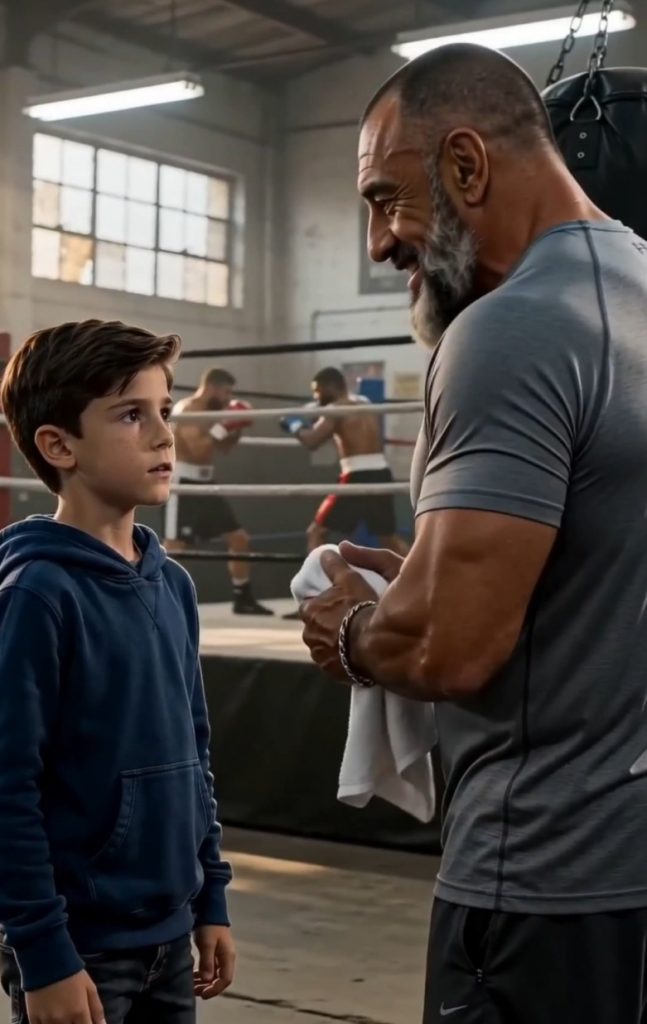
The boy walked through the boxing gym like he had already survived something bigger than fear.
He was small enough that the heavy bags seemed to tower over him, their black leather bodies swinging from iron chains in the hazy afternoon light. Around him, jump ropes snapped against concrete. Gloves cracked against pads. Men twice his size moved through sweat and noise and old ambition.
But the boy did not look left.
He did not look right.
He walked straight to the man with the gray shirt, the salt-and-pepper beard, and the white towel twisted in his calloused hands.
“Are you Coach Diaz?” the boy asked.
The gym softened into a few scattered chuckles.
Coach Rafael Diaz turned slowly, still breathing hard from holding mitts for a middleweight prospect in the ring. He looked down at the kid in the navy hoodie and dark jeans, at the tousled hair, the freckles, the steady brown eyes that did not belong on a nine-year-old.
Diaz gave him a crooked grin.
“Yo, kid,” he said, loud enough for half the gym to hear. “Daycare’s down the block.”
The laughter came easier this time.
Someone near the speed bags snorted. A young fighter leaned against the ropes and whispered something to his trainer. The boy did not blush. He did not back away. He only waited until the laughter thinned out and died on its own.
That was the first thing Diaz noticed.
The kid knew how to wait.
“Depends who’s asking,” Diaz said, wiping his palms with the towel.
The boy stepped closer.
Not boldly. Not rudely. Just with the quiet certainty of someone carrying a message that mattered more than his pride.
“My dad said you gave him this,” he said. “Before his last fight.”
He reached into his pocket and opened his hand.
In his palm lay a heavy silver coin.
The room did not go silent all at once. It happened in pieces. The jump rope stopped first. Then the mitts. Then the speed bag. One by one, the sounds of the gym seemed to realize something old had entered the building.
Diaz stared at the coin.
A phoenix rose from engraved flames on one side, clutching a pair of boxing gloves in its talons. The edges were worn from years of being touched, carried, maybe prayed over. Diaz had not seen that coin in twelve years.
He had only made one.
His grin vanished.
The towel went still in his hand.
“Kid,” he whispered, and his voice no longer sounded like it belonged to a man who mocked anything. “What was your father’s name?”
The boy lifted his chin.
“Tommy ‘Ghost’ Reyes.”
A man in the corner cursed under his breath.
Diaz took one step back as if the name itself had hit him.
Tommy Reyes had once been the best fighter this city ever pretended not to remember.
And everyone in that gym believed he had died a coward.
Act II
For a long moment, Coach Diaz could not see the boy in front of him.
He saw another kid instead.
Seventeen years old. Skinny. Hungry. Hair too long. Shoes falling apart. Eyes calm enough to make older fighters nervous.
Tommy Reyes had walked into that same gym on a rainy Tuesday with nothing but a backpack and a lie.
He said he wanted to learn how to box.
Diaz knew within five minutes that Tommy already knew how to fight. What he did not know was how to trust. He moved like someone who had spent his whole life making sure nobody could catch him from behind.
That was why the gym named him Ghost.
He slipped punches before they were thrown. He vanished against the ropes. He made hard men swing at empty air and come back embarrassed.
But outside the ring, Tommy was quiet.
He swept floors after training without being asked. He taped up broken lockers. He shared food with younger fighters who pretended not to be hungry. When reporters finally started coming around, Tommy answered every question like fame was a coat that did not fit him.
Diaz loved him before he knew what to call it.
Not softly. Men like Diaz did not know how to be soft back then. He loved him by yelling when Tommy dropped his hands, by staying late to wrap his wrists, by pretending not to notice when Tommy slept on the old couch in the back office because he had nowhere else to go.
Then came the title eliminator.
Atlantic City. Bright lights. National broadcast. A payday big enough to drag every greedy man in the state toward Tommy Reyes.
Tommy was twenty-three by then, undefeated, and still carrying himself like the frightened boy who first walked into the gym. Diaz gave him the silver coin the night before the fight.
“A phoenix doesn’t rise because life is fair,” Diaz had told him. “It rises because fire doesn’t get the last word.”
Tommy closed his fist around it and smiled.
Not the smile he gave cameras.
A real one.
“Then I guess I’ll rise clean,” Tommy said.
The next night, everything fell apart.
Tommy lost badly.
Not in the way fighters lose when another man is better. He lost like something invisible had entered the ring with him. He held back. He looked past his opponent toward the tunnel between rounds. He ignored Diaz’s instructions until Diaz was hoarse from screaming.
By morning, the newspapers had their headline.
GHOST TAKES A DIVE.
There were rumors of gambling money. A photograph of Tommy outside a casino with an envelope in his hand. A promoter named Victor Callahan swore Tommy had been paid to lose. The boxing commission suspended him before he could defend himself.
Diaz believed the lie because he was too hurt not to.
He found Tommy in the locker room two days later, sitting alone with that same silver coin in his hand.
“Tell me you didn’t sell the fight,” Diaz said.
Tommy looked up.
There was a bruise under one eye, but his expression was worse. Empty. Worn down. Older than twenty-three.
“I can’t tell you what you need,” Tommy said.
Diaz mistook pain for guilt.
He threw him out.
The whole gym heard it. Every ugly word. Every accusation. Every sentence a father should never say to a son, even when he does not know that is what the boy is.
Tommy left through the back door.
And the Ghost became exactly what they called him.
Gone.
Now, twelve years later, his son stood in the same gym with the same coin in his hand.
Diaz looked at the boy again and saw it.
The eyes.
The stillness.
The way he held pain like it was private property.
“What’s your name?” Diaz asked.
“Noah,” the boy said. “Noah Reyes.”
Diaz swallowed. “Where is your father?”
Noah’s hand closed around the coin.
“He died last month.”
The words landed quietly.
Some losses do.
Diaz turned his face away, but not fast enough. Half the gym saw the old coach break for one second before he put himself back together.
Noah reached into the front pocket of his hoodie.
“He told me not to come unless I was ready to be laughed at,” the boy said. “He said you’d probably do that first.”
Diaz looked back at him.
Noah held out a folded letter.
“He also said you’d stop laughing when you read this.”
And suddenly, Coach Diaz understood the boy had not come to ask for training.
He had come to open a grave.
Act III
Diaz took the letter into his office because his hands were shaking too badly to read it in front of everyone.
Noah followed him inside.
The office had not changed much in twenty years. A dented metal desk. Two chairs. A cracked leather couch against the wall. A row of old fight posters curling at the edges. Above the filing cabinet hung a framed photo of Tommy Reyes after his fifth professional win, one glove raised, his face bright with a hope he had not yet learned to hide.
Noah stared at the photo.
“That’s the one he kept in his room,” he said.
Diaz lowered himself into the chair.
The letter was sealed in a plain envelope. His name was written across the front in Tommy’s hand.
Coach,
If Noah is standing in front of you, it means I ran out of time before I ran out of things to say.
I know what you thought of me.
I know what the city thought.
I let them think it because the truth would have put Elena and the baby in danger. Callahan had men in the tunnel that night. They showed me a picture of her outside our apartment. They knew she was pregnant before I had even told you.
They said if I won, she would pay for it.
So I stayed standing just long enough to lose.
Diaz stopped reading.
The room tilted.
He remembered the tunnel. He remembered Tommy looking past him between rounds, eyes fixed on something Diaz could not see. He remembered screaming at him to fight back.
He had never asked what Tommy was staring at.
He kept reading.
The envelope in the casino photo was not money. It was the contract Callahan tried to make me sign. I refused. He made sure the photo said the rest.
I wanted to tell you.
Then I heard what he had on you.
Diaz’s chest tightened.
Noah watched him carefully, too young to understand all the words, old enough to know which ones hurt.
The letter continued.
He knew about Maria.
He knew about the baby she had before she left the city.
He knew you never stopped looking for her.
Diaz’s breath caught.
Maria Reyes.
A name he had buried so deep he had convinced himself grief was the same thing as forgetting.
She had been seventeen when he met her, all sharp wit and dark hair and songs hummed under her breath while she wiped tables at the diner beside the old gym. Diaz was eighteen, angry at the world, already fighting for money he spent too quickly. They loved each other the way young people do when they think wanting something is the same as protecting it.
Then Maria disappeared.
Her aunt said she had gone south. Her mother refused to speak to him. Every letter Diaz sent came back unopened. Years later, he heard she had died, but by then the city had already hardened around him.
He never knew there had been a child.
Diaz looked at the photo of Tommy on the wall.
His throat closed.
The letter blurred, but he forced himself to finish.
I found my birth certificate after my mother died.
Your name was on it.
I came to your gym to hate you.
Instead, you gave me a place to belong.
I wanted to tell you before the Atlantic City fight, but I needed one clean win first. I wanted to walk into that office not as some mistake from your past, but as a man you had already chosen.
Then Callahan found out.
When you threw me out, I thought maybe blood didn’t matter after all.
But I was wrong.
It mattered every time I looked at Noah.
Diaz pressed one hand over his mouth.
Noah stood very still on the other side of the desk.
There was one final page.
I don’t want my son raised by bitterness.
He has my stubbornness and Maria’s eyes when she was about to argue with God.
He will come to you with the coin because I need him to know the truth from the only man whose opinion ever broke me.
Tell him I was not a cheat.
Tell him I was afraid and did what I thought would keep his mother alive.
Tell him I loved him more than I loved my name.
And if you can bear it, tell him what I never got to say out loud.
That his grandfather is Coach Rafael Diaz.
Diaz put the letter down.
Outside the office, the gym was silent.
Noah’s face had changed. He was trying to stay brave, but brave is not the same as untouched. His lower lip trembled once before he pressed it flat again.
“My dad said you might not want me,” he said.
Diaz stood too fast, knocking the chair backward.
The sound cracked through the office.
Noah flinched.
That broke what was left of the old man.
Diaz came around the desk slowly this time. He lowered himself to one knee, the same knee he had wrapped in ice every winter for thirty years, and held out both hands without grabbing the boy.
“I wanted him,” Diaz said, voice raw. “I just didn’t know he was mine.”
Noah stared at him.
Diaz looked at Tommy’s son, and for the first time in twelve years, the truth did not feel like a punishment.
It felt like a second chance wearing a navy hoodie.
Then the office door opened.
And the man who ruined Tommy Reyes walked back into the gym.
Act IV
Victor Callahan had aged into money.
He wore a camel coat over a tailored suit, with polished shoes that looked offensive against the gym’s worn concrete floor. Two younger men came in behind him, both pretending not to be bodyguards. The fighters stepped aside without being told.
Some men carried violence in their shoulders.
Callahan carried ownership.
“Rafael,” he said, smiling like they were old friends. “You ignoring my calls now?”
Diaz rose slowly.
Noah slipped the silver coin back into his pocket.
Callahan noticed him.
His smile widened.
“Well,” he said. “That face is unfortunate.”
Diaz moved before he thought.
Not with fists. Not with the old rage that had once cost him fights and friendships. He simply stepped between Callahan and the boy, a wall made of grief and late truth.
“Don’t look at him,” Diaz said.
Callahan lifted his brows. “Still sentimental. That was always your problem.”
The whole gym listened.
Callahan’s company owned the building now. Everyone knew it. The rent had doubled twice in three years. There were rumors the gym would be sold to developers by summer, turned into luxury apartments with a lobby mural pretending to honor the neighborhood it erased.
Diaz had been fighting to keep the doors open.
Callahan knew that too.
“You got my paperwork?” Callahan asked. “Or do I need to explain consequences in front of your little after-school program?”
Noah stepped out from behind Diaz.
“My dad said you were smaller in person.”
A few fighters sucked in their breath.
Callahan looked down at him with cold amusement.
“And who was your dad?”
Noah’s chin lifted.
“Tommy Reyes.”
The name moved through the room like a match dropped in gasoline.
Callahan laughed once.
It was a small, ugly sound.
“Of course,” he said. “The Ghost’s kid. Let me guess. Here to clear Daddy’s name?”
Diaz’s hands curled, then opened.
He would not give Callahan the satisfaction of becoming the kind of man Callahan could dismiss.
“No,” Diaz said. “I am.”
Callahan’s expression shifted.
Just slightly.
Enough.
Diaz walked to the far wall, where faded posters and old newspaper clippings covered decades of sweat, losses, and almosts. He took down the framed photo of Tommy after his fifth win.
Behind it was a small metal safe.
The gym watched him turn the dial.
Inside were things Diaz had not touched in years. Old licenses. Fight contracts. A photograph of Maria Reyes folded at the corner. And a cassette tape Tommy had left in his locker the night Diaz threw him out.
Diaz had never played it.
He had told himself there was nothing on it but excuses.
Now, with Noah standing beside him and Callahan’s smile tightening by the second, Diaz placed the tape into the ancient player on his desk and pressed play.
Static filled the gym.
Then Tommy’s voice came through.
You don’t have to hurt her. I’ll lose.
Callahan’s younger voice answered, slick and bored.
You won’t just lose. You’ll look bad doing it. Nobody bets against a man who looks like he quit.
Tommy said something too quiet to hear.
Then Callahan laughed.
Win, and your girl becomes a story on page six. Lose, and she gets to raise that kid.
The tape clicked.
Silence.
No one in the gym moved.
Callahan’s face emptied.
Diaz looked at him with twelve years of shame burning clean into something stronger.
“You framed my son,” he said.
The word son did not come easily.
It came like a door being forced open after being nailed shut.
Callahan recovered quickly. Men like him always did until the moment they realized the room had turned.
“You can’t prove when that was recorded,” he said. “You can’t prove anything.”
Mara Whitcomb, a retired sports reporter who had been sitting by the front desk the entire time with a paper cup of coffee in her hand, stood up.
Diaz had called her after reading the first page of Tommy’s letter.
She lifted her phone.
“Actually,” she said, “I think we can start.”
The recording had already been copied.
The letter had already been photographed.
The old commission investigator who regretted signing off on Tommy’s suspension was already waiting outside in a parked car, brought there by Mara and a guilt that had apparently needed twelve years to become useful.
Callahan looked around the gym.
For the first time, he seemed to realize he was standing in a room full of fighters who no longer feared him.
Not because they could beat him.
Because they could finally see him.
He pointed at Diaz.
“You’ll lose this place.”
Diaz looked at the ring, the bags, the cracked floor, the boys and girls who came here after school because the streets asked too much of them too early.
Then he looked at Noah.
“No,” he said. “I already lost what mattered by staying quiet.”
Callahan left without another word.
But shame did not leave with him.
It stayed in the gym, heavy and honest, until Noah reached into his pocket and placed the silver coin on Diaz’s desk.
“My dad said fire doesn’t get the last word,” he said.
Diaz looked at the phoenix.
Then he looked at his grandson.
For the first time in years, he believed it.
Act V
The story broke three days later.
At first, the city treated it like a boxing scandal from the past. An old tape. A disgraced fighter. A promoter with too many friends and not enough fear. But then the details came out, and people began to understand Tommy Reyes had not simply lost a fight.
He had surrendered his name to protect a family.
The commission reopened the case. The suspension was vacated. The official record changed quietly, as official records often do when they are ashamed of themselves.
But the gym did not change quietly.
Someone painted over the old Callahan-sponsored banner by the entrance. A young heavyweight brought in a ladder. A retired cutman supplied the paint. By sunset, the wall read:
GHOST’S CORNER.
Under it, in smaller letters:
Rise Clean.
Noah stood across the street with Diaz when the last brushstroke dried.
He had not cried at the news station.
He had not cried when reporters asked him what kind of man his father was.
He had not cried when Diaz showed him the old couch where Tommy used to sleep, or the locker where Tommy had scratched a tiny phoenix into the metal with a key.
But he cried when the sign went up.
Quietly.
Angrily.
Like tears were a betrayal he could not stop.
Diaz did not tell him to be strong.
He had made that mistake with Tommy.
Instead, he sat beside the boy on the curb and let the city move around them.
After a while, Noah wiped his face with his sleeve.
“Did my dad hate you?” he asked.
Diaz stared at his hands.
“He had a right to.”
“That’s not what I asked.”
The old coach almost smiled through the pain.
There it was.
Tommy’s stubbornness.
“No,” Diaz said. “I don’t think he hated me. I think that would’ve been easier for him.”
Noah nodded, as if that made sense.
Maybe it did.
A week later, Diaz took Noah to the cemetery where Tommy was buried.
The grave was simple. Too simple for a man whose name had once lit up arenas and then been dragged through mud for someone else’s profit. Noah placed the silver coin on the stone, right beneath his father’s name.
Diaz stood back.
He had prepared words. An apology. A confession. A speech he had built and rebuilt in his head until every sentence sounded worthless.
In the end, he said only the truth.
“I’m sorry, son.”
The wind moved through the grass.
Noah looked at him.
“Do you think he heard you?”
Diaz swallowed.
“I don’t know.”
Noah picked up the coin and pressed it into Diaz’s hand.
“He heard worse from you,” the boy said softly. “Maybe he should hear that too.”
It was not forgiveness.
Not exactly.
It was something better.
Permission to begin earning it.
Months passed.
Callahan lost his license, then his company, then the protection of men who had once returned his calls. The gym stayed open through donations, legal pressure, and a city that suddenly remembered it loved underdogs when the cameras were rolling.
Diaz did not care why help came.
He took it and turned the heat back on.
Noah came every Saturday morning.
At first, he did not train. He swept the floor. He wrapped spare gloves. He sat on the bottom step of the ring and watched the others move.
Diaz never pushed him.
Then one morning, Noah arrived wearing old sneakers and a plain white T-shirt.
He stood in front of Diaz, the same way he had that first day.
“Can you teach me?” he asked.
The gym went quiet again.
This time, no one laughed.
Diaz looked down at him.
“I’ll teach you balance,” he said. “I’ll teach you discipline. I’ll teach you how to breathe when fear wants to make decisions for you.”
Noah waited.
Diaz bent slightly, meeting his eyes.
“But I won’t teach you to become a man by getting hurt. You hear me?”
Noah nodded.
“Good,” Diaz said.
He opened his palm.
The silver coin rested there, the phoenix catching the morning light from the dirty high windows.
“This belonged to your father,” Diaz said. “But it doesn’t mean what I thought it meant.”
“What does it mean?”
Diaz looked at the ring where Tommy had once danced through sunlight and dust, too young to carry so many secrets, too loyal to save himself first.
“It means we don’t let fire name us,” he said.
Noah took the coin.
Then he climbed through the ropes.
He was still small. Still a child in a room built by men who had mistaken hardness for courage far too many times. But when he stood in the center of the ring, chin lifted, eyes steady, Diaz saw three ghosts at once.
Maria, laughing in a diner.
Tommy, smiling with a silver coin in his fist.
And himself, young and foolish, getting one impossible chance to do better.
Noah looked back at him.
“Coach Diaz?”
The old man stepped onto the ring apron.
For a second, the title hurt.
Then it healed.
“Yeah, kid?”
Noah held up his hands, awkward but ready.
“Where do we start?”
Diaz smiled.
Not the mocking smile from the first day.
A real one.
“We start,” he said, “by standing like you belong here.”
Noah planted his feet on the worn canvas.
And this time, when the gym filled with sound again, it did not sound like violence.
It sounded like a family learning how to rise.