Act I
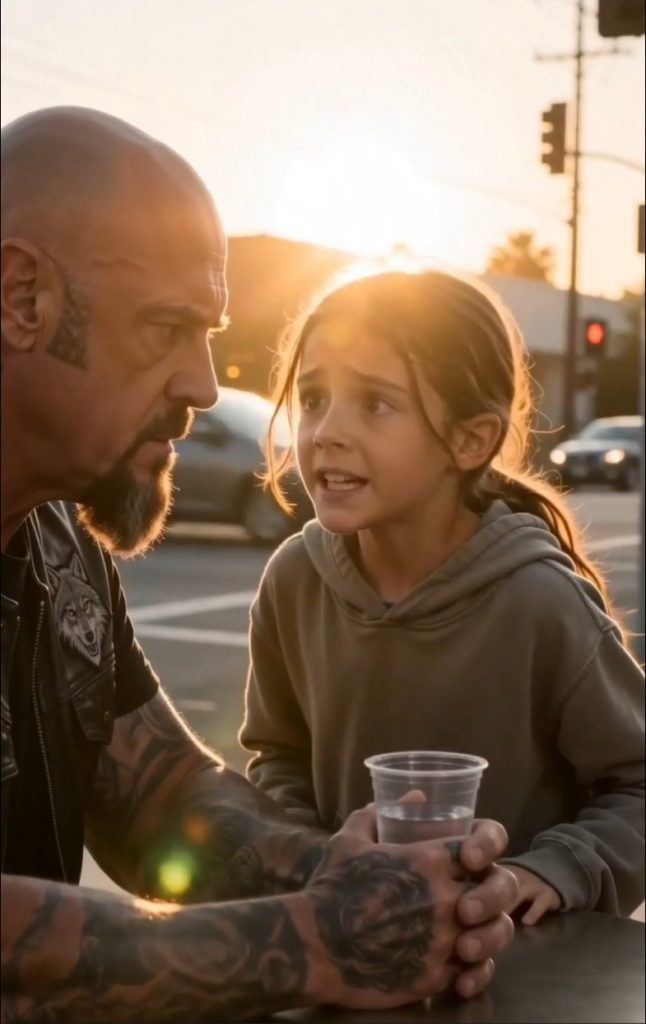
The biker was sitting alone when the little girl ran into his life.
Golden light spilled across the sidewalk café, turning every chair, every glass, every passing windshield into something hot and bright. Cars crawled through late-afternoon traffic behind him. A white commercial building across the street caught the sun so sharply it looked almost on fire.
But the man at the small round table did not look up.
He sat forward, shoulders heavy, both hands wrapped around a clear plastic cup of water like he was holding himself together through force. His black leather vest stretched across a broad chest. On the left side, stitched in grey thread, was the head of a wolf.
Most people never noticed the patch.
The people who did usually looked away.
Then the girl appeared.
She sprinted in from the right so fast one chair scraped backward when she brushed against it. She stopped inches from his table, chest heaving, dark brown hair falling loose from a messy ponytail. Her oversized grey hoodie hung off one shoulder. Her eyes were huge.
Not scared like she had lost her mother in a store.
Scared like she had been told there was nowhere safe left in the world.
The biker stiffened, but he did not move.
The girl leaned close enough for him to hear her breath break.
“Please,” she whispered. “Don’t turn around. They’ll know I chose you.”
The man’s fingers tightened around the cup.
His eyes stayed forward.
Traffic lights blinked red across the street. Somewhere, a horn sounded. Someone laughed near the café door, then went quiet when they saw the girl’s face.
The biker lowered his voice.
“Who’s watching you?”
The girl nodded rapidly, as if the answer was too big to fit into words.
“My mom said if I find that patch, I have to trust you.”
Her small hand rose, shaking badly.
She reached across the table and touched the wolf embroidered on his vest.
The biker stopped breathing.
For years, that patch had been buried in drawers, hidden in old photographs, scraped off motorcycles, cut from jackets before funerals. Men had died wearing it. Others had lied about it. Some had pretended it never existed at all.
The girl’s fingertips brushed the wolf’s grey thread like she was touching a name on a gravestone.
The biker leaned closer, his face suddenly older.
“That patch hasn’t been seen in years,” he said, voice rough. “They said you were dead.”
The girl’s eyes filled, but she did not cry.
Then she whipped her head toward the street.
A black sedan slowed beside the curb.
Her face drained of color.
“No,” she gasped. “Someone’s coming.”
And only then did the biker understand the worst part.
She had not come to him because she was safe.
She had come to him because she was out of time.
Act II
His name was Cole Maddox, though very few people called him that anymore.
To most men who still remembered the old roads, he was Wolf. Not because he liked the name. Not because he wanted it. The name had been given to him during a winter run through Montana years earlier, when he rode through a snowstorm to bring a wounded brother home.
Back then, the Grey Wolves were not a myth.
They were a family.
Rough around the edges, yes. Loud, stubborn, impossible to manage. But not criminals, no matter what the news later made them look like. They escorted women out of bad homes. They raised money for kids whose parents had vanished into hospital debt. They stood outside courtrooms when witnesses were too afraid to testify alone.
That was how Cole met Mara.
Mara Vale was twenty-three, sharp-eyed, and too brave for her own good. She was working as a junior clerk in a county records office when she found documents that did not belong together. Land transfers. Shell companies. Police reports that had been edited after filing.
At the center of it all was a man named Victor Harlan.
Harlan owned tow yards, bail bonds offices, half the strip malls on the west side, and at least three local officials who smiled whenever cameras were around. Everyone knew he was dangerous. No one could prove it.
Mara could.
She went to the police first.
Three days later, her apartment was broken into.
So she went to the Grey Wolves.
Cole still remembered the night she walked into their garage holding a cardboard file box and trying not to shake. She looked straight at him and said, “I don’t need heroes. I need witnesses.”
He had laughed once at that.
Then he opened the box.
Nobody laughed after.
For six months, the Grey Wolves protected her while she helped federal investigators build a case. Cole drove her to meetings. Sat outside diners while she passed documents under tables. Slept in a chair outside her motel room when the threats got specific.
Somewhere between fear and exhaustion, trust became something softer.
Mara never called it love.
Cole never pushed her to.
But on the last night before she entered witness protection, she gave him a small silver necklace with a cracked moon pendant and told him she had one more thing to survive for now.
He did not understand until she placed his hand over her stomach.
A baby.
His baby.
Cole begged her not to disappear alone.
Mara shook her head through tears.
“If Harlan knows she’s yours, he’ll use that forever.”
“She?”
Mara smiled.
“I just know.”
Then she made him promise something that burned him for the next eight years.
“If anything ever goes wrong, I’ll tell her to find the wolf.”
The next morning, Mara vanished into the federal system.
Three months later, Cole was told there had been an accident.
A house fire in another state. No survivors. Mara and the baby were gone.
No body was shown to him. No grave felt real. No answer satisfied him.
But grief is a brutal teacher.
Eventually, even men like Cole learn to stop asking questions when every question comes back holding nothing.
The Grey Wolves fell apart not long after.
Harlan’s case collapsed when evidence disappeared. Two members were arrested on charges that never made sense. One turned informant and vanished. Another was found dead beside a highway, the official story too neat to believe.
Cole cut the wolf patch off every vest except one.
His own.
He kept it not as pride, but punishment.
A reminder that he had failed Mara.
A reminder that he had failed the child he never got to hold.
And now that child stood trembling beside his table in a grey hoodie, whispering about men who were watching her.
Cole did not turn toward the sedan.
He looked instead at the reflection in the café window.
Two men had stepped out across the street.
One stood near the passenger door, scanning the sidewalk. The other had a phone to his ear. Both wore plain clothes. Both moved like they had done this before.
The girl pressed closer to the table.
“My mom said you’d know what to do.”
Cole’s jaw tightened.
“Where is your mom?”
The girl’s lips parted.
For one second, she looked younger than eight.
Then she whispered, “She told me to run.”
Cole’s hands slowly released the cup.
The water inside was still.
His voice was not.
“What’s your name?”
“June.”
The name hit him harder than any punch ever had.
Mara had once told him that if she had a daughter, she would name her June, because June was when all ugly winters finally gave up.
Cole looked at the girl’s face again.
The shape of her eyes.
The stubborn lift of her chin.
The tiny moon pendant tucked beneath the collar of her hoodie.
His daughter had found him.
And the men who had buried her name were crossing the street.
Act III
Cole did not grab June.
He did not stand.
Fear wanted him to move fast. Experience told him speed would make the men move faster.
So he stayed seated, broad shoulders loose, eyes lowered, one hand resting on the table. His other hand moved only enough to slide his phone beneath a napkin.
He tapped twice.
A number he had not used in six years lit up.
Mason Pike answered on the first ring.
Cole did not speak into the phone. He only left the line open.
Mason would listen.
Mason always listened.
June stared at him, panicked by his stillness.
“Why aren’t you doing anything?”
“I am.”
“They’re coming.”
“I know.”
Her breath hitched. “They said if I talked to anyone, they’d take Mom somewhere nobody finds her.”
Cole’s face hardened so subtly only June saw it.
“Mara’s alive?”
June nodded.
Cole felt the world tilt.
Not loudly. Not dramatically. The sidewalk did not shake. Traffic did not stop. The café did not go silent.
But inside him, fifteen years of grief cracked open all at once.
“She’s alive,” June whispered. “But she’s sick. Not hospital sick. Scared sick. They kept moving us. New houses. New names. No phones. Mom said Harlan found us two weeks ago.”
Cole’s eyes lifted to the café window again.
The two men were halfway across the street.
One of them looked directly at the wolf patch.
His pace changed.
Recognition.
Cole leaned closer to June.
“Listen to me. Do not run unless I tell you. Do not scream unless I tell you. And whatever happens, keep your hand on the table.”
June obeyed instantly.
That obedience hurt him.
Children should not know how to follow fear.
The men reached the café edge.
The taller one smiled like a man trying to look harmless.
“There you are, sweetheart,” he said. “Your aunt’s been worried sick.”
June’s small hand curled on the table.
Cole looked up.
The man’s smile faltered.
Cole had that effect on people.
“She with you?” Cole asked.
The man recovered quickly. “Family matter. She gets confused. We appreciate you keeping her calm.”
Cole said nothing.
The second man moved slightly to Cole’s left, blocking the sidewalk exit.
Not enough for strangers to notice.
Enough for Cole.
The first man reached for June.
June flinched.
Cole’s hand closed around the man’s wrist before his fingers touched her sleeve.
It was not a violent move.
It was worse.
It was controlled.
The man froze.
Cole’s voice dropped.
“Don’t.”
The air changed around the table.
The café owner, who had been pretending not to watch from the doorway, stepped backward inside. A woman at the next table pulled her purse into her lap. Cars kept passing, ordinary life moving past an extraordinary moment.
The man’s eyes narrowed.
“You don’t want this.”
Cole leaned in.
“I’ve wanted this for eight years.”
The man looked at the patch again.
Then he smiled for real.
“Well,” he said softly. “Victor always wondered if the wolf still had teeth.”
June made a tiny sound.
Cole released the man’s wrist.
Not because he was afraid.
Because the phone beneath the napkin had gone warm.
Mason was recording.
The taller man straightened his sleeve. “The girl belongs with us.”
Cole looked at June.
“No,” he said. “She doesn’t.”
The second man opened his jacket slightly, just enough to show confidence without showing anything specific. Cole did not look down. He kept his eyes on the taller man.
“Public sidewalk,” Cole said. “Cameras on the café. Traffic cam on that pole. Three witnesses close enough to hear you. You sure this is where you want to make a mistake?”
The man’s smile disappeared.
Then June whispered, “He has Mom’s ring.”
Cole went still.
The man’s left hand twitched.
On his pinky was a small silver ring with a moonstone set into it. Cole knew that ring. Mara wore it the night she said goodbye. She told him it had belonged to her grandmother. She never removed it.
Cole’s calm began to thin at the edges.
The man noticed.
He enjoyed it.
“She handed it over,” he said. “People hand over all kinds of things when they realize no one is coming.”
Cole stood.
The chair scraped backward across the pavement.
The man took one involuntary step away.
Cole was taller than he had expected. Broader. Older, yes, but not weaker. The sunset hit the wolf patch on his chest, and for a second the grey thread seemed almost alive.
Cole reached into his vest.
Both men tensed.
He pulled out a folded photograph.
Old. Worn at the corners. Mara smiling beside him outside the Grey Wolves garage, one hand hiding the early curve of her belly.
Cole placed it on the table in front of June.
The girl stared at it.
Her mouth trembled.
“That’s Mom.”
Cole nodded once.
“And that’s me.”
June looked up at him.
The fear in her face shifted into something more dangerous.
Hope.
Across the street, a third vehicle turned the corner.
Black SUV.
No plates on the front.
June saw it and went pale.
“That’s him,” she whispered.
Cole looked toward the SUV.
Victor Harlan had come himself.
Act IV
Harlan stepped out of the SUV like a man arriving to collect property.
He was older than Cole remembered, but money had preserved him in all the wrong ways. White hair combed back. Expensive jacket. Calm smile. The face of a man who had ruined lives through signatures and phone calls, rarely needing to raise his voice.
He did not look at June first.
He looked at the patch.
“Well,” Harlan said, strolling toward the café table. “The past really does have a sense of humor.”
Cole placed himself between Harlan and the girl.
June slid behind him without being told.
Harlan noticed.
His smile sharpened.
“Mara always did have dramatic instincts. Sending the child to a ghost.”
Cole’s voice was flat.
“Where is she?”
“Safe.”
Cole almost laughed.
The word sounded obscene in Harlan’s mouth.
Harlan tilted his head toward the men beside him. “June has been through a stressful episode. She needs familiar faces.”
“I am her father.”
The sentence landed harder than Cole expected.
He had never said it out loud before.
Not to anyone.
Harlan’s expression did not change, but the men beside him glanced at each other.
June’s fingers touched the back of Cole’s vest.
Harlan sighed. “That will be difficult to prove.”
Cole reached behind him without looking. June placed something in his hand.
A small envelope.
He opened it.
Inside was a birth certificate, folded tight. The paper was worn at the creases, hidden and handled too many times. The name at the top was not June Maddox. Not June Vale.
Emily June Maddox.
Father: Cole Maddox.
Mother: Mara Elise Vale.
Cole stared at the paper until the words blurred.
Mara had not erased him.
She had hidden him where it mattered.
Harlan’s eyes flicked to the document.
For the first time, irritation broke through his polished calm.
“That paper is meaningless.”
“No,” June whispered from behind Cole. “Mom said it was the first truth.”
Harlan looked at her then.
Really looked.
His voice cooled. “Your mother has filled your head with stories.”
June stepped halfway out from behind Cole, still shaking, still terrified, but standing.
“You locked her in the blue house.”
Harlan’s face went still.
Cole turned slightly.
“What blue house?”
June swallowed. “By the old rail bridge. The one with boards on the windows. Mom said if I found the wolf, I had to tell him blue house first, ring second, north room third.”
Cole repeated it inside his mind.
Blue house. Ring. North room.
Harlan took one step forward.
Cole took one step too.
Mason’s voice suddenly boomed from behind them.
“That’s close enough.”
A line of motorcycles rolled to the curb, engines growling low and steady. Not a parade. Not a threat for show. Just men who had once worn the wolf and never stopped answering when Cole called.
Mason Pike got off the first bike, older and heavier than before, but with the same hard eyes. Beside him came Elena, a former club lawyer who had put more corrupt men behind bars than anyone in the county wanted to admit.
She held up her phone.
“Everything from ‘Victor always wondered’ onward is recorded,” she said.
Harlan’s smile returned, but now it looked painted on.
“Recordings can be misunderstood.”
Elena nodded. “That’s why I also called Agent Brooks.”
For the first time, Harlan looked past her.
Two unmarked cars pulled up behind the motorcycles.
Men and women in plain jackets stepped out.
Harlan did not run.
Men like him rarely did. Running suggested guilt. He preferred outrage.
“This is harassment,” he snapped.
Agent Brooks, older now, tired-eyed and unimpressed, approached with one hand on his badge.
“No,” Brooks said. “This is unfinished business.”
Cole stared at him.
“You told me they died.”
Brooks did not defend himself.
His silence was an answer.
Harlan’s mouth curled. “Careful, Agent. Old mistakes can ruin clean careers.”
Brooks looked at June.
Then at Cole.
Then at Harlan.
“Old mistakes already did.”
June tugged Cole’s vest.
“Mom,” she whispered.
That one word cut through everything.
Cole turned to Mason. “Old rail bridge. Blue house. North room.”
Mason was already moving.
Harlan’s calm finally cracked.
“You don’t have a warrant.”
Agent Brooks stepped closer.
“No,” he said. “But I have a child witness stating her mother is being held against her will, a recorded threat, an active missing witness case, and your associate wearing the victim’s ring.”
The man with Mara’s ring pulled his hand behind his back too late.
Elena smiled without warmth.
“Thank you for confirming which one.”
The agents moved in.
Harlan looked at Cole one last time, and the hatred in his eyes was older than the sunset, older than the patch, older than every lie he had built.
“You should have stayed buried,” Harlan said.
Cole took June’s hand.
“So should you.”
Then the motorcycles roared toward the rail bridge.
Act V
The blue house stood at the edge of an abandoned lot where weeds climbed through cracked pavement and the old rail bridge cut a black line against the evening sky.
By the time Cole arrived, federal agents had already surrounded it. Mason and the others waited across the street, engines off, faces grim in the fading light.
Cole was told to stay back.
He did not argue.
June stood beside him, wrapped in Mason’s jacket, her small hand locked around two of Cole’s fingers. She had stopped shaking, but only because she was holding herself too tightly to move.
The front door opened.
Two agents came out first.
Then a woman appeared between them.
Thin. Pale. Hair shorter than Cole remembered. One arm wrapped around herself like she had forgotten what open air felt like.
But her eyes were the same.
Mara.
Cole did not move at first.
For eight years, he had imagined seeing her again so many times that the real thing felt impossible. In his dreams, he always ran to her. In real life, he stood frozen, afraid that one wrong breath would turn her back into smoke.
June broke first.
“Mom!”
Mara’s face collapsed with relief.
She dropped to her knees as June ran into her arms.
Cole watched them hold each other, watched Mara press her face into their daughter’s hair, watched June finally cry now that she had permission to be a child again.
Only when Mara lifted her eyes did Cole step forward.
No speech came.
No perfect words.
Mara looked at the wolf patch on his vest and gave a broken little laugh through tears.
“You kept it.”
Cole’s voice rasped. “You told her to find it.”
“I told her to find you.”
That was when Cole finally understood.
The patch had never been the promise.
He was.
Mara reached for him with one trembling hand. He took it carefully, like she was made of glass and history. She squeezed hard enough to prove she was neither.
“I tried to get back,” she whispered.
“I know.”
“You were supposed to think we were dead. Brooks said it was the only way Harlan would stop looking.”
Cole glanced toward the agents across the yard.
Brooks stood apart from the others, guilt carved into every line of his face.
“It didn’t stop him,” Cole said.
“No,” Mara replied. “It only stopped you.”
That truth hurt.
But it was clean pain. The kind that could heal because it had finally been named.
Harlan’s empire did not fall in one night. Men like him built walls out of favors and fear, and walls take time to tear down. But that night gave investigators what they had never had before.
Mara alive.
June’s testimony.
The ring.
The recording.
And Harlan’s own voice, caught beneath the golden light of an ordinary sidewalk café, saying just enough to open every locked door he thought he owned.
By morning, his face was on every local news channel.
By noon, former witnesses started calling.
By the end of the week, files that had been missing for years appeared on desks where they should have been all along.
The Grey Wolves did not come back as they were.
Cole would not allow it.
Too many ghosts lived in that name. Too much pride. Too many young men mistaking loyalty for silence.
But something else grew in its place.
A legal defense fund.
A witness escort network.
A garage that fixed cars for families hiding from people with power.
No colors. No territory.
Only the wolf patch on the wall inside Cole’s shop, framed behind glass beside a photograph of Mara and June at the café table where everything changed.
June hated that picture at first.
“My hair looks crazy,” she complained.
Mara smiled. “You were busy saving both of us.”
June considered that.
Then she decided the picture could stay.
Months later, when the court finally allowed Cole to speak at Harlan’s sentencing, he did not shout. He did not threaten. He did not perform for the cameras waiting outside.
He stood in a clean black shirt, the wolf patch sewn over his heart, and looked at the man who had stolen eight years from him.
“You made my daughter run through traffic looking for a stranger,” Cole said. “You made her believe trust was something she had to gamble with. You made her brave before she ever should’ve had to be.”
Harlan stared forward, jaw tight.
Cole’s voice lowered.
“But she found me. And because she found me, everyone else found the truth.”
In the back row, June sat between Mara and Mason, swinging her feet above the floor because they did not quite reach. When Cole turned, she lifted one hand in a small wave.
He nearly broke.
Afterward, outside the courthouse, reporters shouted questions.
Cole ignored all of them.
June ran to him with a paper cup of water from the courthouse lobby and held it out with both hands.
“You looked like you needed this.”
Cole stared at the cup.
The last time he had held one like it, he had been sitting alone at a café, pretending the past was dead.
He took it from her.
“Thanks, kid.”
She frowned. “You can call me June.”
He smiled slightly. “Thanks, June.”
Mara stood a few steps away, watching them with the soft, careful expression of someone learning that peace could be real without disappearing.
Cole reached for her hand.
She took it.
No one said happily ever after. People who survive things like that know better. Healing was not a door they walked through once. It was a road. Some days it would be smooth. Some days it would throw them hard.
But they would walk it together.
That evening, Cole brought them back to the same sidewalk café.
The city moved around them in gold and noise. Cars passed. Traffic lights changed. The white building across the street caught the sunset the same way it had before.
June chose the chair facing the street.
Cole noticed.
“You sure?”
She nodded.
“I don’t want to hide from every car forever.”
Mara reached under the table and squeezed her hand.
Cole sat across from them, the wolf patch visible on his vest. This time, his hands were not clenched around the cup. This time, he was not alone with ghosts.
June leaned forward, studying the patch.
“Does the wolf have a name?”
Cole looked down.
For years, he had thought the wolf meant loss.
Then a little girl touched it and turned it back into a promise.
“Yeah,” he said. “It does now.”
June tilted her head.
“What is it?”
Cole looked at Mara, then at the daughter who had chosen him from a crowd because her mother told her the truth would still recognize her.
“Home,” he said.
June smiled.
And as the sun dropped behind the city, the wolf on Cole’s vest caught the last light of the day, no longer a warning from the past, but a sign that someone had survived long enough to be found.