Act I
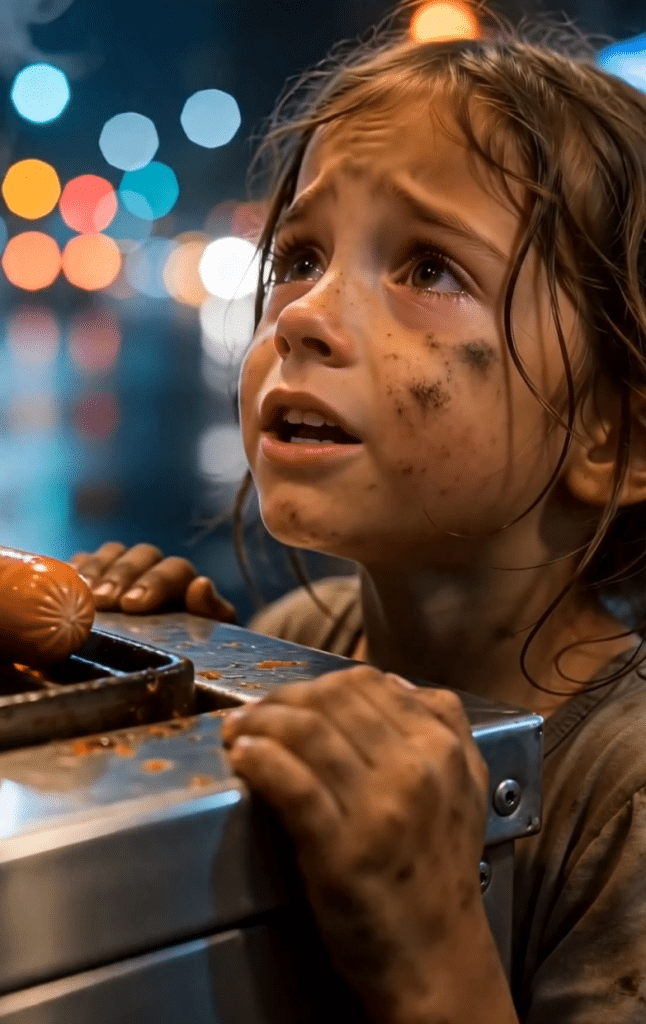
The girl was so small she could barely see over the metal counter.
Rain slid down her tangled brown hair and gathered at the ends like tiny beads of glass. Her olive-gray dress clung to her knees, stained from pavement and old dust. Both of her hands were smudged dark, but she held them carefully against the hot dog stand as if touching anything too hard might make someone yell.
Steam hissed from the grill.
Behind the cart, Maggie Reyes paused with a pair of tongs in her hand.
The city around them kept moving. Tires whispered over wet asphalt. Office workers hurried past beneath black umbrellas. A couple laughed outside a theater awning, their coats expensive enough to buy a month of groceries for someone else.
The girl looked up at Maggie with wide, watery eyes.
“Please,” she said, her voice barely louder than the rain. “Could I get one hot dog?”
Maggie’s chest tightened.
She had sold food on that corner for nine years. She knew hungry people. She knew the difference between someone short on cash and someone who had counted every coin twice before finding the courage to ask.
The girl was not asking like a customer.
She was asking like a child who expected no.
Maggie leaned forward, softening her voice.
“Where are your parents, sweetheart?”
The girl lowered her head.
No answer.
Only the sound of rain tapping the metal cart.
Then, slowly, she opened one small palm.
Three silver coins lay there, wet and dull under the cart light.
Maggie stared at them.
Three coins.
Not enough for a hot dog. Not enough for half a hot dog. Not enough for anything except the humiliation of trying.
The girl’s fingers trembled as she held them out.
“I can pay,” she whispered.
Maggie swallowed hard.
She gently pushed the child’s hand back.
“No, baby,” she said. “Keep those.”
The girl blinked.
Maggie placed a hot dog into a fresh bun, added nothing that might make it messy, wrapped it in paper, and slid it across the counter.
“This one is for you,” Maggie said. “It’s on me today.”
The girl stared at the food.
“Really?”
“Really.”
For a moment, the child looked as if she might cry. But she did not. She gripped the hot dog with both hands and nodded once, solemn and grateful, like a tiny adult who had learned manners from sorrow.
“Thank you,” she said.
Then she turned and walked away without taking a single bite.
Maggie watched her go.
At first, she told herself the girl was shy. Maybe she did not want to eat in front of strangers. Maybe her parents were around the corner. Maybe there was a shelter nearby.
But the girl moved too quickly.
Not toward the bright subway entrance.
Not toward the warm lights of the restaurant district.
She slipped into the alley beside the old brick building where the trash cans stood and the streetlights barely reached.
Maggie removed her apron, stepped out from behind the cart, and followed.
She reached the alley entrance just in time to see the girl kneel beside a cardboard box.
A little boy sat there.
He could not have been more than three.
His clothes were too big, his face streaked with dirt, his small body folded against the cold brick like he was trying to disappear into it.
The girl unwrapped the hot dog and placed it in his hands.
“Eat, Benny,” she whispered.
The little boy bit into it with both hands holding the bread, chewing too fast, too desperate.
The girl watched him with a tender smile.
Her own stomach growled loudly enough for Maggie to hear from the corner.
Still, she did not take a bite.
She only brushed wet hair from her brother’s forehead and said, “Slow down. You’ll get more tomorrow.”
Maggie leaned against the brick wall.
Her hand flew to her mouth.
The rain blurred. The alley blurred. The whole city blurred until all she could see was that little girl smiling through hunger because her brother was eating.
Then the boy lifted his head and said something that made Maggie’s blood go cold.
“Lily,” he whispered, “when is Mama coming back?”
Act II
The little girl’s name was Lily.
Maggie learned that ten minutes later, after she returned to the cart, made three more hot dogs, poured hot chocolate into two paper cups, and walked into the alley with her hands raised so she would not frighten them.
The boy hid behind Lily at first.
Lily stood in front of him with the hot dog wrapper still clenched in her fist, her chin lifted like a soldier guarding a gate.
“We didn’t steal,” she said quickly.
“I know,” Maggie replied. “I brought more.”
Lily’s eyes flicked to the food.
Then away.
Suspicion was stronger than hunger. That broke Maggie more than the hunger itself.
“What’s your name?” Maggie asked gently.
The girl hesitated.
“Lily.”
“And him?”
“Benny.”
The little boy peeked around her dress.
Maggie crouched low, careful not to come too close.
“Hi, Benny.”
He said nothing, but his eyes fixed on the food.
Lily noticed and stepped aside.
Only then did Maggie see how thin the child was beneath the oversized rags. How Lily kept one hand near his shoulder, ready to pull him back. How both children flinched whenever a car door slammed on the street.
Maggie gave them the food.
This time, Lily tried to hand Benny both hot dogs.
Maggie stopped her softly.
“One for him. One for you.”
Lily looked confused.
“I’m okay.”
“No,” Maggie said, and her voice cracked despite her effort to keep steady. “You’re not.”
Something in Lily’s face changed.
For one second, she looked six years old.
Not brave. Not careful. Not responsible for anyone.
Just six.
Then she took the hot dog and ate in tiny bites, as if afraid the food would vanish if she wanted it too much.
Maggie sat on an upside-down crate in the rain, her gray hoodie damp at the shoulders, her red apron darkened with water. She had a whole cart waiting on the corner, customers probably wondering where she had gone, but none of that mattered.
“Where do you sleep?” she asked.
Lily pointed deeper into the alley.
“There’s a door with a broken lock. We go there when it gets too cold.”
Maggie closed her eyes for a moment.
“And your mama?”
Lily stopped chewing.
Benny looked down at his cup.
“She went to get help,” Lily said.
“When?”
The girl’s lips pressed together.
“Before the snow.”
It was December now.
The first snow had fallen three weeks ago.
Maggie felt something heavy settle in her chest.
“What’s her name?”
“Anna,” Lily said.
Maggie froze.
It was not an uncommon name. She knew that. The city was full of Annas. There was no reason for her heart to start pounding the way it did.
Still, she asked, “Anna what?”
Lily looked uncertain.
“Mama said not to tell strangers our last name.”
“That’s smart,” Maggie whispered.
Lily looked down at her dirty shoes.
“But she wrote it in the blue notebook. In case we got lost.”
Maggie’s pulse quickened.
“What blue notebook?”
Lily reached into the cardboard box and pulled out a small plastic grocery bag. Inside were the children’s treasures: a cracked toy car, half a packet of tissues, a comb with missing teeth, and a blue notebook wrapped in another bag to keep it dry.
Lily held it protectively.
“Mama said this is important.”
Maggie did not touch it.
“What does it say?”
Lily opened the first page.
The writing was neat but rushed.
If anything happens to me, my children are Lily and Benjamin Hale. Their father is not to be trusted. Please call Grace Whitman.
The name struck Maggie like a hand against the chest.
Grace Whitman.
For a moment, she could not breathe.
Lily watched her carefully. “Do you know her?”
Maggie’s eyes filled.
“Yes,” she whispered. “I know her.”
Grace Whitman was Maggie’s older sister.
And Grace had been searching for Anna Hale’s children for almost two months.
Act III
Anna Hale had once worked two blocks away from Maggie’s cart, in the kitchen of a luxury hotel where rich guests complained if the soup was not hot enough.
She was quiet, pretty, and always tired in the way single mothers often are when they cannot afford to collapse. Maggie knew her only in passing at first. Anna bought coffee from the cart on early mornings and sometimes saved half a bagel in her purse “for later.”
Later, Maggie learned, usually meant Lily.
Grace Whitman knew Anna better.
Grace ran a small family legal clinic near the courthouse. She helped women escape dangerous homes, fight illegal evictions, recover stolen wages, and navigate systems designed to exhaust them before justice could arrive.
Anna had come to Grace with a bruise hidden under makeup and a folder full of documents.
Not just custody papers.
Bank records.
Photographs.
Threatening messages.
A birth certificate for Benjamin that did not list the right father because Anna had been too afraid to name him.
The man’s name was Victor Lang.
He owned three restaurants, two apartment buildings, and enough friends in expensive suits to make people lower their voices when talking about him. He had never married Anna, but he had controlled her anyway: her rent, her schedule, her phone, her fear.
When Anna tried to leave, Victor told her no one would believe a hotel dishwasher over a businessman.
Grace believed her.
She prepared an emergency custody petition. She arranged a safe apartment. She even bought two stuffed animals for Lily and Benny so the new place would not feel empty.
Then Anna disappeared.
So did the children.
Victor claimed Anna had run off with them for attention. He told police she was unstable. He produced messages that made her look reckless, desperate, confused.
Grace did not believe him.
But suspicion was not proof.
For seven weeks, she called shelters. Hospitals. Schools. Churches. Morgues. She taped flyers to laundromat windows until her fingers went numb. Maggie helped after closing the cart, walking alleys with a flashlight and a photo Grace had printed from Anna’s file.
A little girl with tangled brown hair.
A toddler with serious eyes.
The photo had been taken in summer. Clean faces. Bright shirts. Lily holding Benny’s hand at a playground.
Maggie had looked at that photo every day.
And still, when Lily stood at her cart in the rain, hunger had disguised her so completely that Maggie did not recognize her.
That guilt nearly knocked her to the ground.
She reached for her phone with shaking hands and called Grace.
Her sister answered on the second ring.
“Maggie?”
“I found them,” Maggie said.
Silence.
Then Grace’s voice broke. “What?”
“I found the kids.”
Within twenty minutes, Grace arrived in a cab, hair damp, coat half-buttoned, face white with shock. She entered the alley slowly, as if afraid any sudden movement might make the children vanish again.
Lily saw her and stepped back.
Grace dropped to her knees on the wet pavement.
“Lily,” she said softly. “Your mama told me about you.”
Lily stared at her.
“She said you were brave,” Grace continued. “She said you liked drawing birds. She said Benny won’t sleep unless someone hums.”
Benny’s face changed.
He tugged Lily’s dress.
“Mama hums,” he whispered.
Lily’s eyes filled, but she did not cry.
“Where is she?” Lily asked.
Grace could not answer.
Not there. Not yet.
Maggie saw it on her sister’s face and understood.
Anna had not abandoned them.
Something had happened.
Grace opened her arms, but she did not force the children into them. She simply waited in the rain, knees on the dirty pavement, until Lily took one small step forward.
Then another.
Finally, Lily fell against her.
Not like a child being rescued.
Like a child who had been holding up the sky and had finally found someone strong enough to help.
But when Grace opened the blue notebook, one page in the back revealed the truth Anna had died trying to protect.
Act IV
The last page was not a note.
It was a receipt.
Folded twice and hidden beneath the cardboard backing of the notebook, it showed a storage unit number in Queens and a date from the week Anna disappeared.
Grace took one look and whispered, “She left evidence.”
Maggie brought the children into the heated storage room behind her cart while Grace called the detective who had been quietly helping her. Lily refused to let go of the notebook. Benny fell asleep sitting up, a hot chocolate cup resting between both hands.
By midnight, the police had opened the storage unit.
Inside was a plastic bin sealed with duct tape.
Inside the bin was Anna Hale’s final act of courage.
There were copies of bank transfers from Victor Lang to a private security company. Photos of bruised tenants from one of his buildings. A flash drive containing recordings of Victor threatening Anna if she took the children away. Most importantly, there was a handwritten statement signed by Anna and witnessed by a hotel coworker.
If I disappear, Victor Lang is responsible. He said he would make my children vanish before he let me take them.
Maggie stood outside the storage facility while Grace spoke to the detective. Rain dripped from the awning. Police lights painted the wet pavement red and blue.
Lily stood beside Maggie wearing a dry sweatshirt Grace had brought from her office.
“Is Mama in trouble?” Lily asked.
Maggie knelt.
“No, sweetheart.”
“Then why didn’t she come back?”
Maggie felt the answer rise like a stone in her throat.
Before she could speak, Grace returned.
Her face told Maggie everything.
Anna had been found two days earlier in a hospital outside the city under a false name, unconscious after being left near an emergency entrance. No identification. No phone. No way to tell anyone who she was.
But she was alive.
Grace said the word first.
“Alive.”
Lily stared at her.
Then the whole world seemed to pause around that one small child.
“She’s alive?” Lily whispered.
Grace nodded through tears.
“She’s alive.”
Lily made a sound Maggie would never forget.
It was not a sob exactly. It was hope breaking out of a place where hope had been locked too long.
Benny woke when Lily began crying.
“Mama?” he mumbled.
Lily grabbed his hand.
“Mama’s coming back.”
The next morning, Victor Lang was arrested in front of his flagship restaurant while photographers shouted questions he suddenly had no power to silence. He wore a black cashmere coat and the offended expression of a man who had never expected consequences to touch him in public.
For years, he had fed powerful people behind velvet ropes while children shivered outside his properties.
Now every camera caught his hands being guided behind his back.
Grace did not celebrate.
Maggie did not either.
There was too much damage for celebration.
But when Lily saw his face on the shelter office television, she moved closer to Maggie and whispered, “He can’t take Benny now?”
“No,” Maggie said. “He can’t.”
Two days later, Anna woke up.
The reunion happened in a quiet hospital room with pale curtains and a paper cup of melting ice chips on the table. Anna looked smaller than Lily remembered, her face thin, her lips dry, but when the door opened and her children stepped inside, something fierce returned to her eyes.
“Lily.”
The name came out broken.
Lily ran.
Benny followed half a second later.
Anna gathered both children into her arms with what strength she had, pressing her face into their hair, saying their names over and over as if each one pulled her further back into the world.
“I tried,” she cried. “I tried to come back.”
Lily clung to her.
“I saved him,” she said.
Anna looked at Benny, then at her daughter.
Her face folded with pride and grief.
“I know,” she whispered. “My brave girl. I know.”
Maggie stood near the doorway, wiping her face with the sleeve of her hoodie.
Grace touched her shoulder.
And for the first time since the alley, Maggie allowed herself to believe the children might not have to be brave forever.
Act V
By spring, the hot dog cart had a new sign taped beside the menu.
Kids eat free. No questions asked.
Maggie wrote it in black marker after the third child came by with pockets full of coins and fear in his eyes. At first, she worried people would take advantage. Then she decided she would rather be fooled by ten people than fail one hungry child who needed her to believe them.
Anna and the children moved into an apartment above Grace’s legal clinic.
It was small. The radiator clanged at night. The kitchen tiles were old. But the door had three locks, the windows faced the morning sun, and Benny had a bed shaped like a race car donated by one of Grace’s clients.
Lily chose the bed closest to the door.
No one argued with her.
Healing did not arrive like a parade.
It came in fragments.
Benny stopped hiding bread under his pillow after Anna promised there would be breakfast every morning. Lily stopped waking at every siren after Maggie gave her a little red flashlight and told her she was allowed to turn it on whenever the dark felt too big.
Anna went to court.
Victor Lang’s lawyers tried to paint her as unstable. They brought up poverty. They brought up her job. They brought up every desperate decision she had made while trying to survive a man with money.
Then Grace opened the blue notebook.
She read Anna’s words aloud.
She played the recordings.
She showed the judge the storage unit receipt, the threatening messages, the false police statement, and the photos of Lily and Benny taken after they were found in the alley.
The courtroom changed after that.
Not dramatically.
No one gasped like in movies.
But people stopped looking at Anna like a problem and began looking at her like a mother who had been hunted through a system built to doubt her.
Victor lost custody rights that day.
Then he lost his restaurants.
Then, slowly, he lost the story he had spent years buying.
Maggie did not attend every hearing. She had a cart to run. Rent to pay. Customers to serve. But on the day Anna walked out of court with both children legally and permanently protected, Maggie closed early.
She hung a paper sign on the cart.
Family emergency.
Then she crossed the city with a bag full of hot dogs wrapped in foil.
They ate them in Grace’s office around a folding table.
Benny got mustard on his shirt. Lily laughed for the first time without covering her mouth. Anna cried when no one was looking, and Maggie pretended not to see because some tears deserve privacy.
Later, Lily came to stand beside Maggie at the window.
Below them, the city glowed through light rain.
“That night,” Lily said quietly, “I was going to ask someone else if you said no.”
Maggie looked down at her.
“But I was scared.”
“You still asked.”
“Benny was hungry.”
Maggie’s eyes burned.
“You were hungry too.”
Lily shrugged with the old seriousness that made her look far older than six.
“He’s littler.”
Maggie crouched in front of her.
“Listen to me,” she said. “You did something very brave. But you should never have had to.”
Lily looked away.
For a moment, Maggie thought she might retreat into silence.
Then Lily reached into her pocket and pulled out three silver coins.
The same three coins from the night at the cart.
She placed them in Maggie’s hand.
“I saved them,” Lily said.
Maggie stared at them.
“They’re yours, sweetheart.”
Lily shook her head.
“I want to pay now.”
Maggie closed her fingers around the coins and felt the full weight of them.
Not money.
Memory.
A record of a child standing in the rain, trying to buy food for her brother with everything she had.
Maggie went to the cart the next morning and taped the three coins beneath the counter where only she could see them.
Whenever she was tired, she touched them.
Whenever a customer complained too loudly about onions or weather or waiting thirty seconds too long, she touched them.
Whenever a child lingered near the steam with hungry eyes, she remembered.
Years later, people in the neighborhood would say Maggie’s cart was famous because the food was good.
That was only partly true.
It was famous because no child was ever turned away.
Because a lawyer’s office upstairs kept emergency blankets behind the door.
Because Anna Hale, once strong enough, began volunteering there three afternoons a week, helping other mothers fill out forms with hands that no longer shook.
Because Benny grew round-cheeked and loud, racing toy cars along the sidewalk while Maggie shouted for him not to run too close to the curb.
Because Lily, still watchful but no longer hollow-eyed, learned to eat first sometimes.
On the anniversary of that rainy night, Maggie closed the cart early and cooked dinner for everyone behind Grace’s office.
Nothing fancy.
Hot dogs, soup, bread, cocoa.
Lily sat beside Benny, still tearing his bread in half out of habit until Anna gently placed another roll on her plate.
“You can have a whole one,” Anna said.
Lily looked at it.
Then at her mother.
Then she smiled.
Outside, rain tapped against the windows, soft and steady.
The city corner below shone with blurry lights. The alley was still there, narrow and dark between two brick buildings. But it no longer owned the ending of their story.
Maggie looked at Lily across the table and thought of the child who had stood at her cart with three coins and a trembling voice.
Please, could I get one hot dog?
One small question.
One free meal.
One decision to follow.
That was how a hidden family had been found.
That was how a mother had been brought back.
That was how a little girl who had given away her only food finally learned that love did not always mean going hungry.
Sometimes, love meant someone seeing you in the rain.
And refusing to look away.