Act I
The glass doors opened without a sound, but every head in the executive suite turned.
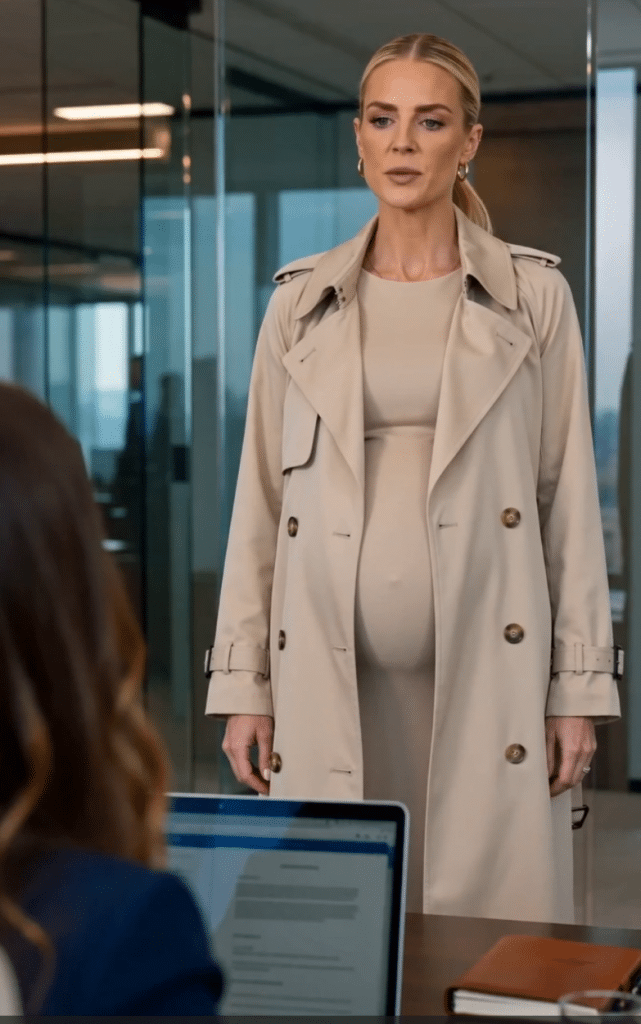
There was something about the woman in the beige trench coat that made people stop typing. Maybe it was the way she moved, slow and controlled, as if every step had already been decided hours ago. Maybe it was the gold hoops at her ears, the neat blonde ponytail, the expensive calm on her face.
Or maybe it was the fact that she was heavily pregnant, one hand resting lightly beneath her stomach, while her eyes scanned the room like she already knew someone had lied.
Behind the dark wooden desk near the corner office, a brunette woman looked up from a laptop.
She was pregnant too.
For one long second, neither of them spoke.
The office was too clean for the moment about to happen. Too polished. Too silent. Sunlight poured through floor-to-ceiling windows, turning the city skyline into a glittering backdrop of steel and glass. On the desk sat a leather-bound notebook, a half-empty glass of water, and a silver nameplate that read:
Benjamin Carter, CEO.
The blonde woman stopped in the doorway.
Her gaze moved from the nameplate to the woman behind the desk, then lower.
To the maternity top.
To the curve beneath the navy blazer.
Something passed over her face, but only for a second. Pain, perhaps. Or rage.
Then it vanished.
“I’m Mr. Benjamin’s wife,” she said, her voice crisp enough to cut through the glass walls. “Are you his secretary?”
The brunette froze.
Her lips parted, but no answer came. Her fingers trembled over the keyboard. Then her face crumpled, as if the question had struck something deep and already broken.
“No,” she whispered.
A tear slid down her cheek.
The blonde woman did not blink.
The brunette pressed one hand to her mouth, trying to hold herself together, but it was useless. Her shoulders shook. Her eyes filled so quickly it looked almost painful.
“No,” she said again, louder now, her voice breaking. “I’m his girlfriend.”
The air changed.
Somewhere beyond the glass partition, a printer stopped humming. A junior associate lowered a folder. Someone in a nearby conference room turned his head, pretending not to listen and failing.
The blonde woman stood perfectly still.
Only her eyes moved.
They dropped again to the other woman’s stomach.
“You’re carrying his child too?”
The brunette gave a small, helpless nod.
“Yes,” she cried. “He lied to us both.”
The wife absorbed the words like a woman taking a bullet in public and refusing to fall.
Her jaw tightened. Her fingers curled once at her side. But she did not scream. She did not slap the desk. She did not collapse into the kind of scene people in offices whispered about for years.
Instead, she looked past the crying woman.
Toward the inner office.
The door at the end of the glass corridor was shut.
“Is he in his office?” she asked.
The brunette stood slowly, revealing the full shape of her pregnancy. Her knees seemed unsteady beneath her white trousers. She wiped her face with the heel of her hand, shame and devastation fighting across her expression.
“Yes,” she said. “He told me you were divorced.”
For the first time, the wife’s mouth moved into something almost like a smile.
But there was no warmth in it.
Only contempt.
“Bastard.”
Then she turned and walked down the corridor toward her husband’s door.
And behind that door, Benjamin Carter was about to lose more than two women.
Act II
For three years, Benjamin Carter had built his empire on the belief that no one ever checked the fine print.
He sold confidence better than he sold software. Investors trusted his handshake. Employees copied his tone. Journalists called him “the rare CEO who understood both numbers and people,” and Benjamin smiled for every magazine cover as if he had invented sincerity himself.
At home, he was different.
Not cruel, exactly. Not at first.
Just absent in the way powerful men learn to be absent while still expecting to be adored.
His wife, Claire, had once admired his ambition. She had met him before the skyline office, before the interviews, before the tailored suits and boardroom dinners. Back then, Benjamin had worked from a cramped apartment with secondhand furniture and a cracked phone screen. Claire was the one who paid the rent when his first company nearly collapsed. Claire was the one who read contracts at two in the morning while he paced the kitchen, promising that one day they would have everything.
And for a while, she believed him.
She believed him when he said the late nights were necessary.
She believed him when he stopped coming home for dinner.
She believed him when he kissed her forehead and told her not to worry about the rumors, because jealous people always invented stories about successful men.
Then she became pregnant.
For a week, Benjamin was radiant. He cried when she showed him the test. He bought tiny shoes in a box wrapped with a silver ribbon. He pressed his ear to her stomach before there was anything to hear.
Then the distance returned.
Only this time, Claire noticed the small things.
A second phone he said belonged to the company.
A receipt from a hotel restaurant on a night he claimed to be at a board retreat.
A woman’s perfume on his scarf, soft and expensive, clinging to the wool like a confession.
Claire did not confront him immediately.
That was not her way.
Her father had raised her with one rule: never ask a question until you can survive the answer.
So she waited.
She watched.
And then, one rainy Thursday morning, a plain envelope arrived at her apartment with no return address.
Inside were printed screenshots.
Messages.
Photos.
Calendar invitations.
And one sonogram image with the name “Maya Bennett” printed at the top.
Claire sat at the kitchen island for a long time after reading them. The city outside blurred behind the rain. Her tea went cold. The baby shifted inside her, a small, living reminder that whatever happened next, she was no longer only protecting herself.
Maya Bennett.
Claire searched the name.
Not a secretary.
Not some stranger from a bar.
Maya was Benjamin’s head of investor relations. Harvard-educated, praised in industry panels, photographed beside him at conferences while Claire stayed home under doctor’s orders.
Every article called her brilliant.
Every photo showed her looking at Benjamin like he was the safest place in the room.
That was the part that hurt Claire most.
Not that Benjamin had betrayed her.
But that he had lied beautifully enough to make another woman believe she was loved.
So Claire did what Benjamin never expected her to do.
She dressed carefully. Beige trench coat. Matching maternity dress. Gold hoops. Low heels. Nothing dramatic. Nothing messy. She wanted the office to remember her exactly as she arrived: calm, polished, and impossible to dismiss.
She drove herself downtown, parked beneath the tower, and rode the elevator to the forty-second floor without once touching the envelope in her bag.
At reception, no one stopped her.
Why would they?
Her face had been in old company photos. Her signature was buried in early incorporation documents. Her money had helped keep the first servers running when Benjamin still told people they were “bootstrapping.”
But as she stepped into the executive suite and saw Maya behind the desk, Claire understood something the envelope had not prepared her for.
Maya was not smirking.
She was not triumphant.
She was not the other woman Claire had imagined in the darkest hours of the night.
She looked tired. Frightened. Alone.
And pregnant enough that the lie had not been casual.
It had been constructed over months.
Maybe years.
That was when Claire’s anger shifted.
It did not soften. It sharpened.
Because this was no longer just an affair.
This was a pattern.
And Benjamin had counted on both women being too humiliated to stand in the same room.
He had made one mistake.
He underestimated what happens when the women he lied to stop blaming each other.
Act III
Benjamin’s office door was made of smoked glass, expensive enough to turn a man inside it into a shadow.
Claire did not knock.
She opened it.
Benjamin Carter stood near the window with his phone pressed to his ear, one hand in his pocket, the skyline spread behind him like a kingdom he believed he owned. His charcoal suit fit perfectly. His hair was neat. His watch flashed at his wrist.
He turned, irritated at first.
Then he saw his wife.
His expression tightened.
“I’ll call you back,” he said into the phone.
Claire stepped inside and left the door open behind her.
That detail mattered.
Everyone in the corridor could hear.
Benjamin glanced past her and saw Maya standing near the desk outside, crying openly now. His eyes flicked between them, calculating damage before emotion.
“Claire,” he said carefully. “This is not the place.”
“No,” Claire replied. “This is exactly the place.”
His jaw flexed.
He lowered his voice. “You’re upset. I understand. But we need to talk privately.”
“You had privacy,” she said. “You used it to build two lives.”
Maya appeared in the doorway then, one hand braced against the glass frame. Her face was pale, but something in her had changed. The helplessness was still there, but underneath it was the first flicker of anger.
“You told me she left you,” Maya said.
Benjamin’s eyes hardened for a second before he disguised it.
“Maya, you’re emotional.”
She flinched at the word.
Claire saw it.
Of course he used that word. Men like Benjamin loved that word. It turned pain into weakness. It turned betrayal into inconvenience.
“Don’t,” Claire said.
Benjamin looked back at her. “You don’t know the whole story.”
That almost made Claire laugh.
Instead, she reached into her bag and pulled out the envelope.
“I know enough.”
She tossed the papers onto his desk. They spread across the polished wood like evidence at a trial: messages, hotel receipts, medical appointment reminders, wire transfers, photographs of Benjamin and Maya leaving private dinners together.
Benjamin stared at them.
For once, he had no immediate answer.
Then he recovered.
“You had me followed?”
“No,” Claire said. “Someone sent them to me.”
That was when Benjamin truly changed.
Not fear. Not yet.
Recognition.
His eyes moved to the last page, half hidden beneath the others. A document printed on old company letterhead, dated five years earlier.
Claire had not understood it when she first opened the envelope. It looked like a routine equity agreement. But at the bottom, her signature appeared beside Benjamin’s.
Only she had never signed it.
The agreement transferred a large portion of her founder shares into a holding company controlled by Benjamin.
She had spent the night reading every line.
Then she called the attorney her father used before he died.
By morning, she knew.
The affair was ugly.
The pregnancy was painful.
But the forged document was the loaded gun.
“Claire,” Benjamin said softly. “That’s old paperwork.”
“It’s fraud.”
His eyes snapped up.
Maya stopped crying.
“What?” she whispered.
Claire did not look away from her husband.
“You forged my signature after my father died,” she said. “You moved my shares before Series B. You told me the dilution was normal. You told me I didn’t understand venture finance. You smiled at me across our dining table while stealing the only part of this company that still had my name on it.”
Benjamin’s face flushed.
“That is not what happened.”
“Then explain why the notary listed on that agreement died six months before the date on the document.”
Silence.
This time, it was not just the executive suite that went quiet.
It felt as if the entire floor stopped breathing.
Maya looked at Benjamin as if seeing a stranger step out of his skin.
“You told me Claire was unstable,” she said slowly.
Benjamin turned toward her. “Maya—”
“You told me she tried to ruin you.”
“She did try to ruin me,” he snapped.
The mask slipped so quickly that several people outside the office visibly recoiled.
Claire’s hand moved to her stomach, not in fear, but to steady herself.
“There he is,” she said quietly.
Benjamin caught himself. Smoothed his tie. Looked through the glass walls at the employees pretending not to watch.
“You’re making a scene,” he said.
Claire looked at the framed magazine cover on his wall.
Benjamin Carter: The Man Who Built Trust Into Technology.
Then she looked back at him.
“No,” she said. “I’m ending one.”
But the envelope had one more page Benjamin had not seen yet.
And that page came from Maya.
Act IV
Maya did not know she had been part of the envelope.
Not until Claire turned and held out a folded sheet of paper.
“Did you write this?” Claire asked.
Maya stared at it, confused.
Then she saw the first line.
Her face went still.
Benjamin’s head turned sharply. “What is that?”
Maya did not answer him.
She took the page with trembling fingers.
It was a letter she had written three weeks earlier and never sent. A letter to Benjamin, saved in a draft folder on her work computer after he pressured her to take medical leave and disappear until “things settled.”
Claire had found it printed at the bottom of the anonymous package.
Maya read her own words silently at first.
Then aloud.
“You said you would tell the board after the merger. You said Claire knew. You said your marriage was over except for legal paperwork. But every time I ask for proof, you make me feel cruel for asking. I don’t want money. I don’t want headlines. I just want my child not to be born into a lie.”
Her voice broke on the last sentence.
Benjamin moved around the desk. “Enough.”
Maya stepped back.
Claire stepped between them.
It was a small movement, but everyone saw it.
The wife shielding the girlfriend from the husband who had betrayed them both.
Benjamin laughed once, bitterly. “This is absurd. You two think you can walk in here and threaten me with private documents? Do you understand what happens if this goes public? The stock drops. People lose jobs. Investors panic. You want to destroy everyone because your feelings are hurt?”
Claire’s face did not change.
“There it is again,” she said. “Feelings.”
Maya wiped her face. Her voice was quiet, but steadier now.
“You told me to sign an NDA yesterday.”
Benjamin went still.
Claire turned to her.
Maya swallowed. “He said it was standard. For the transition. He said if I loved him, I wouldn’t make things difficult.”
Claire’s eyes narrowed. “Did you sign?”
Maya shook her head.
For the first time that morning, something like relief passed across Claire’s face.
Benjamin saw it and understood too late.
The women were no longer speaking as rivals.
They were comparing notes.
And every note led back to him.
“You both need to calm down,” he said.
“No,” Maya said.
The word surprised even her.
She stood a little taller.
“No, I don’t think I do.”
Benjamin’s stare turned cold. “Be careful.”
Claire smiled faintly.
Not because it was funny.
Because he had just made another mistake.
The open door.
The glass walls.
The employees.
The general counsel, who had appeared at the far end of the corridor with a folder in her hand and horror on her face.
“Threatening a pregnant employee in front of witnesses,” Claire said. “That’s a choice.”
Benjamin looked toward the corridor.
His control began to fracture.
“Everyone get back to work,” he barked.
No one moved.
Then the elevator doors opened behind them.
A gray-haired woman in a black suit stepped out with two security officers and a man carrying a slim briefcase.
Benjamin’s face drained.
Claire turned.
“Mrs. Whitmore,” she said.
Maya looked confused.
Benjamin looked trapped.
Evelyn Whitmore was the chairwoman of the board. She rarely came to the office without warning. She preferred private calls, quiet influence, signatures on documents that changed lives without ever raising her voice.
That morning, she walked straight through the executive suite as if she had been expected.
Because she had.
Claire had called her from the parking garage.
Evelyn stopped at Benjamin’s open door and looked at the papers scattered across his desk.
Then at Maya.
Then at Claire.
Finally, at Benjamin.
“I received copies,” Evelyn said.
Benjamin’s mouth opened.
She lifted one hand.
“Do not insult me by improvising.”
The sentence landed with more force than shouting.
The man with the briefcase stepped forward. “Mr. Carter, the board has initiated an emergency review pending allegations of document fraud, coercion, and misuse of corporate resources.”
Benjamin stared at Claire.
“You did this.”
Claire held his gaze.
“No. You did this. I just stopped being quiet about it.”
His face twisted. “After everything I built?”
Evelyn’s eyes were ice.
“You built it with her money, her labor, and apparently her forged signature.”
That was when Benjamin lost the room.
Not legally. Not fully.
That would take lawyers, depositions, forensic audits, and months of public unraveling.
But power is not always lost in court.
Sometimes it leaves all at once, in the eyes of the people who used to fear you.
Benjamin looked through the glass walls and saw his employees staring back.
Not with loyalty.
Not with admiration.
With recognition.
The empire had cracked.
And everyone had heard the sound.
Act V
By noon, Benjamin Carter was escorted out of his own office without handcuffs, without shouting, without the dramatic collapse he deserved.
That almost made it worse.
He walked past the desks with his chin raised, trying to look like a man temporarily inconvenienced by misunderstanding. But no one stood for him. No one rushed to defend him. No one followed him into the elevator.
Claire watched from the corridor, one hand beneath her stomach.
Maya stood beside her.
Neither woman spoke until the elevator doors closed.
Then Maya began to cry again.
Not loudly this time.
Quietly.
Exhausted tears. Humiliated tears. The kind that come after the danger passes and the body finally understands it survived the first wave.
“I’m sorry,” Maya whispered.
Claire looked at her.
For a moment, the old pain flared. It would not vanish in a single morning. Betrayal never worked that neatly. There would be nights when Claire hated the sound of Maya’s name. There would be days when Maya hated herself for believing Benjamin’s lies. There would be lawyers, headlines, medical appointments, questions from strangers, and two children born into a story neither of them had chosen.
But standing in that glass hallway, Claire understood something with brutal clarity.
Maya had not stolen her husband.
Benjamin had stolen truth from both of them.
“You don’t owe me the apology he should be giving,” Claire said.
Maya covered her mouth.
Claire glanced toward the office where Benjamin’s name still sat on the desk.
“Besides,” she added, “we’re going to need each other.”
Maya looked up.
That was not forgiveness.
Not yet.
It was something harder.
An alliance.
Over the following weeks, the company moved faster than anyone expected. Evelyn Whitmore named an interim CEO. The forged documents were turned over to investigators. The board issued a statement so polished it barely resembled the chaos behind it, but the message was clear enough: Benjamin Carter had resigned pending inquiry.
Resigned.
That was the word powerful men often received when ordinary people would have been fired.
But Claire did not waste energy hating the word.
She focused on recovery.
Her shares were frozen during the review. Then restored. Then quietly increased as part of a settlement Benjamin’s attorneys begged her to keep private.
She did not.
Not completely.
She refused interviews, but she allowed one sentence through her lawyer:
“Truth is not a scandal. The cover-up is.”
It traveled farther than she expected.
Maya left the company before the baby came. Not because Benjamin wanted her hidden, but because she chose peace over proximity to the wreckage. Claire’s attorney helped review the NDA Benjamin had tried to pressure her into signing. It was unenforceable, predatory, and written with the arrogance of a man who had never imagined two women comparing documents.
When Maya’s daughter was born six weeks early but healthy, Claire sent flowers.
No note at first.
Then, after staring at the blank card for nearly ten minutes, she wrote:
She deserves a life without lies.
Three months later, Claire gave birth to a son.
She did not invite Benjamin into the delivery room.
He sent messages. Then gifts. Then legal threats disguised as concern.
Claire answered through counsel.
When the first custody hearing arrived, Benjamin entered the courthouse in a navy suit, still handsome, still composed, still convinced that charm could polish anything.
Then he saw Maya sitting beside Claire.
Not behind her.
Not beneath her.
Beside her.
Both women had their attorneys. Both had records. Both had messages. Both had learned the dangerous comfort of being believed.
Benjamin’s lawyer requested privacy.
The judge granted only what the law required.
Outside the courthouse, cameras waited behind barricades. Claire hated them. Maya hated them more. But neither woman lowered her head as they walked out.
A reporter shouted Benjamin’s name.
Another shouted Claire’s.
Then someone asked Maya if she regretted coming forward.
Maya stopped.
Claire looked at her, surprised.
For a second, Maya seemed like she might break again. Then she looked into the cameras with tired, steady eyes.
“I regret trusting the wrong person,” she said. “I don’t regret telling the truth.”
The clip played everywhere by evening.
Benjamin’s reputation did not explode.
It dissolved.
There was no single headline that ended him. No one dramatic confession. No viral apology good enough to save the image he had spent years manufacturing.
Just document after document.
Witness after witness.
Woman after woman remembering the way he made them doubt themselves.
The company survived.
That bothered him most.
It continued without his name on the door, without his portrait in the lobby, without employees lowering their voices when he walked by.
Months later, Claire returned to the forty-second floor for a board meeting.
She wore black this time. Her son slept at home with her mother. The office had changed in small ways. Benjamin’s nameplate was gone. The leather-bound notebook was gone. The desk had been moved closer to the window.
In the glass, Claire caught her reflection and almost did not recognize herself.
Not because she looked different.
Because she looked unafraid.
As the meeting ended, Evelyn Whitmore asked her to stay behind.
“There’s something you should know,” Evelyn said.
Claire braced herself.
But Evelyn only slid a folder across the table.
Inside was a copy of the company’s amended founder history, prepared for the upcoming annual report.
For years, every public version had begun with Benjamin.
His idea.
His risk.
His vision.
This one began differently.
It began with Claire.
Her early investment. Her legal work. Her role in saving the company before anyone knew its name.
Claire read the first paragraph twice.
Then a third time.
Her eyes burned, but she did not cry.
Not there.
Not in the room where her husband once tried to erase her.
Evelyn stood by the window, looking out at the skyline.
“He stole more than shares,” she said. “We can’t give all of it back. But we can stop repeating the lie.”
Claire closed the folder carefully.
For the first time in a long time, the silence did not feel like something forced upon her.
It felt like space.
A place to begin again.
Downstairs, outside the tower, Maya waited near the curb with a stroller. Her daughter slept beneath a pale blanket, one tiny hand curled near her cheek.
Claire smiled despite herself.
Maya looked nervous. She always did when they met, as if waiting for the day Claire might decide the alliance had been temporary.
But Claire only stepped beside her and looked down at the baby.
“She’s beautiful,” Claire said.
Maya’s face softened.
“So is your son,” she replied. “He has your eyes.”
For a moment, they stood together beneath the enormous glass building that had once held all of Benjamin Carter’s secrets.
Then Claire looked up at the forty-second floor.
The sunlight hit the windows so sharply they seemed almost white.
“He thought this place made him untouchable,” Maya said.
Claire adjusted her coat.
“No,” she said. “He thought silence did.”
Then the two women turned away from the tower and walked into the city, not as friends exactly, not yet as family, but as something Benjamin had never planned for.
Witnesses.
Mothers.
Survivors of the same lie.
And behind them, high above the street, the office where everything had shattered gleamed quietly in the afternoon sun.