Act I
The diner went quiet for exactly three seconds.
Long enough for everyone to hear the humiliation.
The elderly woman stood near the entrance trembling beneath the warm yellow lights, clutching the edges of her worn brown cardigan as though it were the only thing holding her together. Outside, rain streaked softly across the glass windows. Inside, customers laughed over burgers and coffee without noticing her at first.
But they noticed when the waitress shouted.
“This isn’t a relief center!” the woman barked loudly. “Get out of here!”
Forks paused midair.
A few people glanced over.
Then, just as quickly, most returned to their meals. That was the strange thing about public cruelty. People preferred pretending it wasn’t happening.
The old woman lowered her head immediately.
No argument.
No anger.
Only shame.
A tear slid slowly down the deep lines of her face as she turned toward the door again, moving carefully like someone already expecting rejection before she ever asked.
Then another voice cut through the diner.
“Wait.”
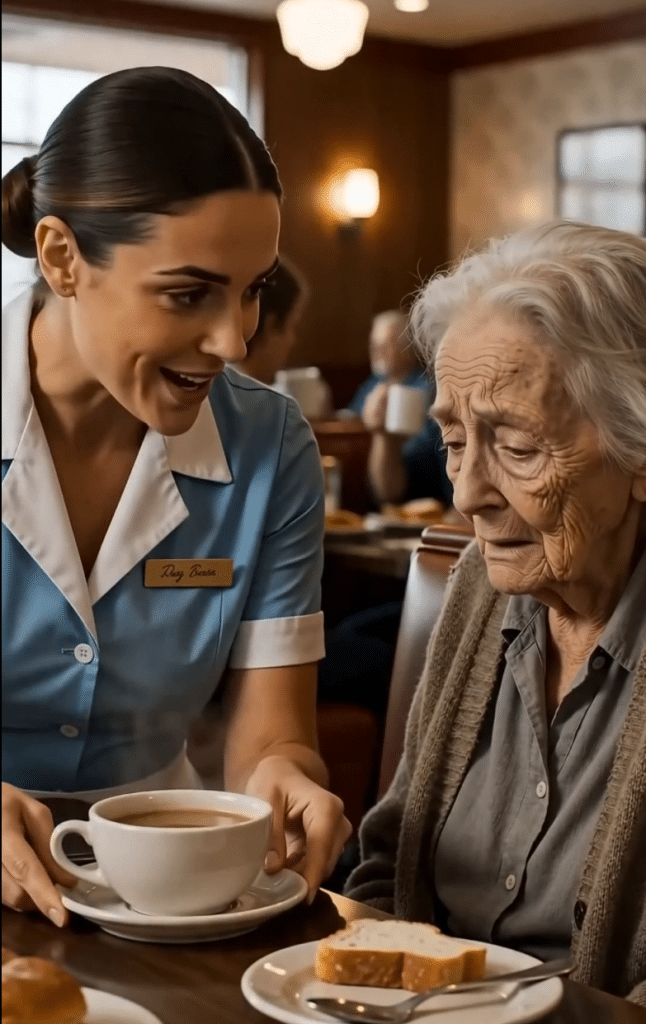
A younger waitress stepped forward quickly from behind the counter.
Her name tag read EMILY.
She placed a gentle hand on the old woman’s shoulder.
“I’m sorry,” she said warmly. “Please. Sit here.”
The rude waitress rolled her eyes. “Emily, don’t start.”
But Emily ignored her.
She guided the woman toward a quiet red leather booth near the back window while curious eyes followed them through the diner.
The elderly woman sat carefully, almost nervously, as though afraid touching the furniture might itself be a crime.
Emily disappeared briefly into the kitchen.
When she returned, she carried a steaming bowl of soup and fresh bread on a tray.
The smell alone nearly broke the old woman.
Emily set the bowl down gently.
“Here’s your meal,” she said with a sincere smile. “Don’t worry. It’s on me.”
The woman stared at her in disbelief.
“But… I don’t have any money.”
“That’s okay.”
For the first time all evening, the old woman’s eyes softened.
Not with relief.
With recognition.
And somehow, that frightened her more.
Act II
Emily had worked at the diner for six years.
Long enough to recognize every kind of hunger.
The loud kind.
The angry kind.
The embarrassed kind.
But the elderly woman carried a different kind entirely.
The kind that had learned silence because dignity was all it had left.
As the woman slowly lifted the spoon with trembling hands, Emily noticed details others ignored.
Her posture.
Her manners.
The way she folded the napkin carefully across her lap despite her shaking fingers.
Even the way she whispered “thank you” before every bite.
This wasn’t someone broken by laziness.
This was someone broken by life.
Across the diner, the rude waitress muttered under her breath while refilling coffee.
“She’ll probably ask for more.”
Emily shot her a look sharp enough to silence her.
But inwardly, Emily was distracted too.
Because something about the old woman felt strangely familiar.
Not her face exactly.
Her voice.
The softness of it.
Like a memory trying desperately to return.
Emily pushed the feeling aside and topped off her water glass.
The elderly woman looked up suddenly.
“You’re very kind,” she whispered.
Emily smiled gently. “My mother used to say kindness matters most when nobody else thinks it does.”
The spoon froze halfway to the woman’s mouth.
Her eyes lifted slowly.
“What did you say?”
Emily blinked. “My mom always said that.”
The old woman stared at her now with frightening intensity.
Not confusion.
Not curiosity.
Recognition.
A deep, painful recognition.
Emily shifted uncomfortably.
“Are you alright?”
The woman quickly lowered her gaze again.
“Yes,” she whispered. “I’m sorry. You just remind me of someone.”
Emily felt an unexpected ache in her chest.
Because she knew that feeling too.
She had spent most of her life being reminded of someone she could barely remember.
Her mother.
Or at least the shadow of her.
Emily had been raised in foster care since she was five years old. The official story was simple: abandoned after a financial collapse left her mother mentally unstable and homeless.
That was all the state records said.
No photographs.
No final goodbye.
Just paperwork.
Cold paperwork.
Emily rarely talked about it anymore because unanswered questions became exhausting after enough years.
Still…
Something about the woman’s eyes unsettled her deeply.
And then the woman reached slowly into her cardigan pocket.
“Please,” she said softly. “Take this.”
She handed Emily a small folded piece of paper.
Emily accepted it politely, expecting perhaps a thank-you note or scripture verse.
But the moment she unfolded it, the world tilted beneath her feet.
Because written in faded blue ink were six words that stopped her breathing instantly.
I never stopped looking for you.
Act III
Emily’s hand flew to her mouth.
The diner noise faded into a distant blur.
The handwriting.
She knew the handwriting.
Impossible.
Her knees nearly gave out as she stared at the paper again.
Beneath the sentence was a name.
Clara Bennett.
Her mother’s name.
The old woman watched her carefully now, tears gathering silently in her eyes.
“No…” Emily whispered weakly.
Customers nearby began noticing her reaction.
The rude waitress frowned from across the room. “What now?”
But Emily couldn’t hear anything clearly anymore.
She looked back at the elderly woman.
“Who are you?”
The woman’s lips trembled.
“My name is Clara.”
Emily’s chest tightened violently.
“That’s not possible.”
Clara nodded slowly through tears. “I know.”
Emily staggered backward into the booth seat across from her.
For years, she had imagined this moment a thousand different ways.
Anger.
Closure.
Questions.
But reality felt nothing like imagination.
Reality felt devastating.
“You abandoned me,” Emily whispered.
The words cut through Clara instantly.
“No,” she said firmly. “I lost you.”
Emily shook her head in disbelief.
“That’s not what the records said.”
“They lied.”
The diner around them grew quieter as nearby customers sensed something heavy unfolding.
Clara reached shakily into her cardigan again and pulled out an old photograph.
Emily recognized herself immediately.
Five years old.
Sitting on a woman’s lap beneath a summer tree.
Both smiling.
Emily’s vision blurred.
“I carried that every day,” Clara whispered. “Every shelter. Every church. Every city.”
Emily stared at the photo, stunned.
“My mother…” she whispered slowly. “She had a necklace in this picture.”
Clara’s trembling hand moved to her chest.
From beneath her blouse, she pulled a small silver pendant hanging from a chain.
Emily gasped.
The necklace.
The exact necklace from the photograph.
“I sold everything else trying to find you,” Clara said softly. “But I kept this because you used to hold it when you slept.”
Emily’s breath shattered.
Across the diner, even the rude waitress had stopped moving completely.
Clara wiped at her tears helplessly.
“The bank took our home after your father died,” she explained. “I worked three jobs. I tried to keep us together. But one night social services came while I was in the hospital.”
Emily listened in stunned silence.
“When I got out,” Clara whispered, “they told me you’d already been relocated.”
“Relocated where?”
“They wouldn’t say.”
Emily felt sick.
All those years.
All those birthdays.
All those nights believing she had simply not been wanted.
And now the truth sat across from her wearing a worn brown cardigan and trembling from hunger.
Act IV
Emily left work early that night.
Not because she wanted to.
Because she physically couldn’t continue pretending her world had not just exploded.
She sat with Clara in the diner booth for hours after the dinner rush ended.
Talking.
Crying.
Filling impossible gaps in each other’s lives.
Clara explained how homelessness swallowed people slowly at first.
One missed payment.
One illness.
One hospital bill.
Then suddenly society looked through you instead of at you.
“There were times I stood outside restaurants just smelling food,” Clara admitted quietly. “Tonight was the first time I finally asked.”
Emily’s heart broke all over again.
Because the cruelest part wasn’t poverty itself.
It was what humiliation did to human beings.
“How did you find me?” Emily asked.
Clara smiled weakly.
“I didn’t.”
Emily frowned.
Clara glanced toward the counter.
“I came in because I was hungry.”
Silence settled between them.
Pure chance.
After decades apart, hunger had led a mother back to her daughter.
Emily suddenly remembered the phrase she had repeated earlier.
Kindness matters most when nobody else thinks it does.
Her mother used to say that.
Not memory.
Not coincidence.
Memory buried so deeply it survived even abandonment, foster homes, and time itself.
Emily broke down completely then.
She moved across the booth and wrapped her arms around Clara carefully, like someone afraid the moment might disappear if held too tightly.
Clara sobbed against her shoulder.
“I’m sorry,” she whispered over and over. “I’m so sorry.”
Emily cried too hard to answer immediately.
Finally, she whispered the words Clara had waited decades to hear.
“You found me.”
Act V
Three weeks later, the diner looked very different.
Not physically.
Emotionally.
Because stories spread fast in places where people usually ignored each other.
Customers now recognized Clara immediately when she entered. Not as a burden. Not as a homeless woman.
As family.
The rude waitress avoided eye contact entirely after learning the truth. The memory of screaming at a starving mother moments before her reunion with her daughter haunted even her.
But Clara never sought revenge.
That surprised Emily most.
“You could hate her,” Emily admitted one afternoon.
Clara stirred her tea quietly.
“Hate already took enough years from me.”
Emily reached across the table and squeezed her hand.
Clara no longer looked invisible now. She had clean clothes. A small apartment arranged through local support services. Warm meals.
But more importantly, she had someone saying “Mom” again.
One evening after closing time, Emily helped wipe down the empty diner counters while Clara sat nearby sipping soup slowly.
The same soup.
Emily glanced at her mother and smiled softly.
“You know,” she said, “I almost didn’t stop you from leaving that night.”
Clara looked up.
“What changed your mind?”
Emily thought about it carefully.
Then she laughed quietly through tears.
“You looked lonely.”
Clara’s eyes filled instantly.
Outside, rain tapped gently against the diner windows just like it had the night they found each other again.
But everything had changed.
Because sometimes the smallest act of kindness doesn’t simply feed a stranger.
Sometimes it returns an entire life that was stolen by time.