Act I
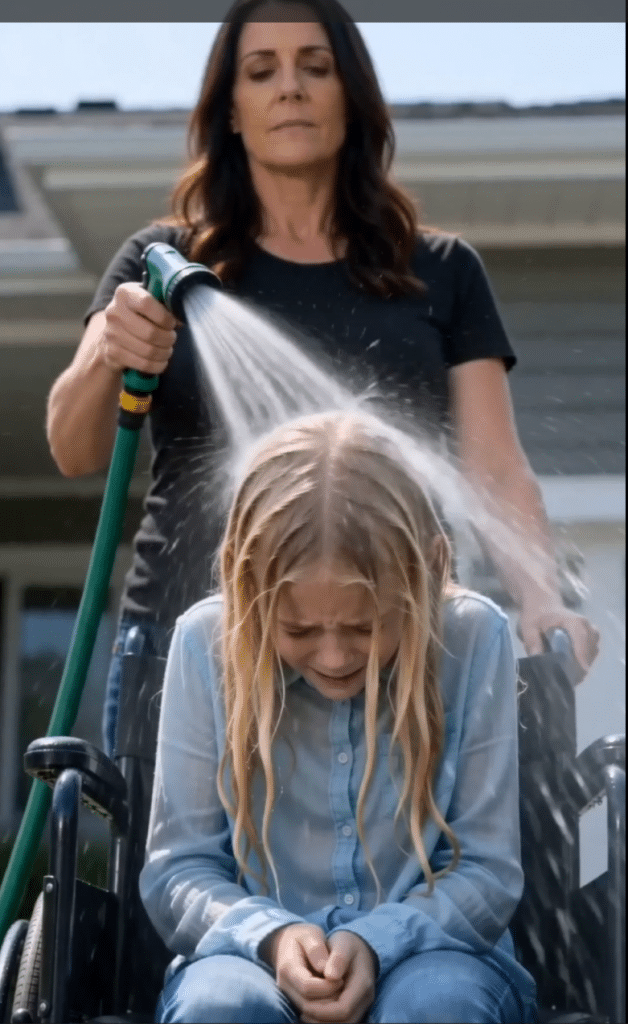
The first thing Daniel saw was water exploding across his daughter’s face.
For half a second, his mind refused to understand it.
Lily sat hunched in her wheelchair in the middle of the driveway, her blonde hair plastered to her cheeks, her blue shirt soaked through, her small hands clenched around the armrests.
Behind her stood Vanessa, holding the garden hose like she was watering flowers.
Not a child.
Not Daniel’s child.
A high-pressure stream struck the top of Lily’s head and ran down her face. She squeezed her eyes shut, shivering so hard the wheelchair trembled beneath her.
Daniel dropped his briefcase.
“What are you doing?!”
Vanessa turned slowly.
She did not look embarrassed. She did not even lower the hose.
“I’m washing your daughter.”
The words were so calm they sounded rehearsed.
Daniel crossed the driveway in three strides. He grabbed the hose from her hand and threw it onto the grass.
“Have you lost your mind?!”
Vanessa’s mouth tightened.
“She made a mess.”
Daniel turned toward Lily, ready to kneel, ready to wrap his jacket around her, ready to carry her inside.
But Lily did not reach for him.
She gripped the wheelchair harder.
Then, with water dripping from her chin and tears streaking her face, she began to push herself up.
Daniel stopped breathing.
Act II
For two years, Daniel had believed his daughter could not walk.
The accident had happened on a rainy Friday night. He remembered the hospital lights, the smell of antiseptic, the doctor’s careful voice, the way Lily’s tiny hand had felt inside his.
Her mother, Grace, had died that night.
Lily survived.
But after the funeral, she stopped standing.
The doctors said trauma could do strange things to the body. Vanessa, who had been Grace’s old friend, stepped in during those first terrible months. She cooked. She cleaned. She answered phone calls when Daniel could not speak.
And slowly, Vanessa became necessary.
Then she became permanent.
Daniel married her because he thought Lily needed a mother.
He did not see the way Lily flinched when Vanessa entered the room.
He did not notice how often the wheelchair was placed just out of reach of the window. How Lily’s physical therapy appointments were rescheduled. How her school counselor’s calls never reached him.
Vanessa always had an explanation.
“She’s tired.”
“She had a bad morning.”
“She doesn’t want to talk about it.”
And Daniel, drowning in grief and work and guilt, believed her.
Because believing her was easier than admitting he had brought danger into his home.
But on that driveway, as Lily lifted herself inch by inch from the wheelchair, every excuse shattered at once.
Her legs shook.
Her face twisted with effort.
But she stood.
And Daniel whispered the only thing his heart could bear.
“No…”
Act III
Lily swayed in front of the wheelchair, soaked and trembling.
Daniel reached for her, but she shook her head.
“Don’t,” she whispered.
Her voice was small.
But it carried.
Vanessa’s face changed.
For the first time, fear crossed it.
“Lily,” she said sharply. “Sit down.”
The command hit the air like a locked door.
Daniel turned.
“Why would you say that?”
Vanessa opened her mouth, but Lily spoke first.
“Because she knows.”
Daniel looked back at his daughter.
Lily’s knees trembled so badly he thought she might fall, but she stayed upright.
“She knows I can walk.”
The neighborhood seemed to go silent.
A car passed somewhere behind them. A dog barked once. Water continued to hiss from the hose lying on the grass.
Daniel’s voice came out rough.
“How long?”
Lily swallowed.
“Since last winter.”
His chest tightened.
Last winter.
Six months of carrying her to bed. Six months of worrying over medical bills. Six months of watching his daughter stare at other children running down the sidewalk.
Vanessa stepped forward.
“She’s confused.”
Lily flinched.
Daniel saw it.
That tiny movement did what her words could not.
It showed him the truth.
Vanessa had not been caring for Lily.
She had been controlling her.
And there was a reason.
Act IV
Daniel found the proof that night.
Not because Vanessa confessed.
She didn’t.
She packed a bag, called him unstable, said Lily was “acting out,” and threatened to have him investigated for neglect.
But Daniel was done being blind.
He searched the office after Lily finally fell asleep wrapped in three blankets. In the locked drawer of Vanessa’s desk, beneath insurance papers and old medical forms, he found a folder with Grace’s name on it.
Inside were therapy reports Daniel had never seen.
Progress notes.
Walking trials.
A letter from Lily’s specialist.
Your daughter has regained partial independent mobility. Continued therapy is strongly recommended.
The date was seven months old.
Daniel’s hands went numb.
Then he found the second file.
A trust document.
Grace had left money for Lily’s recovery. A lot of money. Enough for treatment, schooling, adaptive equipment, and long-term care.
But there was one condition.
The funds were controlled by Lily’s legal caregiver until Lily was declared independently mobile.
Daniel sat in the dark office, staring at the words.
Now it made sense.
The canceled therapy.
The missed calls.
The wheelchair.
The fear in Lily’s eyes.
Vanessa had not wanted Lily helpless because she believed it.
She had wanted her helpless because helpless paid.
And the cruelty in the driveway had not been a sudden loss of temper.
It had been punishment.
Because Lily had started trying to stand again.
Act V
The next morning, Daniel did not shout.
He did not give Vanessa another chance to explain.
He called Lily’s doctor. Then a lawyer. Then the police.
By noon, Vanessa was standing in the driveway again, but this time she was not holding a hose.
She was holding nothing.
Not control.
Not power.
Not the story she had built around a grieving father and a frightened child.
Lily sat on the porch steps with a blanket around her shoulders, her hand tucked safely in Daniel’s.
When the officer asked if she wanted to speak, Daniel bent close.
“You don’t have to.”
Lily looked at Vanessa.
Then she looked at the wheelchair beside the porch.
For two years, that chair had been treated like proof of weakness.
Now it looked like evidence.
“She told me if I walked,” Lily said softly, “Dad would stop loving me because he only stayed home for me.”
Daniel’s face crumpled.
He pulled her into his arms.
“No,” he whispered. “Never.”
Vanessa looked away.
For the first time, she had nothing sharp to say.
Months later, Lily still used the wheelchair on hard days. Recovery was not magic. Trauma did not disappear because the truth came out.
But she went back to therapy.
Daniel went with her every time.
And on a clear Saturday morning, in the same driveway where she had once stood soaked and shaking, Lily took six slow steps toward her father.
Daniel knelt at the end, tears in his eyes, arms open.
This time, no one forced her.
No one watched with cruelty.
No one told her to sit down.
Lily walked because she was ready.
And when she reached him, Daniel held her like he was holding every second chance he almost lost.