Act I
The girl held the bucket of chicken like it was made of gold.
David had only meant to help for one night.
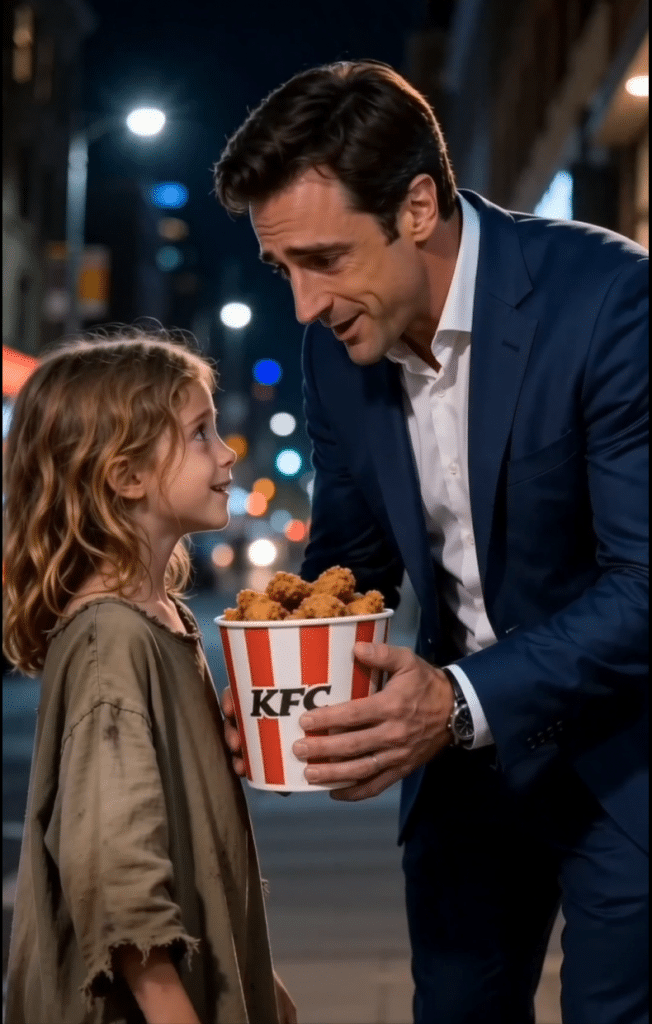
He had seen her standing outside the glowing shop window, staring at the food inside with the kind of hunger children tried to hide. She wasn’t begging. She wasn’t crying. She simply stood there, small and still, wearing an oversized olive-green tunic that hung from her shoulders like it belonged to someone twice her size.
When he asked her name, she answered politely.
“Sarah.”
So David bought her the largest bucket they had.
When he handed it to her, the warmth rose between them into the cold night air.
“You’re welcome, Sarah,” he said gently.
Her eyes lit up.
“Thank you, sir!”
Then she ran.
Not walked.
Ran.
David watched her disappear into the foggy alley, clutching the food tightly against her chest. Something about it made him pause.
Most hungry children would sit down immediately.
Sarah didn’t take even one bite.
So David followed.
He stayed far enough behind that she wouldn’t see him, his expensive shoes striking softly against wet cobblestones. The city’s warm lights vanished behind him, replaced by blue mist and broken walls.
Then, from somewhere ahead, a little boy’s voice echoed through the alley.
“Did you get anything, Sarah?”
David stopped.
The question was too desperate.
Too practiced.
Sarah hurried toward a crumbling doorway at the end of the alley. Two children waited there.
A boy of about six.
A tiny girl no older than three.
Both looked like they had been waiting for hope to come home.
And Sarah, only nine years old, knelt in front of them like a mother returning from war.
She opened the bucket.
Their small hands reached in quickly, trembling with hunger.
Sarah smiled through tears.
“Eat up,” she whispered. “I’ve already eaten.”
David leaned against the wall outside the door, one hand over his heart.
He knew immediately.
That was a lie.
Act II
David had spent most of his adult life inside glass towers.
Meetings. Contracts. Boardrooms. Charity dinners where rich people clapped for causes they never touched.
He was not a cruel man.
But comfort had made him distant.
Hunger was something he donated to.
Poverty was something he read about in reports.
Until Sarah.
Through the cracked doorway, he watched the three children sit on the dirty floor beneath a bare lightbulb. The room had peeling walls, no proper furniture, and a blanket folded in the corner like a bed for all of them.
Leo, the boy, ate too fast. Sarah gently pulled his hand back.
“Slow down,” she said. “You’ll make your stomach hurt.”
Mia, the youngest, sat pressed against Sarah’s side, her curly blonde hair tangled and her pink dress stained from days no child should have had to survive.
Sarah tore the softest piece of chicken and handed it to Mia first.
Not herself.
Never herself.
David’s throat tightened.
She was starving too. He could see it now. The way her fingers lingered over the food. The way her eyes followed every bite. The way she swallowed nothing and smiled anyway.
Leo looked up at her.
“You really ate?”
Sarah nodded too quickly.
“Before I came back.”
The lie was gentle.
A blanket over a wound.
David stepped back into the fog, shaken by the quiet horror of it. Not because the children were dirty. Not because the room was bare.
Because there was no adult voice inside.
No mother calling from another room.
No father returning from work.
No one.
Only Sarah.
A nine-year-old child pretending not to be hungry so smaller children could survive the night.
And in that moment, David understood that this was not a sad scene.
It was an emergency.
Act III
He knocked softly.
Sarah froze.
Leo grabbed Mia’s hand.
For one terrible second, fear replaced hunger in all three faces.
David raised both hands gently. “It’s okay. I’m not here to hurt anyone.”
Sarah stood immediately, placing herself in front of her siblings.
Small body.
Huge courage.
“We didn’t steal it,” she said quickly. “You gave it to me.”
“I know,” David said.
Her chin lifted, but her eyes betrayed panic. “Then why are you here?”
He looked past her at the room.
At the broken window stuffed with cardboard.
At the children’s shoes lined near the wall, too worn to keep out rain.
At a faded photograph lying face-down on the floor.
“I wanted to make sure you were safe,” he said.
Sarah’s expression changed.
Not relief.
Suspicion.
Children who had been failed too often did not trust kindness quickly.
“We’re fine,” she said.
Leo looked at her. “Sarah…”
She silenced him with a glance.
David crouched slightly so he would not tower over them.
“Where are your parents?”
The room went still.
Mia tucked her face against Sarah’s side.
Sarah looked down.
“Our mom got sick,” she whispered. “Then people came. They said they would split us up.”
David felt the words settle heavily between them.
“So you ran.”
Sarah didn’t answer.
She didn’t have to.
Behind her, Leo’s eyes filled with tears. “Sarah said if we stayed together, Mom could find us.”
David looked at the face-down photograph.
Sarah followed his gaze, then quickly picked it up and held it close.
It showed a smiling woman with three children wrapped in her arms.
On the back, written in fading ink, were four words:
Don’t let them separate.
David stared at the handwriting.
Something twisted inside him.
Because the woman in that photo looked familiar.
Not from memory.
From a file.
A legal file buried in one of his company’s housing projects.
And suddenly this was no longer just about three hungry children.
It was about why they had been erased.
Act IV
David brought food first.
Then blankets.
Then a doctor.
Sarah fought him at every step.
Not because she didn’t need help.
Because needing help had become dangerous.
But when Mia coughed through the night and Leo fell asleep sitting upright, Sarah finally broke. She sat on the floor with her back against the wall, holding the photograph to her chest.
“Our mom’s name was Emily,” she whispered.
David went cold.
Emily Carter.
A tenant advocate.
A woman who had once filed complaints against one of David’s luxury redevelopment partners for forcing poor families out of old buildings before winter repairs were complete.
David remembered the scandal.
He also remembered being told it had been resolved.
Cleanly.
Quietly.
But the children in front of him were not resolution.
They were evidence.
The next morning, David made calls that shook people who were used to hiding behind polished language.
By noon, he had the records.
Emily Carter had not abandoned her children.
She had fought for them until the very end.
After she died, the children were supposed to be placed together with an approved family friend. But the paperwork had been altered. Their case had been marked “unreachable.”
Unreachable.
As if three children had simply vanished by accident.
David stared at the screen until the words blurred.
Then he saw the signature.
One of his own executives had approved the cover-up.
A man who wanted the old shelter emptied fast so investors would not see poverty near their new luxury district.
David’s hands curled into fists.
For years, he had believed his money built beautiful things.
Now he understood it had also hidden ugly ones.
That evening, he returned to the shelter.
Sarah stood when she saw him, trying to read his face.
“What’s going to happen to us?”
David knelt in front of her.
“The truth,” he said. “That’s what happens next.”
Act V
The press conference was supposed to be about a new hotel opening.
Instead, David walked onto the stage with three children beside him.
Sarah wore a clean blue coat, but she still held Leo’s hand tightly. Mia slept against a social worker’s shoulder, finally warm enough to rest.
The cameras flashed.
David did not smile.
He told the truth.
About Emily Carter.
About the forged records.
About the families pushed into darkness so wealthy people could enjoy brighter lobbies.
Then he stepped aside and let Sarah place her mother’s photograph on the podium.
No speech could have been stronger.
Within days, arrests began.
Within weeks, the housing project was frozen.
By the end of the month, a foundation was created in Emily Carter’s name, dedicated to keeping siblings together after family loss.
But the real ending did not happen in front of cameras.
It happened one quiet evening in David’s kitchen.
Sarah sat at the table with Leo and Mia, staring at a full plate of food.
For the first time, no one had to lie.
Leo looked at her carefully.
“You ate, right?”
Sarah paused.
The old instinct rose in her.
The old sacrifice.
Then she picked up her fork and took a bite.
David looked away for a moment, his eyes burning.
Sarah smiled softly.
“Yes,” she said.
And this time, it was true.