Act I
“Sir.”
The billionaire barely heard him at first.
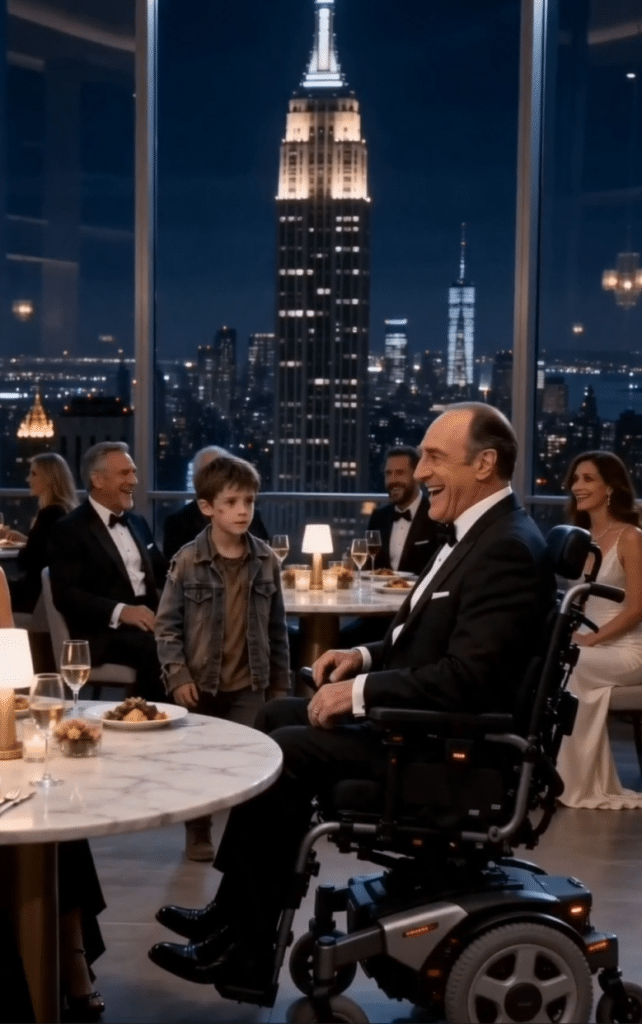
The rooftop restaurant glittered above Manhattan, all marble tables, crystal glasses, black tuxedos, and golden light. Beyond the glass, the Empire State Building burned against the night sky.
At the center table, Victor Langford laughed with his guests, one hand resting on the arm of his motorized wheelchair.
Then the boy stepped closer.
He looked wildly out of place.
Torn denim jacket. Dirt on his cheek. Shoes too worn for a room where a glass of wine cost more than most people’s groceries.
Victor looked down at him with amused curiosity.
“You?”
The boy did not flinch.
“I can fix your leg.”
The table went quiet.
Then someone laughed.
Victor leaned forward, smiling as if entertaining a magic trick.
“How long?”
The boy’s answer was calm.
“A few seconds.”
Victor spread his hands.
“Count.”
The boy knelt.
He removed Victor’s polished black shoe with surprising gentleness, placed it beside the wheelchair, and pressed two fingers against Victor’s bare foot.
“One,” he whispered.
The guests smirked.
“Two.”
A white flash burst beneath the boy’s fingers.
Victor’s laughter died in his throat.
The room froze.
The boy looked up.
“Stand up.”
Victor’s hands gripped the chair.
His face emptied of arrogance.
Then, slowly, impossibly, the man who had not stood in twelve years rose from his wheelchair.
A woman screamed.
A glass shattered.
Victor stared down at his legs like they belonged to a stranger.
The boy stood too, his eyes suddenly sad.
“My mother said,” he whispered, “you’d know me.”
And Victor Langford felt the past reach across the room and close its hand around his heart.
Act II
Victor had spent twelve years telling the world he had accepted his condition.
He had not.
He had simply learned to make suffering look expensive.
Custom wheelchair. Private physicians. Imported therapy equipment. A penthouse redesigned with silent elevators and hidden ramps. Interviews about resilience. Magazine covers about strength.
But in private, Victor hated being pitied.
So he became untouchable.
He bought companies before they could reject him. He crushed rivals before they could mock him. He donated to hospitals but never visited the children’s wing. He funded research but refused to meet patients.
Pain had made him rich in discipline and poor in mercy.
Before all that, before the accident, before the wheelchair, before the empire became armor, there had been a woman named Elena.
Elena Marquez.
A violinist with dark eyes and a laugh that made Victor forget he was supposed to be important.
He loved her when he was still hungry, still building, still human.
Then his father died.
Then the company nearly collapsed.
Then investors told him Elena made him look unserious.
Victor let them say it.
Worse, he believed them.
When Elena told him she was pregnant, Victor was already becoming the kind of man who confused fear with strategy.
He asked for time.
She heard rejection.
By the time he went looking for her, she was gone.
A month later, Victor’s car skidded on black ice outside Albany. His spine was damaged. His legs went silent. His world narrowed to hospital rooms, legal documents, and the brutal humiliation of needing help to cross a room.
Elena became the one wound he never discussed.
Now a boy with her eyes stood in front of him.
And Victor could move his feet.
Act III
“What is your name?” Victor asked.
His voice sounded broken.
The boy looked around at the staring guests, then back at him.
“Noah.”
Victor swallowed.
“Noah what?”
“Noah Marquez.”
The name hit harder than the miracle.
Victor reached for the table to steady himself. His guests, who had mocked seconds ago, now watched with pale, frightened faces.
“How did you do that?” one man whispered.
Noah ignored him.
“My mother told me not to come unless I had no other choice.”
Victor’s chest tightened.
“Where is she?”
Noah’s eyes dropped.
“At St. Agnes Hospital.”
Victor’s first step nearly failed.
Not because his leg could not hold him.
Because guilt could.
Noah reached out, but Victor waved him off, ashamed to need help from the child he had never known existed.
“What happened to her?”
“She’s sick,” Noah said. “And the doctors stopped listening when the money ran out.”
Victor closed his eyes.
The whole city shimmered behind him, cruel and bright.
He owned towers, aircraft, hotels, laboratories.
And Elena had been begging hospitals to keep listening.
“Why would she say I’d know you?” Victor asked.
Noah reached into his ripped jacket and pulled out a small silver watch.
Victor stopped breathing.
He had given it to Elena the night he promised he would come back from London and marry her.
Inside the cover, he had engraved three words.
Come find me.
Elena had kept it.
All these years, she had kept it.
Act IV
Victor ordered his car.
For once, no one argued.
Noah rode beside him in the back seat, staring out at Manhattan as if afraid the city might swallow him before they reached the hospital.
Victor kept flexing his hand over his knee, waiting for the miracle to vanish.
It did not.
Every sensation felt unbearable.
The seam of his trousers.
The pressure of the floor.
The ache of muscles remembering they existed.
At St. Agnes, the nurses recognized Noah but not Victor. That told him more than any accusation could.
They found Elena in a small room with dim lights and a thin blanket.
She looked older, fragile, but still beautiful in a way that made Victor’s throat close.
Her eyes opened.
She saw Noah first.
Then Victor.
Standing.
For a moment, she only stared.
Then tears filled her eyes.
“Noah,” she whispered, “what did you do?”
The boy stepped closer.
“I found him.”
Victor approached the bed slowly.
“Elena.”
She turned her face away.
“You were not supposed to see me like this.”
“I was supposed to see you twelve years ago,” he said.
That silenced her.
Victor sat beside her bed.
“I looked for you.”
“For how long?”
He had no answer strong enough.
Elena smiled sadly.
“That’s what I thought.”
Noah stood at the foot of the bed, small and exhausted.
Victor looked at him.
“Is he my son?”
Elena closed her eyes.
“Yes.”
The word did not explode.
It settled.
Heavy.
Permanent.
Victor reached for the rail of the hospital bed as if the room might collapse beneath him.
Act V
Victor Langford did not fix twelve years in one night.
Money could move doctors, specialists, private rooms, and medical files.
It could not erase absence.
Elena allowed his help, but not his excuses.
Noah accepted new clothes, but still kept his torn jacket folded under his pillow.
And Victor, who had once believed power meant never being vulnerable, began learning the harder truth.
Power meant staying when shame told you to leave.
Weeks later, Elena stabilized.
Not cured.
Not magically saved.
But stronger.
Noah’s gift remained a mystery no doctor could explain. He never performed it for cameras. Never for money. Never for Victor’s wealthy friends, though many asked.
He said it only worked when love had somewhere to go.
Victor did not understand that.
Not fully.
But he stopped trying to own what he could not explain.
Three months later, he returned to the rooftop restaurant.
No party this time.
No laughing guests.
Just Victor, Elena, and Noah at a quiet table near the glass.
The wheelchair was gone, but Victor kept the black shoe from that night in a case in his office.
Not as proof of a miracle.
As proof of the moment a child walked into a room full of rich people and showed him what poverty really was.
It was not torn clothes.
It was not dirt on a cheek.
It was having everything and still becoming empty.
Noah looked out at the skyline.
“Do you like standing?” he asked.
Victor smiled faintly.
“Yes.”
Then he looked at Elena.
“But not as much as staying.”
For the first time, Elena did not look away.
Outside, New York glittered like a thousand second chances.
And Victor Langford, billionaire, skeptic, and father, finally understood that the boy had not come to heal his legs.
He had come to make him walk back into the life he abandoned.