Act I
“Your dad doesn’t drive federal plates.”
The police officer said it with a smile.
Not a kind one.
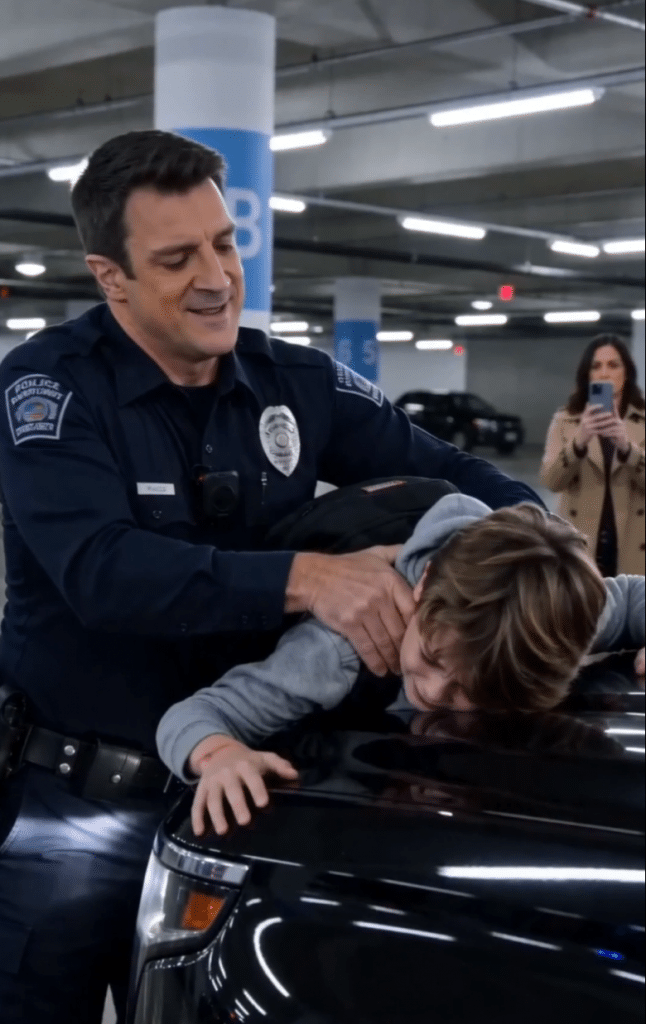
His forearm pinned the boy across the chest, pressing him back against the hood of a black Chevrolet Tahoe in the airport parking garage. The boy’s backpack hung open beside him. His gray hoodie was twisted at the collar. One wrist showed a red mark where he had been grabbed too hard.
“That’s my dad’s car!” the boy cried. “Please!”
The officer chuckled.
Behind them, a police cruiser flashed blue and white against the wet concrete. Travelers stood near the rental car signs, frozen with luggage in their hands. A woman in a tan trench coat had her phone raised, recording.
The officer dug into the boy’s backpack.
“Now fake federal ID too?” he said.
He pulled out a black leather badge wallet.
The boy went white.
“DON’T OPEN THAT!”
Then the sound came.
Tires screaming across concrete.
Three black SUVs tore into the garage and stopped in a hard formation around them. Doors flew open. Men in black tactical gear moved out with rifles raised, silent and exact.
From the middle SUV stepped a tall man in a gray suit.
His gun was drawn.
His eyes were fixed on the officer’s arm across the boy’s chest.
“Take your hands off my son.”
The officer froze.
The boy’s voice cracked.
“Dad.”
The man lowered his weapon only slightly as he came closer.
Then his face changed.
He looked at the empty back seat of the Tahoe.
“Where’s the case?”
And suddenly, the officer understood the boy had not been trying to steal the vehicle.
He had been trying to stop someone else from stealing what was inside it.
Act II
The boy’s name was Ethan Miller.
He was eleven years old, small for his age, with shaggy brown hair and the exhausted eyes of a kid who had learned too early that adults could be dangerous even when they wore badges.
His father, Agent Robert Miller, had spent twenty-three years in federal service.
Ethan knew the rules.
Never touch the locked case.
Never say where Dad works.
Never open the badge wallet in public.
Never get separated in a terminal.
But that morning had not been normal.
They were supposed to be flying to Chicago under ordinary names. No escort. No visible protection. Just a father and son walking through an airport after a delayed red-eye.
Then Robert got the call.
One sentence.
“Your location is compromised.”
After that, everything moved too fast.
Robert told Ethan to stay in the rental car center corridor. He handed him the backpack and said, “Do not let anyone take this.”
Ethan asked about the case in the Tahoe.
Robert looked at him in a way Ethan had never seen before.
“Only I open that vehicle.”
Then he left.
Five minutes later, Ethan saw a man in a maintenance jacket approach the Tahoe with a scanner in his hand.
The lights blinked.
The doors unlocked.
Ethan ran.
He reached the car just as the man pulled a black hard-shell case from the rear seat. Ethan grabbed the handle, screamed for help, and got shoved backward onto the concrete.
The thief ran.
The police officer arrived seconds later.
But he did not chase the man with the case.
He grabbed Ethan.
By the time Ethan tried to explain, the officer had already decided what he was seeing: a kid near a federal-plated SUV, a backpack with credentials, a story too big to believe.
And once a man like Officer Grant decided a child was lying, facts became interruptions.
Act III
Agent Miller did not shout again.
That was worse.
The tactical team held the scene while one agent moved Ethan away from the hood and checked his wrist. The boy tried not to cry, but the second his father touched his shoulder, his face crumpled.
“I tried to stop him,” Ethan whispered.
Robert knelt in front of him.
“I know.”
“The case is gone.”
“I know.”
The officer found his voice.
“Sir, I had no way of knowing—”
Robert looked at him.
“You had a child pinned to a vehicle.”
“He matched a suspicious call.”
“What call?”
The officer hesitated.
That hesitation changed the air.
Robert stood.
“What call?”
Officer Grant swallowed.
“Dispatch reported a juvenile attempting to break into a federal vehicle.”
Jennifer, the woman recording, spoke from behind a concrete pillar.
“That’s not what happened.”
Everyone turned.
Her phone was still raised.
“I saw a man take something from the SUV,” she said. “The boy tried to stop him. The officer ignored him.”
Grant’s jaw tightened.
“That’s not accurate.”
Jennifer looked at the tactical agents, then at Ethan.
“I have the video.”
Robert’s eyes flicked toward one of his agents.
“Get it.”
The footage showed everything.
The maintenance jacket.
The scanner.
The stolen case.
Ethan grabbing the handle.
The thief pushing him down.
Officer Grant arriving after the thief had already disappeared.
Robert watched without blinking.
Then he turned toward the officer.
“You didn’t catch a thief,” he said. “You protected his exit.”
Act IV
The case contained no money.
No weapons.
Nothing a normal thief would risk a federal response to steal.
It held testimony.
A physical drive.
A signed immunity file from a cartel accountant who had agreed to expose a network of dirty officials, airport contractors, and private security companies moving people and cash through terminals across the country.
Only four people knew the case was being transported that morning.
Agent Miller.
His supervisor.
The witness.
And the internal affairs team investigating a leak.
Officer Grant’s face turned gray when Robert said that.
“You think I’m involved?”
Robert stepped closer.
“I think someone knew exactly when that Tahoe would be alone.”
Grant shook his head.
“No. I got a call. That’s all.”
“From dispatch?”
“Yes.”
One of the agents in tactical gear checked his radio log.
“No dispatch record,” he said.
Grant stared at him.
“That’s impossible.”
Robert’s phone rang.
He answered, listened for three seconds, then looked toward the rental car elevators.
“Lock down level two.”
The thief had not left the airport.
He had switched jackets.
That was the mistake.
Security cameras caught him entering an elevator in maintenance gray and exiting in a navy blazer. But Ethan noticed something no adult had.
“He had a red tag on his shoe,” Ethan said.
Robert turned.
“What?”
“The man who took the case. His shoelace tag was red. I saw it when he shoved me.”
That detail moved faster than any order.
Within four minutes, agents found the man near the shuttle exit, one shoe marked with a red plastic rental-lot tag.
The case was not with him.
But he gave them a locker number before he even reached the interview room.
Fear made people efficient.
Act V
The case was recovered from an airport employee locker behind a locked service hallway.
Still sealed.
Still intact.
By sunset, three airport contractors had been arrested, along with one federal supervisor who had been feeding movement details to the network for months.
Officer Grant was suspended pending investigation. His body camera proved Jennifer was right: Ethan had tried to explain three times before Grant shoved him onto the hood.
The video went public before midnight.
But Robert Miller did not care about headlines.
He sat beside Ethan in the back of an FBI SUV, wrapping a cold pack around his son’s wrist.
“You remembered the shoe tag,” Robert said.
Ethan sniffed.
“I thought it was stupid.”
“It solved the case.”
Ethan looked down.
“I was scared.”
Robert’s face softened.
“So was I.”
That surprised the boy.
“You?”
Robert nodded.
“The whole time.”
Outside the SUV, agents moved beneath the fluorescent lights. Airport travelers rolled suitcases past the scene, whispering. Jennifer stood nearby giving her statement, still shaken but steady.
Ethan looked at the Tahoe.
“Am I in trouble for leaving the corridor?”
Robert exhaled slowly.
“Yes.”
Ethan’s face fell.
Then Robert pulled him close.
“But not today.”
Weeks later, Robert received a copy of the parking garage footage from evidence. He never watched the part where Ethan hit the hood. Once had been enough.
But he kept the final still frame.
Three SUVs.
A terrified boy.
A father crossing the garage with every weapon drawn except the one that mattered most.
Trust.
Because Ethan had remembered the rules.
He had protected the backpack.
He had refused to let the badge wallet be opened.
And when everyone bigger than him got the story wrong, he still told the truth.
The officer thought he had caught a kid playing with federal plates.
What he had really done was put his hands on the only witness who saw everything.