Act I
Kane Whitmore was holding his bride’s hands when the church doors flew open.
For one perfect second, Juliet Monroe looked exactly like the woman he thought he was marrying.
White lace. Long veil. Dark waves over her shoulders. Soft eyes fixed on his as the priest lifted his book and the guests leaned forward in polished silence.
Then the Doberman came running down the aisle.
“Kane?” someone shouted from the pews.
The dog did not slow down.
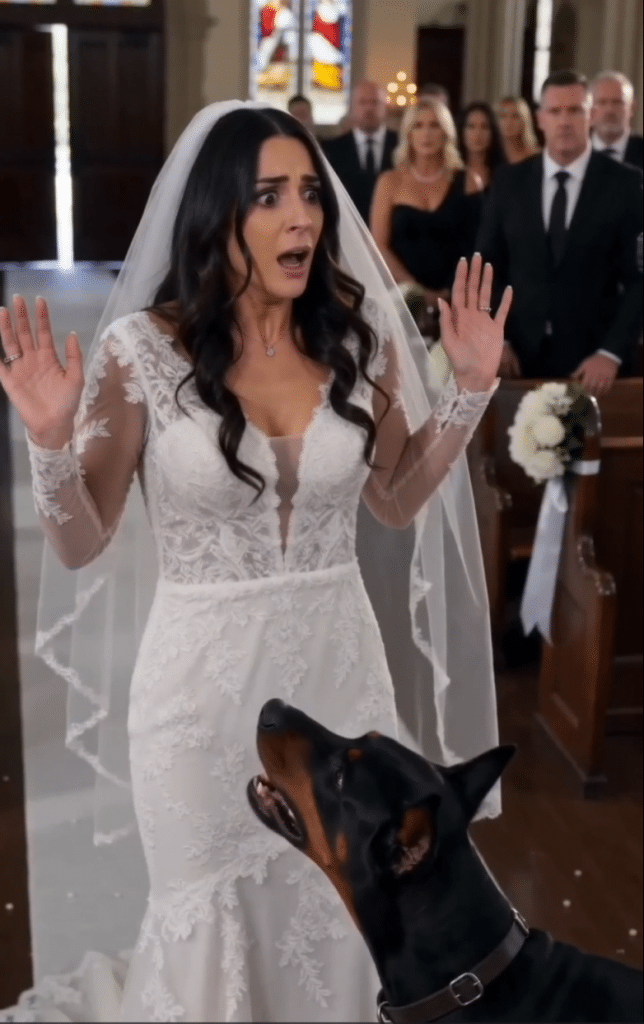
Guests gasped as the muscular black-and-tan animal charged between the white floral arrangements, paws thundering over the aisle runner. Kane turned, stunned, just as Juliet’s fingers tightened around his.
Not in fear.
In panic.
The dog leapt.
Juliet screamed.
“GET HIM OFF ME!”
The Doberman caught the waist of her gown and pulled. Pearls snapped loose. Beads scattered across the wooden floor like hail. Kane grabbed for the dog’s collar, but the animal was locked onto one place beneath the folds of lace.
Then something black slid out from under the dress.
It hit the floor with a hard, metallic clatter.
A knife.
The church went silent.
Kane staggered back, staring at it.
“What the hell is this?”
Juliet froze, her face draining of color.
Before she could move, a man in a black suit rose from the pews and rushed forward with the controlled speed of someone who had never been just a guest.
“Don’t touch that knife!” he ordered. “Juliet Monroe, don’t move!”
His weapon was drawn. His voice filled the church.
The Doberman stood guard in the aisle, ears sharp, body tense.
Juliet lifted her hands.
And Kane realized the woman at the altar had not come to marry him.
She had come to finish something.
Act II
Six months earlier, Juliet had walked into Kane’s life at a charity auction.
She arrived late, laughed softly, and bid too much on a watercolor no one else wanted. Kane noticed her because she seemed unlike the women who usually approached him.
She did not ask about his money.
She did not mention his family.
She did not pretend to know his father.
Instead, she stood beside him near a marble column and said, “You look like a man who hates being recognized.”
Kane laughed before he meant to.
That was how it began.
By then, the Whitmore name was everywhere. Hotels. Real estate. Political donations. Museum wings. But Kane had never been comfortable inside the empire his father left behind.
After his father’s death, Kane inherited not only wealth, but enemies.
Old lawsuits.
Broken partnerships.
People who believed Richard Whitmore had ruined them.
Juliet seemed like peace.
She listened when Kane talked about leaving the company. She touched his arm when he mentioned his mother’s illness. She remembered tiny details and gave them back to him at perfect moments.
Within three months, she had moved into his world.
Within five, he proposed.
People said it was too fast.
Kane ignored them.
Only one member of his household never accepted Juliet.
Brutus.
The Doberman had belonged to Kane’s late father, a retired security dog with a scarred ear and solemn eyes. He obeyed Kane, tolerated housekeepers, and treated strangers with careful distance.
But with Juliet, he was different.
He growled when she entered rooms.
He blocked stairways.
Once, he planted himself between her and Kane’s study door and refused to move.
Juliet laughed it off.
“Your dog hates me.”
Kane smiled.
“He’s protective.”
“No,” she said, eyes hard for just a flash. “He’s a problem.”
A week before the wedding, Brutus disappeared.
Juliet cried when Kane found the side gate open. She helped print flyers. She kissed his cheek and said, “We’ll find him.”
But Kane noticed something later.
There was no mud on her shoes from searching the garden.
And no worry in her eyes when she thought no one was looking.
Act III
The man in the black suit was Officer Adrian Vale.
He had been watching Juliet Monroe for nearly a year.
Not as a jealous ex.
Not as a random investigator.
As the last surviving detective on a case everyone else had been told to bury.
Juliet was not her real name.
Her real name was Mara Voss.
She was connected to three wealthy men who had died or nearly died after whirlwind romances, sudden engagements, and private legal changes made shortly before disaster struck.
Nothing stuck.
There was always grief. Always confusion. Always some document signed in the wrong week.
By the time police found a pattern, Mara vanished.
Then she reappeared beside Kane Whitmore.
Officer Vale tried to warn him twice.
The first letter never reached Kane.
The second came back marked undeliverable.
Then Vale learned someone inside Whitmore security had been paid to intercept outside communications.
That was when Brutus disappeared.
The dog had not run away.
He had been found two towns over by a retired K-9 handler, hungry but alive, with a torn piece of lace caught in his collar. The handler scanned his chip and called the number listed.
It was not Kane’s number.
It was Officer Vale’s.
Because Richard Whitmore, years before his death, had secretly registered Brutus as part of a private protection protocol for his son.
Richard had known powerful families attracted polished predators.
So Brutus was trained for one thing above all else.
To detect concealed weapons and guard Kane.
On the morning of the wedding, Vale brought Brutus to the church himself, hidden in the side vestibule until the final moment.
He had no warrant to stop a wedding.
But he had enough fear to watch the bride.
Then Brutus caught the scent.
And ran.
Act IV
Juliet stood at the altar with her hands raised, breathing fast.
“Kane,” she whispered. “You have to believe me.”
He looked at her.
The veil still framed her face. The pearls still clung to half her bodice. She was still beautiful.
That made it worse.
“Believe what?” he asked. “That you forgot there was a knife under your dress?”
Her lips trembled.
“It wasn’t for you.”
Officer Vale stepped closer.
“Don’t speak without counsel.”
Juliet’s eyes flashed.
For one second, the softness vanished completely.
Kane saw the stranger beneath the bride.
The priest backed away. Guests stood frozen between pews. Kane’s mother covered her mouth, her eyes locked on the blade on the floor.
Then Vale gave another order.
“Check the bridal suite.”
Two plainclothes officers emerged from the back pews.
Kane stared.
“How many of you are here?”
“Enough,” Vale said.
Minutes later, one officer returned carrying a white satin purse inside an evidence bag.
Inside were pills, a folded legal document, and Kane’s private medical summary.
His blood pressure medication.
His allergies.
His emergency contacts.
And a revised spousal inheritance agreement he had never seen.
Kane’s knees nearly gave out.
Juliet shook her head.
“No. Kane, I can explain.”
He laughed once, broken and hollow.
“You already did.”
The old dog moved to Kane’s side and pressed against his leg.
That simple touch nearly destroyed him.
Because Brutus had known.
The whole time, the dog had known what love had made Kane too blind to see.
Officer Vale lowered his voice.
“Mr. Whitmore, your father suspected someone might target you after his death. He left instructions. We failed to reach you sooner, but he didn’t.”
Kane looked down at Brutus.
His father’s final warning had arrived on four legs, down the aisle, before the vows could become a trap.
Act V
Juliet Monroe was arrested in her wedding gown.
No dramatic confession came from her mouth. No apology. No tears that felt real.
Only one sentence as officers led her past Kane.
“You would have given me everything.”
Kane looked at her then, truly looked at her.
“No,” he said. “You almost made me.”
The church doors opened.
Cold daylight spilled across the aisle.
Guests stepped aside as Juliet was taken out past the flowers, past the polished pews, past the life she had tried to steal.
Kane remained at the altar.
For a long time, no one spoke.
Then his mother rose slowly and came to him. She touched his face the way she had when he was a child and whispered, “Your father saved you.”
Kane shook his head.
“No,” he said, looking down at Brutus. “He both did.”
The wedding never happened.
But the truth did.
Over the following weeks, investigators connected Juliet to forged documents, stolen identities, and two older cases that grieving families had never been able to explain. Kane testified. So did Officer Vale. So did the handler who found Brutus.
The knife became only one piece of a much larger story.
Months later, Kane returned to the church alone.
Not for a wedding.
For a memorial service honoring the victims Juliet had left behind.
He stood in the same place where he had once held her hands, beneath the stained glass and white flowers.
Brutus sat beside him, calm and watchful.
Kane placed one hand on the dog’s head.
He had thought love meant ignoring every warning.
Now he knew better.
Sometimes love was a father planning beyond the grave.
Sometimes it was an officer refusing to let a case die.
And sometimes it was a loyal old dog running down a church aisle, tearing apart a beautiful lie before it could become a lifetime sentence.