At first, the men in the diner looked at her the way men like that looked at anything small enough to ignore.
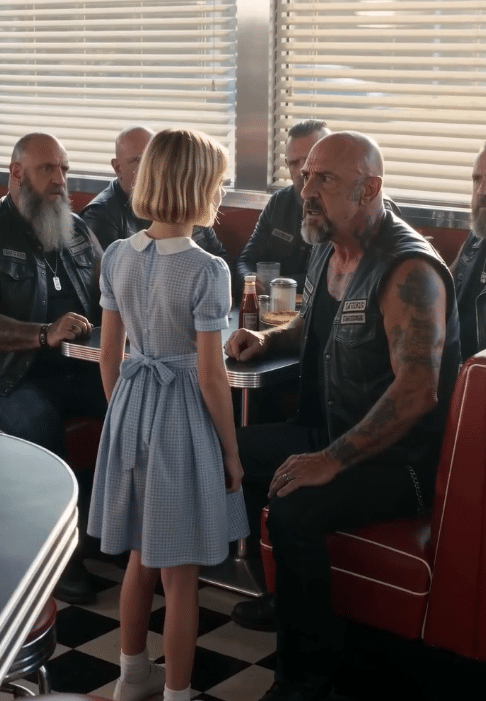
She was just a little girl in a gray long-sleeved shirt, standing in a room built for leather, noise, and the kind of silence that usually came after someone made a bad decision. The golden-hour light slanted through the blinds in warm stripes, catching the red vinyl booths and the chrome edges of the counter, but none of it softened the table she had chosen.
Five bikers sat there like a wall.
The biggest one was at the head of the booth, broad shoulders filling out a black leather vest, throat marked with a tattooed star that looked almost like a warning. He turned sharply when he heard her shoes stop by the table.
“Hey!”
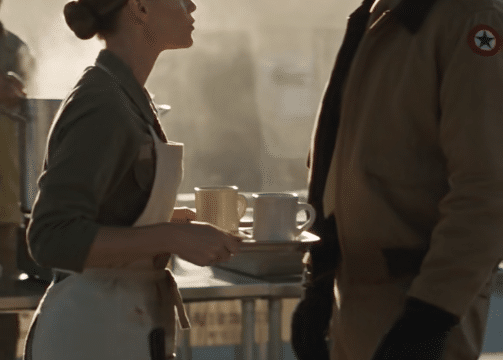
His voice cracked across the diner hard enough to still the waitress at the coffeepot.
The girl didn’t flinch.
She stood directly in front of him, small and pale and serious in a way no child should have needed to be. The men around him stared with open irritation, waiting for her to lose her nerve and back away.
Instead, she raised one finger and pointed at the patch stitched onto his chest.
“My dad had this.”
The biker leader leaned in slowly.
The room got quieter.
“Kid,” he said, low and menacing now, “what did you say?”
Her eyes shone, but her voice didn’t shake.
“He said you would remember him.”
Something changed in the biker’s face then. Not softness. Not yet. But the easy aggression vanished, replaced by something narrower and more dangerous.
“What was his name?”
The girl swallowed once.
Then she said it.
“Daniel Hales.”
The biker went still.
Not stiff. Still.
The men beside him looked from her to him and back again, suddenly unsure whether they were watching some cruel mistake or the first crack in something old and buried. The sunlight caught the dust in the air so clearly it looked like the whole diner had stopped breathing.
At last, the biker leader said the only thing he seemed capable of saying.
“We buried him.”
The girl’s mouth trembled.
Then she whispered, “No.”
And that one word hit the booth harder than if she’d screamed it.
Because there was no childish denial in it. No confusion. No fantasy. She said it like someone carrying a truth too heavy for her age and too urgent to put down now.
Then she reached into the front pocket of her shirt and placed a small brass St. Christopher medal on the table.
The biker leader stared at it.
His face drained of color.
He knew that medal. Years ago, he had given it to Daniel Hales outside a courthouse on the day Daniel said he was done with the club for good. Keep it in your pocket, he’d joked. You always were the one trying to save everybody else.
Only Daniel had filed a hole through the back of it and worn it on a leather cord instead.
Exactly like this.
The biker leader looked at the girl as if the dead had just spoken through her.
Because Daniel Hales had not been the kind of dead man who stayed quiet.
Act II
His name was Rafe Calder, and in three counties people said it the way they said storms were coming.
He led the Badlands chapter with the kind of authority that made men lower their voices when they wanted to cross him. He had the scars, the prison years, the old military posture that never quite left his shoulders. To most people, Rafe looked like the final wrong turn in a life already headed somewhere dark.
Daniel Hales had been the only man in the club who ever talked to him like he was still redeemable.
Years earlier, before the tattoos climbed Rafe’s neck and before the Badlands became the only family either of them trusted, Daniel had been the young one. Smarter than the others. Calmer. The man who knew how to de-escalate a fight before it started and still throw a punch if things went bad anyway. The men called him Halo because he kept acting like trouble was a thing you could still walk away from.
Then he met Sarah Mercer.
She was a county librarian with tired eyes and a laugh that made Daniel look embarrassed by his own happiness. Within a year, he was riding less, drinking less, showing up at meetings in clean shirts and apologizing for leaving early because his wife hated when dinner got cold.
When Sarah got pregnant, Daniel cut back even more.
When his daughter was born, he almost disappeared from the life altogether.
Rafe had mocked him for it once. Called him domesticated. Told him no man left the club without the road dragging something back out of him sooner or later.
Daniel had only smiled and said, “Then I guess I better learn to love the road less than I love her.”
Rafe remembered that now with a shame so old it felt like part of his bones.
Because five years earlier, Daniel Hales had died in a warehouse fire out by Miller’s Ridge. At least that was the story everyone had been given. The sheriff identified the remains. The coroner signed off. There was a closed casket because the body was too badly damaged for viewing, and the Badlands stood in the cemetery under a hard gray sky while Rafe laid the club colors over the coffin and tried not to think about the last phone call they’d had.
Daniel had sounded frightened.
Not for himself. That was what bothered Rafe later.
For Sarah. For the little girl.
He had said he found something. Something bad enough that he didn’t know who to trust. He told Rafe if anything happened, to remember that he had tried to do the right thing.
Rafe, tired and angry and half-drunk at the time, told him everyone thought they were noble right before they made a mess.
Daniel died two days later.
Rafe never forgave himself for that.
Now a little girl stood in front of his booth with Daniel’s medal on the table and Daniel’s eyes looking back at him.
“What’s your name?” he asked, and his voice no longer sounded like the one that had barked at her when she approached.
“Evie.”
“How old are you, Evie?”
“Eight.”
The men in the booth had stopped pretending not to care. One shifted forward, elbows on knees. Another set down his glass so carefully it didn’t even make a sound.
Rafe leaned back slowly.
“Where did you get that medal?”
She looked at him for one long second, deciding whether he had earned the truth.
“My mom kept it in a box under her bed,” she said. “She gave it to me before she died.”
The word hit the table like a dropped tool.
Died.
Not left. Not disappeared. Died.
Rafe felt something cold move through him.
“When?”
“Three weeks ago.”
No one in the diner moved.
Evie kept going because children carrying too much grief often learn that stopping halfway only makes adults interrupt with the wrong questions.
“She was sick for a long time,” she said. “At the end, she gave me the medal and a letter and told me if anyone came asking about my dad, I had to find the man with the star on his throat.”
Every man at the booth looked at Rafe then.
He swallowed once.
Evie reached into her sleeve and pulled out a folded envelope, softened at the edges from being held too tightly for too long. His name was on the front in a handwriting he would have known half blind and upside down.
Rafe.
No last name. No flourish.
Just Rafe.
His hand was unsteady when he took it.
Because the letter in the little girl’s grip proved the grave had ended nothing at all.
Act III
Rafe opened the envelope like it might burn him.
Inside was a single sheet of paper and a key taped to the bottom corner.
The note was dated nine days before Sarah’s death.
If Evie is standing in front of you, Daniel had written, then Sarah is gone or I am, and I have run out of time to keep lying to the people I should have trusted first.
Rafe stopped reading for a second.
Daniel’s voice was there in the page so clearly it felt obscene.
He kept going.
The body you buried was not mine. I survived the fire. Deputy Lorne and Mason Pike made sure the wrong remains wore my ring and jacket, then let the county do the rest. I found out too late that Mason was feeding route information to men using our charity hauls to move stolen pharmaceuticals and cash. When I threatened to go public, they set the warehouse fire and called it bad luck.
One of the bikers at the end of the booth swore under his breath.
Another looked sharply toward a man two seats over.
Mason Pike.
He had been quiet this whole time, too quiet, broad hands locked together on the table, eyes shifting just a little too fast between the letter and the front door.
Rafe kept reading.
I didn’t come to the club because I didn’t know who else was dirty, and I wouldn’t put Sarah or Evie in front of men I couldn’t read anymore. We ran. We changed names. I gathered records. Sarah wanted me to trust you. I wanted to. I was just too late at everything that mattered.
Rafe’s jaw clenched.
Across from him, Mason stood abruptly.
“Come on,” he said. “You’re really taking the word of a dead man and a child?”
No one answered him.
That was answer enough.
Daniel’s letter continued.
The key opens locker 214 at Greyhound Storage on Route 9. Everything is there. The ledger. The copies. The voice file. If Mason is still breathing easy, then he thinks I took the truth down with me. Don’t let him be right again.
The final lines were shorter.
Harder.
Rafe, if Evie makes it to you, remember me by what I loved, not by how they buried me. And don’t let my daughter grow up thinking I abandoned her.
Rafe lowered the letter very slowly.
The diner was silent except for the old hum of the refrigerator behind the counter and the faint clatter of a truck passing somewhere outside. Mason Pike took one step backward, already measuring distance.
That was another mistake.
Because fear looks different when it moves through guilty men.
Rafe rose from the booth.
He didn’t shout. He didn’t grab Mason. He just stood, and somehow that was worse.
“You signed the flowers for Daniel’s funeral,” Rafe said quietly. “You carried his coffin.”
Mason swallowed. “You don’t know what was in that fire.”
“No,” Rafe said. “But apparently Daniel did.”
Mason bolted for the door.
He made it two steps.
Then two of the men from the booth moved at once, not with wild violence, just with the calm efficiency of men who had spent years catching each other before bad choices became fatal ones. They blocked him cleanly. Mason stopped. Looked at one. Then the other. Then back at Rafe.
The whole room knew it was over.
Evie stood very still by the booth, hands clenched at her sides, watching the adults around her finally understand that the dead man they’d buried had been telling the truth longer than anyone had wanted to hear it.
What Daniel left behind was enough to bury someone else instead.
Act IV
Greyhound Storage sat just beyond the county line, all corrugated steel and faded blue paint, the kind of place people rented when they wanted something to exist without being seen.
Rafe drove there himself.
Evie sat in the truck beside him in silence, Daniel’s medal wrapped around her fingers. Two other bikers followed behind on their motorcycles. Mason Pike had already been handed over to the sheriff’s office, though not before Rafe made one cold, unforgettable phone call to the only state investigator he trusted enough to use Daniel’s name with.
By the time they reached locker 214, the sun was nearly gone.
The key worked on the first turn.
Inside, the space looked almost empty at first. One duffel bag. A plastic file box. A rusted tin lunch pail sitting on an overturned milk crate. The sort of ordinary objects that become unbearable only after you understand who packed them and why.
Evie stepped inside before anyone could stop her.
There was a photograph taped to the inside wall.
Daniel, Sarah, and a much younger Evie at a county fair, all three of them half-laughing into the wind while the Ferris wheel lights blurred behind them. Daniel’s arm around Sarah. Sarah bent toward the child between them. The kind of picture families take when they still believe there will be dozens more.
Rafe looked away first.
The file box held everything Daniel promised.
A handwritten ledger. Photocopies of hauling manifests. county seals used on false evidence tags. Bank records linking Mason Pike to Deputy Lorne and a shell charity no one in the club had ever authorized. There were audio cassettes too, labeled in Daniel’s hand by date.
And inside the lunch pail was one final envelope.
For Evie.
Rafe handed it to her.
She stared at her name for a long moment before opening it with trembling fingers.
The letter inside was shorter than the one Daniel had written to him, but it hit harder.
Bug, if you are reading this, then I didn’t make it back in time. That is not because I didn’t want you. It is because I wanted you enough to disappear while bad men looked for me. I hated every birthday I missed. I hated every time I had to love you from a distance. Your mother was the brave one. She made me believe you might still grow up whole after all this.
Evie’s face folded.
Still, she read on.
Go with Rafe if he is the man I remember. He looks dangerous because life got to him first, but he knows the difference between fear and cruelty. That matters more than manners. And if he cries when he sees this letter, don’t tell the others. He was touchy about that even at nineteen.
One of the bikers behind them made a broken sound that might have been a laugh.
Rafe didn’t.
He was staring at the far wall of the locker as if it were the only thing holding him upright.
The last page was signed simply:
Love, Dad.
Evie pressed the paper to her chest.
That was when Rafe understood Daniel’s final request had never really been about revenge. The evidence mattered. The corruption mattered. Mason and the deputy would answer for what they’d done. But Daniel had spent his final years making sure one small girl would not be left alone in the world with nothing but lies about why her father vanished.
So Rafe knelt in that storage locker, on cold concrete that smelled like rust and dust, and looked his dead friend’s daughter in the eye.
“He didn’t leave because he stopped loving you,” he said.
Evie nodded, crying openly now.
“I know,” she whispered. “Mama told me that. I just wanted someone else to know it too.”
The thing Daniel asked for last had nothing to do with punishment.
It had to do with witness.
Act V
The county story broke in pieces, the way ugly truths usually do.
First came Mason Pike’s arrest. Then Deputy Lorne’s. Then the seized records from the fake charity routes. The sheriff’s office had to admit the warehouse fire identification had been rushed, then corrupted, then quietly protected for years because too many men with badges had signed too many false papers to turn back cleanly.
The Badlands were dragged into the headlines for a week.
Then the documents made clear what Daniel Hales had known all along: the club had been used, not obeyed. Their routes, their donations, their veterans drives, their names. Mason had hidden behind the patch while profiting off men too loyal to imagine the betrayal growing at their own table.
Rafe gave one statement and never another.
“Daniel Hales died trying to tell the truth,” he said on the courthouse steps. “Everything after that is paperwork catching up.”
But the real ending happened far from cameras.
It happened at the cemetery.
Not the one where the Badlands had buried a closed casket years earlier with Daniel’s name on it, but a smaller churchyard outside town where Sarah Mercer lay under a simple stone. Three weeks after the arrests, when the state confirmed the remains in Daniel’s old grave were not his, the club held a second memorial. No empty coffin this time. No official performance. Just Daniel’s name restored, the truth spoken out loud, and a fresh marker placed beside Sarah’s.
Evie stood between the two stones in a dark blue dress someone’s wife from the club had found and pressed for her.
Rafe stood a little behind her.
The other bikers kept their distance, hats in hand, leather vests suddenly looking less like armor and more like penance. The same men who had once terrified the whole diner now waited quietly while a little girl knelt in the grass and set the brass St. Christopher medal against the base of her father’s stone.
She didn’t cry at first.
She just touched the name.
Daniel Hales.
For years, that name had been something whispered in letters, guarded in boxes, carried across counties by a mother too tired to tell her daughter the whole truth before death outran her. Now it was carved into stone where no corrupt deputy or false report could smother it again.
Rafe stepped forward only when Evie reached back without turning.
Her hand found his.
That nearly undid him.
“You remembered him,” she said softly.
Rafe looked at the grave.
Then at the little girl beside it.
“Too late,” he admitted.
Evie shook her head.
“No,” she said. “You remembered me.”
There was nothing to say after that, at least nothing worthy of the moment. So he just squeezed her hand and stood there while the evening light settled over the churchyard and the wind moved softly through the grass around the stones.
Months later, the diner still looked the same from the outside.
Same warm light through the blinds. Same counter. Same red booths. Same men in leather too large for the furniture they favored. But one thing had changed. In the booth by the window, where Rafe used to sit like a warning to the whole room, there was often a child’s coloring book beside his coffee now and a backpack slung over the seat.
The county still had hearings ahead. There were legal forms, guardianship motions, reporters sniffing around old lies. Nothing about justice came quickly just because it finally arrived.
But Evie no longer had to carry the story alone.
One evening, as the last of the sunlight turned the diner windows gold, she looked up from her crayons and asked the question that had been waiting quietly inside her for weeks.
“Did my dad ever get scared?”
Rafe stared out the window for a second before answering.
“All the time,” he said. “That’s what made him brave.”
Evie thought about that very seriously.
Then she nodded, as if fitting a final piece into place.
Outside, motorcycles idled in the parking lot. Inside, the old diner hummed with coffee, low voices, and the ordinary sounds of people trying to deserve a second chance.
And in the end, that was what everyone in town remembered.
Not the bikers glaring from the booth.
Not the shock on Rafe Calder’s face.
Not even the name that turned him pale.
They remembered the moment a little girl walked up to a table full of hard men, pointed at a patch on a leather vest, and refused to let the wrong grave have the final word.