Act I
The diner went quiet before the boy even reached the bar.
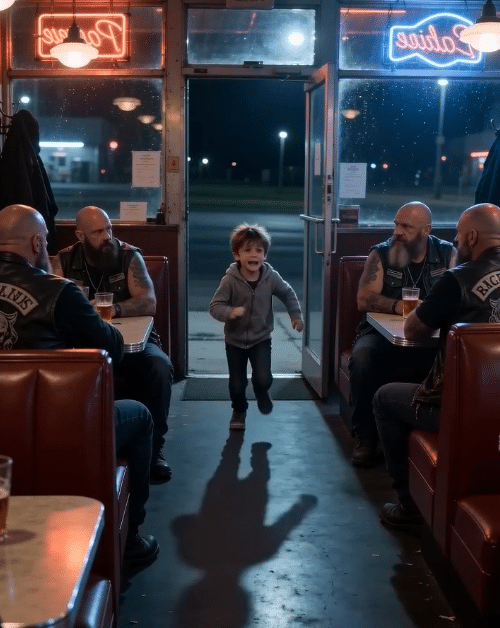
One second it was all neon glow, low country music, and the dull clink of bottles against old wood. The next, the front door slammed open so hard the glass rattled in its frame, and a little boy in a gray hoodie came stumbling in from the dark like the night itself had chased him there.
“Help me!” he cried. “Please, he’s coming!”
Every head turned.
The bikers in the booths stopped mid-sentence. A waitress near the coffee machine froze with a pot in her hand. Outside, the line of motorcycles gleamed wet under the parking lot lights, their chrome catching flashes of red and blue neon from the diner window.
At the bar, the biggest man in the room turned on his stool and took the full force of the child’s fear straight to the chest.
Everyone called him Scar.
He was broad-shouldered, tattooed, and old enough to know that panic in a child’s voice was different from panic in everyone else’s. Adults lied with their mouths. Kids lied with their eyes. This boy wasn’t lying with either.
He ran straight to Scar and grabbed the front of his leather vest with both hands.
“Don’t let him take me.”
Scar didn’t speak right away.
He just looked down.
The kid was seven, maybe eight. Mud on the knees of his jeans. One sneaker half untied. Face wet with tears and cold air. He was shaking so hard it looked like every bone in him had gotten the same terrible message at once.
Then the door opened again.
A man in a black suit walked in like he had every right to own the room.
He was too clean for the place. Too polished. Hair silvered neatly at the temples. Black shirt, black tie, expensive shoes that had never stepped in anything they couldn’t bill to someone else. He didn’t look angry. That would have made him easier to read.
He looked amused.
“There you are,” he said, voice smooth as polished stone. “You lose something?”
The boy clung tighter to Scar’s vest.
The suited man stopped a few feet away and smiled at the room as if everyone inside should be embarrassed for misunderstanding a simple situation.
“That boy belongs with me.”
“No, he’s lying!” the child shouted.
Something shifted in the diner then.
Not loudly. Not yet.
But the men in the booths began standing up one by one. Leather creaked. Boots scraped against the floor. A bottle stopped halfway to a man’s mouth and stayed there. Nobody rushed. Nobody had to. The room had already chosen a side.
Scar rose slowly from his stool.
He didn’t shove the kid aside or step away from him. He moved just enough to put his body between the boy and the man in the suit.
That was when the smile on the suited man’s face thinned.
“Let’s not make this ugly,” he said. “He’s had a difficult night.”
The boy made a small sound, somewhere between a sob and a gasp. Then he pressed his face against Scar’s side and whispered the words that changed the temperature of the room for good.
“He hurt them.”
Scar’s jaw tightened.
Not because of the words alone.
Because while the boy’s hands were clutching his vest, the sleeve of the hoodie had pulled back just far enough for Scar to see a leather cord around the child’s wrist. Threadbare. Old. Tied with a tiny silver cross and a brass dragon charm worn smooth with age.
Scar knew that bracelet.
He had made it twenty years earlier for his little sister the week she ran away from home.
He stared at it once.
Then at the boy.
Then at the man in the suit.
And for the first time since the child burst through the door, Scar looked like something more dangerous than a biker in a roadside bar.
He looked like a man who had just found out the dead had not stayed buried the way he’d been told.
The boy had not run into that diner by accident.
He had come there for someone.
Act II
Scar’s real name was Rafe Danner, but almost no one called him that anymore.
Names from childhood had a way of losing power when life started taking things from you. His sister Lily used to call him Rafe anyway, long before the patch on his chest or the years in prison or the war overseas that came back in pieces and never left all the way. To the rest of the world, he was Scar—because of the line that ran from his right temple to his jaw, and because men who had survived too much often got renamed by whatever stayed visible.
Lily Danner had been the one soft thing in his life that never seemed breakable.
Too bright for the town. Too stubborn for the family. Too good to stay around men who solved everything with fists, engines, and silence. She left at nineteen with a duffel bag, a secondhand sedan, and one long fight with Rafe still burning between them. She told him she was tired of living inside other people’s damage.
He told her if she walked out, he wouldn’t come chasing.
It was the kind of sentence proud men think they can take back later.
Then later disappeared.
For years, all he heard were fragments. Lily had married an accountant named Owen Mercer. They had moved two counties over. They had a son. Then one night the calls stopped coming altogether. A house fire, people said. A tragic accident. Records thin, answers thinner. No surviving family found. The boy unaccounted for.
Rafe looked for months.
Then longer than months.
He ran into legal walls, sealed files, missing paperwork, and one name that kept showing up wherever doors closed: Adrian Vale.
Corporate fixer. Estate attorney. Trustee for wealthy men who needed clean hands while they did dirty things with signatures. The kind of man who never raised his voice because the law already did it for him.
By the time Rafe finally got close enough to smell the lie, the trail had gone cold.
Then, six months earlier, an envelope arrived at the diner with no return address.
Inside was a single photograph of Lily standing on a porch with a little boy at her knees. On the back, in Lily’s handwriting, were eight words:
If he finds you, believe the child first.
Rafe had carried that photo in his cut ever since.
Now the child was here.
And he had Lily’s bracelet on his wrist.
The diner seemed to understand none of this, but it understood enough. The boy was terrified. The man in the suit was not. Sometimes that was all the evidence a room needed.
Adrian Vale glanced around and saw the Black Dragons on their feet now, spread through the booths and barstools like a line being quietly drawn.
He smiled again, but it didn’t reach his eyes.
“I’m this child’s legal guardian,” he said. “You gentlemen are inserting yourselves into a family matter.”
Scar’s expression didn’t change.
“What’s his name?”
Adrian answered too fast. “Benjamin.”
The boy pulled away from Scar just enough to shout, “That’s not my name!”
Adrian’s face hardened.
Scar looked down at the kid. “What do they call you?”
The child swallowed hard. “Noah.”
Something sharp flickered through Scar’s eyes.
Lily had once written to him on a postcard from Arizona, years before she vanished. If I ever have a son, she’d written, I’m naming him Noah. Someone in this family should get a chance to start over.
Scar took one slow breath.
Then he looked back at Adrian Vale with the kind of stillness men only get when violence is no longer the first thing on their minds.
Because something worse had arrived.
Recognition.
Noah reached into the pocket of his hoodie with shaking fingers and pulled out a folded piece of paper, soft with sweat and wear. He pressed it into Scar’s hand like he’d been saving it for exactly this moment.
Rafe opened it.
It was a child’s writing on the outside, uneven and crowded, but the words beneath it belonged to Lily.
If Noah ever gets to Route 16, take him inside the Dragon diner. Find Rafe.
Scar read it once. Then again.
When he looked up, Adrian had finally stopped pretending this was routine.
Because the boy had not run to the nearest safe place.
He had run to the only one his mother had hidden for him.
Act III
“Who gave you that note?” Scar asked softly.
Noah looked like his body wanted to flinch at every sound in the room, but he held on.
“My mom,” he whispered. “A long time ago. She said don’t use it unless the bad man comes.”
Adrian let out a controlled breath through his nose. “This has gone far enough.”
He reached inside his jacket.
Three bikers moved at once.
Not toward him, exactly. Just enough.
Just enough for the diner to become very aware of how many men in leather were now watching one hand disappear into an expensive coat.
Adrian paused, then pulled out a slim wallet and a set of folded documents.
“Guardianship papers,” he said. “Court-issued. Signed. Sealed. That child is in my care.”
Scar didn’t take them.
Noah made a choking sound. “He keeps papers for everything.”
The sentence was so small it nearly disappeared under the hum of neon.
But it landed anyway.
Scar crouched in front of him, bringing himself eye level with the child for the first time. The scar on his face looked rougher up close, but his voice had gone steady.
“What happened tonight?”
Noah looked at Adrian first, then at the floor, then back at Scar as though choosing which fear he could survive.
“I heard him talking,” he said. “On the phone. He said it had to be done before my birthday.”
Adrian’s tone sharpened. “You are confused.”
Noah started shaking harder. “He said the boy signs at eight. He said after that it gets harder.”
Nobody in the diner moved.
Nobody spoke.
Scar’s face went blank in the most dangerous possible way.
“Signs what?” he asked.
Noah dragged a hand over his nose. “He makes me practice my name. Over and over. He gets mad if I use the wrong one.”
Adrian took one step forward. “That is enough. You’re scaring him.”
“No,” Noah said, voice cracking. “You are.”
It hung in the room like a bell.
Adrian had made one mistake too many. He had come in confident the room would believe money, paperwork, and posture. But the boy wasn’t acting coached. He wasn’t glancing around for approval. He was talking like children talked when fear had worn the polish off them.
Scar stood again.
“What’s in the papers?” he asked.
Adrian straightened his cuffs. “A temporary guardianship granted after the death of Noah Mercer’s parents.”
There it was. The real name at last.
A low murmur passed through the diner.
Scar didn’t react to the surname. He reacted to the word temporary.
Because temporary was where men like Adrian hid permanent theft.
“He’s my sister’s son,” Scar said.
Adrian’s smile came back, thinner now. “If that were true, you would have been notified.”
Scar looked at him for a long second.
Then he reached into the inside pocket of his vest and pulled out Lily’s photograph.
He held it beside Noah’s face.
Same eyes. Same stubborn mouth. Same small notch at the left eyebrow Lily had carried since she fell out of a tree at eleven and laughed while bleeding down her nose.
The whole bar saw it.
Adrian saw it too.
For the first time since entering the diner, the man in the suit looked inconvenienced by something real.
Noah took another breath and blurted the rest out all at once, like once the door opened, the fear couldn’t hold the words anymore.
“He hurt my mom and Owen. Not with his hands. He made people come. Then there was fire. Then he said I was lucky and I belonged to him now.”
The room went dead still.
Scar didn’t ask the child for more. He didn’t need to. Not there. Not like that.
Instead, he asked the one question that mattered most.
“Did you bring anything with you?”
Noah nodded and reached inside the lining of his hoodie. He tugged until a small brass key came loose from a slit sewn into the hem.
Scar stared.
He knew that key too.
Years ago, Lily had mailed him a postcard with a joke about finally becoming responsible enough to rent a safe-deposit box “like an adult with real secrets.” She’d even drawn a little dragon next to it because she knew he’d laugh.
Noah put the key in Scar’s palm.
Adrian moved then. Not a lunge. Just enough urgency to reveal his real face.
“Don’t be stupid,” he said, and all the polish fell out of his voice. “You have no idea what you’re holding.”
Scar closed his fingers around the key.
“No,” he said quietly. “But you clearly do.”
And that was when the motorcycles outside started revving.
Not for a fight.
For witnesses.
Because the Black Dragons had already made the call.
Act IV
The first cruiser arrived six minutes later.
Adrian hated that.
It showed in the way he checked his watch, then the door, then the faces around him as if trying to calculate who in this county still answered to fear and who had already shifted over to outrage. He kept repeating that Scar was interfering with lawful custody. He kept gesturing toward the papers in his hand as if ink could outweigh the way Noah shrank every time he spoke.
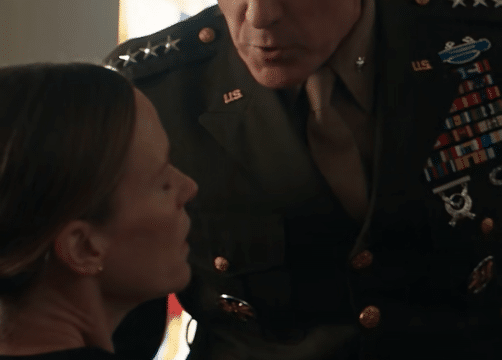
The sheriff who came through the door was a woman named Elena Brooks.
She knew Scar. Everyone in three counties did. But she didn’t know him well enough to take his word over paperwork, and Scar respected that. What mattered was that she also knew Lily Danner’s missing-person file, because she had tried to reopen it once and found half the records sealed under estate privilege.
That had bothered her for years.
When she saw Noah, it bothered her more.
Adrian handed over the guardianship papers with visible relief. “At last,” he said. “Please remove the child from this environment.”
Sheriff Brooks read the documents without expression.
Then she looked at Noah.
“What’s your full name, sweetheart?”
Noah swallowed. “Noah Mercer.”
“Do you want to go with Mr. Vale?”
“No.”
The word came fast. Immediate. Whole.
Brooks turned a page.
“And how old are you?”
“Seven.”
Adrian interrupted. “He’s confused and traumatized.”
Brooks didn’t even look at him. “I wasn’t asking you.”
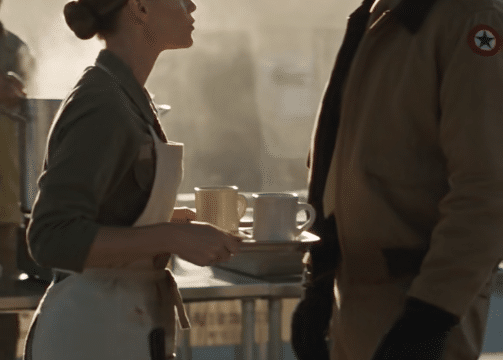
The waitress set a fresh pot of coffee down on the far counter and quietly killed the jukebox. Even the diner seemed to know it was time for truth to stop competing with background noise.
Scar stepped forward and handed Brooks the bracelet, the note, the key, and the old photograph.
“She was my sister,” he said. “And if this child got here with that sewn into his sleeve, somebody knew he’d need a way out.”
Brooks took the items slowly.
When she read Lily’s handwriting, her mouth tightened.
Then Noah, who had spent the last twenty minutes trying not to fall apart, did something that finished Adrian’s chances for good.
He reached into his other pocket and pulled out a tiny voice recorder, the cheap kind that clipped to a folder or keychain. His hand was shaking so badly he nearly dropped it.
“My mom said don’t play it unless he finds me,” he whispered.
Brooks took it.
Adrian stepped forward fast. “That device is privileged material—”
Two bikers moved between him and the sheriff at once.
No threats. No swinging fists. Just a wall of leather and bone and certainty.
Brooks pressed play.
The room filled with static first. Then Lily’s voice.
Thin. Tired. Unmistakably afraid.
If you’re hearing this, Noah got away.
A sound moved through Scar’s chest that didn’t quite make it to his mouth.
On the recording, Lily kept speaking.
My name is Lily Mercer, and if anything happens to me or my husband, it was Adrian Vale. He took Owen’s files. He forged the trust documents. He said if we fought him, our son would disappear into his system and no one would ever find him again.
Noah closed his eyes.
Scar did not.
Lily’s voice cracked once, then steadied.
Noah, if Rafe is with you, listen to him. He was a hard brother, but never a cruel one. He will keep you safe. The key opens box 214 at County First Bank. Everything Adrian wants is in there. Birth records. The real guardianship letter. Owen’s files. All of it.
The recorder clicked off.
No one in the diner moved for two full seconds.
Then Sheriff Brooks looked up from the device to Adrian Vale, and whatever remained of his confidence finally slipped.
“You want to explain why a dead woman named you on a hidden recording?” she asked.
Adrian’s face became a mask again. But now it was the mask of a man running out of exits.
“She was unstable.”
Scar took one step toward him.
Just one.
And Adrian, for all his tailored calm, stepped back.
That told the room everything it needed to know.
By the time Brooks put him in cuffs, the diner still had not exploded into violence. That was the strange, satisfying part. Adrian had walked in expecting chaos from bikers and control from himself.
Instead, he got the opposite.
He was the one unraveling in public.
And when Noah finally let go of Scar’s vest, it wasn’t because he felt less afraid.
It was because for the first time all night, he believed someone else was afraid instead.
Act V
They opened safe-deposit box 214 the next morning.
Scar, Sheriff Brooks, a county attorney, and Noah all stood in a little room at County First Bank that smelled faintly of paper, metal, and stale air-conditioning. Noah sat in a chair too big for him, clutching a carton of chocolate milk from the diner because the waitress had insisted no child should face a morning like this empty-handed.
Inside the box was Lily’s whole fight, neatly stacked.
Birth certificates.
A notarized emergency guardianship letter naming Rafe Danner as Noah’s caretaker if anything ever happened to her and Owen.
Copies of trust transfers Adrian had altered.
Email printouts proving Owen had discovered embezzlement inside one of Adrian’s estate accounts.
And at the bottom, wrapped in a baby blanket with faded blue stitching, there was a photograph of Lily holding Noah as a newborn, smiling into the camera like a woman who still believed love alone might be enough to protect what she had made.
Scar had to turn away for a second after that.
The legal storm came fast.
Adrian Vale’s temporary guardianship was suspended that afternoon. By the end of the week, the county had reopened the fire investigation, the financial fraud case, and the missing records tied to Noah’s identity. Men who had once answered Adrian’s calls stopped picking up. Firms distanced themselves. Reporters started digging. One accountant decided cooperation sounded better than prison.
The truth, once it got air, moved quicker than fear.
Noah stayed at the diner the first two nights because he refused to sleep anywhere else.
So Scar made up a bed in the apartment over the kitchen, and three Black Dragons who looked like they’d lost fistfights with trucks spent those nights taking turns sitting outside the boy’s door in folding chairs, pretending they were only there because no one trusted the old lock.
By the third night, Noah finally asked the question he’d been holding back.
“Are you really my mom’s brother?”
Scar was fixing the torn hem of the gray hoodie at the counter when the words came. He looked up, needle still in one scarred hand, and nodded.
“Yeah.”
Noah considered that carefully. “Why didn’t she live here?”
Scar gave a tired half-smile.
“Because she was smarter than me.”
That got the smallest laugh out of the boy.
Then Scar set the hoodie down and told him the truth in the only way children ever really accepted it.
“She left because she wanted a softer life than the one we grew up in. She was right to want it. I was just too proud to say that in time.”
Noah looked at the patch on Scar’s chest. Then at the motorcycles outside the window. Then back at the man who looked built for damage but had spent ten minutes threading a needle so he could fix a child’s sleeve instead of buying a new sweatshirt.
“She said you were hard,” Noah said.
Scar huffed once. “Sounds like Lily.”
“She also said you weren’t cruel.”
That landed deeper than Scar expected.
For a long moment, he didn’t answer. The diner hummed around them below, all ordinary noise again—plates, laughter, boots, coffee.
Finally, he said, “Your mom was one of the only people who ever knew the difference.”
The custody hearing came two weeks later, but by then the outcome barely felt in doubt. The judge had the recording. The real papers. The evidence. The history. Most of all, she had Noah’s own voice, clear and unwavering when asked where he felt safe.
“With my uncle Rafe,” he said.
He did not look at Adrian when he said it.
He didn’t need to.
Months later, the diner still looked the same from the highway—same neon, same old wooden bar, same line of bikes outside after dark. But inside, there was a drawing taped near the register now. Crayon dragons. A crooked motorcycle. One enormous man in a leather vest standing in front of a little boy with messy hair.
The waitress had framed it.
Scar pretended not to notice it most days.
One late evening, when the crowd had thinned and the road outside was all darkness again, Noah climbed onto the stool beside him and leaned against his arm like the movement had become natural.
“Was I lost?” he asked.
Scar glanced down at him.
Noah’s eyes were on the window, on the motorcycles, on the night that had once looked like nothing but danger.
Scar shook his head.
“No,” he said. “You were hidden.”
Noah was quiet for a second.
“Then how did you find me?”
Scar looked toward the door where the child had burst in terrified that first night, small enough to be swallowed by the room and brave enough to run into it anyway.
“You found me first,” he said.
And in the end, that was the part no one in that diner ever forgot.
Not the suit. Not the papers. Not even the handcuffs.
Just a little boy in a gray hoodie running through the door, grabbing a biker’s vest with both hands, and choosing the right kind of monster to save him.