Act I
At first, it looked like a small thing.
That was how public humiliations always began. Small enough for everyone nearby to pretend they were misunderstanding what they were seeing. A raised voice disguised as procedure. A trembling hand mistaken for inconvenience. A woman in distress reduced to a problem that needed to be removed before departure.
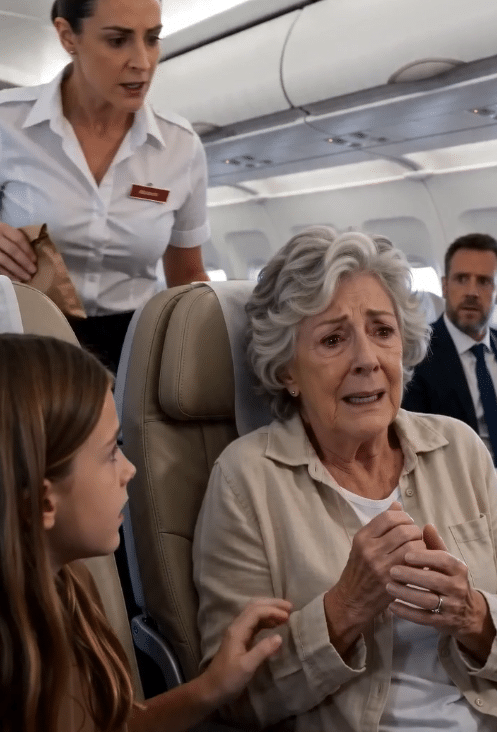
The airplane cabin was still in that strange half-settled stage before takeoff, when seat belts clicked, overhead bins thudded shut, and strangers avoided eye contact with the concentration of people who knew they were about to be trapped together for hours. Soft beige seats. Dim overhead light. The stale hush of recycled air. A businessman in a suit sat directly behind Row 14, already pretending not to notice anything that did not affect his itinerary.
Then the elderly woman in 14A clutched the brown paper bag tighter and said, in a voice so raw it turned heads anyway, “Please, I need it.”
The flight attendant did not raise her own voice.
That almost made it worse.
She bent down with the calm, professional severity of someone who had already decided this was not a conversation. Her dark hair was pinned back neatly. Her scarf sat perfectly at her throat. Her expression did not hold anger. Only the cold efficiency of a person who believed rules became virtue the moment she enforced them.
“Ma’am, I’ve told you already,” she said. “You cannot keep this with you during taxi and takeoff.”
The woman’s fingers tightened around the bag until the paper crinkled under the strain. Her pearl necklace trembled lightly against the collar of her coat. “Please,” she repeated. “I need it.”
There were tears in her eyes now, the kind that made nearby people deeply uncomfortable because they suggested something more serious than inconvenience. But the discomfort in the cabin did not become courage. It became silence.
The flight attendant reached down and pulled the bag free.
Not violently. Not dramatically. Just firmly enough to let the woman know that pleading would not move her.
The grandmother made a small sound when it left her hands.
It was not loud. But it was devastating.
Beside her, the little girl who could not have been older than eight went stiff. She had long blonde hair and a white cardigan buttoned crookedly, as if she had dressed herself in a rush that morning. Until then she had stayed quiet, one hand resting on her grandmother’s sleeve, watching everything with eyes too old for her face.
Now those eyes followed the paper bag as the flight attendant turned and walked away with it.
The woman in 14A looked like someone who had just been separated from the only thing keeping her together.
Around them, the cabin did what cabins always did. People shifted. Looked away. Reached for phones they would soon have to turn off. A man across the aisle frowned in mild sympathy and then returned to his magazine. The businessman behind them remained perfectly still, though his jaw tightened once, almost imperceptibly, as if even he understood that whatever had just happened did not belong in the category of ordinary travel conflict.
The little girl turned quickly and took both of her grandmother’s hands.
“Grandma,” she whispered, steady in a way no child should have needed to be, “don’t say anything.”
The older woman’s face crumpled.
For one strange, painful second, the roles in the row seemed to reverse. The child became the anchor. The grandmother became the one trying not to break apart in public.
“Lucy,” the woman said shakily, “she took it.”
“I know.”
“It can’t go in cargo,” her grandmother whispered. “It can’t go anywhere else.”
Lucy squeezed her hands harder. Not with childish panic. With intent.
There was a look in her face then that did not belong to a little girl on an airplane. It belonged to someone who had seen adults make terrible decisions and had quietly learned that waiting for them to fix those decisions was often a mistake.
She glanced once toward the aisle where the flight attendant had disappeared with the bag.
Then she reached into the sleeve of her cardigan, pulled out a blue smartphone, tapped the screen with practiced fingers, and lifted it to her ear.
“Hi,” she said.
Her voice was calm. Serious. Focused.
“I need help.”
And in the seat behind them, the businessman finally looked up.
Because he knew exactly who that child was calling.
Act II
Her grandmother’s name was Eleanor Wren, and once, long before grief had made her hands shake, people used to fall silent when she entered a room for entirely different reasons.
Not because she was important in the polished, magazine-profile sense. She had never wanted that kind of life. She had spent forty-two years as a conservator at a major city museum, the sort of woman who repaired damaged things so carefully that strangers trusted her with objects they considered irreplaceable. Paintings scarred by water. Letters browned by time. Family heirlooms rescued from estate boxes and fire damage and neglect.
Eleanor believed, almost stubbornly, that what people carried mattered.
Not the expensive things. The meaningful ones.
The wedding veil kept in acid-free tissue. The cracked photograph repaired at the edges because it was the last image of someone gone. The child’s drawing tucked into a frame because a mother could not bear to lose the crooked little sun in the corner.
She had built her life around the quiet rescue of fragile things.
Then, five years earlier, her daughter Mara died in a winter car accident on an icy bridge outside Hartford, and Eleanor discovered there were some losses no pair of careful hands could restore. Mara left behind only one child—Lucy—and a husband who had always loved distance a little more than family. He was gone from their lives within a year. Not dead. Just absent in the clean, legal way men sometimes disappeared while still sending birthday money and calling it devotion.
So Lucy moved in with Eleanor.
From that moment on, Eleanor stopped thinking of herself as a widow or a retired conservator or a woman aging into loneliness. She became one thing above all else: the keeper of what remained.
That was why they were on the plane.
Not for a vacation. Not even for family.
They were flying to Seattle because a private clinic there had finally agreed to review Lucy’s case after two years of delays, rejections, and insurance language so cold it felt almost elegant in its cruelty. Lucy had a rare neurological condition that no one had caught quickly enough after the accident that killed her mother. It wasn’t visible at a glance. That was part of the problem. From the outside she looked healthy, bright, composed.
But there were episodes.
Sudden, terrifying collapses that began with a tremor in her left hand and ended with her body locking in ways no child should ever experience. The specialists back home had called it manageable when what they meant was expensive. The medication that helped most had to stay temperature-stable, accessible, and under direct supervision. It could not be checked. It could not be tossed casually into overhead storage. It definitely could not be removed and handled by people who had reduced it to “that paper bag.”
Because the bag was not just a bag.
Inside it was a slim insulated pouch holding Lucy’s emergency medication, a letter from the clinic, and a sealed envelope written by Mara in the final week before her death—a letter Eleanor had never been able to read all the way through without crying.
She had carried all of it close to her chest from the moment they left home.
And now a woman in a pressed navy blazer had taken it as if it were a lunch she could surrender for convenience.
“Grandma,” Lucy said softly, lowering the phone for a second, “breathe.”
Eleanor tried.
She could feel the plane around her in sharp, unpleasant fragments—the hard armrest, the cool air vent above, the rustle of strangers pretending not to listen. Shame crept in fast at her age. Not because she had done anything wrong, but because public distress made people treat old women like they had become unreliable narrators of their own lives.
“I told her what it was,” Eleanor whispered. “I told her.”
Lucy’s face tightened. “I know you did.”
Across the aisle, a young man in headphones stole a glance, then another. The woman in the window seat opposite frowned sympathetically but kept still. The businessman behind them leaned forward just slightly.
“Excuse me,” he said in a low voice.
Eleanor turned.
Up close, he looked younger than his suit suggested, maybe early forties, controlled and expensive in the way of men who spent more time in airports than in living rooms. But something in his expression was off. Not detached. Tense.
“I heard enough to understand there may be a medical issue,” he said carefully. “Did she take medication?”
Lucy answered before Eleanor could. “Yes.”
The man’s gaze shifted to the phone in her hand. “Who are you calling?”
Lucy looked straight at him.
“My mother told me if grown-ups stop listening to Grandma, I’m supposed to call the one person who can make them.”
For the first time, the businessman’s composure cracked.
“What’s your name?” he asked.
“Lucy Wren.”
He went still.
Very still.
Eleanor looked from him to her granddaughter, confusion rising through the panic. “Lucy?”
Lucy swallowed. Then, with the air of a child saying something she had been taught to use only when necessary, she spoke into the phone again.
“Tell him it’s me,” she said. “Tell him Grandma has the brown bag.”
The businessman shut his eyes for one brief second, like a man recognizing disaster by its exact shape.
When he opened them again, he no longer looked like a stranger behind them in Row 15.
He looked like someone who had spent years trying not to deserve this moment.
“Your mother,” he said quietly, “was Mara Wren.”
It was not a question.
Eleanor’s breath caught.
The girl nodded once.
And that was the moment Eleanor recognized him too—not from the plane, not from any recent photograph, but from the painful, half-buried architecture of her daughter’s old life.
Daniel Mercer.
The man Mara had nearly married before she chose someone gentler, poorer, and, as it turned out, far less dependable.
The man who had left for London the same week Mara announced her pregnancy.
The man who had returned too late for everything that mattered.
The phone remained at Lucy’s ear.
Then a voice on the other end spoke loudly enough that even Eleanor heard only one sentence clearly:
“Keep that line open. I’m calling the captain.”
And suddenly the humiliation in Row 14 was no longer just a fight over a bag.
Because the child’s call had reached much higher than the aisle.
And the man sitting directly behind them had secrets of his own.
Act III
Daniel Mercer had spent seven years learning how to live with regret in a way that still looked successful from the outside.
He had the right title now. The right apartment. The right photographs in financial magazines. The kind of reputation that made people use phrases like strategic brilliance and operational leadership. He was, among other things, a senior crisis consultant for the parent group that handled service escalation for three regional airlines, including the one he was currently flying.
That mattered.
But not as much as the other truth.
Lucy was his daughter.
No one in Row 14 knew for certain that he knew it.
Mara had told him once, after the wedding plans had collapsed and the timing no longer allowed for easy forgiveness. She had done it in a single email, one paragraph buried between anger and heartbreak and that frightening kind of honesty only the deeply wounded can manage without embellishment. Daniel had read it in a hotel room in Geneva at 2:14 in the morning and spent the next ten years hating himself in professionally manageable portions.
He had tried to come back.
Mara had refused.
Not out of cruelty. Out of exhaustion.
By the time he finally found the courage to insist, she was already gone.
Eleanor had never forgiven him for that. She had not needed to say it. The silence after the funeral had done all the work for her.
So Daniel had done what ashamed men with resources often did when they believed they had forfeited the right to love openly: he helped from a distance. Anonymous medical grants routed through foundations. Quiet pressure on insurers. Recommendations to specialists without his name attached. Enough to ease the road a little. Never enough to make up for not having walked it beside them.
Lucy had known the truth for less than a year.
Mara’s final letter had told her.
Eleanor had wanted to wait until she was older, but grief had rearranged too many things. The girl found the envelope in a cedar box one rainy Saturday, and once questions like that entered a child’s life, they did not leave politely.
Daniel had met Lucy twice since then, always carefully, always with Eleanor present, each meeting so fragile it felt as if one wrong word might send the whole structure crashing down.
Now he was on the same flight by coincidence that no longer felt like coincidence at all.
“Where is the bag?” he asked, already standing.
Eleanor stared at him, stunned by the collision of timelines—Mara’s past, Lucy’s present, this impossible cramped airplane row.
“The flight attendant took it,” she whispered.
Daniel was in the aisle before she finished the sentence.
A few passengers looked up as he moved toward the galley with a speed that belonged less to anger than to terror disguised as control. He did not shout. Men like Daniel almost never shouted. They became quieter when they were most dangerous to the smooth machinery around them.
The flight attendant turned when he approached.
“Sir, you need to return to your seat—”
“The brown paper bag you removed from Row 14,” he said. “Where is it?”
Her face hardened slightly at the interruption. “A non-compliant item is being secured until after departure.”
“It contains emergency pediatric medication.”
That made her pause, but only for a second.
“The passenger did not present it properly for—”
“She told you,” Daniel said.
The words landed with precise force.
“She told you, and you decided her age and distress made her less credible than your assumption.”
Passengers nearby had started listening openly now.
The attendant shifted into that brittle tone airline staff used when they sensed conflict turning against them but had not yet accepted that it already had. “Sir, I’m following cabin procedures.”
Daniel took out his phone, showed her the call screen, then lifted his gaze.
“Good,” he said. “Then you’ll appreciate knowing the captain is on with corporate medical operations and that this conversation is currently being documented.”
The color changed in her face.
In the cabin behind them, Lucy remained very still, holding the phone with both hands now. Eleanor could hear only fragments of distant voices, but one thing was clear: her granddaughter had not called for comfort.
She had called for leverage.
“Grandma,” Lucy said softly, “it’s okay.”
But Eleanor’s eyes had filled again, and not just from panic this time.
For years she had been the one holding everything together with tired dignity and detailed folders and careful explanations for people who needed three forms, two signatures, and a witness before believing the truth of another person’s need. She had spent so long making herself smaller in offices and waiting rooms that she had not realized Lucy had been watching, learning where gentleness failed.
Now the child beside her was doing what Eleanor had always feared she might someday need to do.
She was becoming hard too early.
At the galley, the flight attendant swallowed once. “I’ll retrieve the item.”
But Daniel wasn’t finished.
“No,” he said. “You’ll retrieve it, and then you’ll explain to the captain why an elderly woman had to beg you in public to keep her granddaughter’s medication near her.”
That was when the other part of the story surfaced.
Because another crew member, older and far less certain now, opened the service compartment and handed over the brown paper bag with obvious reluctance. Attached to it was a printed note.
Security concern flagged by attendant after passenger behavior deemed erratic.
Daniel read it and went cold.
Erratic.
That was the word.
Not grieving. Not frightened. Not medically urgent. Not elderly and trying not to cry.
Erratic.
Eleanor had been translated into a category that stripped her humanity and made confiscation look reasonable.
When Daniel turned back toward Row 14 with the recovered bag in his hand, the cabin had gone almost completely silent.
Everyone understood now that something ugly had happened.
But they still didn’t know the worst part.
The medication pouch inside the bag was open.
And one of the vials was missing.
Act IV
Eleanor saw it immediately.
The moment Daniel placed the bag back in her lap, her trembling fingers went straight to the insulated pouch as if they already knew how disaster felt by touch alone. She opened it, stared inside, and all the blood left her face.
“No,” she whispered.
Lucy leaned closer. “What?”
Eleanor looked up at Daniel with the expression of someone standing at the edge of a cliff she no longer had the strength to climb away from.
“There were two.”
Daniel took the pouch gently, checked it himself, then looked toward the galley with a calm so dangerous it no longer even resembled anger.
“How many doses does she need?”
“One emergency dose accessible at all times,” Eleanor said, her voice shaking harder now. “The second is for the clinic in Seattle. It has to be documented unopened. It has to be there.”
Lucy blinked, not fully understanding the medical bureaucracy of her own survival, but understanding enough to know something irreversible had just happened.
“If they touched it,” Eleanor said, almost to herself, “if chain custody is broken, the clinic may refuse intake. They’ve postponed us twice already. They said this appointment was final. Daniel, they said final.”
Hearing his name from her in that tone did something to him.
Not forgiveness. Nothing that easy.
But necessity had broken through old resentment, and now they were standing together inside the same emergency at last.
Daniel turned and walked back to the galley.
This time he did not stop at the attendant.
“Open every service compartment,” he said.
The lead flight attendant stared at him. “Sir, you cannot instruct cabin crew—”
“Then call the captain out here,” Daniel replied. “Right now.”
His voice never rose. It only got flatter. More exact. The kind of tone that made institutions realize one of their own languages had just been turned against them.
A murmur ran through the nearby rows. The businessman in 12C unbuckled slightly to see better. A mother across the aisle drew her son closer without quite knowing why. Even the passengers who hated delay more than injustice could tell this had moved beyond inconvenience.
An older purser arrived from first class within minutes, followed by the captain himself from the cockpit door, summoned before pushback. He was a silver-haired man with the exhausted expression of someone used to solving problems quickly and quietly, but whatever he expected, it was not the sight of a child sitting rigidly beside a distraught grandmother while one of his attendants stood near a service cart looking increasingly cornered.
Daniel explained everything in three clipped sentences.
The captain listened once, then asked the only sensible question.
“Was medication removed from passenger custody?”
The attendant hesitated.
That hesitation destroyed her.
Because guilt, once visible, changes the temperature of an entire space.
“I was concerned about possible undeclared liquid items,” she said. “I separated them for review.”
“You opened a medically labeled insulated pouch?” Daniel asked.
She said nothing.
The captain’s face hardened.
Meanwhile Lucy touched Eleanor’s wrist. “Grandma.”
The tremor had started.
Small at first, just a faint shake in Lucy’s left fingers, barely visible against the armrest. But Eleanor knew the signs too well. Stress was one of the triggers. So was heat. So was fear swallowing too much oxygen from a little body trying to act brave.
“Not now,” Eleanor whispered, horrified. “Please, sweetheart, not now.”
Daniel saw it too.
Everything accelerated.
The captain ordered the pouch contents accounted for immediately. A second crew member opened the top storage of the service cart. Nothing. Another checked the waste compartment. Nothing. The attendant finally admitted she had removed one vial and placed it separately “for security review,” then could not immediately remember where.
That was the moment the cabin’s sympathy turned.
People had tolerated sternness. They had tolerated delay. They had even tolerated public embarrassment because air travel had trained them to accept miniature tyrannies as part of the cost of movement.
But misplacing a sick child’s medication after humiliating her grandmother?
That was different.
A man across the aisle spoke up first. “Are you kidding me?”
Then the woman with the magazine stood. “She told you she needed it.”
The older purser found the vial at last inside a plastic service drawer beneath sealed beverage stock, rolling loose beside napkin packs and plastic stirrers.
Eleanor made a sound halfway between relief and fury.
The captain took the vial himself, checked the label, then handed it directly back to her with both hands, as if trying to restore dignity along with possession.
But the real reversal had not happened yet.
Because when Lucy’s tremor worsened and Eleanor, panicking, prepared the emergency dose, the captain knelt beside the row and asked quietly, “Do you need us to deplane for medical priority?”
Daniel looked at Lucy, then at the trembling in her hand, then at the clinic file sticking from the brown bag.
The choice was brutal. Stay and risk escalation in the air. Deplane and likely lose the appointment that had taken two years to secure.
Lucy, pale but composed, looked at her grandmother first.
Then she looked at Daniel.
And in a voice so small it made half the row lean in to hear, she said, “If we miss this one, will they stop trying?”
No one answered immediately.
No one could.
Because everyone around them suddenly understood the real shape of the fight. This was not just about one rude crew member. It was about what happened when fragile people needed systems built by the unafraid.
Then the captain made a decision that changed everything.
“This aircraft is not moving,” he said, rising to his feet, “until our medical consult clears the child, the medication is verified, and the clinic in Seattle confirms intake upon landing. And someone from executive support will be meeting this family at the gate.”
He looked directly at Daniel then, understanding enough now.
Daniel nodded once.
The attendant looked like she might finally cry, but it was too late for tears to protect her from consequence.
Because the little girl in 14B had made one call.
And by the time the plane doors reopened for priority medical review, the people around Row 14 were no longer pretending not to see what dignity looked like when a child fought to protect it.
Act V
The flight took off seventy-three minutes late.
In ordinary travel logic, that was a disaster.
In Eleanor Wren’s life, it was the first time in years an institution had delayed itself instead of asking her granddaughter to bear the cost.
A doctor on the ground reviewed Lucy’s symptoms before departure. The emergency dose was not needed after all; water, oxygen, quiet, and the sheer easing of panic stabilized her enough for clearance. The clinic in Seattle was called directly from the tarmac and agreed to hold the intake window no matter when they landed. The captain personally updated the passengers, not with vague apologies about operational issues, but with a plain statement: a medical handling error had occurred, and it was being corrected.
Something shifted in the cabin after that.
People looked at Eleanor differently.
Not with pity. With recognition.
The woman across the aisle offered Lucy a packet of crackers and said she had a granddaughter the same age. The young man in headphones quietly traded seats so Daniel could move closer without making a scene of it. Even the businessman two rows up, who had spent the first half hour tapping irritably at his watch, muttered that some delays were worth having.
The flight attendant who had taken the bag did not return to their section.
The older purser did. More than once. Each time with a gentleness so careful it almost hurt. Tea for Eleanor. A blanket for Lucy. Water for Daniel, who barely touched it.
For most of the flight, the three of them sat in a silence that no longer felt empty.
Lucy slept eventually, her head tipped against Eleanor’s arm. Eleanor kept one hand over the brown paper bag the whole time, not out of fear now, but out of habit so old it had become part of her. Daniel sat beside them in the reassigned aisle seat, looking not at the clouds beyond the window but at the child he had missed too much of.
At one point, somewhere above Minnesota, Eleanor spoke without turning.
“She had your eyes from the day she was born,” she said.
Daniel’s breath caught.
For a long moment, he said nothing at all.
Then, very quietly, “I know.”
Eleanor looked down at Lucy’s sleeping face. “Mara hated you for leaving.”
“I know.”
“She loved you anyway.”
That landed harder.
Daniel pressed his thumb once against the edge of the armrest as though holding himself steady by force. “I know that too.”
Eleanor finally turned toward him. The years between them were still there, layered and heavy. Funerals. Silence. Missed first days of school. Fevers. Bills. Letters half-read and not answered fast enough. No single flight across the country was going to solve that.
But grief had taught her something pride never could.
The people who failed you once were not always the people they remained forever.
“She told Lucy,” Eleanor said. “In the letter.”
Daniel closed his eyes briefly. “I didn’t ask her to.”
“I know.”
When he opened them again, they were wet.
Not dramatically. Just enough.
“I don’t know what right I’ve earned,” he said. “Maybe none. But I’m here now.”
Eleanor studied him for a long second, then looked back at the sleeping child between them.
“Then be here without making her pay for how late you are.”
It was the closest thing to mercy he deserved, and he knew it.
When they landed in Seattle, the gate area was already waiting.
A wheelchair escort for Eleanor, though she insisted she could still walk. A pediatric transport liaison from the clinic. A senior airline executive with the pale, rattled politeness of someone who had been briefed thoroughly and urgently. There were apologies, formal and personal. There were offers of reimbursement, upgraded return travel, hotel coverage, written assurances, direct lines.
Eleanor accepted only what helped Lucy.
Nothing more.
At the clinic, the intake nurse checked the second vial, verified it had remained sealed after all, and smiled with the relief of someone who knew how close bureaucracy had come to ruining something precious.
“You made it,” she said.
Eleanor nearly broke at those three words.
Not because they were dramatic.
Because they were rare.
Lucy looked from the nurse to her grandmother, then to Daniel standing just a little apart, unsure of where to place his hands, his guilt, his hope.
“Grandma,” she said, “can he stay?”
Eleanor looked at Daniel.
Then at Lucy.
Then at the brown paper bag resting on the chair beside them, creased and ordinary and still somehow carrying the full weight of the last twenty-four hours.
“Yes,” she said.
Daniel exhaled like a man who had been underwater for years.
Later that night, after tests and consultations and cautious good news from specialists who believed they could actually help, Lucy asked Eleanor for the envelope from Mara.
The one that had traveled inside the bag all along.
Eleanor hesitated, then handed it over.
Lucy unfolded it carefully, reading in silence for a long time before looking up with tears shining in her eyes.
“What did she mean,” Lucy asked, “when she wrote that love is not proved by who holds you when it’s easy, but by who refuses to let go when the world starts treating you like luggage?”
Eleanor looked toward the hallway where Daniel stood speaking quietly with a doctor, his shoulders still tense, still learning how to remain instead of run.
Then she smoothed Lucy’s hair back from her face.
“She meant,” Eleanor said softly, “that some people only understand your value when they’re forced to stop the machine for you.”
Lucy thought about that.
Then she smiled, tired and small and suddenly very much her mother’s daughter.
On the plane, the flight attendant had seen an old woman with a paper bag and decided inconvenience before humanity. She had looked at trembling hands and heard instability. She had looked at desperate love and called it non-compliance.
But by the end of that day, the thing everyone remembered was not her authority.
It was the little girl in Row 14 lifting a blue phone to her ear while her grandmother tried not to cry.
It was the calm in her voice.
It was the fact that she knew, somehow, that dignity sometimes had to be defended before it disappeared behind procedure.
And it was the sound that came afterward.
Not the flight announcement.
Not the apology.
Not even the captain’s order.
Just the soft, wrinkled rustle of a brown paper bag finally returned to the hands that never should have lost it at all.