Act I: The Foot on My Armrest
By the time the cabin lights dimmed, I already knew the flight was going to be miserable.
It was one of those overnight routes that feels less like travel and more like a suspended argument with gravity. Narrow blue seats. Stale air. Half the cabin trying to sleep, the other half pretending they still had patience left for strangers.
I had seat 14A.
Window.
The kind of seat I usually liked because it let me disappear.
That night, disappearing stopped being an option the moment the man in 14C took off his shoes.
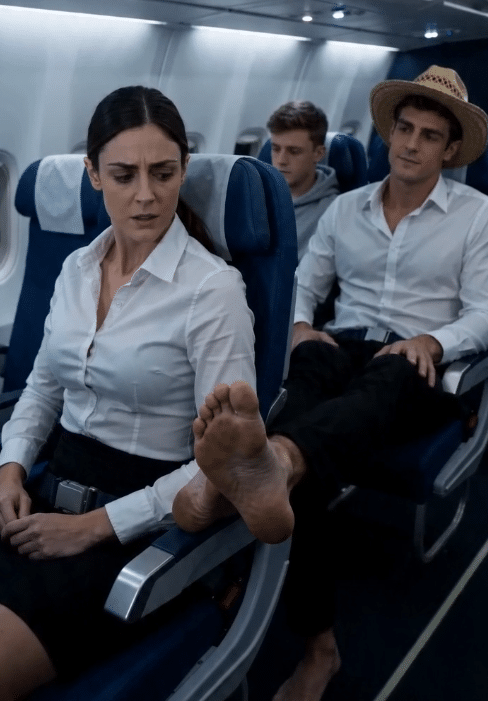
He wore a straw hat tilted too low over his eyes and a dark shirt printed with yellow pineapples. He had a heavy mustache, long dark hair, and the sort of deeply relaxed body language some men cultivate as if public spaces were simply unfinished extensions of their own living rooms.
The man between us was thin, nervous, and silent in a grey bucket hat and purple jersey. He kept his elbows close to his ribs like he was trying to reduce himself to a legal minimum. I remember thinking he looked exactly like someone who had learned early that surviving conflict meant becoming smaller than it.
Then the barefoot man lifted his left foot and placed it on my armrest.
For a second, I honestly thought it had to be an accident.
I looked down.
Bare skin.
Dirt at the heel.
Toenails I did not need to know anything about.
And then I turned toward him.
“Remove your foot,” I said.
He didn’t even look embarrassed.
He adjusted the brim of his hat with two fingers, glanced at me once, and said, “No.”
The middle passenger stared straight ahead so hard I thought his eyes might lock that way permanently.
I pushed the foot off my armrest.
Not violently. Firmly.
The man’s leg dropped to the floor, and for one hopeful second, I thought maybe that had been enough. Maybe he was just one of those overgrown boys who mistakes rudeness for freedom until someone pushes back.
Then, without a word, he lifted the same bare foot and placed it back on my armrest.
This time he angled it closer.
Deliberately.
I turned away toward the aisle because if I kept looking at him, I was going to do something noisy and stupid on a plane six miles up with nowhere to go. Anger sat in my chest like a second pulse.
That was when the middle passenger spoke for the first time.
Not aloud.
He slid a napkin onto the tray table between us.
Three words, written in cramped blue ink.
Don’t say your name.
I stared at the napkin.
Then at him.
He didn’t look at me. He kept his gaze fixed on the seatback screen in front of him, jaw tight, breathing shallow. If I had not seen his hand move, I might have thought the note appeared by itself.
I folded the napkin under my phone.
My heart had changed rhythm.
Because annoying men on planes are common.
Men who arrive with instructions attached to them are not.
A few minutes later, the barefoot man leaned his head back, closed his eyes, and said in a voice just loud enough for me to hear:
“You look exactly like her, you know.”
I didn’t answer.
He smiled without opening his eyes.
“Your mother had the same eyes.”
And just like that, the flight stopped being about a stranger’s foot on my armrest.
Act II: The Files My Mother Died Protecting
My mother’s name was Linda Mercer.
Until six months earlier, the worst thing I thought I knew about her death was how ordinary it looked on paper.
Complications after a fall.
Medication interaction.
End-stage stress.
Private hospice transfer.
The language was tidy enough to make grief feel bureaucratic.
Then I found the file box in the back of her hall closet, hidden behind winter blankets and old tax binders. Inside were patient intake forms, notarized powers of attorney, probate transfer letters, and copies of court petitions tied to elderly patients from three private care facilities in Maryland and Virginia.
The same names kept repeating.
Same attorney.
Same evaluator.
Same “emergency incapacity” wording.
Same rapid estate transfers.
And in my mother’s handwriting, circled in red on the front of one folder, were six words:
They are stealing people before death.
My mother had been a records administrator for a private elder-care network called Sun Harbor Holdings. Publicly, the company specialized in dignified end-of-life transitions and family support planning. Privately, according to the files she died trying to organize, they accelerated legal control over vulnerable patients before those patients or their families understood what was happening.
Homes moved.
Trusts changed.
Access restricted.
Children locked out.
Bank accounts consolidated.
All of it under the language of care.
When I started calling reporters, no one called back.
When I tried a state ombudsman’s office, my message never got returned.
When I brought a folder to a probate attorney in Baltimore, his receptionist glanced at two pages and told me, very carefully, that he had a conflict and could not advise me.
That was when I understood the problem was bigger than a predatory care chain.
My mother had found a machine.
And machines are never made of one man.
By the time I boarded the red-eye to Washington, I had copied every document onto two encrypted drives. One was in my carry-on. The other was taped inside the lining of my suitcase. I was flying to meet a Senate investigator who had finally agreed to see me in person after a former hospice nurse confirmed parts of my mother’s notes.
I had not told a single person on the plane my name.
Not at the gate.
Not during boarding.
Not to the flight attendant.
Not to the man with the foot.
So when he said my mother had my eyes, my skin went cold.
I looked at the middle passenger again.
This time, he risked a glance.
There was fear in it, yes. But also recognition. The kind that comes when someone realizes the person he’s been too scared to warn has finally understood the shape of the room.
The barefoot man shifted slightly in his seat and pretended to settle for sleep.
Then, without looking at me, he said, “Linda Mercer should’ve stayed out of grown people’s paperwork.”
The middle passenger flinched.
I stopped breathing for a second.
He knew her name.
He knew enough to say it like a threat.
I pressed the flight attendant call button.
Not because I thought she could solve it. Because I wanted a witness with a uniform and a timestamp.
The man smiled again.
“Go ahead,” he said softly. “Tell her about my foot.”
I did not.
Not yet.
Because in that moment, I realized something worse than being followed.
He wasn’t trying to hide who he was.
He was trying to make me react first.
And the moment I understood that, the middle passenger finally whispered the words I should have heard at the gate.
“He’s not here by accident.”
Act III: The Man in the Hat Knew the Hearing Time
The flight attendant came, heard “seat dispute,” looked tired enough to resent all three of us, and politely asked him to keep his foot in his own space.
He apologized so smoothly it made my stomach turn.
A perfect little smile.
A respectful nod.
A muttered “didn’t realize.”
The performance was good enough that if you had only watched those ten seconds, you would have believed I was difficult and he was merely careless.
The moment she left, he placed the foot back on my armrest.
More gently this time.
Like a signature.
I stood.
“Can we switch?” I asked the middle passenger.
The man in the bucket hat shook his head almost imperceptibly.
Not yet.
That answer made no sense until he unfolded a boarding pass from his pocket and slid it halfway under the safety card. The name printed there was not his. Seat 14B belonged to someone named Stephen Rowe.
He saw me read it and whispered, “He made me trade at the gate.”
The barefoot man kept staring ahead, smiling faintly at nothing.
“You should listen to him,” he said. “He’s had a very stressful year.”
That got my full attention.
The middle passenger’s mouth tightened.
He finally turned toward me.
Very quietly, in the tone of someone trying to keep a weapon from hearing its own name, he said, “My real name is Dr. Simon Vale.”
I knew the name.
Not from the flight.
From my mother’s files.
A consulting physician had signed eight rapid incapacity certifications tied to Sun Harbor. The same physician later filed amended notes claiming two of those patients had shown “terminal confusion” severe enough to justify restricted family access. My mother had written beside his name:
He knows.
He signs anyway.
Simon saw recognition hit me and looked like a man who had just accepted his own shame all over again.
“I’m trying to fix it,” he whispered.
The barefoot man clicked his tongue once.
“That’s a generous phrasing.”
I looked between them.
Then it snapped into place.
The rude act.
The foot.
The forced seating.
The note.
The doctor.
My mother’s name.
This wasn’t random intimidation.
It was containment in transit.
The man in the hat wasn’t just harassing me. He was making sure I stayed visible, agitated, and distracted while the real asset in the row—Simon Vale—stayed pinned between us, unable to pass me anything without risk.
“What’s in your bag?” I asked Simon.
He stared at the seat pocket.
The man in the hat answered for him.
“Nothing that survives landing.”
Then he turned his head and finally looked at me fully for the first time.
His eyes were flat.
Professional.
Almost bored.
“Your hearing’s at nine tomorrow,” he said. “The committee room was changed an hour ago. Shame if you show up with the wrong folder and the wrong witness.”
My pulse surged so hard my vision sharpened at the edges.
He knew about the meeting.
He knew about Simon.
He knew about the files.
Which meant the breach wasn’t somewhere around the edges of my mother’s case anymore.
It was inside the state response.
I reached for my phone under the tray table.
No signal, of course.
Then I remembered the airline Wi-Fi.
The barefoot man saw the movement and smiled.
“You really think you’re the first daughter to try sending things from a plane?”
I logged in anyway.
Not to email the investigator.
To upload the files into a public dead-drop archive with timed release I had set up the week before and almost forgotten in my own panic. Three clicks. One password. Send.
The upload bar began moving.
Slowly.
Painfully.
But moving.
Simon watched the screen.
Then, with a speed born of desperation rather than courage, he pulled a folded packet from inside the magazine pocket and shoved it into my lap.
“Originals,” he said.
The barefoot man moved at the same time.
Too late.
I got my hand over the packet first.
And when the first page slid half-open under the cabin light, I saw my mother’s name at the top and the words SEALED SETTLEMENT AGREEMENT beneath it.
The man in the hat stopped smiling.
Act IV: What They Buried in the Probate File
The packet held seven original documents.
Not copies.
Not scans.
Not summary notes.
Originals.
Signed incapacity certifications. A private settlement with Linda Mercer’s name on it. A nondisclosure agreement she had never signed. A draft guardianship expansion order prepared before the patient evaluation it claimed to rely on had even occurred.
And on the final page, the thing that blew everything open:
a transfer memo moving certain “sensitive witness materials” from Sun Harbor legal counsel to the office of Senator Harold Baines’s constituent review director.
That office.
My meeting.
My dead mother’s evidence.
They hadn’t simply infiltrated the elder-care chain, the probate courts, and the doctors. They had reached the point where political oversight itself was being filtered before it could become dangerous.
The man in the hat leaned close enough that I could smell peppermint and aircraft coffee on his breath.
“Give me the packet,” he said quietly.
“No.”
His expression didn’t change.
That frightened me more than anger would have.
He pressed the flight attendant call button himself.
When she arrived, he put on a strained, weary smile and said the words exactly as he had planned them:
“This woman is threatening passengers and stealing private documents.”
There it was.
The whole game at once.
If I reacted loudly, I became unstable.
If I argued, I became disruptive.
If I mentioned my mother, probate fraud, hidden files, and a coercive witness in row fourteen, I sounded delusional at thirty thousand feet.
He had built the scene perfectly.
Almost.
What he had not accounted for was Simon Vale finally choosing a side he could survive being remembered for.
“This man is lying,” Simon said, voice shaking. “He works for Carrick Protective. He’s not a passenger. He was sent to retrieve those papers before we land.”
The flight attendant froze.
The man in the hat didn’t even turn toward Simon. He looked only at me and said softly, with almost gentle disappointment:
“That was the wrong choice, doctor.”
Then the plane hit turbulence.
Not severe.
Not dramatic.
Just enough.
Enough for the cabin to lurch, the cart in the galley to rattle, and the envelope in my lap to spill wide across the tray table. Papers slid half into the aisle.
The flight attendant saw the names.
Linda Mercer.
Sun Harbor.
State review.
Settlement.
She looked up at me differently after that.
Not convinced.
But alert.
That bought us the thirty seconds we needed.
I said, very clearly, “I need the captain to request law enforcement at the gate and preserve row fourteen as a possible crime scene.”
The man in the hat stood.
Big mistake.
Only one. But enough.
Because when he rose too fast, his shirt lifted just slightly at the waistband, and the flight attendant saw what I saw: not a weapon, but a laminated access credential tucked against his side.
Carrick Protective Services.
Corporate security.
Not passenger.
Not random.
Not accidental.
The cabin changed immediately.
Two other flight attendants arrived. The lead purser came from business class. A pilot voice crackled overhead about remaining seated due to turbulence while, in row fourteen, a man in a straw hat who had spent the last hour pretending to be nothing more than a vulgar nuisance was suddenly being asked why his identification did not match his boarding record.
He sat back down slowly.
The smile was gone.
The plane began its descent.
And for the first time that night, I believed we might actually make it to the gate with the papers still in my hands.
Act V: The Gate They Thought They Controlled
Federal agents met the plane before the doors fully opened.
Not airport police.
Not local transit officers.
Two FBI financial-crimes agents, one U.S. Marshals liaison, and a Senate counsel investigator whose face I recognized from my encrypted correspondence but had never expected to see in person with a badge clipped to his jacket.
The release archive had done its work.
Not just the files.
Everything.
My mother’s notes.
The packet from Simon.
The settlement drafts.
The transfer memo linking the fraud network to the Senate office staffer.
By the time row fourteen deplaned, the man in the hat was no longer a rude passenger.
He was David Kerr, contracted retrieval specialist for Carrick Protective, and he was being walked up the jet bridge with both hands visible while trying very hard to remain calm in front of the people he had assumed he could choreograph.
Simon Vale broke in the gate tunnel.
Not theatrically.
Not for sympathy.
The kind of collapse that happens when a man has been holding a decade of cowardice upright with professional language and finally runs out of it.
He admitted signing false certifications under pressure.
He admitted seeing Linda Mercer’s settlement packet before her death.
He admitted the “fall and decline” narrative around her final days had been discussed in advance as damage control if she ever stopped cooperating.
And when I asked what exactly my mother had refused to sign, he looked at me with wet, sleepless eyes and said the sentence I had been carrying in my bones for months without hearing aloud:
“She wouldn’t certify a patient as incompetent while the patient was still begging for her daughter.”
That patient was my grandmother.
Not dead when they filed.
Not confused when they claimed she was.
Just old, stubborn, and expensive enough to be worth disappearing inside procedure.
My mother had refused to finish the lie.
Weeks later, after hearings and subpoenas and six ugly names climbing through the news cycle, Senator Baines held a public committee review on elder conservatorship abuse. His constituent review director resigned before the first session opened. Sun Harbor’s general counsel invoked the Fifth. Two judges recused themselves from pending probate matters they had once waved through in five-minute blocks.
My mother’s files sat on the hearing table in a banker’s box with her name typed cleanly across the front.
That mattered to me more than any of the men sweating under oath.
When it was my turn to speak, I brought the napkin from the plane in my purse.
Don’t say your name.
I kept it because it felt like a perfect summary of what systems like that depend on. Silence. Fear. Delay. The hope that daughters will stay daughters, witnesses will stay tired, and strangers will stay strangers even when they are being touched by something rotten.
They almost won with all of it.
A red-eye flight.
A rude man’s bare foot.
A frightened doctor in the middle seat.
A gate swap.
A false accusation.
A packet meant to disappear before morning.
But they made one mistake.
They assumed humiliation would distract me.
Instead, it introduced them.