Act I: The Slap in the Ballroom
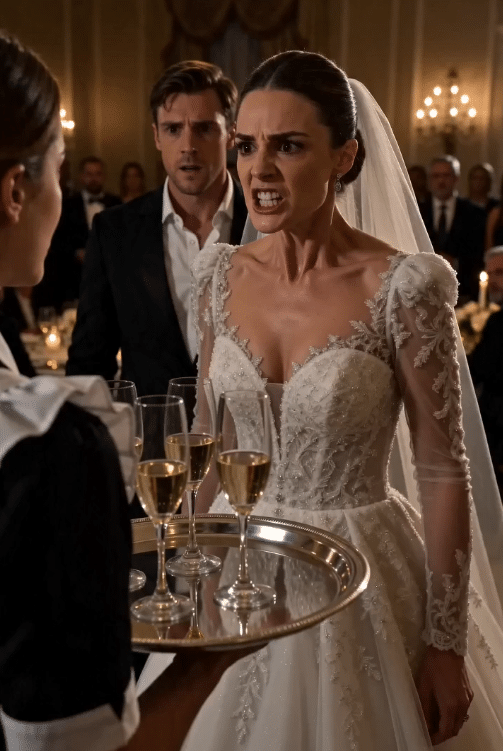
I was carrying champagne when she hit me.
Not a tray of cheap prosecco for the back tables. Real champagne. Vintage, pale gold, served in flutes so thin they looked like they could split under a breath. The kind of drink you carry carefully because one spilled glass costs more than your shoes.
The ballroom glowed like expensive guilt.
Crystal chandeliers hung low enough to catch every candle flame and multiply it into a hundred points of warm light. White linens. Gold place cards. A black grand piano near the center of the room. The sort of wedding where even the silence feels rehearsed.
I had been in the room exactly nineteen minutes when the bride decided I was a threat.
Her name was Vivienne Laurent.
She wore an off-the-shoulder satin gown cut so close to her body it seemed less sewn than poured. Her lipstick was dark, almost cruel. Her smile, until she saw me speaking to the groom, had been the smile of a woman certain the evening belonged to her.
Then Adrian handed me the envelope.
That was all it took.
He did it quickly, discreetly, while guests were still rising from dinner and the pianist was finishing a soft arrangement near the center of the floor. A white envelope. Thick, unmarked, passed from his hand to mine in one practiced motion.
Vivienne saw it.
Then she crossed the room like fire finding air.
“Stay away from my husband!” she screamed.
The slap came hard and clean across my face.
The tray jumped from my hands. Glass hit marble. Something shattered against my ankle. Someone near the back gasped loud enough to be heard over the crash. By the time I looked up, red gift boxes from the bridal table had been kicked open in the chaos and scattered across the floor like fresh wounds.
My cheek burned.
My eyes watered instantly, more from shock than pain.
Vivienne stood over me breathing hard, one hand still lifted, as if she could not believe she had enjoyed it that much in public. Adrian had taken one step forward and then stopped, trapped between the instinct to intervene and the terror of doing it too late.
The room went very still.
That was the ugliest part.
No one moved to help me.
No one knelt.
No one said her name in warning.
The guests simply stared, caught in that rich-people paralysis where cruelty is terrible as long as it doesn’t make the evening complicated.
I crouched slowly among the broken glasses.
Not because I was defeated.
Because the envelope had burst open when it hit the floor, and a black-and-white photograph had slid halfway beneath a spill of champagne and glass shards. I reached for it before anyone else could.
“I came for this,” I said.
My voice shook, but not enough to hide.
Adrian extended his hand toward me again, not to pull me up, but to pass me the rest of the papers that had spilled from the envelope. He looked pale. Guilty. Cornered. Like a man who had known tonight would end badly, just not exactly how badly.
That was when the piano stopped.
The last note hung in the ballroom and died.
The old pianist turned on the bench and stared at the photograph in my hand with the kind of expression men wear when memory hits harder than age.
Then he whispered, into the silence of three hundred guests and one ruined wedding:
“That child… she was the missing heiress.”
And across the room, I saw the bride’s mother rise from her chair and go white.
Act II: The Name My Mother Could Never Say Safely
I was not born Ana Santos.
That is the name on my employment forms, my rental agreement, and the school records I carried through childhood like secondhand clothing. It belonged to the woman who raised me, and for most of my life, I believed it belonged to me too.
Her name was Marisol Santos.
She worked as a housekeeper until her joints failed, then as a seamstress until her eyesight began to dim. She smelled of starch, lavender soap, and the kind of fatigue that enters the body when survival becomes routine enough to stop feeling temporary. She was never soft, but she was loving in the exact ways that matter.
She died in May.
Three nights before she died, she told me the truth.
Not all at once. Not cleanly. The morphine made her thoughts drift and circle, and guilt had eaten enough of her life that even confession came out like something being dragged over broken stone. But by dawn, I understood the shape of what she had hidden from me for twenty-two years.
I was born Clara Laurent.
The only daughter of Victor Laurent’s first marriage.
And the child the city had spent nineteen years calling dead.
My father, according to newspapers and family history, lost me in a house fire during a winter charity gala when I was three. The official story said the smoke, confusion, and panic made it impossible to reach the nursery in time. My mother had died the year before. My father was left devastated. The mansion was restored. The foundation in my mother’s name expanded. And five years later, Victor Laurent married Evelyn Harrow.
Evelyn brought a little girl named Vivienne into the marriage.
By the time Victor died, that girl was the only daughter anyone remembered.
Marisol had worked in the Laurent house then.
Not in the family wing. Downstairs. Laundry, breakfast service, flower resets, and emergency cleanup after the sort of dinners where old money gets drunk enough to say true things in front of people they assume don’t count. On the night of the fire, Evelyn took me from the nursery before the alarm spread through the east corridor.
She handed me to Marisol in the service passage and told her to leave through the kitchen entrance.
There was money. A forged baptism record. A car waiting behind the greenhouse. And one sentence Marisol said she could still hear whenever she tried to sleep.
“If the child lives, my daughter gets nothing.”
Victor Laurent had changed his will that same week.
He had moved controlling rights in the family holding trust to me.
Not to Evelyn.
Not to Vivienne.
To Clara.
Marisol took me because she thought Evelyn meant to have me killed if she refused. She took me because she was poor and terrified and because sometimes the first terrible choice is also the only one that keeps a child breathing through the night. Then she kept me because once the lie survived a week, the truth became harder to walk back without destroying everything.
“Your father looked for you,” she whispered that last night. “But not in the places Evelyn allowed.”
Before dawn, she made me open the cedar box she had kept hidden beneath her sewing table for as long as I could remember.
Inside were the photograph, half a hospital bracelet, one newspaper clipping about the missing Laurent heiress, and a note written in a hand I did not recognize.
If you are old enough to ask, you are old enough to know this: the piano man saw you that night.
The note had an address and a name.
Armand Delacroix.
The pianist.
Two weeks later, before I had gathered the courage to knock on any old man’s door and ask whether I used to belong to a dead family, an anonymous letter arrived in my apartment mailbox.
I know who you are.
If you want the rest, come to the wedding.
Wear staff white.
Ask Adrian Laurent for the envelope.
I almost burned it.
Instead, I borrowed a maid’s uniform from a catering girl whose brother owed me money, pinned my hair into a tight bun, and walked into the ballroom with a tray in my hands and my dead mother’s secrets under my skin.
What I didn’t know then was that Adrian Laurent had already found the document Evelyn failed to destroy.
Act III: The Photograph Under the Glass
The first person who moved after Armand spoke was not the bride.
It was Evelyn.
She stood too quickly, chair legs scraping against marble, one jeweled hand gripping the edge of the table hard enough to rattle the silver. She was still beautiful in the polished, punishing way some women remain beautiful long after kindness has left their faces. Pearls at her throat. Black silk. A spine built from reputation and fear.
And in that second, every guest in the ballroom looked exactly where I was looking.
At her.
Vivienne turned first to the pianist, then to her mother, and finally to me.
“What is he talking about?” she asked.
No one answered.
Adrian bent and picked up the rest of the papers that had spilled from the envelope. He looked less like a groom then than a man who had finally run out of ways to postpone a necessary disaster.
“Say something,” Vivienne snapped at him.
He didn’t.
I stood up slowly with the photograph still in my hand. My face still stung from the slap, and glass glittered around my shoes like a broken constellation. Across the ballroom, people were no longer pretending to be shocked by impropriety. They were smelling inheritance.
Armand rose from the piano bench with visible effort. He had to be near eighty, thin and formal in his tuxedo, with the stiff dignity of men who have survived long enough to become archives. He came toward me one careful step at a time, eyes fixed on the photograph.
“I played that winter gala,” he said. “The little girl disappeared before midnight. Her mother had already died. Her father nearly tore the house apart looking for her.”
Vivienne gave a short, disbelieving laugh.
“This is insane.”
“No,” I said.
It was the first time I had spoken to her directly all night.
“This is late.”
Her eyes sharpened.
The room leaned inward.
I turned the photograph so the guests closest to us could see it: a small child in a velvet dress standing beside the grand piano in the Laurent ballroom, one hand touching the carved leg, Armand blurred in the background, and behind them the edge of the old family crest that no outsider would know well enough to fake.
Armand looked at me with tears standing in his eyes.
“You had a crescent-shaped birthmark behind your left ear,” he said quietly.
I pushed back the hair at my neck.
The room went silent enough to hear candles spit.
There was a murmur then, low and frightened, moving from table to table as people began doing the arithmetic of years, names, and faces.
Vivienne stared at the mark.
Then at her mother.
Then back at me.
I could see the first crack in her certainty. Not guilt. Not empathy. Just a sudden, horrifying sense that the floor of her life might have been built over a room she had never been allowed to enter.
Evelyn found her voice first.
“This woman is lying,” she said. “She came here to extort this family.”
It was a strong sentence.
Elegant.
Almost useful.
Then Adrian opened the envelope and pulled out the first document.
“I don’t think she is,” he said.
Vivienne turned toward him so sharply the satin at her shoulder twisted.
“Adrian—”
He held up a notarized codicil to Victor Laurent’s trust, dated eleven days before the fire.
In the event of my death, all primary voting control, estate rights, and family residence title shall pass to my daughter Clara Laurent, surviving issue of my first marriage.
The ballroom stopped breathing.
I looked at Evelyn.
She looked back.
And at last I said the line Marisol had spent twenty-two years choking on.
“Your mother paid to have me taken.”
Act IV: The Fire That Wasn’t Meant to Kill
Evelyn slapped me a year after the fire.
Not tonight.
Back then.
That was something Marisol only confessed on the last morning, when the pain medicine had turned memory loose from shame. I had asked why she never came back to claim reward money or at least send proof that I was alive.
Marisol cried for the first time in all the years I knew her.
“Because she found me once,” she said. “And she wanted to know whether fear still worked.”
Fear had worked then.
It did not work in the ballroom.
Not after Adrian unfolded the second paper from the envelope. This one wasn’t a trust document. It was a bank transfer order from an account controlled by Evelyn Harrow to a shell company that turned out to be nothing more than a laundering step between her and Marisol’s forged relocation funds.
The transfer date was two days after the fire.
The memo line read: domestic resettlement.
Guests began standing now. Not all of them. Just the ones rich enough to understand what it means when money and family myth cross paths in writing.
Vivienne looked as though she might faint.
“You knew?” she whispered to her mother.
Evelyn ignored her.
She was watching Adrian.
That interested me.
It told me he was the real threat in her mind, not me. Not because he mattered more morally, but because he possessed the one thing she could no longer control in that room: the legal bridge between rumor and consequence.
“How did you get that?” she asked him.
Adrian laughed, but there was no humor in it.
“My father kept duplicates of everything after he stopped trusting you.”
That landed like a body blow.
For the first time, Evelyn looked old.
Not in the face. In the posture. In the brief failure of her neck and shoulders to remember how to hold themselves up under scrutiny. The ballroom saw it too. Decades of social engineering, donor dinners, remarriage respectability, all undone by two sheets of paper and one living woman in a maid’s uniform.
Armand stepped closer then.
There are moments when the truth chooses unexpected mouths. His was one of them.
“I saw you that night,” he said to Evelyn.
She closed her eyes.
Just once.
The whole room leaned in.
“You came through the service passage with the child wrapped in a blanket,” he continued. “I told myself it was smoke confusion. I told myself if I said nothing, none of us would be destroyed by scandal. I was a coward. I know that now.”
He was crying openly by then, and I hated him a little for it. Not because his remorse wasn’t real. Because it was late. Men in tuxedos always seem to find conscience only after women have carried the fear for decades.
Vivienne turned to me.
Her lipstick had gone pale at the edges.
“Who are you?” she asked.
Such a strange question, given the room.
For twenty-two years I had been Ana Santos, daughter of a seamstress, occasional maid, almost-college dropout, woman who counted rent in grocery decisions and learned early that nice rooms weren’t designed for people like me to keep their voices. But under that, beneath the name and the poverty and the habits built around survival, there had always been something else.
Something stolen.
“I’m Clara Laurent,” I said.
The bride flinched as though I had struck her back.
Then, quietly enough that only those nearest heard it, she said, “My mother built my whole life on your grave.”
That was the first honest sentence she’d spoken all evening.
And before anyone could decide whether pity or horror belonged to her, the ballroom doors opened and the private security detail Adrian had summoned after receiving my first message stepped inside.
Act V: The Name I Walked Out With
The wedding ended before dessert.
That is the polished version.
The true version is less graceful. Guests gathered their coats with the desperate speed of people who understand history becomes expensive the longer you remain near it. Half the board from Laurent Holdings vanished into private calls. One of Evelyn’s lawyers tried to reach the side exit and found security already there.
Vivienne did not cry.
That surprised me more than anything else.
She stood in the center of the ballroom in her white satin gown while the room emptied itself around her and looked not at me, not at Adrian, not even at the doors, but at her mother as if she were finally seeing the architecture of her life exposed without wallpaper.
Adrian crossed to me once the first wave of panic had passed.
“I’m sorry,” he said.
He meant the envelope, the wedding, the slap, the delay, the years, the fact that he had only believed the story might be true after seeing enough financial exposure to make it personally dangerous not to. I appreciated the apology. I did not mistake it for redemption.
“You should’ve been sooner,” I said.
“I know.”
That, at least, was honest.
Evelyn was taken out through the side hall under “temporary questioning,” which is the phrase wealthy families buy before an arrest becomes formal. But the damage had already escaped the building. Guests had filmed. Staff had heard. One of the younger trustees was already sending the codicil to outside counsel before the family office could contain it.
Nothing in a room like that stays private once inheritance starts bleeding.
Armand returned to the piano after security moved the nearest tables aside.
I thought, for a strange second, that he intended to keep playing for the remaining guests out of habit or denial. Instead, he sat down and touched the keys with the tenderness of someone asking permission.
“It was your mother’s piece,” he said to me. “She used to sing it when you wouldn’t sleep.”
Then he played.
I did not remember the melody.
Not consciously.
But something in my body did.
A turn of notes. A pause at the end of the second phrase. The way the left hand held the lower harmony half a beat too long before resolving. I had heard that music somewhere older than language. It reached into me like light through dirty water, and for one impossible moment I felt not triumph or revenge, but grief so clean it made everything else irrelevant.
Marisol was gone.
My father had died believing me dead.
The mother who might have saved me chose fear.
The woman who raised me chose love after choosing wrong.
There was no version of justice that could untangle those things into a shape without loss.
Still, when the music ended, the silence in the ballroom belonged to me.
Not because of money.
Not because of the trust.
Because for the first time in my life, I was no longer standing in a room built by someone else’s lie.
Two weeks later, the courts froze the Laurent estate until chain-of-title review could unwind nineteen years of false succession. Evelyn was charged on fraud, conspiracy, and child concealment counts before her attorneys could finish arguing that family complexity had been misread as criminal intent. Armand gave a sworn statement. Adrian withdrew from the marriage and from the family board. Vivienne disappeared from the society pages for six months and then resurfaced in Florence, where rich daughters go when they are too publicly humiliated to remain local but too well-funded to vanish honestly.
People kept asking me whether I wanted the estate.
That question always sounded wrong.
As if the point of all this had been property.
As if being stolen from begins and ends in square footage.
What I wanted, at first, was simpler.
My mother’s name on the death registry corrected.
Marisol Santos acknowledged not as kidnapper but as coerced witness and the woman who raised me when the wealthy wanted me erased.
My own birth certificate restored.
Clara Laurent, living.
Those came first.
Everything else came after.
Three months later, I returned to the ballroom in daylight.
No guests. No candles. No flowers. Just dust motes moving through sun and a restoration crew measuring drapes for the next event. The piano still stood in the same place. The marble still gleamed. Nothing in the room visibly remembered the slap that cracked my old life open.
That is how buildings work. They keep standing. They let humans carry the memory.
I touched the piano lid once.
Then I walked to the long mirror near the north wall and looked at myself properly. Not Ana trying to survive. Not the maid in borrowed white. Not the missing child in a photograph.
Clara.
I didn’t look richer.
I didn’t look transformed.
I looked exactly like someone who had been hidden under other people’s fear and finally decided to stop carrying the inconvenience of their lie for them.
The bride slapped me in front of everyone because she thought I was reaching above my station.
The truth was harder for all of us.
I wasn’t reaching above it.
I was standing in the ruins of the place that had always been mine, waiting for the room to remember my name.