Act I: The Bracelet in Her Pocket
Luxury stores are built to make people lower their voices.
The marble floors, the soft lights, the glass cases lit like altars—everything in a boutique like Maison Valeur is designed to suggest control. Wealth does not like to look messy, even when it is about to become violent.
That afternoon, violence arrived in a black blazer and diamond earrings.
Her name was Helena Croft, though most of the city knew her as Mrs. Nathaniel Croft, collector, donor, patron, board member, one of those women whose photographs appeared in charity brochures beside captions about grace and culture. Up close, grace was not the word that came to mind.
I heard the first scream from the private consultation room.
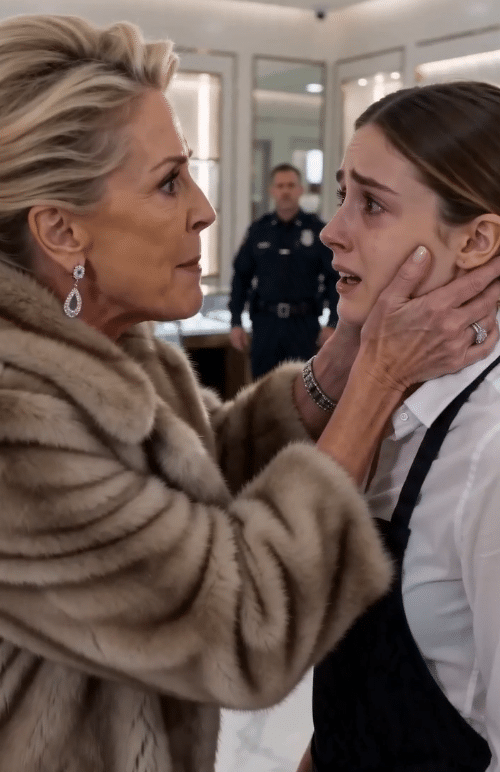
By the time I reached the jewelry floor, Helena had one of my assistants by the face.
Anika was twenty-three, newly promoted from gift services, with a light blue shirt, a white waist apron, and the sort of gentle patience luxury retail often exploits because frightened people mistake it for weakness. Helena had both hands clamped around her jaw, shaking her head hard enough that Anika’s ponytail snapped side to side while tears streamed down her face.
“Thief!” Helena shouted. “I saw you hide my bracelet!”
Red gift boxes were scattered across the marble around them, evidence of either a struggle or one expertly staged. Two sales associates stood frozen near the handbag display. A police officer, summoned by building security for an earlier “disturbance,” had just stepped in from the entrance and was still trying to understand whether he was witnessing shoplifting or assault.
Anika’s eyes found mine.
That look will stay with me a long time.
Not just fear. Pleading. The look of someone who already knows the room has decided she looks easier to blame than the woman hurting her.
I crossed the floor quickly and said Helena’s name in the tone I reserve for clients who have mistaken politeness for permission.
“Let her go.”
Helena didn’t even look at me.
“She stole from me,” she said, still gripping Anika’s face. “Search her now. I knew it.”
Then she released one hand, reached into the pocket of Anika’s apron, and pulled out a diamond bracelet.
The officer took one step closer.
A breath moved through the room like a living thing. Not surprise, exactly. More the relief of witnesses who think reality has suddenly become simple again. There was the evidence. There was the crying young woman. There was the rich customer holding the proof up between two glittering fingers.
Anika stared at the bracelet as if it had appeared by black magic.
“That—that doesn’t belong to…” she stammered.
Then she stopped.
I knew why.
Because the bracelet did not belong to Helena Croft.
I had seen that piece only once in six months.
It had never been displayed on the floor.
It had been kept in our private vault downstairs.
And only four people in the entire store had access.
One of them was me.
The second was our owner in Geneva.
The third was our head of security, who was currently in the hospital after what he’d called an unlucky staircase fall.
And the fourth was standing right in front of me, holding the bracelet with shaking hands and a smile that had just started to turn to fear.
Act II: The Vault Below the Marble
My name is Julian Mercer, and I have run Maison Valeur for eleven years.
That sentence used to mean something cleaner to me than it does now. I believed in the order of beautiful things, in the discipline of inventory, in the soft architecture of luxury. I thought a well-run store revealed character. It does, but not always the right kind.
The bracelet Helena had pulled from Anika’s pocket was called the Lys Noir.
Black-diamond lattice. Old-mine white stones. Platinum setting so fine it looked liquid under light. It wasn’t just expensive. It was strategically invisible. The sort of piece we only brought out for vetted collectors after background review, wire confirmation, and private room protocol.
It had arrived nine days earlier from an estate in Lyon.
I knew because I had signed for it myself.
The paperwork was still in my desk drawer upstairs, along with the insured transfer valuation and the internal note from Geneva reminding me that the Crofts had specifically asked to be alerted when anything “museum-caliber” appeared in the house inventory. I had chosen not to tell them yet. Helena Croft was many things, but patient was not one of them, and the piece required provenance re-verification before any viewing.
Only someone with vault access could have touched it.
That was why the room suddenly felt so dangerous.
Anika didn’t know the bracelet’s name. I was certain of that. She had never worked a private jewel handoff, never seen the vault, never even held one of the coded keycards necessary to get below the showroom. If the Lys Noir was in her pocket, one of two things had happened.
Someone had planted it.
Or someone inside my store had used her as a body to carry a theft.
The police officer reached for his notebook.
Helena turned toward him at once, composed enough now to start weaponizing the moment.
“I want charges,” she said. “This girl attacked me and stole from me.”
Anika recoiled as if struck a second time.
“That isn’t yours!” she said, sobbing openly now. “I never touched that. I swear I never—”
“Enough,” Helena snapped.
She held the bracelet up higher, displaying it to the room like a trophy. That was when I saw the inside clasp.
Tiny initials.
E.C.
Not Estate Croft.
Etienne Charbon.
The deceased French collector who had owned the piece before it ever reached our bank shipment. Helena couldn’t have mistaken it for hers. No client could. We hadn’t even reset the clasp engraving yet.
She didn’t believe Anika stole her bracelet.
She knew exactly what piece it was.
I looked at her very carefully then.
At the triumph trying to hold itself together on her face. At the brief misstep in her breathing when she realized I wasn’t moving to assist her version of events. At the flash of calculation beneath the outrage.
I understood something all at once.
Helena had not merely taken the opportunity to humiliate a vulnerable girl when a loose item appeared. She had come into the store already needing an accusation. She needed a thief before anyone noticed the bracelet itself should never have been on the floor.
The police officer asked the obvious question.
“Sir,” he said to me, “is that piece hers?”
And for one second, before I answered, I thought about what would happen if I said yes.
The scandal would stay small. Internal. Embarrassing, but containable. Anika would be removed quietly. Helena would leave vindicated. The vault issue could be buried under process until I figured out who inside my own store had opened the wrong door.
Instead, I heard myself tell the truth.
“No,” I said. “That piece was locked in our private vault.”
The effect was immediate.
Helena’s fingers tightened around the bracelet.
The officer went still.
And Anika, through all her tears, looked at me with the stunned expression of someone who had just realized the humiliation in front of her was not the whole crime.
It was only the cover.
Act III: The Woman Who Needed a Public Thief
Helena’s husband had been dead for fourteen months.
Officially, Nathaniel Croft passed from a stroke on his yacht off Capri, which was the kind of ending wealth magazines know how to describe tastefully. He left behind a development empire, a charitable foundation, a townhouse full of black-and-white photography, and a widow who inherited more power than she had ever expected and less peace than she could perform.
I had known them both for years.
Nathaniel bought jewelry the way other men buy absolution. Helena bought it as armor. She understood that rare stones did not merely signal money. They signaled control, lineage, distance from ordinary consequence. She had a collector’s eye and a survivor’s instinct, which made her dangerous in rooms where nobody said no often enough.
Six months before his death, Nathaniel visited the boutique alone.
That was unusual enough to stay with me.
He asked to see pieces we normally never brought out without prior notice. Not because he wanted to buy them. Because he wanted to understand how estate storage worked when items were held temporarily before sale. He asked odd questions about discretionary consignments, vault access, and whether certain objects could be kept “off family visibility” during valuation.
At the time, I thought he was planning to surprise Helena.
Now I know better.
Three days after Nathaniel died, Helena called asking if we had ever held a bracelet matching the Lys Noir description under private advisement. I told her no. That was true at the time. She sounded disappointed, but not surprised.
Nine days ago, when the Charbon estate shipment arrived and the Lys Noir entered our vault, I should have remembered that call more carefully. I should have heard the old echo in it. I should have asked why a woman already worth more than most city blocks sounded so hungry over one specific bracelet.
I know now.
Because the Lys Noir wasn’t just valuable.
It had history.
Not public history. Family history.
Nathaniel Croft bought it nineteen years earlier and transferred it, through three shell consignments and one private intermediary, into the hands of a woman named Mireille Charbon in Lyon. An affair, almost certainly. Maybe love. Maybe guilt. Maybe a child. The city’s wealthy men have always used Europe as a filing cabinet for the parts of their lives they hoped would never come home.
When Mireille died, her estate liquidated quietly.
The bracelet came back across the Atlantic in an anonymous lot.
And Helena must have recognized it the moment she saw our intake metadata through whatever channel she had inside the store.
If that bracelet resurfaced publicly, then whatever Nathaniel had buried with it might surface too.
A mistress.
An illegitimate heir.
A hidden transfer.
Something large enough to threaten Helena’s control of the Croft estate.
That was why she needed a public thief.
A missing bracelet from a vault is a scandal.
A stolen bracelet found in a crying salesgirl’s pocket is a resolution.
The elegance of the trap almost impressed me.
Almost.
“What exactly are you saying?” the officer asked, his voice sharpening.
Helena found her footing again for half a second.
“I’m saying your employee panicked after being caught with a restricted piece and is now inventing nonsense to save herself.”
She said it looking at me, not him.
We both knew the accusation wasn’t for the police. It was for the room. Luxury survives on confidence. If she could force me into hesitation, if she could make this look like a management dispute instead of a crime, the truth might still drown in ambiguity.
Anika wiped at her face with trembling fingers.
“I didn’t take it,” she whispered. “She touched me first. She kept coming closer and saying no one would believe me.”
That line turned the officer’s head.
Good.
Witness language matters. So does sequence.
I looked at the cameras above the cases, then at the red boxes on the floor.
“Don’t let anyone leave,” I said.
Helena laughed once.
“On what authority?”
I met her eyes.
“On the authority of the vault you just exposed.”
That was when my phone buzzed in my jacket pocket.
One message.
Unknown number.
Don’t open the left vault log. He died because of it.
I stared at the screen.
Then at Helena.
And for the first time, I understood the bracelet was not the real target either.
It was the bait leading me back downstairs.
Act IV: The Left Vault Log
Every high-end store has two floors.
The one the customer sees.
And the one that makes the fantasy possible.
Below our marble showroom sat the operational heart of Maison Valeur: receiving room, transfer safe, secure packing stations, surveillance archive, and the private jewel vault behind a reinforced door coded to ignore panic if it trusts your fingerprint. I descended with the officer, Anika, my floor supervisor Lena, and Helena herself under informal detention, which infuriated her more than handcuffs would have.
The left vault log was a leather-bound register used only when pieces entered or exited off-market review.
Most managers never touched it.
I did.
And so, supposedly, did only one other person in the building: Stefan Morrow, our head of security. The same man currently in hospital with a broken wrist and three cracked ribs after a “fall” down his apartment staircase.
I unlocked the outer cabinet.
The log was still there.
So was a second envelope taped beneath the drawer lip.
The same unknown sender.
Inside were two photocopied pages and a photograph.
The first page was a duplicate access entry showing Helena Croft’s guest authorization logged under Nathaniel Croft’s old private collector credential six nights earlier—an impossibility, because that credential should have died with him. The second was a silent alarm override signed by Stefan Morrow but timestamped two hours after hospital records showed he’d already been admitted unconscious.
The photograph was the final piece.
Stefan in the parking garage behind the boutique, alive, upright, speaking to Helena Croft the night before his fall.
I looked up slowly.
She had gone pale enough to look gray under the vault lights.
The officer took the papers from my hand and read them once. Then again. Then he did what competent police do when a shoplifting allegation turns into conspiracy with money behind it—he stopped trying to handle it alone and called detectives.
Helena saw the shift and made her first genuine mistake.
She lunged for the left vault log.
Not away from it.
For it.
The officer caught her wrist before she reached the cabinet, but the movement told us more than any confession could have. Whatever sat in that book mattered more to her than elegance, more than public control, perhaps even more than avoiding arrest.
I opened the log.
Most entries were routine in the discreet way private luxury routines can be. Estate consignments. Unnamed family reviews. Pre-auction holds. But on the page dated six days earlier, someone had inserted a secondary note in handwriting that was not mine and not Stefan’s.
Cross-reference Charbon packet with Croft codicil file. Heir risk confirmed.
Heir risk.
There it was.
Nathaniel Croft had not merely hidden a bracelet with a dead French woman.
He had linked the bracelet to an estate codicil.
A child, then.
Or proof of one.
Lena, standing at my shoulder, whispered, “My God.”
Helena closed her eyes for one second.
When she opened them, all the performance had gone out of her face. In its place was something cleaner and more frightening.
Necessity.
“You have no idea what he did to this family,” she said.
Not denial.
Not innocence.
Just justification arriving too late to be useful.
“What did he do?” I asked.
She laughed, but there was no humor in it.
“He left half of everything to a girl in Marseille he’d never even named publicly.”
The room went still.
Anika, poor terrified Anika, was looking from face to face like she had stumbled out of a petty retail nightmare into some ancient rich-people blood feud and couldn’t understand why her body had been chosen as the bridge between them.
Helena kept talking, because some people mistake revelation for control once they’ve lost all other tools.
“She appeared after his death with letters, blood tests, old transfers. Stefan found the codicil packet before it reached probate counsel. He brought it to me because he knew what it meant.”
“And then he fell down the stairs?” the officer said.
That finally shut her up.
But not before we had enough.
Because the left vault log, combined with the access records, the bracelet, and the attempted frame, had turned a humiliating scene on a luxury floor into something else entirely:
A widow’s attempt to erase an heir by stealing the proof and planting the crime on the most disposable woman in the room.
And upstairs, beyond the marble and light, detectives were already walking through the front door.
Act V: The Girl She Thought No One Would Believe
Her name was Colette Charbon-Croft.
She was nineteen, lived in Marseille, studied architecture, and had never once asked to become the reason a widow in Manhattan started tearing through vault records with diamond rings on both hands. The estate lawyers reached her by midnight. By dawn, she was on a plane with counsel, DNA records, and one truth Helena had spent six days trying to smother under theft, class prejudice, and spectacle.
Anika was cleared within the hour.
The officer made sure the first written record named her correctly: victim, not suspect. I insisted on that. Labels matter. Rich women like Helena count on the first version of a story sticking hardest, especially when it attaches itself to a young Brown employee in an apron and tears.
When the detectives reviewed the floor footage, it was worse than even Anika had managed to say through sobs.
Helena had entered already angry. She had circled the cases instead of browsing them. She had watched Anika’s movements closely, stepped into her space twice, then bumped the stack of red gift boxes herself before grabbing Anika’s face. The bracelet appeared in Anika’s apron pocket only after Helena’s own hand disappeared inside the blazer she wore.
She brought the evidence in with her.
Of course she did.
Some crimes are planned. Others are arranged like a room before guests arrive.
Stefan Morrow survived.
That surprised everyone except, I suspect, Helena. She struck me as the sort of woman who had long ago learned to confuse probability with certainty. His staircase fall became aggravated assault by the second afternoon, after he woke under hospital guard and said Helena offered him enough money to “misplace” the codicil packet, then enough fear when he hesitated.
By the time Colette arrived three days later, the story had left the boutique entirely and become what it always was beneath the luxury fabric: a war over legitimacy. Old money, secret daughters, a widow protecting control with a violence she thought would look like refinement until the right camera angle caught her hands.
I met Colette in the private viewing room where the Lys Noir had started this whole disaster.
She looked nothing like Helena.
But she had Nathaniel’s mouth.
That was enough.
She stood by the window in a dark coat, rain on the shoulders, one hand closed around the old French letters her mother had kept. She was composed, more so than most adults would have been in her place, but I could see the exhaustion in the way she held her spine.
“I’m sorry it came to this,” I said.
She looked at the bracelet lying under evidence glass on the velvet pad between us.
“My mother said if that piece ever reached New York,” she replied, “it meant my father was finally dead or finally ashamed.”
I didn’t ask which she thought it was.
Some questions deserve to sit unanswered a little longer.
The boutique reopened the following week.
The marble still shone. The glass still reflected wealth in flattering fragments. Customers still came in asking to see bags and stones and things that promised permanence. Luxury has a genius for continuing after ugliness, which is why so much ugliness chooses it as camouflage.
But some things had changed.
Anika came back on a Wednesday wearing the same pale blue shirt and gold nameplate, though she stood differently now. Straighter. Not healed, exactly. Vindication doesn’t heal. It only stops the lie from doing more damage. I doubled her pay and paid for the attorney who made sure the police report and store record would never again attach the word suspect to her name.
She cried when I told her.
This time no one mistook the tears for weakness.
As for Helena, she left the boutique in handcuffs, all satin lapels and smeared lipstick and disbelief that a room built for people like her could ever become a witness against her. That image has circulated enough now that I suspect she will never again walk into a luxury floor without feeling the ghost of marble under her knees.
And maybe that is fitting.
Because what she counted on, more than anything, was the old equation: rich woman accuses, frightened girl breaks, manager hesitates, police simplify. It almost worked because that equation has worked too many times before.
But she misjudged one thing.
She thought the bracelet was the truth.
It wasn’t.
It was only the door.
The real truth was the child her husband left behind, the man he paid to hide it, and the woman who would have destroyed another life rather than let the wrong daughter step into the light.
That is the ugly inheritance of people like Helena Croft. They do not merely steal money. They steal legitimacy, timing, narrative—the right of other people to enter a room under their real name.
She tried to do it to Colette.
She tried to do it to Anika.
In the end, she only managed to reveal herself.
And if there is any justice in luxury at all, it is perhaps this: the brightest rooms are often the worst places to lie, because once the glass catches the right angle, there is nowhere left for the hand that planted the evidence to hide.