Act I
“Staff sits in the back.”
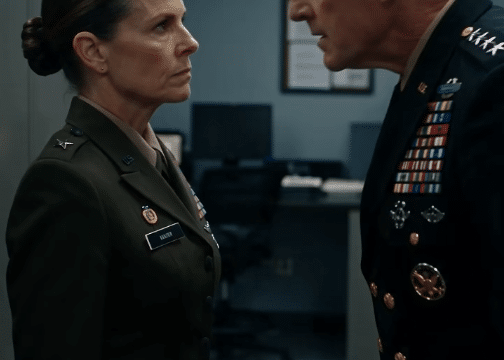
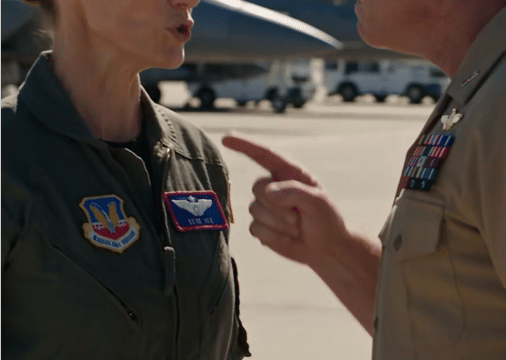
The Colonel’s voice cut across the military hearing room. He stood beside the center chair, his silver eagle insignia and rows of ribbons displayed prominently on his Army service uniform. At forty-eight, he had spent years making sure everyone understood his rank—and he had little patience for anyone he considered beneath him.
The woman facing him did not move.
“I’m staying here.”
She was forty-one, with dark hair secured in a formal bun and a composed expression that gave away almost nothing. Her Army service uniform carried two stars, though her restrained decorations made her appearance less imposing than the Colonel’s heavily decorated jacket.
He glanced at her, then at the chair reserved for the presiding officer.
“Know your place.”
Around the U-shaped table, board members exchanged uneasy looks. A clerk sat near the recording equipment, surrounded by folders and official documents. The American flags behind the board gave the room the unmistakable atmosphere of a place where careers could be examined, reputations challenged, and decisions permanently recorded.
The Colonel believed he was correcting an officer who had taken a seat she did not deserve.
He had no idea that the chair he was trying to keep her away from was about to become the most important seat in his military career.
And he was about to make a mistake that everyone in that room would remember.
Act II
The hearing concerned a disciplinary matter that had been building for months.
The Colonel had been accused of using his position to pressure subordinates, disregard formal reporting procedures, and manipulate the account of a disputed operational decision. Several officers had submitted statements, but the accounts did not match the version of events he had provided to his superiors.
The board had been convened to examine the evidence and determine what action, if any, should follow.
For the Colonel, the hearing was an insult.
He believed his years of service, his decorations, and his reputation should have protected him from being questioned by people he considered less experienced. He was accustomed to being the officer who asked questions, not the man required to answer them.
That attitude had followed him into the hearing room.
He had already challenged the seating arrangement, complained about the order of the documents, and questioned why certain witnesses had been allowed to submit statements. Every objection seemed to carry the same underlying message: he did not believe the process had the right to scrutinize him.
The woman had arrived quietly.
She had not brought an entourage or made a dramatic entrance. She had simply taken her place near the center of the room, carrying herself with the composure of someone who understood the significance of the proceedings.
The Colonel saw her differently.
He noticed the minimal medals, the lack of visible ceremony, and the fact that she had not announced herself. He decided she must be administrative staff or a junior legal officer assigned to assist the board.
It was an assumption built entirely on appearance.
He had no interest in asking who she was. He was too busy deciding where he thought she belonged.
But the woman knew the hearing’s history. She knew which reports had been submitted, which objections had been raised, and why the board needed to examine the matter without interference.
Most importantly, she understood that the Colonel’s contempt for the proceedings was not separate from the allegations against him.
It was part of the same pattern.
And when he ordered her away from the center chair, she refused to help him continue it.
Act III
The Colonel stepped closer.
The woman remained where she was, her expression formal and controlled. She had no intention of turning a procedural disagreement into a personal confrontation.
But the Colonel had stopped treating it as a procedural disagreement.
He struck her hard across the face.
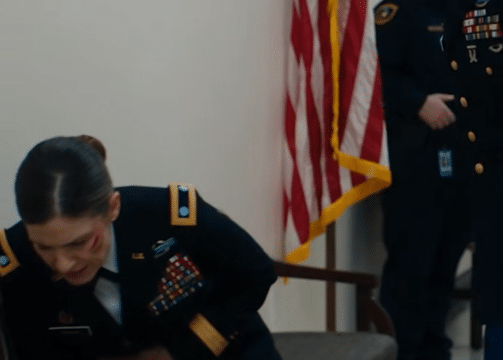
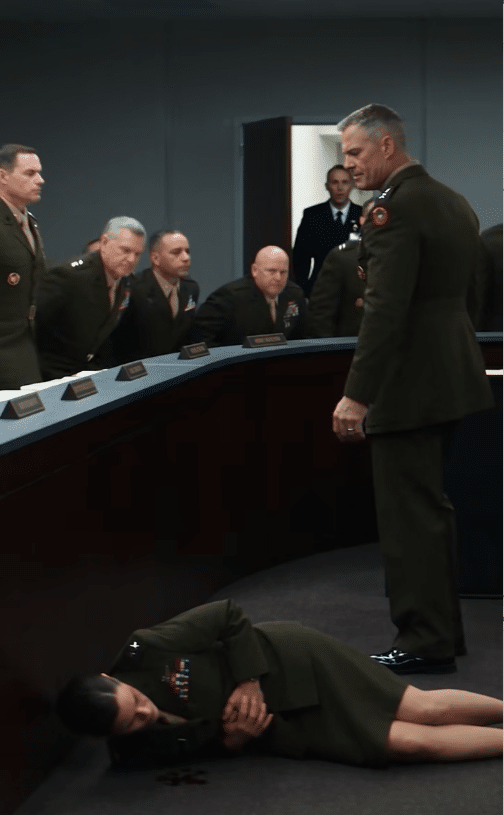
The sound echoed through the hearing room. Her head turned with the impact, and she stumbled toward the center chair. A red mark spread across her cheek, followed by visible swelling and a small trace of blood at the corner of her mouth.
For one suspended moment, nobody moved.
Then the Colonel drove a hard kick into her abdomen.
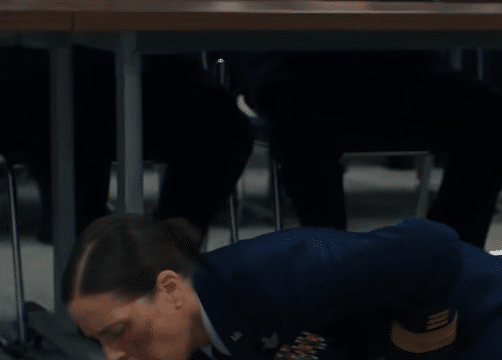
She lost her balance and fell beside the chair, one arm moving instinctively to guard her stomach as she struggled to regain her breath.
The room erupted into shocked silence rather than action.
A board member pushed back slightly from the table. Another stared at the Colonel as though unable to reconcile what had just happened with the uniform he wore.
The Colonel looked down at the woman.
Then, with deliberate contempt, he kicked the center chair sideways.
It scraped across the floor, leaving the place of authority displaced in front of everyone. The gesture was unmistakable. He wanted the woman on the floor, the chair out of position, and every witness to understand that he believed he could decide who belonged in the room.
“Know your place.”
The woman looked up at him.
Her cheek was swollen. Her breathing was guarded, and the pain in her abdomen made every movement difficult. But her eyes remained steady.
She did not plead with him.
She did not apologize.
And she did not look away.
The Colonel interpreted her silence as surrender. He straightened his uniform and glanced around the table, apparently expecting the board members to accept his display of authority.
Instead, he found faces frozen in disbelief.
He had attacked a woman in the very room where his conduct was supposed to be examined.
And the chair he had kicked aside was not an ordinary chair.
Act IV
The door opened.
The clerk entered, carrying the final procedural documents. The movement was ordinary, but the timing changed everything.
The clerk looked toward the center of the room and delivered the announcement.
“Board members, rise for the presiding general.”
Every board member stood.
The change was immediate and unmistakable. Chairs moved back from the U-shaped table. Officers straightened. The room shifted from stunned silence into disciplined recognition.
The Colonel turned toward the board, confused.
Then he looked back at the woman.
She was beginning to rise.
Slowly, carefully, she pushed herself upright despite the pain in her abdomen. Her swollen cheek remained visible, and the small trace of blood at her mouth had not disappeared.
She reached for the same chair the Colonel had kicked away.
She pulled it back into place.
Then she sat at the center position.
The two stars on her uniform were now fully visible.
She was a Major General.
Not an administrative assistant. Not a junior officer. Not a member of the staff who had wandered into the wrong seat.
She was the presiding general—the officer appointed to chair the disciplinary board and oversee the proceedings.
The Colonel’s face changed as the realization settled in.
The board members were not standing because the clerk had interrupted the hearing for another senior officer. They were standing because the woman he had assaulted was the person whose authority governed the room.
Her quiet arrival had not been an accident.
Her place at the center had never been a matter of preference.
It had been her assigned position from the beginning.
The Colonel looked at the chair, then at the officers standing around the table. His earlier confidence began to disappear. He had spent the opening moments of the hearing trying to assert his rank over the very officer empowered to preside over his case.
Worse, he had done it in front of the board itself.
The woman adjusted herself in the chair, moving carefully against the pain. She did not need to announce her rank or explain her appointment. The clerk’s words and the board’s response had already established what the Colonel had refused to consider.
The chair was hers.
And the room knew it.
Act V
The hearing room remained silent.
The Colonel stood beside the displaced space where he had expected the woman to retreat. His silver eagle insignia was still visible, his ribbons still arranged neatly across his chest, but none of it seemed to provide the confidence it had moments earlier.
The board members remained standing.
The presiding general sat at the center of the U-shaped table, her posture controlled despite the visible injuries. Her cheek was red and swollen. She kept one hand close to her abdomen, carefully managing her breathing.
Yet her expression had returned to the same quiet composure she had displayed when she first refused to move.
The Colonel looked around the room, searching for some sign that he had misunderstood the announcement.
There was none.
The clerk stood ready. The board members faced the center chair. Every person in the room understood the chain of authority, and no one appeared willing to pretend the assault had been an ordinary disagreement over seating.
The Colonel’s mistake was larger than his failure to recognize a two-star general.
He had mistaken dignity for weakness, restraint for uncertainty, and a formal hearing for a place where his personal status could override the rules.
The woman had never needed to compete with him for authority.
She had already been entrusted with it.
Now the room reflected that truth in every disciplined movement. The officers who had watched him strike her were standing for her. The chair he had kicked away had been restored to its proper place. And the proceedings he had tried to dominate were now under the control of the very person he had humiliated.
The Colonel swallowed.
His face had lost its color. Sweat gathered along his forehead, and his posture stiffened as the consequences became impossible to ignore.
He looked at the woman seated at the center of the board.
For the first time, he seemed to understand exactly who he had attacked.
His voice came out smaller than he intended.
“You’re chairing this?”
Give the Colonel a stronger consequence