Act I
“Rescue flight goes first.”
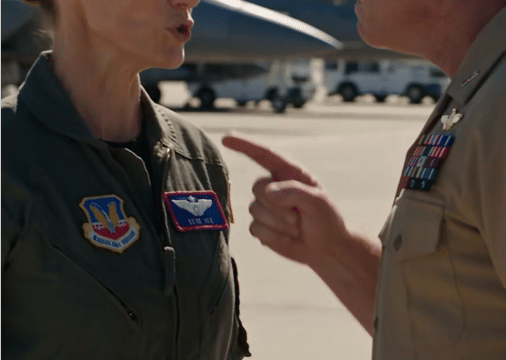
Rain hammered the military disaster-relief staging area. Beyond the rows of rescue trucks, helicopters waited on the soaked flight line while exhausted soldiers moved supplies toward civilians waiting for evacuation.
The woman giving the order stood in a soaked Army OCP uniform, her rain shell hanging open and her brown hair secured against the weather. She looked toward the nearest helicopter, then at the Brigadier General blocking her path.
“You don’t redirect my aircraft.”
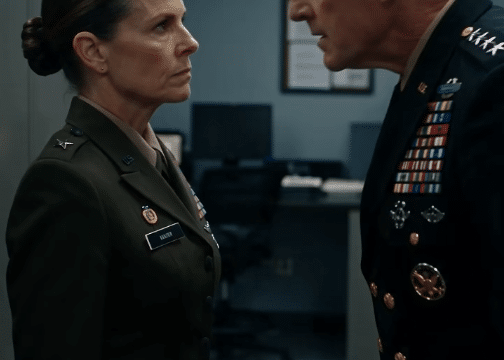
General Marcus Reed was fifty, a one-star commander who seemed more concerned with protecting his authority than understanding the urgency around him. His rain-resistant outer layer was soaked, but his expression remained rigid with contempt.
The woman did not retreat.
She knew the rescue flight needed to go first. Floodwater was rising in several isolated areas, and people were waiting for evacuation. Every delay mattered.
Reed stepped closer.
Then he slapped her.
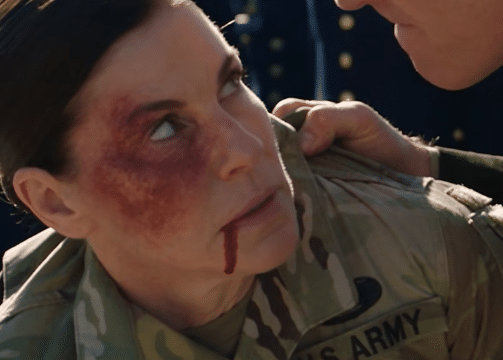
The blow turned her face sharply. A red swelling spread across her cheek, and a faint trace of blood appeared at the corner of her mouth.
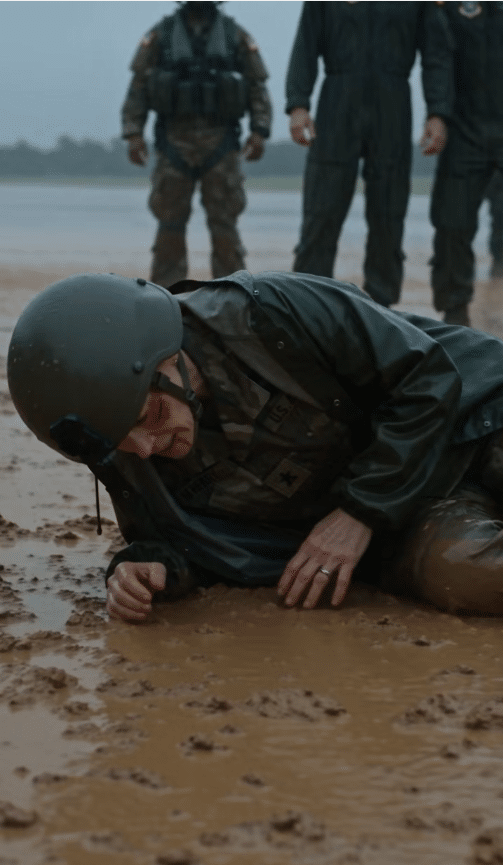
Before she could regain her balance, he drove a hard kick into her front torso, knocking her into the mud. She tried to brace herself, struggling to breathe through the pain.
He kicked her again in the side.
Mud splashed across her uniform.
Nearby aircrew members froze. A pilot stared at the scene, while rescue soldiers looked on in disbelief. The rain continued falling as Reed stood over the woman he had just attacked.
He believed he had settled the disagreement.
But the helicopter crews were about to make a decision that would expose exactly how little he understood about the authority he had just challenged.
Act II
Her name was Claire Bennett.
At forty, Claire had built a career around aviation operations, difficult decisions, and the coordination required when military resources were deployed under pressure. She understood that a rescue mission was not simply another assignment on a commander’s schedule.
It was a chain of decisions in which timing could determine whether people reached safety.
That morning, the staging area was operating under difficult conditions. Heavy rain had turned the ground into mud, visibility was deteriorating, and rescue teams were trying to coordinate helicopter movements with ground vehicles and evacuation personnel.
Civilians were waiting for transport.
Some had already been moved to temporary collection points. Others were still stranded in areas threatened by rising water.
Claire had been reviewing the deployment priorities when she recognized that the rescue flight needed to move ahead of another planned aircraft movement.
Her reasoning was straightforward: the rescue mission was urgent, and the aircraft assigned to it needed to be launched without unnecessary delay.
Reed disagreed.
He regarded the aircraft as assets under his command and disliked being corrected in front of the crews. He had spent years building a reputation as a forceful commander, but his confidence had hardened into something less useful.
He expected people to obey first and ask questions later.
Claire expected them to understand the mission.
That difference had become increasingly difficult to ignore.
She had not challenged him for attention. She had not tried to embarrass him. She had simply made the operational judgment she believed the situation demanded.
Reed took it personally.
To him, the fact that she wore a rain-soaked combat uniform and spoke without ceremony made her easier to dismiss. He did not ask what authority she carried. He did not verify her role in the operation.
He assumed that the only person entitled to redirect aircraft was the general whose rank he could see.
That assumption led him to do something no commander should ever do.
He turned a disagreement over rescue priorities into a physical assault.
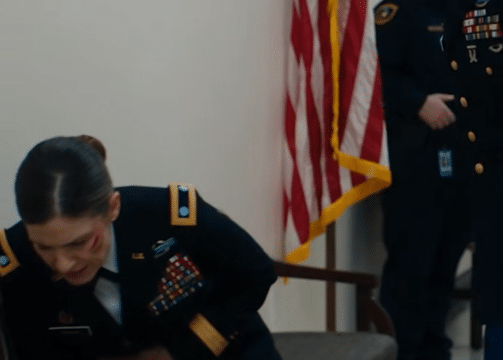
Now Claire was lying in the mud, her cheek swollen, her breathing strained. Her uniform was stained, and rainwater ran down her face.
Reed stood above her, convinced that his authority had been restored.
But the rescue crews had not forgotten the original instruction.
And the pilot was about to ask the one question that would reveal who truly had the power to send the helicopter into the storm.
Act III
The pilot appeared at a run.
His flight gear was wet, and his expression was serious. He looked toward the helicopter, then toward the command group, trying to establish who could authorize the next move.
The rescue mission could not wait indefinitely.
He approached Claire.
“Ma’am, we need launch authority.”
Reed turned sharply.
The question had not been directed at him.
That small detail unsettled him more than the assault witnesses’ silence. The pilot had approached the woman lying in the mud and addressed her with unmistakable professional respect.
Claire looked up.
For a moment, the pain seemed to hold her in place. Her swollen cheek was clearly visible, and she kept one arm close to her torso as she struggled to rise.
Then she forced herself upright.
The rain continued beating against the staging area. Behind the pilot, the helicopter waited with its crew ready.
Claire looked toward the aircraft.
“Launch.”
The response was immediate.
The pilot turned and moved toward the helicopter. Aircrew members began their launch sequence. Rescue personnel shifted into position, and the ground crew moved with practiced urgency.
No one waited for Reed to repeat the order.
No one turned to ask whether he approved.
The crew had received its authorization, and it came from Claire.
Reed watched them move.
The woman he had knocked into the mud had just issued the command that set the rescue flight in motion. The pilot had sought her approval directly, and the crew had responded without hesitation.
It was not a ceremonial gesture.
It was operational recognition.
Claire’s authority had become visible through the actions of the people who depended on it. The helicopter crew knew whose permission they needed. They knew whom to approach when the mission required a decision.
And they had not looked to Reed.
The realization began to register on his face.
He looked at the pilot, then at the helicopter, then back at Claire. His expression shifted from irritation to confusion.
He had believed the aircraft belonged to him simply because he was the loudest officer on the flight line.
Now the rescue crew was preparing to launch under someone else’s authority.
And the woman he had assaulted was the person they trusted to give the order.
Act IV
The helicopter crew continued preparing for departure.
The sound of the aircraft grew louder against the heavy rain. Rescue personnel moved into their assigned positions, focused on the mission rather than the confrontation that had just unfolded beside them.
Claire remained upright.
Her injuries were visible. The cheek Reed had struck was red and swollen, and the faint trace of blood at her mouth had not disappeared. She moved carefully, protecting her torso, but her attention remained fixed on the rescue operation.
That was what unsettled Reed most.
She was not trying to humiliate him in return.
She was not demanding that the crews watch her.
She was doing the job.
The rescue flight had priority, and she had given the authorization needed to move it forward.
Reed’s face began to lose color.
He looked around for a sign that the crew might reconsider. Perhaps the pilot would come back and ask him to confirm the order. Perhaps someone would explain that Claire had been mistaken.
But the opposite happened.
The personnel continued following the launch sequence. Their movements were disciplined, immediate, and unmistakable.
They were not ignoring Reed out of defiance.
They were responding to the authority responsible for the mission.
The difference mattered.
Military operations could not function if every decision became a contest of ego. In a disaster-relief operation, the people directing aircraft and rescue teams needed to be trusted to make decisions under pressure.
Claire had demonstrated that trust.
Reed had undermined it.
He had ignored the urgency of the rescue flight, attacked the officer trying to prioritize it, and then watched the crew seek authorization from her rather than him.
The rain ran down his face. His jaw loosened. The posture that had made him seem so imposing only moments earlier began to collapse.
He finally understood that his one star did not give him ownership of every aircraft, every decision, or every person standing on the flight line.
The crews had their orders.
The rescue mission had its authority.
And neither depended on his wounded pride.
Act V
The helicopter was ready.
The pilot and crew had moved into position, and the rescue operation was proceeding under Claire’s direction. The rain still fell heavily, but the confusion around the aircraft had been replaced by purposeful movement.
Claire stood in the mud, injured but composed.
She had not escaped the consequences of Reed’s assault. Her cheek remained swollen, her side hurt, and every movement reminded her of the kicks that had knocked her down.
But she had not allowed the confrontation to become more important than the people waiting to be rescued.
The crew had seen the difference.
They had watched Reed use his rank to silence a warning. They had watched him attack an officer who refused to abandon the rescue priority. Then they had watched that same officer rise through the pain and give the command they needed.
No grand speech was necessary.
The helicopter’s preparation said everything.
Reed stared at the aircraft as if he were seeing it for the first time. His authority had seemed absolute when he was standing over Claire. Now he looked uncertain even as the crew carried out the operation.
He had assumed that people followed him because of his rank.
But the pilot had run to Claire.
The crew had moved when she spoke.
And the rescue flight was proceeding because they recognized her authority, not because Reed had approved it.
For a commander who had built his identity around being obeyed, the realization was devastating.
Claire looked toward the helicopter once more. Her expression remained focused, her attention fixed on the mission rather than the man who had tried to stop her.
Reed finally turned toward her.
His face was pale. Sweat and rain mixed across his forehead, and his mouth opened as the last of his certainty disappeared.
“Launch authority… you?”
The question hung between them.
Claire did not answer.
The helicopter crew already had.
Give Claire a clear official roleReduce repeated authority explanations