Act I
“I’m sorry. I didn’t mean to splash you.”
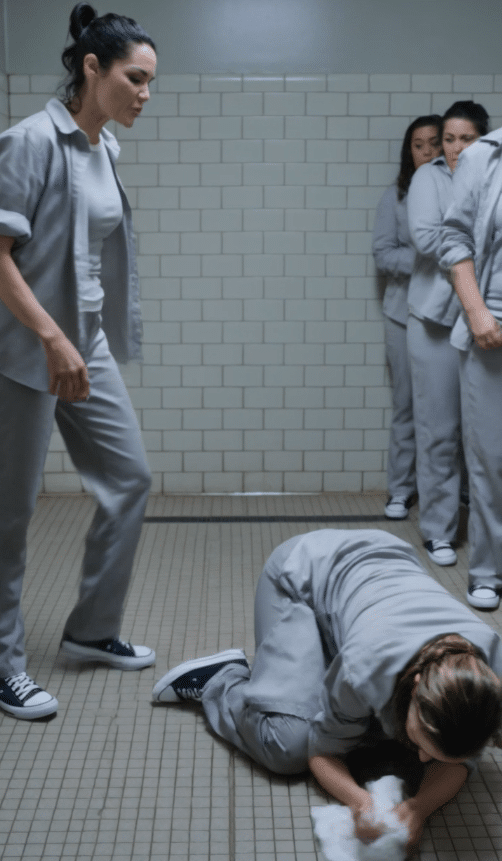
The words barely escaped Emily Carter’s mouth before the woman standing over her took another step forward. Water dripped from Emily’s wet blonde hair onto the cold white tiles, and her fingers tightened around the cleaning towel she had grabbed from the wall.
The other woman looked down at the small puddle near her shoes as if Emily had committed an unforgivable crime.
“Trash. Clean it with your sleeve.”
Her name was Vanessa Cole. At thirty-five, Vanessa had spent enough time inside the prison to develop a reputation that traveled farther than she did. Tall, strong, and rarely seen without two loyal followers behind her, she controlled the shared shower area through intimidation rather than any official authority.
No one had appointed her queen of the block.
She had simply learned that if you frightened enough people, they eventually began treating your wishes like rules.
Emily was twenty-two, barely three weeks into her sentence, and still struggling to understand how quickly ordinary mistakes could become dangerous. She had accidentally splashed a little water near Vanessa’s shoes while reaching for the faucet. She apologized immediately, stepped back, and tried to make herself smaller.
It did not matter.
Vanessa had noticed the way Emily lowered her eyes whenever someone raised their voice. She had noticed how the younger woman kept her belongings close and never argued over a place in line. To Vanessa, those gestures meant weakness.
And weakness, in her world, was an invitation.
“Did you hear me?” Vanessa demanded.
Emily glanced at the towel in her hands. “I have one right here. I can clean it.”
“Not with that.”
Vanessa tilted her chin toward Emily’s sleeve.
Along the tiled wall, several inmates stopped what they were doing. One woman covered her mouth. Another suddenly became fascinated with the floor beneath her feet.
They all knew the ritual. Someone made a mistake, Vanessa turned it into a public humiliation, and everyone else learned to stay out of her way.
Emily looked from the wet tiles to Vanessa’s face.
“I said I’m sorry.”
That was the first thing Vanessa disliked.
The second was that Emily did not remove her jacket or offer her sleeve.
Instead, Emily bent down with the towel and began wiping the water from the floor.
For one brief second, Vanessa’s expression changed. She had expected a frightened argument or a desperate plea. Instead, Emily had obeyed the practical request while quietly refusing the degrading part.
It was a small distinction.
Inside that shower room, it was enough to become a challenge.
Vanessa stepped closer.
Then she drove one deliberate kick into Emily’s upper back and shoulder.
Emily lurched forward, losing her footing on the wet tile. Her knee and forearm struck the floor, and a thin trace of blood appeared where her skin scraped against the rough surface.
The towel slid away from her hand.
Before Emily could push herself upright, Vanessa stood over her and delivered exactly two more kicks, one after the other, into her back and side.
Emily curled inward, bracing against the floor. Pain stole the breath from her lungs, and she struggled to keep herself from sliding across the wet tiles.
Nobody moved.
Vanessa looked around at the silent witnesses, apparently satisfied that everyone had understood the lesson.
“New girls scrub where I step.”
She said it as casually as someone commenting on the weather.
Then the steel door at the end of the shower area slammed open.
A short alarm chirped through the room.
Every head turned.
A woman in a long black coat stood in the doorway, a silver badge catching the cold overhead light. Behind her waited an internal response team in dark uniforms, their faces serious and their movements controlled.
The woman was Warden Margaret Shaw.
She surveyed the room, the wet floor, the abandoned towel, and Emily struggling to rise. Her gaze finally settled on Vanessa.
There was no shouting. No dramatic rush forward. The warden did not touch the woman who had delivered the kicks.
She simply stepped inside.
“You’re done in this block.”
Vanessa’s expression changed.
The confidence disappeared first. Then the irritation. What remained was something far less familiar to her: uncertainty.
“Done in this block?”
For the first time that morning, Vanessa did not sound like someone giving orders.
She sounded like someone who had just realized she might have misunderstood the rules entirely.
And the reason Warden Shaw had arrived so quickly had nothing to do with a little water on the floor.
It had everything to do with what had been happening behind that locked door for months.
Act II
Three weeks earlier, Emily Carter had believed the hardest part of prison would be the loss of freedom.
She had been wrong.
The hardest part was the constant feeling that every small decision belonged to someone else. When she could shower, where she could stand, how long she could remain in a line, and whether a harmless mistake would be forgiven or turned into a spectacle.
Before her arrest, Emily had worked as a receptionist at a small medical billing office outside Columbus, Ohio. She had lived in a modest apartment, driven an aging sedan, and spent most weekends helping her mother manage the household bills.
She was not innocent of every mistake that had brought her to prison.
Emily had knowingly altered several billing entries after her supervisor convinced her that the changes were temporary corrections. When investigators began looking into the company, she initially repeated the explanations she had been given. Later, when she discovered how much she had helped conceal, she cooperated with the investigation.
But cooperation did not erase her own decisions.
She pleaded guilty to her part in the fraud and accepted a sentence that would keep her away from home for years. Her mother still wrote to her, though the letters had become shorter as medical expenses and old debts consumed the little money the family had left.
Emily carried one of those letters folded inside her property folder.
It was the last thing she read before her first night in the cellblock.
You can still become someone you respect, her mother had written. Even if you have to start with one decision at a time.
Emily repeated that sentence whenever she felt overwhelmed.
At first, she thought keeping her head down would be enough.
She learned the schedules, followed instructions, and avoided taking anything that did not belong to her. When other inmates argued, she stepped aside. When someone tried to provoke her, she remembered that another disciplinary incident could complicate her sentence and damage the progress she hoped to make.
She believed patience would protect her.
Vanessa Cole noticed her almost immediately.
Vanessa had been incarcerated long enough to understand the unofficial structure of the block. Some inmates had influence because they were respected. Others had influence because people feared what would happen if they refused them.
Vanessa belonged to the second group.
She had developed a system of small demands that rarely looked serious when considered individually. Someone had to surrender a preferred seat. Someone else had to carry a bag. A newer inmate might be told to wait until everyone else had finished using the common area.
Every demand came with an implied threat.
Refuse, and the next encounter would be worse.
Vanessa’s two closest followers, Tasha and Renee, helped reinforce that reputation. They did not always participate in the confrontations, but their presence made it clear that Vanessa was rarely alone.
The shower area was one of her favorite places to demonstrate control.
The tiled walls amplified every raised voice. The wet floor made people cautious. The steel door limited the feeling of escape. Even a short confrontation could draw an audience, and an audience was exactly what Vanessa wanted.
Emily became a convenient target because she refused to play the role Vanessa had assigned her.
She would lend someone a towel, but she would not hand over her personal property without permission. She would apologize when she made a mistake, but she would not agree that every mistake made her inferior. She followed legitimate instructions from correctional staff, yet she did not treat Vanessa’s demands as official orders.
Those distinctions irritated Vanessa.
One afternoon, Vanessa ordered Emily to give up her place in line for a shower. Emily complied because the dispute was not worth the risk.
The following day, Vanessa demanded that Emily carry a bundle of clothing across the block. Emily helped, then returned to her assigned task.
Two days later, Vanessa told her that the corner bench near the laundry corridor was reserved for people who had earned the right to sit there.
Emily stood elsewhere.
Each time, Vanessa interpreted the absence of an argument as proof that the pressure was working.
She did not understand that Emily was trying to survive without surrendering the last pieces of herself she could still control.
The other inmates understood more than they admitted.
A middle-aged woman named Denise had watched Vanessa target newcomers for nearly a year. She had once tried to intervene verbally, only to find herself subjected to weeks of petty harassment. Since then, she had learned to keep her expressions neutral and her warnings quiet.
When she saw Emily entering the shower area on the morning of the assault, Denise almost approached her.
Then she noticed Vanessa already standing near the faucets.
Denise stopped.
That hesitation would haunt her later.
Because the violence that followed was not the first time Vanessa had crossed a line. It was simply the first time someone with the authority to stop her had arrived at exactly the wrong moment for Vanessa—and exactly the right moment for everyone she had frightened.
The warden had not come looking for a puddle.
She had come because the prison’s own records had begun telling a different story about the woman who believed she controlled the block.
Act III
Warden Margaret Shaw had spent seventeen years working in corrections before becoming the senior authority at the facility.
She had seen the difference between a frightened inmate who lashed out once and a calculated aggressor who turned intimidation into a daily routine. The distinction mattered because the response had to be fair, documented, and strong enough to prevent retaliation.
Vanessa had learned how to exploit the gap between isolated incidents and a recognizable pattern.
A complaint about a stolen snack might sound petty. A dispute over a seat could look like ordinary tension. An argument over shower access might be dismissed as a scheduling problem if no one explained what had happened before it.
But when the same name appeared repeatedly, when the same group of witnesses kept describing the same threats, and when newer inmates began changing their routines to avoid one person, the pattern became harder to ignore.
For weeks, the warden’s internal review team had been examining reports from the housing block.
Several inmates had described being ordered to perform humiliating tasks. Others had reported threats after refusing to surrender personal belongings. Some had withdrawn their complaints almost immediately, claiming they no longer wished to pursue the matter.
The withdrawals concerned Shaw more than the original allegations.
People sometimes changed their minds. But when several witnesses did so after the same individual learned that they had spoken to staff, the pattern demanded closer scrutiny.
The warden instructed her team to preserve available footage, compare incident logs, and review the handling of earlier complaints. She also ordered staff to assess whether inmates who had reported intimidation were being left vulnerable to further pressure.
The investigation did not establish every allegation as fact. Shaw knew better than to treat suspicion as proof.
But it established enough to justify a more direct intervention.
Then a new statement arrived.
It came from Denise, the inmate who had watched Vanessa’s conduct for months. Her first account was brief and cautious. She described the demands, the threats, and the way Vanessa’s followers positioned themselves during confrontations.
When investigators asked whether she had witnessed anything else, Denise hesitated.
Finally, she described an incident in the shower area.
A newer inmate had accidentally splashed water near Vanessa’s shoes. Vanessa had demanded that the woman clean it with her sleeve. When the woman refused and used a towel instead, Vanessa had attacked her.
Denise did not know the new inmate’s full name.
She knew only that the woman was young, blonde, and still carried herself as if she believed following the rules might keep her safe.
The warden ordered the relevant camera footage preserved and directed the response team to remain ready for a rapid intervention if another assault occurred.
Shaw understood the danger of acting too late.
She also understood the danger of acting carelessly. A disciplinary decision had to rest on evidence, not rank or personal outrage. Vanessa would be entitled to a formal review of the allegations against her, and any sanctions would have to follow the prison’s established procedures.
But no procedure required the warden to wait for another injury before protecting an inmate at immediate risk.
That morning, Shaw was reviewing an update from the internal team when the call came through.
There had been a disturbance in the shared shower area.
A staff member reported a possible assault. The response team moved immediately, and Shaw followed them through the secured corridor.
She heard the steel door before she saw the room.
When it opened, the scene was unmistakable.
Emily was on the wet tile, one knee scraped and one forearm marked with a thin trace of blood. A towel lay several feet away. Vanessa stood over her, while the other inmates watched from the wall.
The warden did not need anyone to explain the power dynamic.
She could see it in the distance between the witnesses and the victim. She could see it in Vanessa’s posture, in the way the younger woman struggled to move, and in the silence that fell when the response team appeared.
Shaw stepped forward.
“You’re done in this block.”
The words were short because the immediate situation required no speech.
Staff moved to secure the area, separate the involved inmates, and arrange medical assessment for Emily. Vanessa was directed away from the shower floor under supervision. Her followers were kept apart from the witnesses so that accounts could be gathered without immediate pressure.
No one struck Vanessa. No one needed to.
The warden’s authority was not a license to return violence with violence. It was the power to stop the incident, preserve the evidence, and make sure the consequences did not depend on who was most feared.
Vanessa looked at Shaw as though she expected a different kind of confrontation.
Perhaps she expected shouting. Perhaps she expected an argument she could turn into another contest of wills.
Instead, the warden looked past her and addressed the staff.
“Secure the scene. Preserve the footage. Get the injured inmate evaluated, and separate the witnesses before anyone speaks to them.”
Every instruction was calm, precise, and unmistakably official.
For the first time, Vanessa had no control over what happened next.
And when the warden turned back toward her, the words that followed would explain why this was not simply another disciplinary incident.
Act IV
“Done in this block?”
Vanessa’s question came out smaller than she intended.
Warden Shaw held her gaze.
“You heard me.”
Vanessa glanced toward the response team, then at the steel door. Her followers had stopped moving. The inmates along the wall remained silent, but the silence no longer felt like an audience waiting for Vanessa’s next command.
It felt like a room waiting for her to lose the power she had taken for granted.
“You can’t just remove me because somebody spilled water,” Vanessa said.
“No one is removing you because of water.”
The warden’s answer landed harder than a shout.
“This is about the assault, the evidence we’re preserving, and the pattern of reported intimidation that was already under review before this morning.”
Vanessa’s jaw tightened.
She had heard rumors that staff were looking into complaints. She had assumed they were empty threats. In the past, people had accused her of bullying, but nothing seemed to change for long. A few conversations with officers, a warning, perhaps a temporary restriction—then the block settled back into its familiar rhythm.
She believed that history had made her untouchable.
She had mistaken delay for permission.
Shaw did not announce a final sentence in the shower room. She did not promise that Vanessa would never return to the block. She knew that disciplinary outcomes required an investigation, documented findings, and a formal decision.
But she made the immediate consequences clear.
Vanessa would be separated from the affected inmates while staff assessed the risk. The assault would be investigated. The earlier complaints would be reviewed alongside the new evidence. Any attempt to intimidate witnesses or interfere with the inquiry would become a separate matter.
The response team began carrying out those instructions.
Vanessa tried to recover her composure.
“Ask them what really happened,” she said, gesturing toward the inmates by the wall. “They know how this place works.”
For a moment, nobody answered.
Then Denise stepped away from the wall.
Her hands were trembling. She looked at Vanessa, and the older fear returned to her face so visibly that Shaw ordered staff to give her space.
Denise swallowed.
“I know what happened,” she said.
Vanessa stared at her.
Denise continued, speaking slowly at first. She described the demands Vanessa had made of newcomers, the humiliating tasks, the threats that followed refusals, and the way people learned to stay silent to avoid becoming the next target.
She did not embellish. She did not claim to know things she had not witnessed.
That made her statement harder to dismiss.
Another inmate quietly confirmed one of the earlier incidents. Then a third said she had been pressured to surrender property and warned not to complain.
The accounts did not establish every accusation on their own, but together they gave investigators specific incidents to examine against the existing records.
Vanessa’s expression shifted with each statement.
“You’re all lying,” she snapped.
No one stepped forward to defend her.
For months, Vanessa had depended on the belief that no one would risk speaking while she was present. Now the room was full of people who had spent too long mistaking silence for agreement.
Emily remained under medical observation. She was shaken and in pain, but conscious. A staff member helped her away from the wet floor and made sure she received the attention she needed.
Before she left, Emily looked toward the warden.
“I tried to clean it,” she said quietly.
Shaw’s expression softened, though her voice remained steady.
“I know.”
Emily looked down at her scraped knee.
“I didn’t want trouble.”
“You did not cause this by making a mistake,” the warden replied. “And you did not deserve it because someone decided to punish you.”
The words nearly broke Emily’s composure.
She had spent weeks believing that survival meant finding the perfect way to avoid provoking people. If she moved carefully enough, apologized quickly enough, and never took up too much space, perhaps no one would notice her.
But she had done everything Vanessa demanded except surrender her sleeve for the sake of humiliation.
And Vanessa had attacked her anyway.
For the first time, Emily began to understand that she could not make another person’s cruelty her responsibility to prevent.
Meanwhile, the formal process moved forward.
The footage was secured. Medical findings were documented. Witnesses were interviewed separately. Investigators compared the shower-area incident with previous reports and examined how earlier warnings had been handled.
Vanessa was removed from her informal position of influence while the inquiry proceeded. Her access to the affected inmates was restricted under the facility’s safety procedures, and she was informed that retaliation or witness intimidation would carry additional consequences.
The investigation eventually substantiated the assault and several related acts of intimidation. Not every rumor proved accurate, but the confirmed findings were enough to trigger serious disciplinary sanctions, including her removal from the block and restrictions on her participation in preferred programs.
She had spent years believing that influence meant being able to make other people afraid.
Now, the same behavior that had built her reputation was being documented as evidence against her.
Still, one question remained.
Why had it taken so long for anyone to intervene?
Warden Shaw refused to let the case end with Vanessa’s punishment. She ordered a review of how earlier complaints had been recorded, how quickly they had been investigated, and whether vulnerable inmates had received adequate protection afterward.
The prison would not fix every failure with one review.
But it could no longer pretend that the problem had been invisible.
And for Emily, the most important change was not the removal of the woman who had hurt her.
It was what happened when she finally returned to the block.
Act V
The first time Emily walked past the shower-area door after the assault, she stopped.
The corridor smelled faintly of disinfectant. Somewhere farther down the hall, a metal cart rattled across the floor. The ordinary sounds of prison life continued as though nothing significant had happened.
Yet Emily could still remember the impact of her knee against the tile. She remembered the sudden pain in her back, the towel slipping from her hand, and the terrible realization that the women watching her were too frightened to help.
Her body was healing, but her mind had not caught up.
A staff member noticed her hesitation and asked whether she needed a moment.
Emily nodded.
She stood there until her breathing steadied, then continued down the corridor.
It was not a dramatic victory. No one applauded. No door opened to offer her a new life. She was still an inmate serving a sentence for choices she had made before prison, and the future remained uncertain.
But she had taken another step without allowing fear to decide where she could go.
In the days that followed, the block began to change in small, visible ways.
Staff reminded inmates how to report threats and explained that complaints would be documented and assessed. The housing team increased attention to situations where one inmate repeatedly controlled access to shared spaces. Witnesses were given opportunities to speak privately, and investigators reviewed whether anyone faced pressure for cooperating.
The changes were not perfect, and the warden did not pretend otherwise.
Rules could reduce opportunities for abuse, but rules worked only when people enforced them consistently. A reporting system meant little if frightened inmates believed that speaking up would make them less safe.
Shaw made that point clear during a staff briefing.
“An inmate does not have to be popular to deserve protection,” she told her team. “And a complaint does not become less important because the person making it is difficult to hear.”
She also made it clear that the investigation had to remain fair. Vanessa would be held accountable for substantiated misconduct, not for every rumor attached to her name. The prison had to demonstrate that authority could be firm without becoming arbitrary.
That distinction mattered to Emily.
She had learned outside prison how easily people could hide behind systems. At the billing office, her supervisor had told her that the false entries were harmless, that everyone understood the arrangement, and that the rules would not be applied to people who were simply trying to keep their jobs.
Emily had believed him long enough to become part of the wrongdoing.
She had eventually accepted responsibility for her own role, but that did not mean she believed every person in authority was automatically right.
Warden Shaw’s response showed her something different: authority could be legitimate when it was constrained by evidence, procedure, and a responsibility to protect people who had less power.
Emily began writing again.
At first, she wrote short notes to her mother, mostly about ordinary things. She described the food, the books available in the unit, and the small moments when she managed to feel like herself. She did not hide the assault, but she stopped treating it as proof that she had failed to survive correctly.
In one letter, she finally wrote about the sentence her mother had sent her before she entered prison.
You can still become someone you respect.
For weeks, Emily had understood those words as a promise that she could recover from her own wrongdoing.
Now she understood something more.
Respecting herself also meant refusing to believe that accepting responsibility for her past made her deserving of cruelty in the present.
Her mother’s reply arrived several days later.
You do not have to become hard to prove that you are strong, it read. You only have to keep choosing what kind of person you want to be.
Emily folded the letter carefully and placed it inside her property folder beside the earlier one.
Across the block, Vanessa was facing the consequences of her conduct. Her reputation had not vanished overnight, and no one could guarantee that she would suddenly become remorseful. Accountability was not a magic trick that transformed a person the moment the rules caught up with her.
But she no longer controlled the shower area.
She no longer decided which newcomer would be humiliated next.
And when she looked toward the tiled corridor, she could no longer be certain that the people around her would remain silent.
That uncertainty was the beginning of the change.
One morning, Emily entered the shared area with a towel folded over her arm. Another inmate accidentally knocked a small amount of water across the floor.
The woman immediately stiffened.
“Sorry,” she said, looking around as though expecting an accusation.
Emily glanced at the puddle, then at the frightened expression on the woman’s face.
“It’s okay,” she said. “There’s a towel right there.”
She picked it up and offered it to her.
The woman accepted it cautiously.
For a second, neither spoke. Then the woman gave a small, almost disbelieving smile and began wiping the floor.
Emily continued with her morning.
The tiles were still cold. The lights still hummed overhead. The steel doors still slammed shut with the same unforgiving echo.
Prison had not become a kind place.
But one small corner of it no longer belonged to the woman who had once demanded that new inmates scrub wherever she stepped.
And Emily, who had entered the facility believing that keeping her head down was the only way to survive, had learned that dignity did not require her to challenge every threat—or to surrender to every one.
Sometimes, it meant knowing when to step away.
Sometimes, it meant telling the truth.
And sometimes, it meant standing up again after someone had tried to convince you that the floor was where you belonged.
Warden Shaw had not struck Vanessa. She had not needed to. The evidence, the witnesses, and the consequences of Vanessa’s own decisions had done what intimidation never could: they had stripped away the illusion that fear was the same thing as power.
The last time Emily passed the shower-area door, she did not stop.
She kept walking, one measured step after another, carrying her towel and the letter from her mother.
She was still paying for the choices that had brought her there.
But she was no longer willing to let someone else decide what those choices made her worth.
And somewhere behind her, in the block Vanessa had once treated as her private kingdom, a question remained for every inmate who had watched the assault and done nothing:
When fear teaches everyone to stay silent, who is really in control—and what happens when one person finally refuses to look away?