Act I
“What happened?!”
Marcus rushed into the living room at the sound of his youngest daughter’s crying.
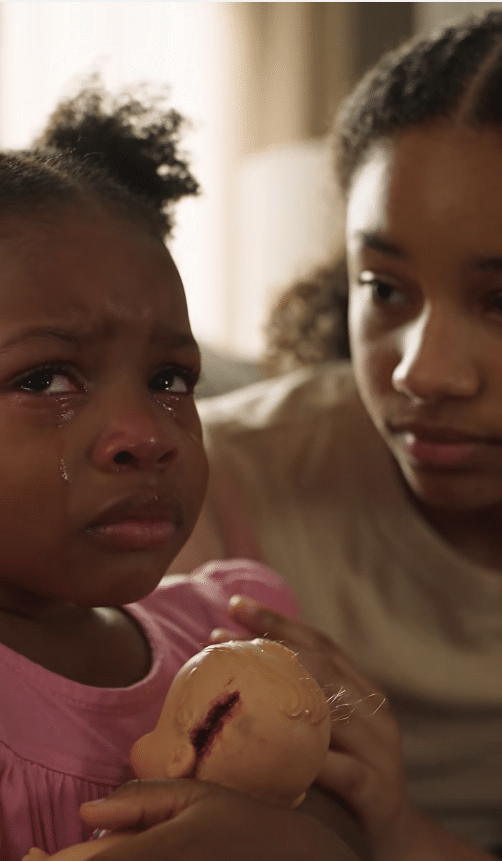
Emma, four years old, sat on the couch in her pink dress, her little face red and wet with tears. Her two messy hair puffs had come loose around the edges, and she clutched a doll against her chest. One of its arms had torn away from the body.
She held it as though the damage were something far worse than a broken toy.
Nearby, Nia knelt beside her little sister. The fourteen-year-old wore a cream-white T-shirt and black trousers, her curly hair tied into a low ponytail. She was trying to comfort Emma, but the child’s sobs kept breaking through every gentle attempt to soothe her.
Marcus looked from one daughter to the other.
Before Nia could explain anything, his wife stepped forward in her black dress, her glossy chin-length bob perfectly arranged. Her arms were crossed, and her expression carried the confidence of someone who had already decided how the story should end.
“Ask your daughter. She broke Emma’s doll.”
Nia looked up sharply.
The accusation seemed to strike her harder than the surprise of her father’s arrival. She had been trying to calm Emma, not arguing with her, and now she was being blamed for something she insisted she hadn’t done.
“I didn’t touch it! I was in the kitchen!”
Her stepmother didn’t hesitate.
“Liar. Emma, tell Daddy who broke it.”
Emma’s crying grew louder.
The little girl pressed the damaged doll against herself and looked down. She was too young to understand all the tension gathering around her, but she could feel it. Her father was waiting for an answer. Her mother stood nearby, insisting that someone had done something wrong.
And Nia was suddenly at the center of it.
The room seemed to shrink around the four-year-old.
Marcus looked at the doll, then at Nia. He had walked into a scene already shaped by his wife’s accusation, and the sight of Emma crying made it difficult to know where to begin.
Nia remained kneeling beside her sister.
She could have stood up and demanded that everyone listen to her. She could have pointed out that she had been in the kitchen, or insisted that her stepmother explain why she was so certain about what had happened.
Instead, she stayed close to Emma.
The child was frightened, and Nia could see it in the way her little fingers gripped the doll. Whatever had happened to the toy, Emma needed someone who would make her feel safe enough to stop crying.
But the accusation was already spreading through the room, and Nia knew how quickly a claim could become accepted as truth when an adult repeated it with confidence.
Her father took a step toward her.
Before he could decide whom to believe, Nia would have to defend herself against a story that was already being treated as fact.
Act II
“Nia, did you—”
Marcus stopped before finishing the question.
He looked at his daughter, searching her face. The torn doll lay in Emma’s lap, its damaged arm visible beneath her small hand. His wife stood with her arms crossed, appearing certain that the explanation was simple.
Nia’s eyes filled with tears.
“Dad, please believe me!”
The words came out quickly, carrying more fear than anger.
She wasn’t simply upset about being accused of breaking a toy. She was frightened that her father might accept the accusation before hearing her side of the story. She knew that once an adult decided what had happened, it could be difficult to convince them to reconsider.
Nia had been in the kitchen.
She hadn’t touched Emma’s doll.
Yet here she was, kneeling beside a crying four-year-old while the adults around them treated her as though the question had nearly been settled.
Her stepmother tilted her head.
“She’s jealous of her little sister. It’s obvious.”
The claim hung in the air.
It offered Marcus a motive to attach to the accusation. According to his wife, Nia hadn’t merely broken the doll by accident. She had supposedly done it because she resented Emma.
Nia stared at her.
The accusation was painful in a different way. It suggested that her love for her little sister was false, that the bond between them concealed resentment, and that the girl’s distress was proof of a character flaw rather than a reaction to being blamed.
Nia glanced at Emma.
The little girl was still crying, her breaths uneven. She looked confused and overwhelmed, caught between adults who were speaking about her while she struggled to hold on to the doll.
Nia understood something her stepmother seemed unwilling to consider.
Emma was only four.
She didn’t need to be questioned like a witness in a courtroom. She needed to feel safe enough to explain what she remembered, in her own words, without worrying that the answer might upset someone she loved.
Nia shifted closer.
She didn’t reach for the doll or demand that Emma tell everyone who had broken it. She gently wiped the tears from her sister’s cheek, careful not to frighten her further.
The stepmother watched, her arms still folded.
She appeared convinced that the accusation had done its work. Nia was upset, Emma was crying, and Marcus had already begun to question his older daughter.
But Nia wasn’t going to make Emma choose sides.
She wasn’t going to frighten her little sister just to prove a point.
The girl softened her voice and focused entirely on the child beside her. She let the silence settle, giving Emma room to breathe between the last of her sobs.
Emma’s grip on the doll loosened slightly.
Her crying became quieter, breaking into small hiccups.
Nia brushed a stray curl away from her sister’s forehead.
Then she spoke with the gentleness that had been missing from the room.
What Emma needed was not another question from an adult. She needed someone to promise her that telling the truth wouldn’t make everyone angry.
Act III
“It’s okay, sweetie. Tell us what happened. No one’s mad.”
Nia spoke softly.
She didn’t tell Emma what to say. She didn’t suggest that their stepmother had done anything, and she didn’t ask the little girl to defend her. She simply reassured her that she was safe.
For the first time since Marcus had entered the room, the pressure around Emma began to ease.
The little girl took a shaky breath.
Her face was still red from crying, and she kept the damaged doll close to her chest. But she was no longer sobbing as hard. Nia stayed beside her, wiping away the last tears and allowing her to gather her thoughts at her own pace.
Marcus watched them.
He had come rushing into the room because Emma was crying. His wife’s explanation had immediately placed blame on Nia, and his own question had nearly followed that same path. Now he could see the difference between the way the two women were treating the child.
One was demanding that Emma identify someone to blame.
The other was helping her feel safe enough to speak.
The room grew quieter.
Emma’s hiccups slowed. She looked down at the doll, then toward the adults. Her small fingers moved over the torn arm as if she were trying to reconstruct the moment when the toy had been damaged.
Nia didn’t rush her.
She didn’t repeat the question or insist that Emma answer immediately. She simply remained beside her sister, offering comfort without making it conditional on what the little girl might say.
That mattered.
A four-year-old could easily become overwhelmed by the thought of upsetting an adult. Emma was crying, confused, and surrounded by people whose reactions she couldn’t fully understand. If she believed that telling the truth would make someone angry, she might remain silent even when she wanted to explain what had happened.
Nia gave her a different possibility.
She could tell what she remembered.
She could speak without being scolded for it.
And she didn’t have to protect her sister by inventing a story or protect an adult by hiding one.
Emma lifted her face.
Her eyes moved toward her mother.
The stepmother’s crossed arms remained fixed across her chest, but the confidence in her expression began to falter. She had insisted that Nia broke the doll, called her a liar, and described jealousy as an obvious motive.
Now the child she had asked to confirm that accusation was finally preparing to speak.
Marcus stood still.
He didn’t interrupt.
Nia kept one hand near Emma’s shoulder, her attention focused on the little girl rather than on the adults waiting for an answer. She had already pleaded with her father to believe her, but she wasn’t turning Emma’s distress into an opportunity to prove herself right.
She was simply being a big sister.
Emma swallowed.
Then she raised one small hand and pointed toward the woman in the black dress.
The room went silent.
The truth came from the smallest person in the room—and it was nothing like the story Marcus had first been told.
Act IV
“Mommy yelled… dolly fell… Mommy said hide it.”
Emma’s voice was small and uneven.
She spoke in fragments, pausing between them as though each part of the memory had to be pulled carefully into words. She didn’t deliver a polished explanation or try to persuade anyone. She simply described what she remembered.
Her mother had yelled.
The doll had fallen.
And her mother had told her to hide it.
For a moment, no one moved.
Marcus looked at Emma, then at the doll in her lap. Finally, he turned toward his wife.
The accusation against Nia had collapsed in a handful of childish words.
Only moments earlier, his wife had presented the damage as proof that his older daughter had deliberately hurt her little sister. She had called Nia a liar and suggested that jealousy explained everything.
Now Emma had given a different account.
The four-year-old had not been pressured into speaking against anyone. Nia had reassured her that no one was angry, wiped her tears, and allowed her to talk when she was ready. The truth had emerged because the child felt safe enough to share what she remembered.
The stepmother’s face paled.
Her arms remained crossed, but the certainty that had defined her posture was gone. She looked at Marcus as though searching for a way to interrupt the silence or redirect his attention toward something else.
There was no immediate distraction.
The broken doll remained in Emma’s hands.
Nia remained kneeling beside her.
And Marcus had heard his youngest daughter explain what happened.
He looked at Nia again.
She had been telling the truth when she said she hadn’t touched the doll. Yet instead of forcing Emma to repeat the accusation or using the little girl’s fear to strengthen her own defense, Nia had comforted her until she was ready to speak.
That contrast was impossible to ignore.
Marcus’s expression hardened as he faced his wife.
“You yelled at a four-year-old. Then blamed her sister.”
His voice was cold, but it wasn’t raised.
He didn’t need to shout. The room had already heard the accusation, the denial, and Emma’s explanation. Everyone had witnessed the moment when the story changed, not because someone had delivered a louder argument, but because the youngest child had finally been allowed to speak without fear.
The stepmother opened her mouth.
“I… she was being loud—”
Her explanation faltered.
The words offered no answer to the most important part of Emma’s account. Whatever had caused the doll to fall, the little girl had said that her mother yelled and then told her to hide the damaged toy.
And Nia, the person accused of causing the damage, had been the one to comfort her.
Marcus held his wife’s gaze.
Emma looked down at her doll, still nestled against her pink dress. Her crying had faded to occasional hiccups. Nia remained close enough to reassure her, not asking her to repeat anything or prove that she had told the truth.
The girl had never needed to win an argument against her stepmother.
She had needed her little sister to feel safe.
Now, with Emma’s words hanging in the silence, Nia made one final choice that said more than any defense could.
Act V
Nia pulled Emma into her arms.
The four-year-old leaned against her older sister, still clutching the doll with its torn arm. Her cheeks were damp, and her breathing remained uneven, but she was no longer crying with the same desperate fear.
Nia held her gently.
She didn’t tell Emma that everything was fixed. She didn’t promise that no one would ever be angry again. The room was still filled with tension, and the adults had not yet found a way to move beyond what had just been revealed.
But Emma was no longer alone with her fear.
Nia had been accused of breaking the doll, called a liar, and told that she was jealous of her own sister. Her father had nearly asked whether she had done it before she could finish defending herself.
Still, when Emma began to speak, Nia hadn’t demanded that the child prove her innocence.
She had offered comfort.
And that simple kindness had given Emma enough security to tell the truth as she remembered it.
Marcus stood facing his wife.
The torn doll was a small thing, the kind of toy that might be repaired or replaced. But what had happened in the living room was about more than a damaged arm. It was about the accusation placed on a fourteen-year-old girl, the fear of a four-year-old child, and the way one adult’s version of events had nearly become the family’s accepted truth.
Emma’s words had changed that.
Marcus had heard his wife blame Nia.
He had heard Nia plead to be believed.
And he had watched his youngest daughter identify her mother as the person who yelled, after which the doll fell and she was told to hide it.
The contrast remained in the room.
Nia had responded to Emma’s distress with patience. Her stepmother had responded to the broken toy by directing blame toward someone else. When the little girl finally spoke, the account she gave contradicted the accusation that had started the confrontation.
Marcus’s face stayed cold.
His wife stood before him, unable to finish the explanation she had begun. The confident expression she wore at the start of the scene had disappeared, replaced by the strained look of someone whose account had been challenged by the very child she had expected to confirm it.
Nia didn’t look away from her.
She kept Emma close, one arm wrapped around the little girl’s shoulders. Her expression was hurt, but there was no triumph in it. She wasn’t celebrating that her stepmother had been exposed, and she wasn’t trying to make Emma choose between the adults.
She was protecting her sister.
The living room remained still beneath the warm afternoon light. The doll’s torn arm rested against Emma’s pink dress, and the little girl’s fingers slowly relaxed around it.
Marcus continued looking at his wife.
Nia held Emma a little closer.
Then she raised her eyes toward the woman who had accused her, called her a liar, and tried to use her little sister’s distress against her.
She said nothing.
She didn’t have to.
Hard cut.