Act I
“My leg hurts. I’m moving.”
The injured inmate barely finished the sentence before Officer Blake Harlan stepped into his path. The narrow prison hallway stretched between rows of iron doors, its cold white lights reflecting off the polished floor. Behind the thirty-year-old prisoner, a line of inmates waited to move toward the dining area, their footsteps echoing beneath a security camera mounted high above the corridor.
Harlan glanced at the man’s limp and sneered.
“Trash. Move when I tell you.”
The inmate, Daniel Mercer, tightened his jaw. His orange uniform hung loosely around his shoulders, and his white prison shoes dragged slightly whenever he put weight on his injured leg. He had been trying to keep pace with the line, one hand occasionally brushing the wall for balance.
He wasn’t refusing an order.
He was trying not to fall.
“I’m moving,” Daniel repeated, his voice strained. “I just need a second.”
Harlan stepped closer until Daniel had nowhere to go without either colliding with him or pushing past the other prisoners. At forty-two, the correctional officer had built his reputation on making people afraid to question him. He kept his uniform immaculate, his black gloves fitted tightly over his hands, and his nameplate polished enough to catch the overhead light.
He liked the hallway because it was narrow.
There was little room to avoid him, and the iron doors made every command sound final. When Harlan ordered someone to move, people moved. When he told someone to stop talking, the corridor usually went quiet.
Daniel knew the reputation.
He also knew that the pain in his leg had become sharper since morning. He had reported the injury after slipping near a wet patch of concrete, but the medical evaluation had not yet resulted in a clear treatment plan. He had been told to continue with normal movement unless the pain became unbearable.
Now, with the line pressing forward behind him, he tried to take a faster step.
His leg buckled.
He caught himself against the wall, breathing hard.
Harlan’s face darkened as if Daniel had deliberately embarrassed him.
“You think you’re special?” the officer demanded. “You think you get to set your own pace?”
“No, sir.”
“Then move.”
Daniel forced himself forward again, but his limp remained obvious. Harlan watched him struggle for another second, then moved into the space between Daniel and the cell doors.
What happened next was not an attempt to restore order.
It was punishment for failing to move quickly enough.
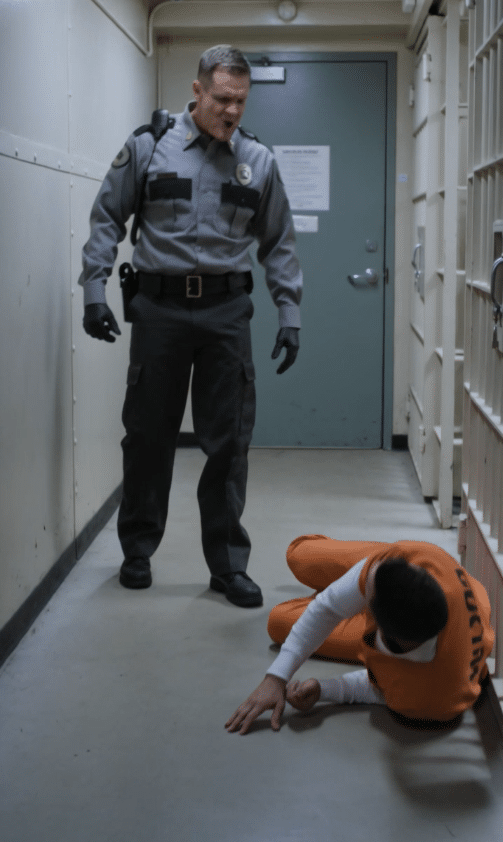
Harlan drove one hard kick into Daniel’s chest.
Daniel stumbled backward into the wall before collapsing onto the floor. His elbow struck the concrete, leaving a thin trace of blood along the skin. For a moment, he seemed unable to understand how he had gone from trying to walk to lying beneath the officer’s boots.
The inmates behind him froze.
Harlan stepped over him and delivered exactly two more kicks, one into Daniel’s back and another into his side. Daniel curled in pain, trying to protect himself as he attempted to crawl away from the edge of the cell door.
A prisoner near the front of the line covered his mouth.
Two junior guards stood several feet away, their expressions tightening. Neither moved forward.
Harlan looked down at Daniel with open contempt.
“You crawl faster than you walk.”
Daniel pressed one hand against the floor. His other arm trembled as he tried to pull himself upright, but the pain forced him back down.
He had learned before entering prison that humiliation could linger longer than an injury. He had not expected to learn it from someone wearing the uniform of a person sworn to protect the people in his custody.
Then a security door at the far end of the hallway slammed open.
The electronic lock snapped loudly through the corridor.
Deputy Prison Director Robert Whitaker stepped out, accompanied by a camera audit technician carrying an active monitor. Whitaker was fifty-four, dressed in a black suit beneath a management coat, his authority badge clearly visible on his chest.
He did not rush toward Harlan.
He did not threaten to hit him.
He simply looked at Daniel on the floor, then at the officer standing above him.
The technician raised the monitor so Whitaker could see the footage.
The deputy director’s expression became colder.
“That camera just ended your badge.”
Harlan’s posture stiffened.
For the first time since Daniel had entered the hallway, the officer appeared to have forgotten what he was supposed to say next.
“My badge?”
The question came out smaller than he intended.
He looked toward the camera overhead, then back at Whitaker, his face slowly losing its color.
He had spent years believing that a uniform made him untouchable.
Now the man standing in front of him had arrived with the one thing Harlan could not intimidate, order into silence, or force to look away.
The camera had seen everything.
And the footage was only the beginning.
Act II
Daniel Mercer had not always been the kind of man who needed a wall to steady himself.
Before prison, he had worked as a delivery driver in Ohio, making early-morning runs through neighborhoods where porch lights still glowed and coffee shops had barely opened. He was thirty when his life narrowed to an orange uniform, a cell assignment, and the constant awareness that other people controlled nearly every detail of his day.
His conviction had followed a desperate, reckless decision.
During a period of mounting debt, Daniel had become involved in a burglary with an acquaintance who promised that the job would be quick and that no one would be home. Daniel knew the plan was wrong, but he went along with it anyway. The situation escalated, property was stolen, and the case that followed exposed his involvement.
He was convicted and sentenced to prison.
He never pretended he had been innocent. He had made a choice, and another person’s home had been violated because of it. He had spent the months before sentencing replaying the decision, wondering why he had allowed a moment of panic about money to outweigh everything he knew about right and wrong.
His mother, Linda, had stood beside him through the legal process. His younger sister, Rachel, had helped her manage the bills when Daniel’s income disappeared. But the strain changed the family in ways none of them knew how to repair.
Rachel stopped answering some of his calls.
His mother continued writing, though the letters became shorter whenever she was tired.
Daniel understood why.
He had not only damaged his own future. He had forced the people who loved him to carry the consequences of his decisions.
Inside prison, he tried to make the best of what remained. He enrolled in educational classes, worked when assignments were available, and kept a notebook of things he wanted to do differently if he ever returned home.
His biggest goal was simple: to leave prison without becoming the kind of person he had once feared.
Then, several weeks before the hallway assault, he slipped while carrying supplies through a damp service passage.
The injury was not dramatic. There was no obvious deformity, and he could still walk. But pain began to build around his leg, especially when he had to stand for long periods or move quickly.
Daniel reported it.
A nurse examined him and documented his symptoms. He was advised to limit unnecessary strain where possible, but the facility had not yet completed the follow-up assessment he needed. In the meantime, he continued with his assigned routine.
That was when Harlan began noticing him.
The officer had been working in corrections for more than a decade. He knew how to complete reports, manage movement through the cellblock, and deliver instructions in a voice that made people respond quickly.
He also knew how difficult it could be for an inmate to challenge an officer’s account of an incident.
Over the years, Harlan had developed a habit of treating hesitation as defiance. A prisoner who asked him to repeat an instruction was being disrespectful. Someone who moved slowly was trying to manipulate him. Anyone who questioned his judgment was attempting to undermine his authority.
The habit became worse when other staff members failed to challenge it.
Harlan had received informal complaints about his temper before, but no single incident had led to a decisive review of his conduct. Some inmates had declined to submit formal statements, fearing retaliation or believing their complaints would not change anything. Other reports had been handled as ordinary disagreements between staff and prisoners.
Harlan interpreted the absence of serious consequences as proof that his methods worked.
Daniel became a target because his injury made him visibly slower than the others.
At first, Harlan’s comments were small enough to dismiss as ordinary cruelty. He mocked Daniel’s limp during movement. He told him that the prison was not a hospital. On one occasion, he ordered Daniel to repeat a short walk because he believed the inmate was exaggerating his pain.
Daniel tried to avoid confrontation.
He answered politely. He followed instructions when he could. When he needed extra time, he explained why.
That only seemed to irritate Harlan further.
The officer wanted obedience that looked effortless. He wanted prisoners to react before he finished speaking, and he wanted them to understand that his judgment was not open to discussion.
Daniel’s pain challenged that fantasy simply by existing.
A body that could not move quickly enough reminded Harlan that his authority had limits. Instead of accepting those limits, he tried to force Daniel to overcome them through fear.
The hallway assault happened after Daniel’s medical concern had already been recorded.
That fact would matter later.
For now, Daniel was being helped off the floor by staff members who had finally moved forward. His breathing remained uneven, and he held one arm close to his body as he tried to stand.
Whitaker instructed the staff to summon medical personnel immediately and to keep Harlan away from the injured inmate.
Then he turned to the camera audit technician.
“Save the original recording,” he said. “Preserve the time before and after the incident. I want the complete sequence, not a clip.”
The technician nodded.
Harlan swallowed.
“Sir, I was maintaining order.”
Whitaker did not answer immediately.
He looked at the officer’s nameplate, then at the monitor, where Daniel could be seen struggling to walk moments before the assault.
“Then we’re going to establish exactly what kind of order you were maintaining.”
For the first time, Harlan realized that this would not end with a verbal warning.
But he still believed he could explain his way out of it.
He had no idea how much the camera had already recorded.
Act III
The footage was clear.
It showed Daniel moving more slowly than the rest of the line. It showed him touching the wall for balance and trying to comply when Harlan ordered him to hurry. It captured the officer stepping into his path, the exchange of words, and Daniel’s attempt to take another step despite the pain.
Then came the assault.
There was no hidden struggle. No sudden attack by Daniel. No moment in which Harlan appeared to be defending himself.
The recording showed one deliberate kick to Daniel’s chest, followed by exactly two more kicks while the inmate was down.
The camera had also captured the reactions of the witnesses.
Several prisoners recoiled. Two junior guards hesitated. One looked toward his colleague as if silently asking whether either of them should intervene.
Whitaker watched the footage once without speaking.
Then he asked the technician to replay the moments before the first kick.
“Was the audio synchronized with this recording?”
“Yes, sir.”
“Preserve that version as well.”
Harlan stood near the wall, his hands stiff at his sides. His first instinct was to describe Daniel as difficult, but the footage left little room for that explanation.
He tried anyway.
“The inmate was delaying movement. I believed he was refusing a direct order.”
Whitaker turned toward him.
“Did he refuse to move?”
“He was moving too slowly.”
“That’s not what I asked.”
Harlan’s jaw tightened.
“No, sir.”
“Did he threaten you?”
“No.”
“Did he strike you?”
“No, sir.”
Whitaker glanced back at the monitor.
“Then explain why you kicked him.”
Harlan opened his mouth, but the answer that came out was not an explanation.
“He has to understand that orders matter.”
Whitaker’s expression did not change.
“Orders matter. So do the rules governing the people who enforce them.”
The technician continued reviewing the footage while another administrator requested Daniel’s medical records and the reports related to his earlier complaint. The investigation needed to establish not only what had happened in the hallway, but whether the facility had responded appropriately when Daniel first reported the injury.
The medical record confirmed that his leg pain had been documented before the assault.
It did not automatically excuse every delay in the follow-up process, and investigators would still have to determine whether the facility had met its obligations. But it undermined Harlan’s claim that Daniel had invented the problem on the spot to avoid moving.
The record showed that Daniel had sought help before the confrontation.
The footage showed him trying to comply.
Together, they told a very different story from the one Harlan wanted to present.
Whitaker ordered that the recording be secured according to the facility’s evidence-preservation procedures. The relevant staff members were instructed to provide individual statements, and Daniel’s medical evaluation was prioritized.
Harlan was removed from his duties pending the investigation.
His access to the affected housing area was restricted, and he was instructed not to contact Daniel or attempt to influence potential witnesses. The decision was administrative, intended to protect the integrity of the investigation rather than to substitute for a final disciplinary finding.
But Harlan heard only one thing.
He was no longer in control.
For years, he had relied on his uniform to settle arguments before they began. He could order an inmate to stand against a wall, demand silence, or insist that a movement line continue. Most prisoners had little practical ability to challenge him in the moment.
Now he was the person being told where to stand, what not to do, and when he would be permitted to speak.
He looked toward the two junior guards who had witnessed the assault.
“Tell them what really happened,” he muttered.
Neither responded.
One of them lowered his eyes.
The other looked directly at Whitaker.
“Sir, I saw the whole thing.”
Harlan turned sharply.
“You know I was trying to keep the line moving.”
The junior guard’s face tightened, but he did not withdraw his statement.
“He was limping. He wasn’t attacking you.”
The words were quiet.
They were also devastating.
Harlan had expected the younger officer to protect him out of loyalty, fear, or simple habit. Instead, the man had chosen to describe what he saw.
Whitaker made a note and instructed the investigators to interview both junior guards separately.
Then he asked for any existing complaints involving Harlan’s conduct.
That request uncovered a pattern that had never been examined as a whole.
Several reports described humiliating language, unnecessary confrontations, or the use of disciplinary threats during routine movement. Not every allegation was substantiated, and some incidents lacked enough evidence to reach a firm conclusion. But enough complaints had similar features to justify a broader review.
The question was no longer limited to whether Harlan had crossed a line in one hallway.
Investigators needed to determine whether he had repeatedly treated his authority as personal permission to punish people who inconvenienced him.
The camera had captured a few seconds of violence.
The records suggested a much longer history of behavior.
When Whitaker returned to Harlan, the officer’s expression had shifted from indignation to guarded alarm.
“You’re reviewing old complaints?” Harlan asked.
“We’re reviewing relevant records.”
“Those were different situations.”
“Then the evidence should make that clear.”
Harlan looked toward the camera monitor again.
He had spent years assuming that recordings were there to protect the institution from false accusations. He had never seriously considered what they might reveal when the accusation was true.
Whitaker stepped closer, stopping at a respectful distance.
“You’ve been telling people that your badge gives your orders weight,” he said. “It gives you responsibility. Those are not the same thing.”
Harlan’s eyes narrowed.
“Are you firing me over a single incident?”
Whitaker’s answer was cold and precise.
“I’m removing you from duty while the evidence is reviewed. What happens next will depend on the findings, the applicable rules, and the formal process.”
It was not the dramatic dismissal Harlan feared.
It was worse in a different way.
There would be no quick argument to win, no single supervisor to intimidate, and no opportunity to make the incident disappear behind competing stories.
Every claim would be checked.
Every record would matter.
And every second captured on camera would remain exactly as it was.
Act IV
By the end of the week, Harlan’s name had become the subject of a formal internal investigation.
He was no longer patrolling the cellblock or directing the movement line. His duty belt and authority badge had been surrendered as part of the administrative process, and he was assigned away from his previous responsibilities while investigators examined the assault and the surrounding circumstances.
For a man who had built his identity around control, the sudden loss of routine authority felt like a public collapse.
He still had opportunities to respond to the allegations. He could provide his account, challenge evidence through the established process, and submit information relevant to his defense. But he could not order the witnesses to change their statements or make the recording show something different.
The footage remained the central piece of evidence.
The investigators compared it with Daniel’s medical records, the written incident report, and the statements provided by the junior guards and inmates who had witnessed the confrontation.
The evidence showed that Daniel had been moving slowly because of a documented injury. It showed that he had attempted to comply with Harlan’s instructions. It showed that Harlan had used force after Daniel failed to move at the speed the officer demanded.
And it showed that the force continued after Daniel was already on the floor.
Harlan’s initial report described the incident in terms that suggested a routine confrontation during prisoner movement. The video revealed that the report had omitted critical details about the kicks.
That discrepancy became a separate concern.
Investigators did not treat every imperfect phrase as proof of deliberate dishonesty. Reports can be incomplete, and the formal review required them to distinguish carelessness from intentional misrepresentation. But the omission was serious enough to be examined alongside the assault itself.
The camera had not merely recorded what Harlan did.
It had created a reliable basis for testing what he later claimed.
As the investigation progressed, the two junior guards provided detailed statements. One admitted that he had hesitated because he feared that contradicting a senior officer would damage his career. He had seen Harlan humiliate inmates before, he explained, but he had convinced himself that challenging the behavior was not his responsibility unless a supervisor specifically asked him to intervene.
The other guard described similar pressure.
Neither statement erased their failure to act in the moment. Both men were required to explain their conduct, and the facility reviewed whether their response had complied with training and policy.
But their testimony helped establish the atmosphere in which Harlan had operated.
His authority had not depended entirely on what he could do himself.
It had also depended on what other people were afraid to question.
Whitaker ordered a broader review of how staff members reported and responded to allegations of unnecessary force. The prison would examine whether officers understood their obligation to report misconduct, whether supervisors were following up on complaints, and whether the facility’s procedures allowed concerning behavior to be dismissed as ordinary conflict.
The changes would take time.
Training would need to be reviewed. Reporting practices would need to be clarified. Supervisors would need to show that complaints were being assessed rather than merely closed.
But the assault had made it impossible to pretend the issue was theoretical.
Daniel, meanwhile, was recovering under medical supervision.
The first few days were difficult. His chest and side remained painful, and he moved cautiously whenever he had to stand. The scrape on his elbow was minor, but the experience had left him tense in narrow corridors.
He began noticing sounds he had previously ignored.
Bootsteps behind him.
Keys turning in locks.
A door opening unexpectedly.
Each sound reminded him how quickly an ordinary moment could become something he had no control over.
A counselor encouraged him to describe what had happened rather than minimize it. Daniel struggled with that at first. He had learned to avoid drawing attention to himself, and part of him worried that being identified as the person who had triggered an investigation would make his life harder.
Then he remembered Harlan standing over him.
He remembered the officer’s words.
You crawl faster than you walk.
The cruelty of the sentence had stayed with him because it turned his pain into something shameful, as if needing time to recover were a moral failure.
Daniel decided he would give a complete statement.
He described the injury, the earlier attempts to report it, the confrontation, and the assault. He did not claim to know what Harlan had been thinking. He did not embellish the officer’s words or invent threats that had not been made.
He simply told the truth.
When an investigator asked whether he had any reason to believe the assault was accidental, Daniel answered carefully.
“No. He looked right at me before he did it.”
The investigator wrote down the response.
“Did you do anything that you believe justified the force used against you?”
Daniel thought about the question.
“I was walking slowly,” he said. “I wasn’t refusing to move.”
He paused, then added, “I know I’m here because I made a bad decision. But that doesn’t mean he gets to do whatever he wants to me.”
The statement became one of the clearest descriptions of the distinction at the center of the investigation.
Daniel was not asking anyone to erase his conviction.
He was asking the institution to recognize that punishment had boundaries.
When the formal review concluded, the findings supported serious disciplinary action against Harlan for the assault and for the deficiencies identified in his account of the incident. After the required process, he was dismissed from his correctional officer position. The relevant findings were referred through the appropriate channels for any further review warranted by the evidence.
His badge was no longer his to wear.
The decision was not made because Whitaker disliked him or because Daniel had suddenly become a favored inmate. It followed from the evidence, the investigation, and the standards Harlan had violated while exercising authority over someone in his custody.
Harlan had been entitled to a fair process.
Daniel had been entitled to safety.
The two principles had never been in conflict.
Harlan had acted as though they were.
When Whitaker informed him of the final employment decision, the former officer stared at the paperwork for a long time.
“My whole career,” he said quietly.
Whitaker remained standing across the desk.
“Your career gave you authority over people who couldn’t simply walk away from you,” he replied. “That made your responsibility greater, not smaller.”
Harlan looked down at the empty space where his badge would once have rested.
He had believed that losing the badge would be the worst consequence.
He was only beginning to understand what it meant to lose the story he had told himself about the man who wore it.
Act V
Daniel returned to the hallway several weeks later, cleared by medical staff to resume his regular movement with appropriate precautions.
The same iron doors lined both sides of the corridor. The same white lights hummed overhead. The security camera remained mounted above the passage, its dark lens pointed toward the place where Daniel had fallen.
For a moment, he stopped before entering.
He could still remember the pressure of Harlan’s stare and the awful helplessness of trying to move faster when his body would not cooperate. He could remember the sound of his elbow hitting the floor and the silence that followed.
He also remembered the deputy director’s voice.
That camera just ended your badge.
The words had not repaired Daniel’s injury. They had not shortened his sentence or returned the years he had lost. But they had marked the moment when the truth became harder to ignore than the authority of the person who had hurt him.
Daniel took a careful step forward.
Then another.
His leg still ached, but he no longer felt compelled to disguise every sign of discomfort. He walked at a pace he could manage, following the instructions he had been given and allowing himself the time his recovery required.
No officer demanded that he prove his pain by moving faster.
No one mocked him for using the wall to steady himself.
The corridor had not changed physically. Its meaning had changed because the facility had been forced to confront what had happened there.
The investigation led to more than one employee’s dismissal. Supervisors reviewed the handling of prior complaints, and staff received renewed instruction on the reporting and documentation of force. The facility also strengthened its review of incidents in which an officer’s written account differed from available video evidence.
Those changes did not guarantee that misconduct would never happen again.
They did, however, create clearer expectations and a more reliable way to examine future allegations.
For Daniel, the most meaningful change came during a later medical appointment.
A clinician reviewed his progress, documented his remaining discomfort, and explained the next steps in his recovery. The conversation was practical, not dramatic. No one promised that his leg would heal overnight, and no one suggested that he should be ashamed of needing care.
Before leaving, Daniel asked a question he had been carrying for weeks.
“What happens if an officer doesn’t believe me next time?”
The clinician answered that he should report the problem through the established channels and seek medical attention when needed. The facility had also revised the process for escalating concerns about injuries and access to care.
It was not a guarantee.
But it was an answer that acknowledged his concern rather than treating it as defiance.
Daniel returned to his cell with the medical instructions folded inside a small envelope.
That evening, he wrote to his mother.
He told her about the injury and the investigation. He did not describe every detail, knowing how much she would worry, but he made sure she understood that he had received medical attention and that the officer was no longer assigned to his housing area.
He also wrote something he had not said in any of his earlier letters.
I’m trying to take responsibility for the choices that brought me here without believing that I deserve everything that happens to me.
He stared at the sentence before continuing.
It felt strange to write it.
For a long time, Daniel had treated guilt as a kind of debt that could never be paid off. Because he had harmed others through his own decisions, he had assumed that he had forfeited the right to object when someone treated him unfairly.
He now understood that accountability was not the same as surrendering his humanity.
He could acknowledge the damage he had caused and still expect people to follow the rules. He could accept the consequences of his conviction without accepting an officer’s personal cruelty as part of the sentence.
The distinction did not make his past less serious.
It gave him a way to face it honestly.
Several days later, Whitaker visited the cellblock during a routine review. He stopped briefly when he saw Daniel standing near the wall, waiting for the movement line to advance.
“How’s the leg?” the deputy director asked.
“Getting better, sir.”
“Are you receiving the follow-up care you need?”
“Yes, sir.”
Whitaker nodded.
“If something changes, make sure it’s documented. Don’t assume you have to wait until things become worse.”
Daniel hesitated.
“Can I ask you something?”
“Go ahead.”
“Was it really the camera that ended his badge?”
Whitaker considered the question.
“The camera recorded what happened,” he said. “The investigation established what it meant.”
Daniel looked up toward the lens.
“So the camera didn’t do it by itself.”
“No. Evidence doesn’t make decisions. People do. But evidence can make it much harder for people to pretend they didn’t see what happened.”
Daniel absorbed that answer.
He had spent weeks thinking about the camera as if it were a silent witness that had finally spoken for him. Now he understood that the recording had mattered because people had chosen to preserve it, examine it, and act on what it showed.
The camera could not help him stand.
It could not call for medical care or demand that a report be taken seriously.
But it could preserve the truth long enough for someone with the power to act to see it.
That was what Whitaker had done.
He had not struck Harlan, humiliated him, or used his own authority to settle a personal score. He had secured the evidence and allowed the process to reach a conclusion supported by the facts.
Justice had not required another act of violence.
It had required someone to stop looking away.
As Whitaker continued down the corridor, Daniel remained near the wall. The line began moving, and he took his place among the other inmates.
His pace was slower than some.
This time, nobody mistook that for permission to hurt him.
He still had a sentence to serve. He still had difficult conversations ahead with his family, and he still needed to reckon with the choices that had brought him behind those iron doors.
But he was no longer carrying the additional burden of believing that his conviction made him less deserving of protection.
At the end of the corridor, a door opened with a familiar metallic sound.
Daniel moved forward carefully.
Above him, the security camera continued recording.
And the lesson left behind by Harlan’s empty badge was not that every cruel person would inevitably be caught, or that every institution would always get things right.
It was something more difficult—and more important.
Authority is not proven by how quickly someone obeys you. It is proven by what you choose to do when the person in front of you is vulnerable, frightened, and unable to fight back.
Harlan had possessed the badge.
Daniel had possessed nothing but a painful leg, a prison uniform, and the hope that someone would eventually listen.
In the end, the man with the badge lost his position because he abused the power entrusted to him.
And the injured inmate, who had been told to move faster while struggling simply to stand, took his next step at his own pace.